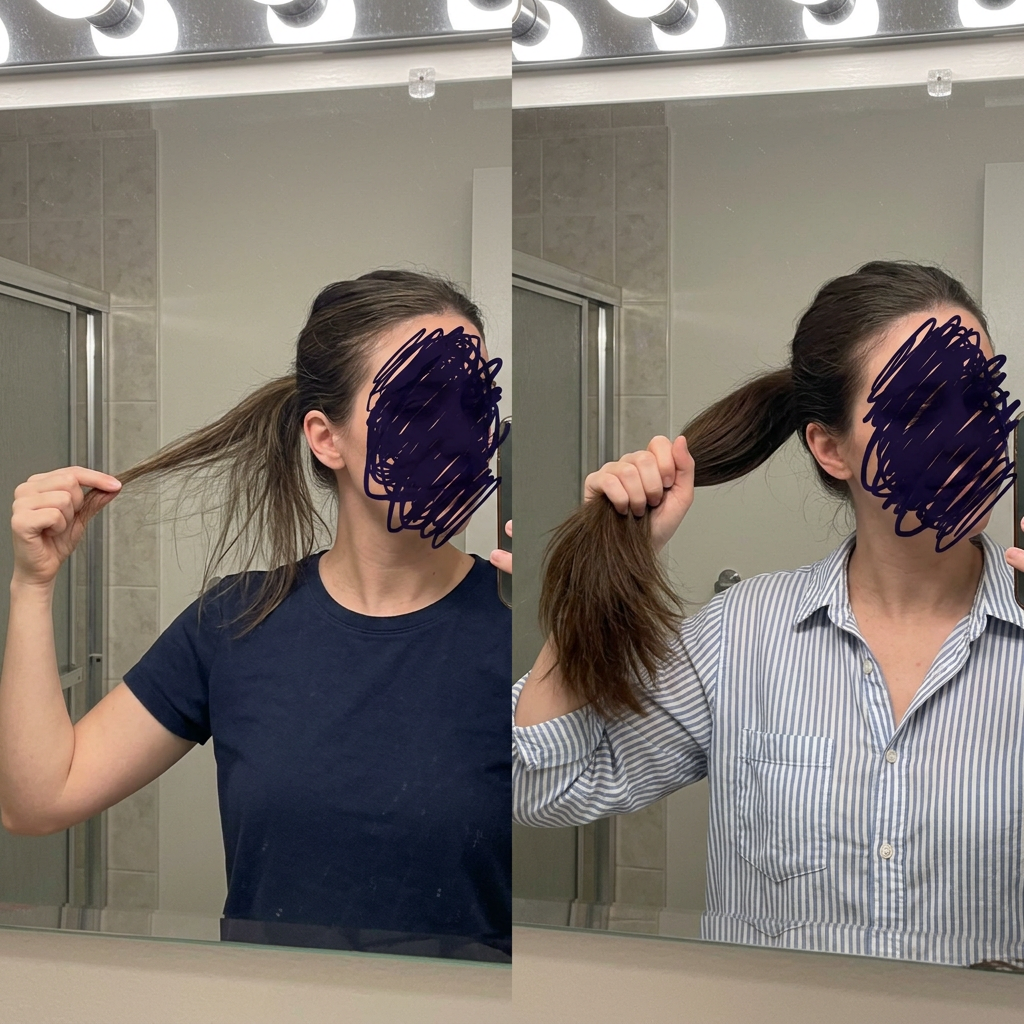
The Hair Growth Journal
The Hair Growth Journal Facebook ad: “Tap below. Try it for seven months. If it doesn't work for…”

Ran for 25 days, from September 1 to September 26, 2026, the last day Crush saw it.
Run by The Hair Growth Journal on Facebook. Crush is not the advertiser and does not verify its claims. See this ad in Meta's Ad Library(opens in a new tab)
Want an ad like this for your product?
Crush makes new ad images for your product from this ad: your logo, your product photo, your offer.
Trials from $19.95 USD, then $79.95 USD a month. Cancel anytime.
About this ad
- Meta Ad Library ID
- 1548512546515229
- Platforms
- Facebook, Instagram, Audience Network and Threads
- Relaunches
- 0
- Niche
- Hair Care
Ad text
After my wife died, my friends stopped inviting me places. Six months later I walked into a room full of people who'd written me off. I want to tell you what happened. But more than that, I want to tell you what I figured out in those six months — because if you're reading this and you've been avoiding mirrors, avoiding cameras, or quietly declining invitations, this is the part that actually matters. For twelve years, my wife Karen and I did everything with the same five couples. Dinners. Lake weekends. The Scottsdale trip every spring. Eight months after she died, I saw a group photo on Facebook. All of them. At the resort. Without me. Karen's best friend Diane was holding up a margarita. Caption: "The crew, back together!" I texted her husband Dave. He didn't respond. Diane called back instead. She used that voice. The one that means you're about to be managed. "Oh Tom, we didn't want to upset you. It's a couples thing now. But honestly? We were worried about you." Then: "You haven't been yourself. The last time we saw you at the memorial, you looked... rough. Exhausted. Older. We just didn't think you were up for it." I sat there for a long time after we hung up. She wasn't calling me a widower. She was calling me a ghost. And here's the part I couldn't argue with. She wasn't entirely wrong. The year Karen was sick, I'd stopped taking care of myself. Grief does things to you that don't show up in places you expect. The place it showed up hardest for me was my hair. It had been thinning for years. But stress and grief accelerated it in a way I wasn't prepared for. By the time Diane made that call, my crown was nearly gone. My hairline had retreated somewhere it had never been. I looked at photos from Karen's memorial and barely recognized myself. I had started avoiding mirrors. Avoiding cameras. Avoiding invitations. Which, as it turns out, makes it very easy for people to decide you're done. Then I got angry. Karen didn't marry a man who disappears. She married a man who handles things. So I drove to see Marcus. My barber. The one who'd been cutting my hair every month for fifteen years and knew exactly what was happening up top without ever making it awkward. I told him what Diane said. He put the clippers down. Looked at me in the mirror. "Don't buy a hat collection," he said. "Don't do the comb-over. If you show up hiding it, you prove her right. You treat it." I told him I wasn't doing the pills — I'd read enough about finasteride's side effects to know I wanted no part of it. And I wasn't flying somewhere for a transplant. He pulled out his phone. "I see forty heads a week. You know what the guys with the best regrowth have in common?" He showed me the research. I sat there in the chair and read it. Here's what Marcus had figured out — and what I've since spent considerable time understanding: **The reason stress and grief accelerate hair loss isn't random.** It's vascular. When the body experiences prolonged stress, blood vessels in the scalp constrict. The capillaries that feed your hair follicles narrow. Oxygen and nutrient delivery drops. Follicles that were actively growing hair enter a dormant phase — not because they're genetically programmed to die, but because they're being starved of what they need to function. They don't die. They go quiet. This is why grief-related and stress-related hair loss can look so sudden and feel so severe. The underlying genetic thinning that was happening slowly gets dramatically accelerated by the vascular effects of cortisol, poor sleep, poor nutrition, and everything else that comes with losing someone. And this is precisely why the standard pharmaceutical treatments fail so many people in this situation. Minoxidil temporarily forces vasodilation — briefly widens blood vessels to increase blood flow — and produces some regrowth while you use it. But the moment you stop, the effect disappears. The underlying circulation problem is still there. Everything reverses within months. You're not solving anything. You're renting a result you can never stop paying for. Finasteride blocks DHT, which slows the hormonal component. But it doesn't restore circulation. It doesn't address the stress-driven vascular damage. And the side effects — sexual dysfunction, depression, emotional flatness — are documented and real and the last thing someone rebuilding their life after loss needs to add to the equation. Neither drug was built for what actually happened to my scalp during the worst year of my life. What is built for it — what Marcus showed me, what the clinical evidence actually supports — is FDA-cleared low-level laser therapy. Specific wavelengths of light. 650 nanometers. The precise frequency at which the mitochondria inside your follicle cells absorb light and trigger ATP production — cellular energy. The energy your follicles need to come back out of dormancy. Simultaneously, the light stimulates nitric oxide release, which dilates blood vessels in the scalp. More blood flow. More oxygen. The vascular starvation that grief and stress caused, addressed at the source. Double-blind clinical trials. Published results. FDA clearance — actual clearance, not just registration, which means they submitted clinical data and went through regulatory review. Not a wellness gadget. A medical device cleared specifically for hair loss treatment. "Three of my clients use Kiierr," Marcus told me. "I watched it happen in this chair. The crown, the hairline. Real growth, not just maintenance." Then he said the thing that made me order it that night. "Don't sit on this, Tom. They run out of stock on the flagship cap constantly. When a batch sells through, clients wait months for the next one. I've got two guys waiting right now." I ordered it before I got home. What happened over the next six months wasn't dramatic. It wasn't a movie montage. Month one: nothing visible. I almost convinced myself Marcus was wrong. Month two: I noticed the shower drain first. Less hair. Noticeably less. That was the first morning in a year I felt something close to hope. Month three: Marcus stopped mid-cut. "Tom. Look at your crown." There was new growth coming in. Fine, but unmistakably real. Follicles I'd assumed were gone, waking back up. Month four: I had a hairline again. Not my hairline at 30. But mine. And something else came back with it that I didn't expect. I started going to the gym again. Started saying yes to things. My sister-in-law set me up on a date — first one in twenty-six years — and I didn't cancel it. Her name was Linda. On the second date she ran her hand through my hair and said, "I love that you've still got all of this. Most men our age gave up years ago." I just smiled. Six months after Diane's call, Dave texted me. His 60th birthday dinner. The whole group. The old me would have made an excuse. I booked a blazer fitting instead. I walked into that restaurant and the table went quiet. Diane saw me first. Something crossed her face that I'd been waiting six months to see. She looked at my hair — full, under the restaurant lights, looking five years younger than the man at Karen's memorial — and she said: "Tom? You look... different." "Better, you mean." "Did you get plugs? You can tell us." "No surgery. No pills." Dave's brother-in-law — a physician's assistant at a dermatology practice — leaned across the table. "Hang on. Is this the laser cap? Low-level laser therapy?" "Kiierr. Six months." He turned to the table. "We recommend LLLT constantly. It's one of the only FDA-cleared options without the drug side effects. Textbook response — crown and hairline both." Dave, who'd been hiding his own thinning under a golf hat for five years, pulled out his phone right there at dinner. His wife elbowed him. "You're getting one. Tonight." I looked at Diane. "You were saying something about me not being up for it?" She got very interested in the dessert menu. --- Here's why I'm telling you this. Not for the Diane moment, satisfying as it was. I'm telling you because of what I know now about the window. Every month of dormancy is a month your follicles are closer to permanent atrophy. The clinical evidence is clear on this: follicles that have gone quiet can be reactivated — but only within a window. Follicles that stay dormant long enough eventually can't be brought back. Stress, grief, hormonal shifts — they accelerate that timeline. Which means the months I spent doing nothing were months I was losing ground I might not have been able to recover. I got lucky with the timing. Not everyone does. If you've been watching your hair change over the last year — if stress or grief or just the accumulated weight of time has done what it did to me — the window you have right now is worth more than the window you'll have in six months. Marcus was right about one other thing. The Kiierr flagship sells out in batches. When stock is gone, it's gone for months. I've seen it happen to people who waited too long to decide and spent the next three months watching their hairline continue to thin while they waited for a restock. Kiierr backs this with a seven-month money-back guarantee. Not thirty days — seven months. Because that's the full window for results to develop, and they're confident enough in what they built to back the entire thing. If you don't see new growth, reduced shedding, and thicker hair in seven months — full refund. I showed Diane the before photo at that dinner. The picture from Karen's memorial. The one she'd been describing when she said I looked rough, exhausted, older. She went quiet for a long time. "That's the same person?" she said. Same person. Six months. Thirty minutes every other day. While I was making dinner for one and most people had quietly decided I was done. Karen didn't marry a man who hides. She married a man who handles things. This is how I handled it. Your move. 👉 Check Stock and Try Kiierr Risk-Free — 7-Month Guarantee — kiierr.com
Where the ad sends people
kiierr.com
Tap below. Try it for seven months. If it doesn't work for you, you get your money back, no argument.
It works or your money-back
See details: kiierr.com(opens in a new tab)