
Inactive· since May 18, 2026
- 116
- days it ran
- 0
- relaunches
Ad copy
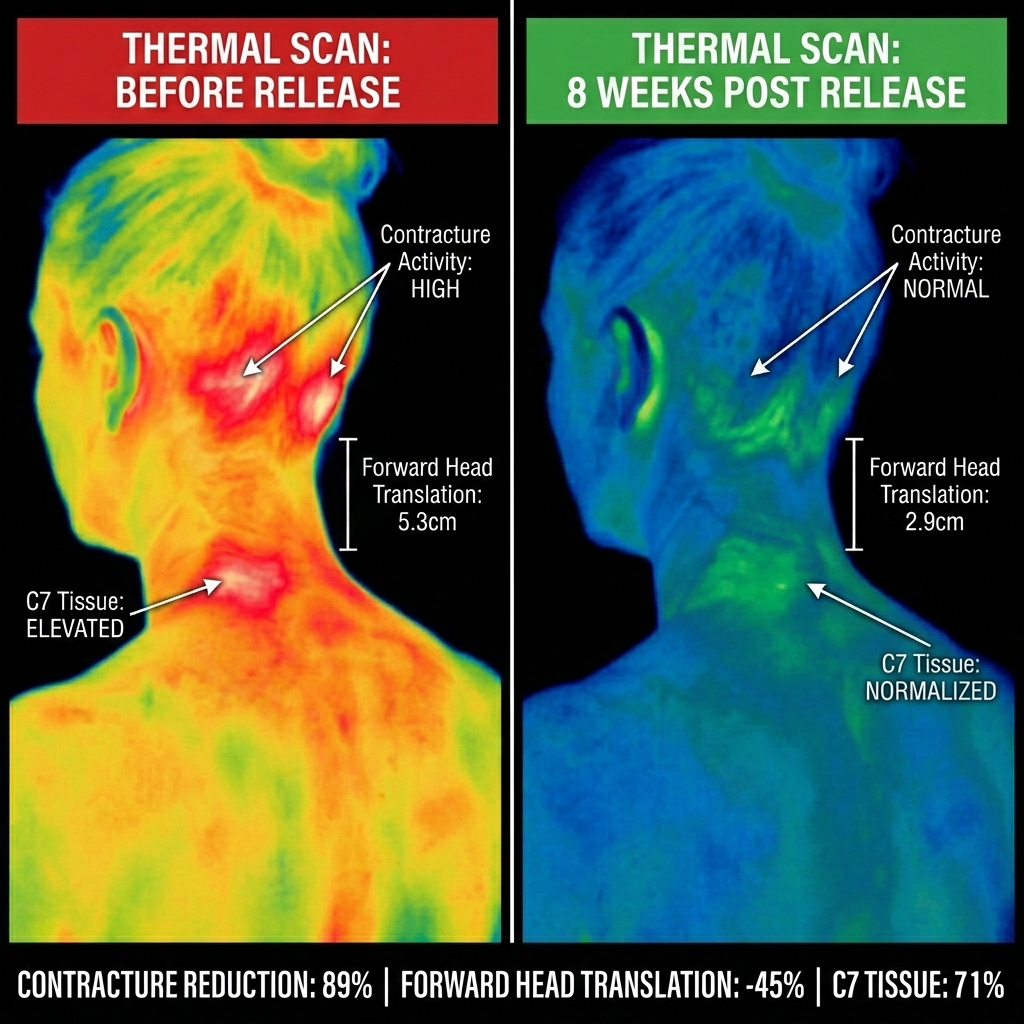
I've watched too many neck hump patients end up covering themselves completely to keep my mouth shut about this. If you've been told "just keep up the adjustments" for your neck hump, I need to tell you something your chiropractor isn't telling you. My name is Carol Bennett. I've treated over 200 neck hump patients in 15 years as a manual therapist. And when a patient walks into my practice with progressing tissue after their chiropractor said "keep up the adjustments, we'll recheck in six months," I already know what their measurements will show 2 to 3 years later if nothing changes. Advanced tissue consolidation. The same suboccipital contracture driving their tissue buildup is silently consolidating their cervical structure right now. And at 52, when my own forward head translation came back elevated at my annual assessment, I knew exactly what my colleague was about to tell me. And exactly what she wasn't. Your neck hump isn't a "watch and adjust" problem. It's a neurological lock happening at the cellular level of your suboccipital muscle layer. I've been treating neck humps for 15 years. I've seen hundreds of patients dismissed with "keep up the adjustments, we'll monitor the measurements." Most of them walked out, Googled their diagnosis, and stopped at the posture aisle on the way home. Foam rollers. Cervical pillows. Posture braces. One of those multi-function cervical devices. The tools every neck hump article on the internet eventually recommends. They used them for months. Some for years. Their measurements barely moved. And what's worse, they thought they were doing something about the problem. Because the chiropractor sees you every two weeks. Writes the measurement. Sends you home. They don't see you 2 to 3 years later when you're sitting in my practice with tissue that has consolidated to the point where your entire wardrobe has reorganized itself and you've stopped appearing in family photos. But I do. Dorothy's daughter. Dorothy diagnosed with a progressing neck hump at 56. Same advice. Keep up the adjustments, recheck next year. Year after year. By 68 her tissue had consolidated enough that she stopped going to family gatherings. By 71 she was essentially invisible in her own life. Her starting forward head translation was 2.6cm. Almost exactly what mine was. Patricia, 58. Came to me with forward head translation 2.9cm. Perfect posture habits. What I'm ashamed to say I didn't recognize quickly enough was that the adjustment protocol I put her on was never reaching the structure that was actually driving the tissue. I gave her the same "brace and twice-weekly adjustment" protocol I'd been giving for years. She came back 18 months later with tissue that had consolidated significantly. Still addressable at that stage. But barely. She's the patient I think about at night. They had months to address this properly. They just didn't know they had them. Because nobody had explained what their measurements were actually pointing at, or what was quietly building underneath while they attended their adjustment sessions. The assessments were telling them the truth from the first appointment. The tools they were using didn't change anything. They just made them feel like they were doing something. My own situation told me I was fine. My measurements said otherwise. I felt fine. A little more tightness in the morning than I used to notice. Brain fog about my own cervical position that I told myself was just awareness from my work. My tissue had built slightly but nothing dramatic. Then a routine annual assessment caught it. My colleague looked at the measurements and said what practitioners say to every patient. "Standard plan. Keep up your postural awareness, add some cervical exercises, recheck in six months." I knew it wouldn't work. That's not the point. I'm a manual therapist. I'd watched over 200 patients try exactly that and watched their measurements stay exactly the same or even worsen. So I ran my own full cervical assessment. Forward head translation 2.6cm. Suboccipital pressure response minimal. I ordered a detailed contracture assessment. Because I know what elevated forward head translation actually means. Early contracture establishment. Neurological lock at the cellular level of the suboccipital muscles. The kind of chronic pull that posture awareness alone was never going to fix. My progressing tissue wasn't a "sit up straighter" problem. It was my suboccipital release mechanism being overridden faster than my body could compensate for it. And another six months of "monitoring" would have masked the only early warning sign I had. Here's what standard chiropractic doesn't tell you because they don't follow long-term contracture outcomes. Your suboccipital muscles don't send pain signals when they lock. They don't swell noticeably. They don't warn you the way an injury does. By the time your tissue is visibly building, the suboccipital contracture has been established for years. By the time the tissue has consolidated, the lock has been running in silence. You're not "just getting older" or "not sitting straight enough" or "spending too much time on screens." Your suboccipital muscles are losing the ability to release after every forward movement. The same process pulling your head forward is quietly consolidating your tissue underneath. Right now. Roughly 1 in 3 women with established cervical tissue buildup sees significant consolidation within 3 to 5 years of initial diagnosis if the contracture is never directly addressed. By the time most neck hump patients come to me, the lock is already well established. Your tissue buildup isn't something to be embarrassed about. It's your 3 to 5 year early warning system. And foam rollers silence that alarm while the contracture advances. So I tried what patients try. Postural awareness. Ergonomic assessment. Screen time reduction. Improved how I felt a little, but tissue kept building. Tools. Foam roller. Cervical pillow at 1,200 thread count. A multi-function cervical traction device. A posture correction blend of 4 different tools. 18 weeks of disciplined use. Reassessment came back. Forward head translation 2.7cm. I gained a millimetre. 18 weeks of doing exactly what I'd been telling 200 patients to do. Nothing was releasing the contracture driving the tissue buildup. But I kept thinking about something that made no sense. The cervical structure can restore. Early tissue buildup CAN reverse. The suboccipital contracture CAN release. The research proves it. So why wasn't mine releasing? And why hadn't my patients' contractures released either? October 8th. Late at night. I was reviewing 18 months of patient outcome data in my home office after a long shift. Couldn't sleep. My own assessment had just come back at 2.7cm. I wasn't looking for anything specific. If I'm being honest, I was pretty desperate. I'd compiled outcomes for every patient I'd put on twice-weekly adjustment for at least six months. Average forward head translation change at 6 months. Average change at 12 months. Average change at 18 months. The numbers stopped me cold. Patients on twice-weekly adjustment showed no statistically meaningful improvement in tissue buildup compared to patients doing posture exercises alone. Eighteen months. 200+ patients. Almost zero meaningful difference in tissue. I sat there staring at a spreadsheet I should have run five years earlier. I was the therapist recommending adjustment protocols for 15 years. And I was wrong about what it was actually doing. Then I pulled up the small subset. The ones who'd done their own research. They'd quietly added something else on their own while I was still recommending adjustments. Home tools. Self-directed protocols. Some had bought generic tools after Googling. Foam wedges. Standard cervical rolls from Amazon. Their tissue barely moved either. Maybe a millimetre, then they plateaued. That sent me down another rabbit hole. Standard cervical tools have a serious placement problem. They apply broad pressure to the thoracic spine or general cervical curve rather than the exact suboccipital pressure points where the contracture lives. So a foam wedge at the upper back? Your suboccipital contracture sees almost none of it. That's the wrong address, delivering the wrong type of pressure. No wonder my own patients on standard cervical tools saw nothing. But the small group who'd found precision-engineered direct suboccipital compression? Those outcomes told a different story. Tools with two foam nodes positioned specifically at C1-C2, with gravity-assisted delivery through their own head weight, held for the minimum 8 to 10 minutes required for the neurological release signal to activate. Their tissue was reducing. Real reduction. The kind of result I'd been hoping to see in 15 years of practice but never actually seen. I'd been a manual therapist for 15 years. I'd studied cervical biomechanics my entire career. And I'd never properly understood why adjustment protocols weren't doing the job. Standard adjustment mobilizes the joint above the contracture. That's its mechanism. But it can't give your suboccipital muscles the three simultaneous inputs they need to release the lock directly. Direct suboccipital compression can. It delivers sustained gravity-assisted pressure at the exact C1-C2 pressure points, held long enough for the proprioceptive receptors to activate and the release signal to fire. One mobilizes the joint above the lock. The other releases the lock itself. It's the same principle emergency manual therapists use when they need rapid cervical release in acute forward head trauma. They don't apply broad thoracic adjustment. They don't use general cervical decompression. They target the suboccipital zone with sustained precision compression. Same structure. Same mechanism. Same problem. The difference is speed. Acute trauma requires immediate release. Chronic contracture takes weeks. But the root cause is identical. A 2024 manual therapy research review studied direct suboccipital compression head to head against adjustment-based management in 89 patients with established cervical tissue buildup. Direct suboccipital compression was the only approach that showed significant tissue reduction at 12 weeks. The ONLY one. At 12 AM, I ordered Cevera. Two foam nodes engineered for exact C1-C2 placement. Gravity-assisted delivery through my own head weight. Ten-minute protocol before sleep. The clinical delivery method, not the broad foam tool I'd been telling patients to try. I didn't expect miracles. But for the first time in 15 years, the mechanism was sound. The tool arrived three days later. I started October 12th. Ten minutes before bed. 10 days in, I noticed the morning tightness wasn't there. I'd just woken from a full night's sleep and the automatic forward pull awareness I'd been waking up with for months was quieter. First change in months. Three weeks in, my colleague noticed before I told her. "Your posture looks different," she said during a shared clinic session. "What changed?" I hadn't told her I was using anything. "Different approach," I said. "Whatever you're doing, keep doing it." Eight weeks in, I had my forward head translation reassessed and a full contracture evaluation. When the numbers came up, I stared at the screen for almost one minute. Forward head translation: 1.4cm. Down from 2.6cm. Nearly 50% reduction in 8 weeks. Suboccipital pressure response measurable in both points for the first time. Tissue at cervical base visibly reduced on assessment. The drop wasn't subtle. It was the kind of movement I'd been hoping to see in patients for 15 years and never seeing. My tissue was reducing because my contracture was finally being directly released. I printed both assessments. Walked them to the next clinical review meeting. Dr. Sarah, my colleague physiotherapist, looked at the results. Looked at me. Looked back at the results. "Carol, what protocol did you put yourself on? Tissue doesn't reduce this fast on adjustment alone." I explained the suboccipital contracture. The three simultaneous input requirement. The direct compression delivery. The exact C1-C2 placement vs the broad tools most of our patients were buying. She studied the numbers for another minute. "And you said your contracture assessment improved too?" "Measurable release in both pressure points at 8 weeks. Nothing on the assessment at baseline." She was quiet for a moment. "I need to start asking my cervical patients whether they've ever tried direct suboccipital compression at the clinical delivery standard." I cancelled my referral to the posture specialist. But I started telling patients something standard management doesn't. I started with Margaret. 61. Three years of doing everything her practitioners told her. Cut all screen time. Perfect ergonomic setup. Walked every morning. Attended every adjustment session twice weekly for eight months. Tried a foam roller her daughter found online. Her forward head translation when she started with me? 3.1cm. Her translation after three years of all of that? 2.9cm. Two millimetres. Three years. That was her reward for doing everything right. Margaret sat across from my desk and said, "I'm not going to end up like my mother. But nobody will tell me what to do besides keep coming in for adjustments." So I told her what I'd just figured out. 10 weeks on the same protocol I'd put myself on. Cevera. Ten minutes before bed. Direct C1-C2 suboccipital compression with gravity-assisted delivery. Her forward head translation at 10 weeks: 1.6cm. Down from 3.1cm. At her 8-week follow-up, her husband pulled me aside in the hallway. He said, "I don't know what you gave her, but she's getting dressed in ten minutes for the first time in two years. Whatever you're doing, keep doing it." I'm not telling you this because I'm against adjustment. Chiropractic adjustment has a place. It's a useful mobilization approach. It might marginally improve joint mobility above the contracture. But it doesn't release the suboccipital contracture. It doesn't address the neurological lock causing tissue progression. It doesn't move tissue meaningfully in the patients who need it most. It temporarily mobilizes the joint above the lock while the contracture progresses below. Your progressing tissue is warning you. The same suboccipital contracture driving your tissue buildup is quietly consolidating your cervical structure underneath. And foam rollers silence that warning while the contracture advances. Your tissue buildup isn't your fault. But it is your early warning system. And you have two choices. Work around the lock with foam rollers and adjustments while the contracture progresses inside. Or deliver the three inputs the contracture requires and let your cervical structure restore. I think about what I almost did. I almost wasted years the way my own patients had wasted theirs. I almost let my own tissue consolidate on a protocol I'd already proven didn't reach the contracture. I almost became the patient I see in my practice 2 to 3 years later, wishing someone had told them their tissue buildup isn't something to just monitor. Because once your tissue has fully consolidated, your treatment options narrow. Once the wardrobe has completely reorganized, the behavioral changes are harder to reverse. Once you've stopped appearing in your own family's photographs, something is lost that's hard to get back. You don't get a second early warning. Your progressing tissue is your first warning. The only warning you can still act on before the contracture becomes more established. Your tissue buildup is your check engine light. Foam rollers are electrical tape over the warning indicator. The contracture is still running. You just can't feel the pull as clearly anymore. But I see it every day in my patients' assessments. Every single one of them says the same thing. "I wish someone had told me the tissue buildup was actually addressable." Someone just told you. You can't unhear it. The choice is yours. Release your contracture, and you potentially reverse tissue buildup before it consolidates completely. Or work around the lock with tools that never reach it, and risk everything continuing underneath. I'm a manual therapist. I understand suboccipital neuromechanics at a clinical level. And I chose to address my own contracture directly before it progressed further. That's all I'm asking you to consider. Give your cervical structure a chance to restore before you accept "monitoring" or risk further tissue consolidation. Your progressing tissue is giving you months of advance warning. Use them. Eight weeks. That's all it took my tissue to begin measurably reducing and my contracture assessment to show release for the first time. Eight weeks of releasing the contracture directly instead of working around it. This is the tool I used: 👉 https://trycevera.com/pages/adv-womens-wellness-report P.S. The direct suboccipital compression protocol I used is Cevera. Two foam nodes at exact C1-C2 placement. The clinical delivery standard, not the broad foam tools most patients are buying that never reach the contracture address. Gravity-assisted delivery so the pressure is consistent and non-fatiguing throughout the full hold. Ten minutes before sleep when the nervous system is most receptive to releasing chronic holding patterns. If you've been told "just keep up the adjustments" for your neck hump, and you've been using foam rollers or braces, and you have any family history of neck hump progression or cervical tissue consolidation, get a baseline forward head translation measurement. Use Cevera for 8 to 12 weeks. Get a follow-up assessment. Compare your tissue. Cevera backs the protocol with a 90-day money-back guarantee. If your tissue doesn't measurably reduce on the 90-day protocol, you get every dollar back. No questions. Cevera is small. They've had availability constraints twice this year already. If your tool ships, use it consistently. If it's low on stock, get on the waitlist before the next batch. You can always go back to foam rollers if it doesn't work. But you can't undo consolidated tissue if your progressing measurements tried to warn you and you managed them with a tool that was never reaching the contracture. I wish someone had told me this 15 years ago when I started telling patients to just keep attending adjustments and try some foam rolling. I can't get those years back. But I can tell you now. Don't waste the time you have. This is the tool I used: 👉 https://trycevera.com/pages/adv-womens-wellness-report
Like this ad? Make it yours.
Crush rebuilds this exact creative around your product — your brand, your colors, your offer — in about a minute.