Sarah Fischer
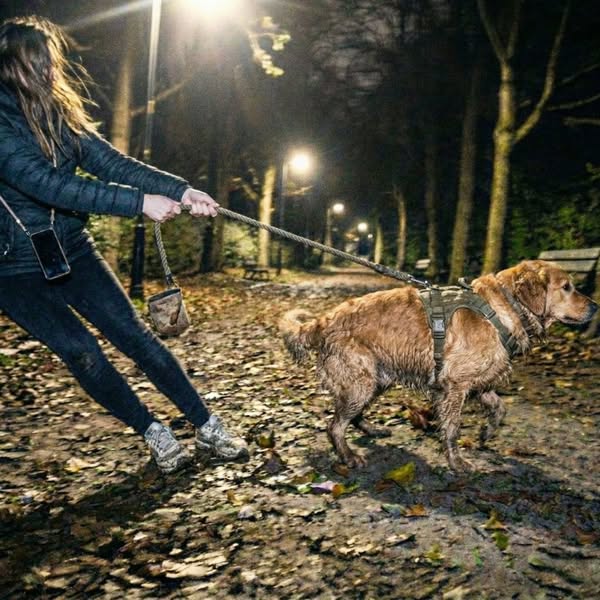
Sarah Fischer Facebook ad: “How to stop your dog pulling on the lead, without training”
Ran for 3 days, from June 18 to June 21, 2026, the last day Crush saw it.
Run by Sarah Fischer on Facebook. Crush is not the advertiser and does not verify its claims. See this ad in Meta's Ad Library(opens in a new tab)
Want an ad like this for your product?
Crush makes new ad images for your product from this ad: your logo, your product photo, your offer.
Trials from $19.95 USD, then $79.95 USD a month. Cancel anytime.
About this ad
- Meta Ad Library ID
- 1664406644672379
- Platforms
- Facebook, Instagram, Audience Network, Messenger and Threads
- Relaunches
- 0
Ad text
I've been a dog trainer for 23 years. Last week a client showed me something that left me speechless. I need to share this with you. In my life I have trained more than 4,000 dogs. Shepherds, labradors, chihuahuas, great danes. Aggressive dogs. Fearful dogs. Dogs that had driven their owners to despair. I thought I had seen everything. I thought I knew everything about walking on a lead. Last week I was proven wrong. And I'm almost ashamed that I hadn't understood this sooner. It was a Thursday afternoon. A private lesson. Sandra came with her Golden Retriever Rocky. Her second lesson with me. In the first lesson I had shown her the basics. Walking on a lead. Direction changes. Attention training. Rocky was a classic puller. 35 kilos permanently pushing forward. But he wasn't that bad. I had seen worse. Much worse. "We'll get there," I had told her. "In six to eight weeks he'll walk nicely beside you." I've been saying that for 23 years. With some dogs it holds true. With many it doesn't. But what else was I supposed to say? So Sandra came back for her second lesson. And something was different. Rocky was walking beside her. Without pulling. I thought: OK, she's been practising. Good. Then Rocky spotted another dog by the fence. Normally he would have exploded right then. Would have dragged Sandra along with him. But he pulled briefly — and was somehow turned to the side. Automatically. He looked at the other dog. Then at Sandra. Then he walked on. I stood there and didn't understand what I had just seen. "What did you do?" I asked. Sandra smiled shyly. "I hope you don't mind." "Mind? Why would I mind?" "I... I bought a new harness. A friend had recommended it." I looked at the harness. It looked different from what I normally see. The clip was at the front. On the chest. "Is that all?" I asked. "A different harness?" "Yes. Just three days ago. And he's stopped pulling." Three days. I had told her it would take six to eight weeks. That evening I sat in my office and stared at the wall. 23 years. 4,000 dogs. And a client solves in three days what takes me weeks. With a harness. My first instinct was dismissal. That can't be right. It's placebo. The dog was having a good day. Next week he'll be pulling again. But then I thought about all the dogs I had trained. All the clients who had given up in frustration. All the people who said: "It works during the lesson, but at home he still pulls." And for the first time I asked myself: What if I've been training the wrong thing all along? I started researching. I read studies on biomechanics. On reflexes. On the physiology of dogs. And I came across something I had never been taught during my training. The opposition reflex. The opposition reflex is an innate instinct. When pressure acts on the body from behind, the body automatically resists it. That's true for humans. That's true for dogs. That's biology. And here's the part that makes me furious as a trainer: Most harnesses have the clip on the back. When the dog pulls forward, that's exactly where the pressure builds. Pressure from behind. The opposition reflex is triggered. The dog MUST resist it. Biologically he has no choice. I sat there at midnight staring at my screen. For 23 years I had been teaching dogs not to pull. For 23 years I had been working with lead corrections, direction changes, reward-based training. And the whole time these dogs had been wearing a harness that was triggering a biological reflex. I had been trying to train away a reflex. That's like teaching a human not to blink when something flies into their eye. Impossible. I thought about all the clients. The frustrated ones. The desperate ones. Those who had called me and said: "It just isn't working. My dog is still pulling." I had told them to be more consistent. I had told them to practise more. I had told them that some dogs simply take longer. But the truth is: I had never told them that their harness might be the problem. Because I didn't know it myself. The next day I called Sandra. "Could you come and show me how the harness works?" She came round. Put it on Rocky. Explained the principle to me. Front clip on the chest. When the dog pulls, he's automatically turned to the side. Back towards the handler. No pressure from behind. No opposition reflex. The dog can no longer resist it, because there is no "against" to resist. I stood there and watched Rocky walk beside Sandra. Relaxed. Without any struggle. "Where did you get that?" I asked. She gave me the name. PawKingdom. The following week I ordered ten of them. For my most difficult cases. The dogs I'd been making no progress with for months. A Bernese Mountain Dog that regularly knocked his owner off her feet. An Australian Shepherd that pulled so hard his owner had already needed physiotherapy. A Great Dane that literally couldn't be taken for a walk. I gave them the harnesses. Without much explanation. "Just try this." The results blew me away. The Bernese Mountain Dog: After two walks he was trotting nicely beside his owner. She called me in tears. The Australian Shepherd: His owner sent me a video. The dog was jogging alongside him as if they'd never had a problem. The Great Dane: For the first time in two years the family could go for a walk together. With all three children. And me? I sat in my office wondering how many clients I could have helped. If only I had known this sooner. I'm not telling you this because I want to advertise something. I'm telling you this because I made a mistake for 23 years. And I don't want you to make the same mistake. Training matters. Bond matters. Consistency matters. But if your dog's harness is triggering the opposition reflex, all of that is secondary. You can have the most perfect training plan. The best technique. The greatest patience. As long as the harness is working against your dog's biology, you're fighting a battle you cannot win. I have changed my training methods. Every client who comes to me because of pulling on the lead now gets one question first: "Where is the clip on your harness?" If the answer is "on the back", we talk about the harness before we talk about training. Some colleagues shake their heads. "You're taking business away from yourself, Karin." Maybe. But I didn't become a dog trainer to make money. I became a dog trainer to help dogs and their people. And if a harness achieves in three days what takes me eight weeks — then it's my damn duty to say so. Last week I saw Sandra again. She came for her final lesson. Really just a formality at that point. Rocky walked perfectly. Relaxed. Happy. "Thank you," she said. "Without you I never would have found this." I shook my head. "You found it. Not me. I would have spent another six weeks teaching you things you never needed." She smiled. "But you listened. You paid attention. Other trainers would have said: That's nonsense, we carry on as before." Maybe I would have said that too. A few weeks ago. But I'm glad I didn't. If you want my advice — and I've been giving advice for 23 years: Before you spend hundreds of pounds on training. Before you get desperate. Before you start wondering if you have the wrong dog. Look at the harness. Where is the clip? If it's on the back, now you know why your dog pulls. Not because he's stubborn. Not because he's dominant. Not because you have failed. But because his body biologically cannot do otherwise. The PawKingdom No-Pull Harness is what I now recommend to my clients. Not because I'm paid to. But because it works. 30-day money-back guarantee. If it doesn't help, send it back. But I'll tell you this: In 23 years I have rarely seen anything change so much so quickly. 👉 Check it out here: https://pawkingdom.uk/products/kneebrace P.S.: If you've ever trained with me and you're wondering whether this would have worked for your dog — yes, it probably would have. Write to me. I'm happy to help.
Where the ad sends people
pawkingdom.uk
How to stop your dog pulling on the lead — without training 👆
Elvantera
Learn more: pawkingdom.uk(opens in a new tab)