Dr. Sam Valentine
Dr. Sam Valentine Facebook ad: “Your neck keeps your vertigo alive. Here’s why!”
Ran for 27 days, from August 14 to September 9, 2026, the last day Crush saw it.
Run by Dr. Sam Valentine on Facebook. Crush is not the advertiser and does not verify its claims. See this ad in Meta's Ad Library(opens in a new tab)
Want an ad like this for your product?
Crush makes new ad images for your product from this ad: your logo, your product photo, your offer.
Trials from $19.95 USD, then $79.95 USD a month. Cancel anytime.
About this ad
- Meta Ad Library ID
- 1737909094091200
- Platforms
- Facebook, Audience Network and Messenger
- Relaunches
- 0
Ad text
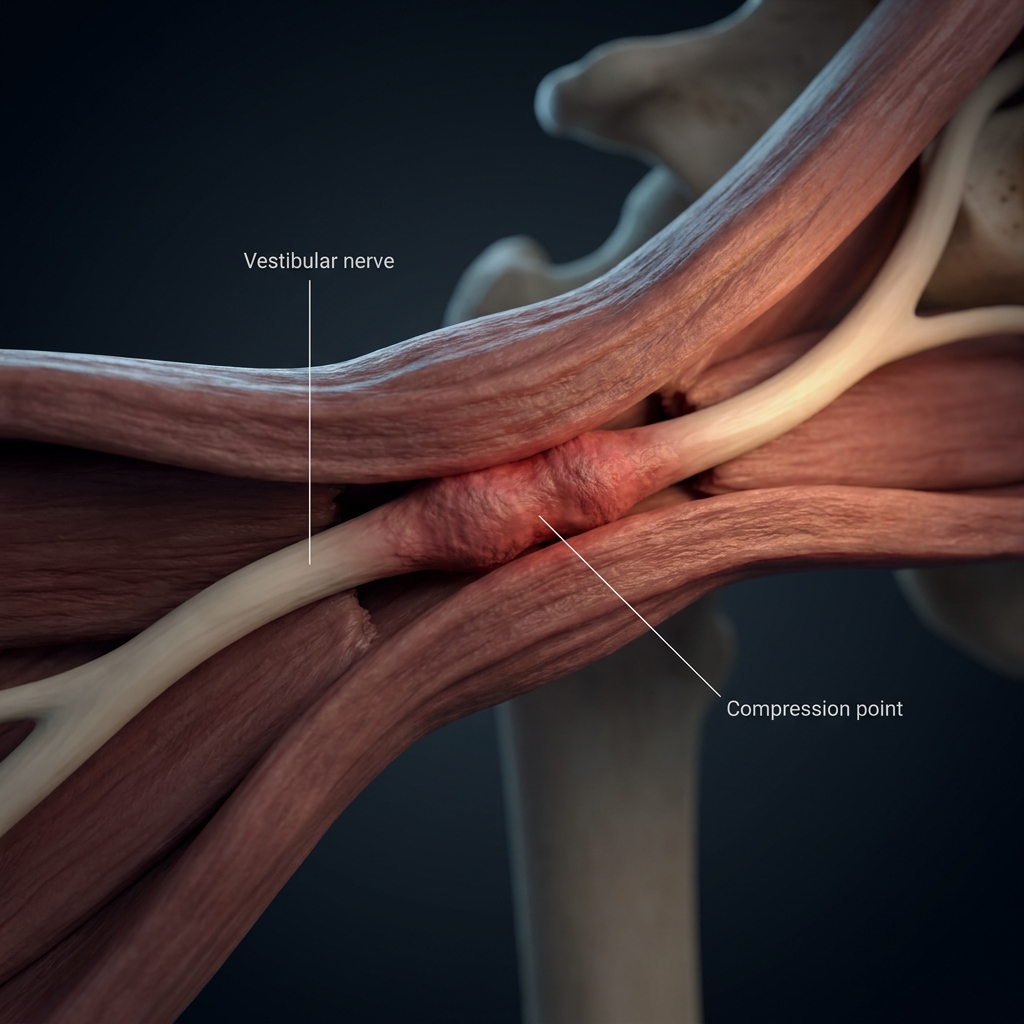
When a woman finally stops driving because of her vertigo — the specialist doesn't write "cervical-vestibular feedback loop" in her chart. He writes recurrent positional vertigo. He repeats the Epley. He renews the Meclizine. He mentions, if she pushes, that some patients need to consider a procedure. He does not mention that the muscles in her neck have been tightening around the nerve pathways for years — squeezing the very channel her balance signals travel through — and that every attack she's had has been pulling that channel a little tighter. There is a reason for that, and it has nothing to do with paperwork. It has to do with where vertigo actually lives. And once you understand where, you understand why the Epley stopped working, why Meclizine has never once fixed anything, and why the answer may be sitting three inches lower than every specialist you've seen has bothered to look. I want to tell you what chronic vertigo actually is. Not what's in the pamphlet. The real thing. Chronic vertigo is a feedback loop disguised as a series of attacks. The attacks are the part you can point at. They have a start and an end. They're what you report, what gets written down, what gets treated. But the actual thing driving them — the thing that turns one bad episode into four years of your life — is running the entire time. Between the attacks. On the good days. Right now, while you read this. It's running in a circuit between your inner ear and your neck. Here is the circuit. The vestibular nerve runs from your inner ear to your brain. Its only job is to report whether you're moving or still. And it doesn't stay in your ear — the pathway travels out, behind your ears, down to the base of your skull, through the soft tissue of your neck. That's the physical route the signal takes. Through muscle. When you have a vertigo attack, your body does what any body does when the floor betrays it. It locks down. Your neck muscles seize to hold your head still, because keeping your head still is the only defense you have. That's step one, and it's completely involuntary. You've never once decided to do it. Step two is the part nobody tells you. Tight muscle compresses the pathway running through it. And a compressed pathway misfires harder. So the nerve — already sensitized from the original episode — is now sending its signals through a channel that's been squeezed. The false alarms come through louder. More frequent. On less provocation. Which produces another attack. Which produces more guarding. Which tightens the tissue further. Which compresses the pathway more. Round and round. That is the loop. And once it's established, it doesn't need the crystals anymore. It doesn't need the fluid. It doesn't need whatever started it. It runs on itself. Now think about everything you've noticed and never had an explanation for. The stressful week that turned into a vertigo week. The desk job that seemed to make it worse. The morning after a bad night's sleep. The way your neck is always, always tight and you assumed that was separate. The fact that you had one bad Tuesday and paid for it until Sunday. The long drive that set you off. The two hours on your phone. The dentist appointment where you had to hold your head back. Those are not six unrelated triggers. They are six ways of tightening the same muscles around the same pathway. It's all the same loop. And here's what should make you angry. There is not a single thing in the standard vertigo protocol that touches it. The Epley repositions crystals. That's what it's for, and when crystals are the trigger it often works — which is exactly why it's so disorienting when it stops. Because the maneuver succeeded. Your crystals are where they belong. And the loop kept running, because the Epley has never in its history addressed a compressed nerve pathway. Meclizine doesn't calm that pathway. It sedates every pathway you have. Twelve hours of fog, can't drive, can't read, can't feel the floor properly — and when it wears off the loop is exactly where you left it. It's cutting power to your whole house so you can't hear one alarm. The alarm never stopped. You just couldn't hear it. A trigger diary tracks the loop. It doesn't interrupt it. Low sodium, hydration schedules, avoiding your triggers — all of it manages the conditions around the loop while the loop keeps tightening. And avoiding triggers has a cost nobody mentions: every time you avoid a movement, you brace instead. Every brace tightens the tissue. The strategy you were given to protect yourself is, mechanically, feeding the thing you're protecting yourself from. That is not treatment. That is a spiral. I've been calling it the guarding spiral — and you have been inside it for years. It started with one bad episode. You got the Epley and felt better for a while. Then it came back, so you got it again. Then you started sleeping on one side only, because rolling the other way was the reliable trigger. Then you stopped driving at night. Then you stopped driving on the highway. Then you started turning your whole body instead of your head — you probably don't even remember when that became automatic. Then you noticed your neck hurt all the time and mentioned it to someone who told you it was stress. Then the attacks got closer together and nobody could tell you why. Maybe right now, this morning, you got out of bed in stages. Sat up slow. Hand on the nightstand. Ran a sequence you never consciously wrote. And the conversation at every appointment is the same. Let's try the maneuver again. Keep the diary going. Come back in six months. Repeat. Repeat. Repeat. Never interrupt. Never break the circuit. Just the same three things, forever. Nobody in any of those appointments is going to put a hand on the back of your neck. Your specialist is not the one who's going to break this loop for you. I want to say that carefully, because I've spent twenty years inside this profession and I respect the people in it. Most of them are good clinicians working inside a system that decides what they're allowed to look at. But I have to be honest with you about how that system works. Vertigo is triaged by organ. Dizziness goes to ENT or neurology. Necks go to orthopedics, physical therapy, or chiropractic. Those are separate referrals, separate specialists, separate appointments, separate notes. There is no specialty that owns the space between them. So the ENT examines your ear and finds it normal. And the physical therapist works your neck without ever being told it might be driving your dizziness. And the loop runs straight through the gap between two clinicians who each did their job correctly. Neither of them is wrong. The problem is that the loop doesn't respect the referral map. And I'll tell you the honest arithmetic: there are a small number of clinicians in this country who genuinely work the cervical-vestibular connection. There are millions of people with chronic vertigo. You are almost certainly not going to be assigned one of those clinicians. You are going to get the specialist with fifteen minutes and another patient waiting. So you're going to have to take the lead. Not by firing your doctor. Not by stopping your medication. Not by doing anything reckless with your care. By addressing the one thing the referral system was never built to see — the circuit between your inner ear and your neck that decides whether you spend the next twenty years planning every movement, or whether you get to stop thinking about it entirely. The pathway. That pathway is the whole thing. It's the physical channel the false alarms travel through. It's the piece the ear specialist can't reach and the neck specialist doesn't know to treat. And it's the only place in this entire loop where you can actually break the circuit — because you can get to it from the outside. Which is where this becomes solvable. Because a loop has a property that a one-way disease doesn't: you only have to break it in one place. You don't have to fix your inner ear. You don't have to undo four years of episodes. You have to interrupt the circuit at one point, hard enough and often enough, and the whole thing loses its momentum. The nerve stops being provoked. The neck stops guarding. The pathway opens. The signals come through cleaner. Fewer alarms means less bracing means less compression means fewer alarms. The same loop, running the other direction. And there is exactly one place where all three pieces of that circuit are physically reachable at once — behind the ears and at the base of the skull, where the pathway runs closest to the surface. I've spent twenty years on this. Over 2,000 patients. And the frustrating part was never the science — the technology to calm nerve pathways has existed for years. Vestibular clinics have used it. Electrical stimulation, therapeutic heat, targeted massage. It worked. The problem was $150 a session, weeks-long waitlists, and insurance that wouldn't touch it. I watched patient after patient who needed it and couldn't get to it. So I worked with a team of ENT specialists to build something that delivers the same nerve-calming stimulation at home. It's called VertiClear Pro. I'm not going to insult your intelligence with a miracle pitch. You've seen those. The pressure-point trick. The head-tilt hack. The "one weird herb Big Pharma doesn't want you to know about" for vertigo. You've been burned. So has everyone in every vertigo group online. So I'm going to do the opposite and tell you exactly what it is and exactly why each piece is there. It's a device that sits around your neck. Four pads position behind your ears and at the base of your skull — directly on the pathways where the false signals travel. Not near them. On them. That placement is the entire point. Three technologies run simultaneously, and each one hits a different point in the loop. EMS. Gentle electrical pulses delivered straight into the pathway to interrupt the overactive nerve firing. This is the alarm side of the circuit. Not sedation of your whole nervous system — targeted interruption, at the nerve. Sixteen intensity levels, because a nerve four years into sensitization needs to be met where it actually is. Therapeutic heat. Penetrates deep into the same tissue, reducing the inflammation and stress signaling that amplifies every alarm the nerve sends. This is why attacks are always worse on the days you're already depleted — the amplification is higher when your system is under load. Multi-level massage. Six vibration modes releasing the chronic muscular tension wrapped around the pathway. This is the compression side. This is the piece that undoes what four years of guarding built. Alarm. Amplification. Compression. Three points on one circuit, hit at the same time, on the same four spots, for fifteen minutes. Nothing enters your bloodstream. Nothing waits on digestion. Nothing is thirty minutes away from where it needs to be — which matters, because an attack arrives in eight seconds and no pill on earth moves that fast. And unlike Meclizine, which shuts your entire nervous system down for twelve hours, this targets only the overactive pathways. You stay alert. You can drive. You can think clearly. The difference between cutting power to your entire house and turning down the volume on one alarm. Now let me draw a hard line, because if I don't I'm no better than the people selling head-tilt hacks. VertiClear Pro is not a cure for vertigo. There is no such thing. Anyone telling you otherwise is selling you something. It is not a replacement for your medical care. Do not stop your medication. Do not skip your follow-ups. If your crystals are displaced, you still need the maneuver — the device doesn't reposition crystals and was never built to. If you have a pacemaker, are pregnant, or have a seizure disorder, talk to your doctor before using it. It is not instant. Your loop has been tightening for somewhere between one and twenty years. A nerve that sensitized over four years does not un-sensitize in four days. You'll usually feel something in the first session — most people do — but the circuit losing its grip happens over weeks. That's why the guarantee is 90 days. That's the line. Now here's what people actually report, and in what order. The first thing is the session itself. The room settling while the device is still on. This is the most common first-day feedback and it's the one that makes people keep going, because most of them have stopped expecting anything to do anything. The second thing is mornings. Getting out of bed without gripping the mattress first. Usually week one to two. Small. But mornings are where this condition lives, and people notice. The third thing is the neck. The tightness they'd stopped mentioning because they assumed it was a separate problem. It lets go. Usually around week two. A lot of people are genuinely surprised by this one — they'd been carrying it so long they'd stopped registering it as a symptom at all. The fourth thing is the gap. The space between episodes widening. Weeks three to four. This is the loop losing momentum. The fifth thing is the one nobody expects, and it's the one that actually means something. The bracing stops. Not the attacks — the bracing. Turning your head to check a blind spot without preparing for it. Reaching for a high shelf without a plan. Rolling over in your sleep and waking up on the wrong side and nothing happening. People notice this one late, usually around month two, and always the same way: they notice it after the fact. They realize they did something they hadn't done in years and didn't think about it first. The sixth thing is that they stop counting. One day they don't know how many days it's been since the last episode. They knew that number, to the day, for years. The piece of feedback I think about most came from a woman who wrote in around month three. She said: "I turned my head in the car to look at my husband while he was talking. That's it. That's the whole thing. I didn't plan it. I just turned my head like a person. I had to pull over." I've read that one out loud more than once. I know you're skeptical. You should be. Every vertigo product on the internet has earned that skepticism ten times over. So let me be plain about why this is different. The mechanism is anatomical, not theoretical. The vestibular nerve pathways physically run behind your ears and down to the base of your skull. That's not a marketing claim — that's where they are. The device sits on them because that's the only place you can reach them from outside. The technology isn't new. Vestibular clinics have used this combination for years at $150 a session. We didn't invent a mechanism. We took one that was already working behind a paywall and built it into something you can own. It addresses the loop, not one side of it. Every other option in this category hits either the trigger or the symptom. This hits three points on the circuit at once, which is the only reason it interrupts anything. And I'm telling you what it doesn't do. It doesn't cure anything. It doesn't reposition crystals. It isn't instant. I've now said all three of those in writing, which is more than most people in this space will say out loud. Right now VertiClear Pro is 50% off — $180 down to $89.99 — with a 90-day money-back guarantee. Use it every night. Use it whenever you feel one coming. Give it 90 full days. If the attacks don't get less frequent, if the neck doesn't let go, if you're not satisfied for any reason at all — contact us and you get every penny back, that same day. Doesn't matter if it's been five minutes or eighty-nine days. That isn't a marketing trick. If it doesn't work for you, we lose money on your order. The only way that math survives is if it works for most people. It isn't sold on Amazon or eBay. Only here. Now I want you to picture two versions of the next few years. In the first, nothing changes. The loop keeps running. Your neck stays locked and you keep assuming that's separate. The episodes stay just far enough apart that you never quite escalate, and just close enough together that you never quite relax. You stop driving at night, then on the highway, then at all. You take the aisle seat at everything. You sleep on one side for so long that your shoulder starts to hurt and you add that to the list of things you've stopped mentioning. Your daughter asks you to come out for a weekend and you say yes and then you cancel, and she says it's fine, and it is fine, and you both know it's the fourth time. Your world contracts by about a mile a year and you barely notice because it happens so slowly. And one Tuesday afternoon in a specialist's office, someone uses the word procedure, and you go quiet — not because you're surprised, but because you've known for two years it was coming. And the person you used to be, the one who turned her head without thinking about it, is just gone. Not from one event. From a loop nobody ever told you was running. In the second, you interrupt it. Tonight, or this week. Fifteen minutes with a device around your neck while the TV's on. You give it ninety days. Your neck lets go somewhere in week two and you realize how long you'd been holding it. Your mornings stop starting with a question. You catch yourself checking a blind spot without preparing for it and you have to sit with that for a second. You drive to the store, and then you drive the long way home, and you sit in the driveway afterward for a while. Someone asks what's different about you and you don't have a short answer. And one ordinary afternoon, you turn your head to look at someone who's talking to you — just turn it, like a person — and you don't think about it at all. You break the loop. Not for everyone. For you. While it's still just a loop and not a decade. That isn't a guarantee. I'm not permitted to make that guarantee and I wouldn't want to. But it's what's possible. And it is not possible if the circuit keeps running unopposed for another four years. If you've read this far, you already know. You knew when your neck was tight for the third straight month. You knew when the stressful week turned into a vertigo week. You knew when the Epley worked and you still didn't feel right. You knew this morning, sitting on the edge of the bed, running a sequence you never agreed to learn. You don't need more evidence. You need someone to name the thing and hand you a way to interrupt it. This is both. Click below to get VertiClear Pro at 50% off, backed by the 90-day money-back guarantee. Fifteen minutes a night. One circuit nobody was assigned to look at. Three inches lower than every specialist has been searching. And one real chance — at 45, at 58, at 67 — to be the person who turns her head to look at someone she loves and doesn't think about it first. I'll see you on the other side of 90 days. — Dr. Stephen Joseph Licensed Doctor of Neurology 20 years, vertigo and balance disorders
Where the ad sends people
information.shopverticlear.com
Your neck keeps your vertigo alive. Here’s why!
After seeing her describe sitting on the floor of a Costco... unable to stand because the room was spinning so violently she couldn't tell which way was up...
Learn more: information.shopverticlear.com(opens in a new tab)