NoctiX
NoctiX Facebook ad: “Final hairfall fixer”
Running for 22 days since September 16, 2026. Crush last saw it on October 8, 2026.
Run by NoctiX on Facebook. Crush is not the advertiser and does not verify its claims. See this ad in Meta's Ad Library(opens in a new tab)
Make your own version of this ad
Crush makes it, launches it in your own Meta ad account, scales the winners and pauses the losers.
About this ad
- Meta Ad Library ID
- 1745241676627681
- Platforms
- Facebook and Instagram
- Relaunches
- 0
- Niche
- Hair Care
Ad text
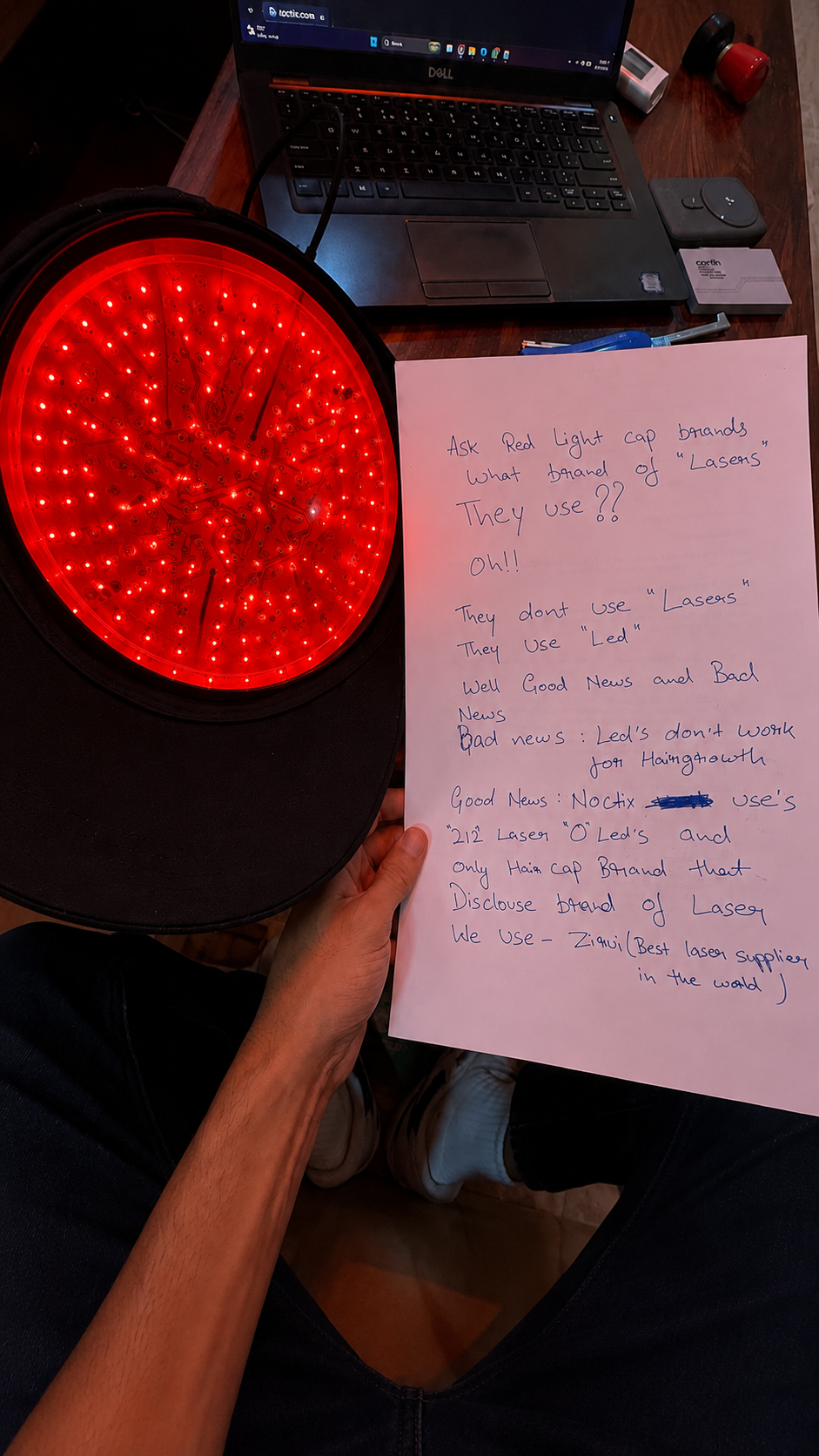
I didn’t launch a hair growth cap because I thought Noctix needed another product. I launched it because I genuinely became frustrated with what I was seeing in the hair-growth device market. When I first started researching hair-loss technology, I assumed finding a genuinely good laser cap would be simple. There were hundreds of them online. Red lights everywhere. Caps claiming “advanced light therapy.” Devices with 200 lights. 300 lights. Even 500+ lights. At first glance, they all looked almost the same. Then I started looking at what those lights actually were. And that is where things became interesting. A huge number of the affordable hair caps I came across were primarily using LEDs. They looked impressive when switched on. The entire inside of the cap would glow bright red. But I wasn’t interested in how bright or futuristic the cap looked. I wanted to understand one thing: What is actually reaching the scalp? Because hair creates a very different problem compared with something like an LED face mask. On your face, the light has a relatively clear path to your skin. On your head, the light has to travel through existing hair before reaching the scalp and follicles underneath. And during my research, that distinction between a normal LED and a laser diode started mattering a lot more to me. A laser produces a much more focused beam. An LED produces much more scattered light. That doesn’t mean every LED device in the world is useless. But for the hair-growth cap I personally wanted to build, I didn’t want to put hundreds of inexpensive LEDs inside a cap simply so I could advertise a huge diode number. I wanted actual laser diodes. So then I started looking at the genuinely established laser hair-growth devices internationally. And suddenly I had the opposite problem. The technology I actually liked existed. But the good devices were mostly foreign brands. And once you imported them into India, some of the serious laser systems could cost an absurd amount of money. ₹1 lakh. ₹2 lakh. Sometimes even more depending on the model, shipping, duties and brand. And I kept thinking: Why does an Indian customer have to choose between an inexpensive LED cap I wouldn’t personally buy… and an imported laser device that costs lakhs? There had to be something in between. A genuinely premium laser device. Real laser diodes. A wavelength that has actually been studied for pattern hair loss. Proper scalp coverage. Without turning it into a ₹2 lakh luxury purchase simply because it came from an American brand. That question basically became the starting point for the Noctix Laser Hair Growth Cap. And I became slightly obsessive about it. I didn’t want: “Laser-like LEDs.” I didn’t want: “Red light technology.” I didn’t want vague marketing language where you have to dig through five pages before discovering what is actually inside the cap. I wanted to be able to say very clearly: These are laser diodes. And not hide behind terminology. That is why the Noctix cap uses 212 individual 655nm laser diodes. Not 212 LEDs marketed as lasers. Not a mixture where most of the device is LED and a handful are lasers. 212 lasers. And I chose 655nm for a reason. Low-level laser therapy around this wavelength has been studied in controlled clinical research for pattern hair loss. In one randomized, double-blind, placebo-controlled study using 655nm light, researchers observed a significant increase in terminal hair counts in the treatment group after 16 weeks compared with placebo. That was the kind of research I wanted to see before building a ₹48,999 device. Because if I’m asking someone to put something on their head for months… I need a better explanation than: “Trust me, red light is good for hair.” The basic idea behind the device is actually very simple. The laser light needs to reach the scalp. Once there, low-level light therapy is intended to support follicles that are still viable during the hair-growth cycle. And over time, with consistent use, the goal is to support thicker, stronger and fuller-looking hair. It is not magic. You are not going to wear it tonight and wake up tomorrow with twice as much hair. Hair simply doesn’t work like that. And I actually think one of the biggest problems in this industry is how impatient the marketing has made everyone. Use this oil for seven days. Use this serum for two weeks. Take this supplement and your hairline comes back. Every month there is another miracle. I didn’t want to build Noctix that way. Hair follicles have growth cycles. Meaningful changes take time. So our protocol is boring. 30 minutes every other day. Put the cap on. Press the button. Continue working. Watch Netflix. Read. Answer emails. Sit at home. Then take it off. That’s it. No oil dripping down your forehead. No washing your hair afterwards. No weekly clinic appointment. No injections. No needles. And no 10-step hair routine you’ll probably stop following after three weeks. But the part I cared about most wasn’t actually making it convenient. It was making sure I could personally look inside this device and feel comfortable putting my own name behind it. That’s also why I took the photo you’re seeing here. This isn’t some perfect studio render. That’s literally me sitting with the product open, looking at the internal diode layout while working on it. Because this was the question I kept coming back to during development: If someone asks us what is actually inside the Noctix cap, can we answer them clearly? I wanted the answer to be yes. Ask us the wavelength. 655nm. Ask us how many laser diodes. 212. Ask us whether we mean LED or actual laser diode. Actual laser diodes. Ask us how often it is used. 30 minutes every other day. I would rather disclose those details and let customers compare for themselves than cover the website in vague words like “advanced technology” and hope nobody asks questions. And yes, building it this way made the product more expensive. Of course it did. Real laser diodes cost considerably more than simply filling a plastic cap with LEDs. But my goal was never: How do I make the cheapest hair cap in India? There will always be someone willing to make a cheaper one. My question was: What would I personally buy if I noticed my own hairline getting thinner? Would I buy another ₹5,000 cap because it has hundreds of glowing red LEDs? Probably not. Would I casually spend ₹2 lakh importing one of the established foreign laser devices? Also probably not. So I wanted to build the product that sits between those two extremes. The type of device where you can actually understand where the money went. Not into celebrity marketing. Not into a luxury foreign-brand markup. Into the part that actually matters: the technology inside the cap. And because hair takes time, I knew a normal 7-day or 30-day return promise would be almost meaningless here. You cannot realistically judge a hair-growth device in two weeks. That is why I wanted to put a 6-month growth guarantee behind it. Use it consistently. Follow the recommended protocol. Document your progress according to the guarantee requirements. Give the device the time hair biology actually requires. And if you don’t see visible improvement after the full period, you can qualify for a full refund under the policy. Because at ₹48,999, I don’t want the entire risk sitting with the customer. I want Noctix to have something at stake too. Maybe that is not the most profitable way to sell a device. But it is the way I’m comfortable selling one. And that’s really the whole story behind why we launched this. I didn’t wake up and think: “Hair fall is a big market. Let’s sell something.” I saw an obvious gap. At one end: Cheap red-light caps where it was often difficult to understand exactly what technology you were getting. At the other: Very good foreign laser devices that can become ridiculously expensive by the time an Indian customer gets one. I wanted to build the option I felt was missing. 212 actual laser diodes. 655nm wavelength. 30 minutes every other day. 6 months to prove itself. Nothing hidden. Nothing unnecessarily complicated. Just the hair-growth device I would personally want available in India. That is why I built the Noctix Laser Hair Growth Cap. And if you’re considering any hair cap—not only ours—I would genuinely suggest asking the brand one question before buying: “Exactly what type of diodes are inside it?” Not how many red lights it has. Not how bright the photos look. Not how futuristic the cap appears. Ask what the light source actually is. Because when I started asking that question, it completely changed the kind of product I wanted Noctix to build. — Adarsh Founder, Noctix
Where the ad sends people
noctix.in
Final hairfall fixer
Shop now: noctix.in(opens in a new tab)