
Inactive· since May 13, 2026
- 97
- days it ran
- 3
- relaunches
- 37,540
- EU reach
Ad copy
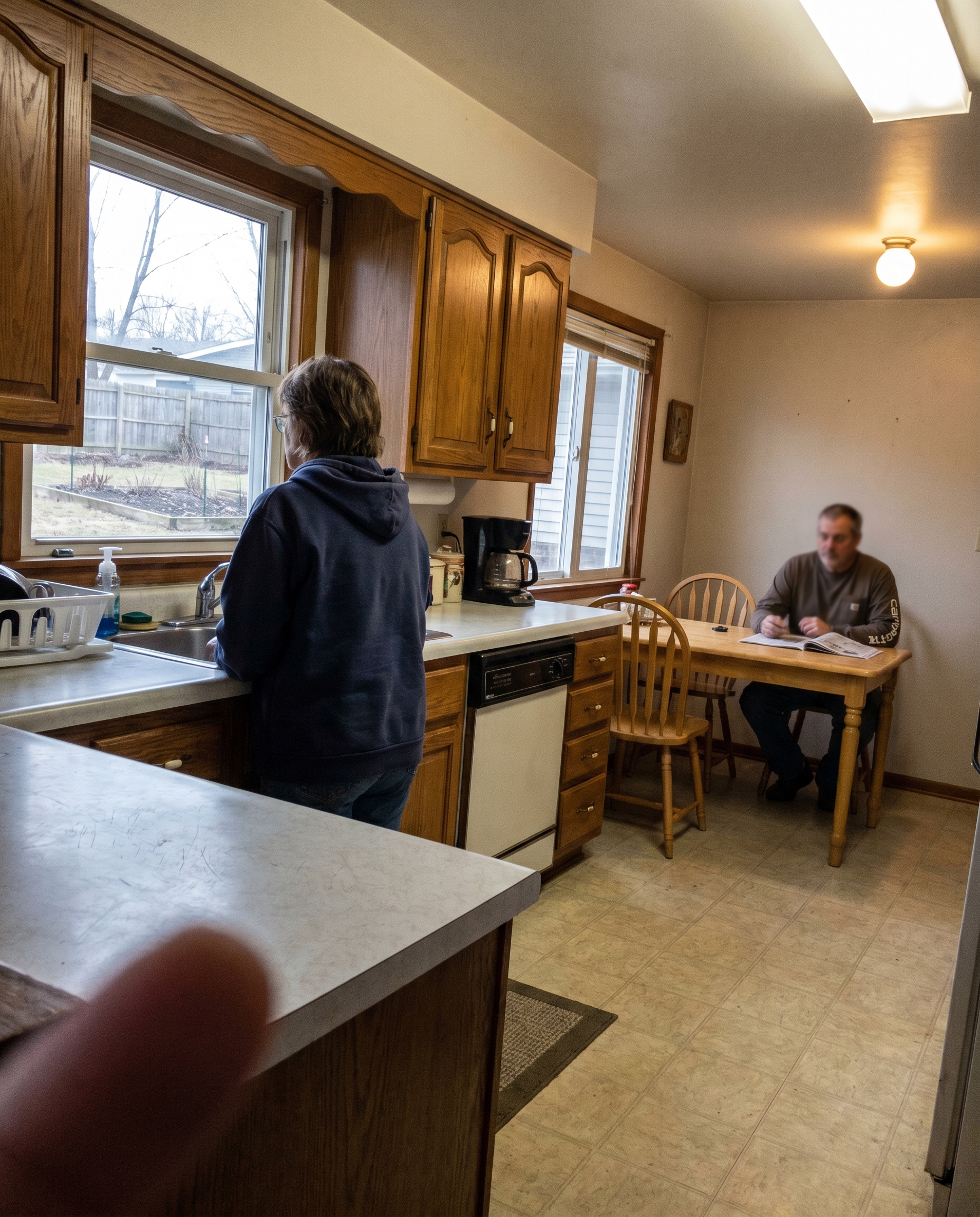
My husband used to be the first one out of bed in our house. For about two years I watched that quietly stop being true. I've been married to Frank for thirty-seven years. I want to start there because the story I am going to tell you only makes sense if you understand that I have been watching this man wake up in the morning for a very long time. I know what he is like in a kitchen at six a.m. I know what his shoulders look like when he is moving through a day with everything in the tank. And I know what they look like when he isn't. After thirty-seven years, you do not need to ask. You just look across the table. Frank is sixty-eight. He retired four years ago from the post office, where he had been a route carrier for the better part of three decades — a man who walked nine miles a day for thirty-one years, in every kind of weather Pennsylvania produces. He came home from those routes lean and tired in the way a person should be tired at the end of a working day. He read the newspaper after dinner and fell asleep in his chair sometimes, the way men of his generation do, and got up the next morning and did it again. Retirement was supposed to be the easy part. We'd talked about it for a decade. Small plans — the kind people our age actually keep. A garden in the back. The grandchildren on Sundays. A trip to see his brother in Oregon. The pontoon boat his nephew was going to sell us for a song. The first year was fine. The second year was a little less fine. By the start of the third year I was watching something happen that I did not have a name for, and that he would not have admitted to if I had named it for him. He was not sick. I want to say that at the top so you don't think this is going somewhere it isn't. His annual physical was clean. His bloodwork was where the doctor wanted it. His blood pressure was good. His cholesterol was in range. The doctor — a woman in her fifties who has been Frank's doctor for twelve years — told him at every visit that he was in good shape for sixty-eight. He took the small things she had him on, faithfully. He did the walks, the salads, the eight hours of sleep, faithfully. There was no chart-level problem. But. He stopped being the first one up. For thirty-seven years, Frank had been the one who started the coffee. Around month fourteen of retirement, I noticed I was the one starting the coffee. He'd come down twenty minutes later. He'd say good morning, sweetheart in the same voice. But the twenty minutes had moved. Then it was twenty-five. By the start of the third year it was sometimes nine o'clock before he came downstairs at all. The garden got planted late one spring and was not planted at all the spring after that. He didn't say I'm not going to plant the garden this year. He just didn't plant it. I would catch myself looking out the kitchen window at the empty bed and feeling something I didn't have a word for either. He fell asleep in his chair earlier in the evenings. Used to be nine after a baseball game. Now it was seven-thirty during the news. He stopped going down to the basement for the woodworking projects he'd done since the kids were little — a birdhouse for one of the grandkids, a stool for the back porch, the kind of thing that used to fill his Saturday afternoons. The radial-arm saw had a thin coat of dust on it the last time I went down there to look for an extension cord. The pontoon boat conversation stopped happening. The trip to Oregon kept getting pushed. He was not depressed. I knew the difference — I had a sister who was depressed for most of the 1980s and I know what that looks like in a man. Frank was not depressed. He was less. That is the only word I can find for it that doesn't overstate it. He was the same kind man, the same husband, the same grandfather. There was just less of him in the room. I mentioned it once, gently, at his sixty-eighth birthday dinner. He waved his hand and said: Mary, I'm sixty-eight years old. The body slows down. That's the deal. He was right, of course. That is the deal. I dropped it. I let him have the dinner. But I kept watching. This is the part where, in the kind of story that gets written about supplements, something dramatic is supposed to happen. A health scare. A collapse. A moment where everything changes. Nothing dramatic happened. What happened was a Saturday afternoon in October, at the hardware store on Route 9, where Frank goes for sandpaper. I had gone with him because I needed lightbulbs. In the paint aisle, there was an older gentleman — I would guess late seventies, maybe early eighties — looking at deck stain. He had a cart with two cans of stain, a roll of painter's tape, a couple of brushes. He was wearing the kind of work pants men in their seventies wear when they still actually do work. Frank, who has never met a stranger in his life, asked about the stain — what color, which brand. The man said he was redoing the porch on the cabin his son had given him. Then his son was going to take him out on the lake in the morning and they were going fishing. Frank said: You're doing the porch yourself? The man said: Sure, who else would do it. He was, by my estimation, ten years older than Frank. He had a cart full of stain. He was going fishing the next morning. He was, in the small ordinary way that tells you everything, not less. Frank and I didn't say anything about it on the drive home. We talked about groceries. We talked about my sister's the following Sunday. The man at the hardware store didn't come up. But that night, after dinner, Frank was quiet at the table in a way he is sometimes quiet when something is working in him. And he said — without me having brought any of it up: Mary, I think I want to talk to Dr. Patel about being more tired than I think I should be. I said okay. He made the appointment the following Monday. Dr. Patel saw him on a Thursday afternoon. I went with him, the way we go to each other's appointments now that we are at the age where two heads in the room is better than one. She listened. She did not dismiss him and she did not panic. She ran additional bloodwork. She looked at his sleep. She looked at his medications. She made one small adjustment to a dose he'd been on for a few years. She talked to him for almost forty minutes, which is not a thing doctors usually do. At the end of the appointment, she said something that has stayed with me ever since. She said: Frank, what you are describing is real, and it is also normal. Both things are true. Your numbers are good. Your medications are doing what they should be doing. And your body is sixty-eight. The cellular machinery in all of us starts slowing down somewhere in our sixties, and there is no medication for that because it isn't a disease. What we can do is keep doing the things we are doing, keep the bloodwork where it is, and pay attention to anything else that supports the body's own energy. That is the conversation now. Frank asked what anything else meant. She said walking, which he was already doing. Sleep, which she wanted him to protect more carefully. The salads, which he was already eating. She told him that if he wanted to look into other small things he could add, she had no objection — as long as he ran anything new past her or the nurse line first. Frank came home and started reading. Two weeks, evenings, with a notepad next to him. He read about beetroot — about the deep crimson pigment called betalain, the color that stains your cutting board. He read about the dietary nitrates naturally present in the root. He read about the long, patient relationship the research community has had with this vegetable for decades — in the context of cardiovascular wellness, supporting healthy circulation, and the body's own cellular energy. None of what he read was a fireworks story. It was a vegetable that has been quietly studied for a long time. He settled on a brand called Rosabella, and he picked it for one specific reason. The betalain pigment is heat-sensitive. If you process beetroot with heat — which is the standard way — you lose some of the compound in the process. Rosabella chose to cold-press the root at low temperatures, because they wanted as much of the compound as possible to make it from the field into the capsule. That is a slower way to make a supplement. It told Frank something about who was running the operation. The other thing he liked: two capsules in the morning with a glass of water. That's it. Frank does not like protocols. He likes things he can keep on the counter and remember. Before he started, he called Dr. Patel's office. The nurse pulled up his chart, looked at the small things he was taking, and called him back the same afternoon. Go ahead. No concerns. Don't change anything else. Frank was adding it to what he was already doing. He was not stopping the cholesterol medication. He was not stopping the blood pressure medication. He was not adjusting either of those without his doctor in the room. And neither — I want to say this carefully, because I am going to say it again — should anyone reading this ever do that on their own. Whatever your doctor has you on, stay on. Call the office and ask before you add anything. That is the only rule that matters. Frank started on a Monday, because Frank starts everything on a Monday. The first two weeks, nothing dramatic happened, and Frank told me so several times because he wanted me to know he was being honest with himself. I had read enough alongside him to know that bodies are different. Some people notice something within the first week or two. Some take much longer. Some don't notice much at all. I told him to give it some time before he decided anything. He nodded the way he nods when he agrees but doesn't feel like saying so. I was the one who noticed first. I noticed because I was the one watching. He wasn't. The first thing I noticed was the coffee. After a few weeks, I came down one morning at six-fifteen and there was already coffee in the pot. Frank was at the table with the paper. He didn't make a thing of it. I didn't either. I poured a cup and sat down across from him. The second thing I noticed, sometime in the second month, was that he was not falling asleep at seven-thirty anymore. He was making it through the evening news. Some nights to nine. One night in November he stayed up to ten-fifteen to watch the end of a basketball game that meant nothing to either of us, and I went to bed without him for the first time in I don't know how long. The third thing I noticed was the basement. A couple of months in, I came in from the grocery store and I heard the radial-arm saw. He was making a small bookshelf for our granddaughter's bedroom. He came up for lunch covered in sawdust the way I remembered him on a hundred Saturday afternoons over the course of our marriage. He sat down and ate his sandwich and did not say anything about feeling different. He just was. I made a point of not saying anything either. I poured him more iced tea. The garden got planted that spring. The pontoon boat conversation came back. The trip to Oregon to see his brother is on the calendar for May. I want to be careful here, because I am writing this to people I do not know, about a husband I love very much, and I do not want to overstate anything. I am not telling you Rosabella did any of that on its own. Frank was already walking. Already eating the way Dr. Patel wanted him to eat. Already taking his medications and protecting his sleep. Dr. Patel had made an adjustment to one of his doses. Several things were changing at once, the way they do when a person decides to pay attention to something they had stopped paying attention to. All I am telling you is that he added one thing to the list, kept everything else exactly the same, and a quiet stretch of months followed that had not been preceded by an equally quiet stretch of months. That is the honest version. I would not trust anyone who gave you a cleaner one. Frank went back to see Dr. Patel at the six-month, on her schedule. She ran the bloodwork. It was where she wanted it, in the same ranges it had been. She looked at him across the desk — she has known him for twelve years and she knows what he looks like — and she said: Frank, whatever you're doing, don't change a thing. I'll see you in six months. We drove home and Frank said: I think we should call Bill about that boat. That's the whole story. There isn't a more dramatic one. There is just a quiet one about a man who got less for a couple of years, and who came back to most of himself. I wanted to tell you about it because I have a feeling there is a woman somewhere reading this who is watching her own husband stop being the first one out of bed, and who doesn't have a word for what she's seeing either. I didn't have a word for it. I still don't, really. But I know what it looks like to come back from it. And I wanted you to know that the second one is still possible. If you are watching someone you love get less — quietly, gradually, in the small ways nobody else would notice — I want to say a few things to you carefully. I do not know your husband, or your father, or whoever it is you are watching. I do not know his bloodwork or his medications or his history. Bodies are different. Some people notice something within the first week or two. Some take much longer. Some don't notice much at all. That is the honest version, and anyone offering you a cleaner one is selling you harder than I am. Here is how Frank and I think about Rosabella now, in the words we would actually use. It is something the body uses. The research community talks about it in the context of supporting healthy circulation, cardiovascular wellness, and the body's own cellular energy — in people whose numbers are already in the range their doctors want them in. It is not a fix for anything. It is one small thing you add to the long list of things you are already doing. Please — and I really do mean this — have the person you're watching call his doctor or his pharmacist before he adds it. If he is on any medication for blood pressure, or cholesterol, or anything cardiovascular at all, this is non-negotiable in our house. The people who know his chart will tell him in two minutes whether it makes sense. I am the wife of a man who got back to most of himself. I am not the person to ask. His doctor is. The company has a ninety-day satisfaction guarantee. If he isn't satisfied — for any reason at all, including just changing his mind — they refund you. It is not tied to his bloodwork. It is not tied to anything he has to prove to anyone. If he is not satisfied, he is not satisfied. That is the whole policy. The beets are grown on a small operation that harvests on its own schedule, which means there are stretches when they are in stock and stretches when they are not. I mention that not to push you — please do not let anybody push you into a health decision for someone you love — but so that if you go to the site and they are out, you know why. That is all I have. Thank you for reading this far. I hope something here was useful to you, and to him. — Mary P.S. I want to come back to the cold-press for a second, because I rushed past it. The betalain pigment — the deep red, the part the research community keeps circling back to — is heat-sensitive. If you process beetroot the standard way, with heat, you lose some of the compound. Rosabella chose the slow way. Cold-press, low temperatures, more of the compound through to the capsule. It costs them money and time. They made the choice anyway. That was a piece of why Frank picked them. P.P.S. Two capsules. In the morning. With a glass of water. That is the entire protocol. No powder to blend, no afternoon dose, no schedule taped to the inside of the cupboard. Frank is sixty-eight and he has earned a simple morning. He keeps the bottle on the counter next to the coffee pot. It has not moved in nine months. P.P.P.S. I am going to say this one more time, because I have to. Please. Whoever you are watching, have him call his doctor or his pharmacist before he adds anything new to what he is already taking. Especially if he is on anything for blood pressure or cholesterol or anything cardiovascular. They have his whole picture in front of them. I have written you a letter. There is a difference, and the difference matters. The two minutes it takes to ask are worth every second. P.P.P.P.S. The guarantee, again, in case you skimmed. Ninety days. Any reason at all. You don't have to prove a single thing — not to them, not about anyone's numbers, not about how anyone feels. If he tries it and he is not satisfied, he is not satisfied, and they send the money back. That is the whole policy and it is a small-company policy, the kind of thing companies used to do when companies still answered the phone. P.P.P.P.P.S. The thing Dr. Patel said to Frank at that long appointment — what you are describing is real, and it is also normal. Both things are true — has stayed with me longer than almost anything a doctor has ever said in our presence. We spend so much of our sixties being told that what we are feeling is just what bodies do, and so much of our sixties wondering whether we are allowed to ask for more than that. Frank asked. His doctor took him seriously. He came back to more of himself. I do not know what the equivalent of that is in your house, or in the house of whoever you are watching. But I hope you find it. I hope a chance encounter at a hardware store, or a sentence in a letter from a stranger, gives one of you the small push you need to ask the question. That is the whole reason I wrote this. — M. https://track.tryrosabella.com/14309c20-4d60-44e3-9565-5ba6bb358986 Individual experiences vary. These statements have not been evaluated by the FDA. This product is not intended to diagnose, treat, cure, or prevent any disease.
Support stamina and heart health every day
"Best customer support ever. My issue was resolved quickly and professionally. I so love how the beetroot capsules are helping manage my blood pressure."
LEARN MORELike this ad? Make it yours.
Crush rebuilds this exact creative around your product — your brand, your colors, your offer — in about a minute.