50 Plus & Glowing
50 Plus & Glowing Facebook ad: “What the Makeup Counter Will NEVER Tell You About Your…”

Ran for 5 days, from June 26 to June 30, 2026, the last day Crush saw it.
Run by 50 Plus & Glowing on Facebook. Crush is not the advertiser and does not verify its claims. See this ad in Meta's Ad Library(opens in a new tab)
Want an ad like this for your product?
Crush makes new ad images for your product from this ad: your logo, your product photo, your offer.
Trials from $19.95 USD, then $79.95 USD a month. Cancel anytime.
About this ad
- Meta Ad Library ID
- 1772176037556685
- Platforms
- Facebook, Instagram, Audience Network, Messenger and Threads
- Relaunches
- 0
Ad text
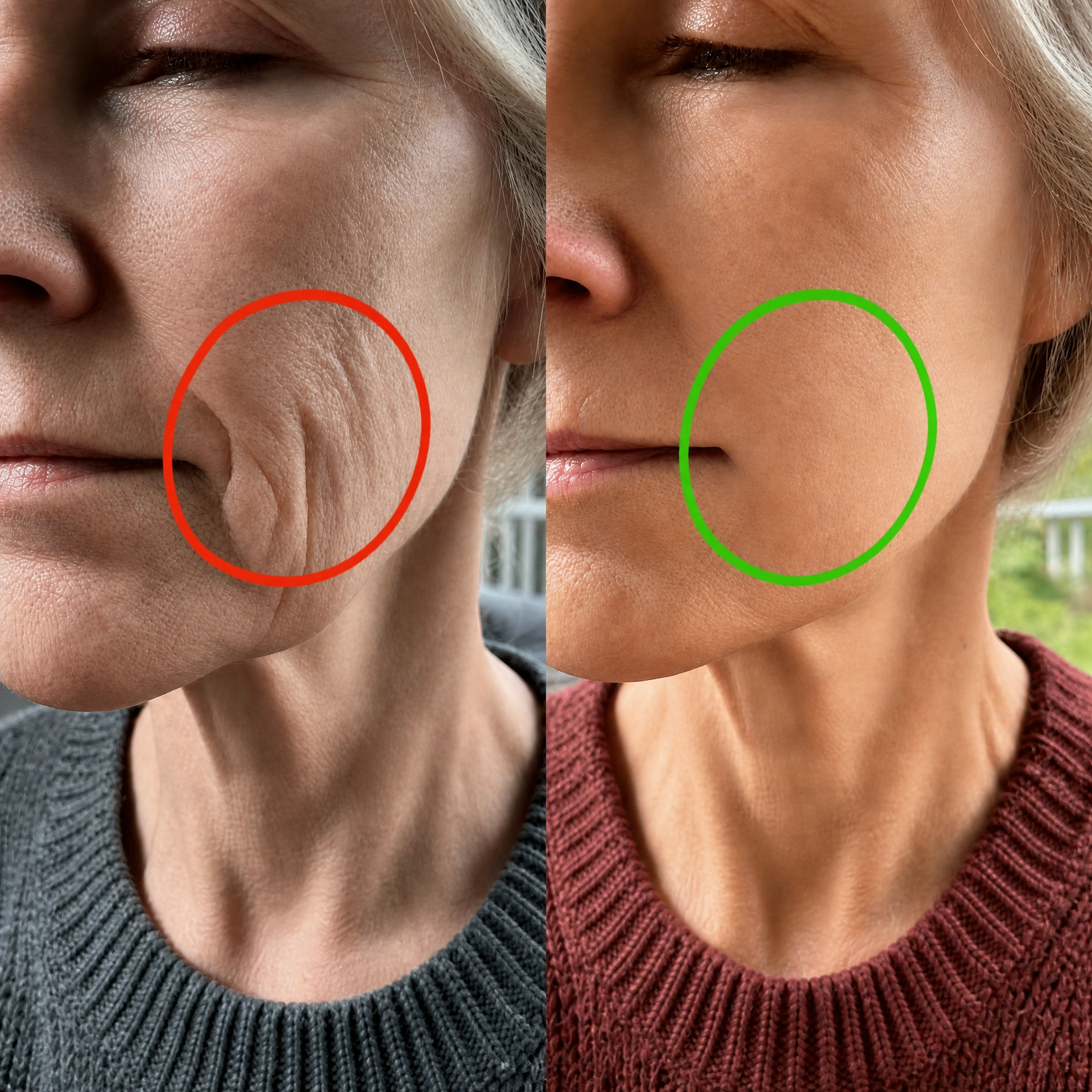
My husband of 27 years has never seen my bare face in daylight. He thinks I'm an early riser. I let him think that. The truth is I've been hiding something under my makeup for almost twenty years. And I have built my entire morning — my entire marriage, if I'm honest — around making sure he never sees it. Not at the lake. Not camping. Not on our anniversary trip to Charleston. Not once in 27 years. I'm writing this because last Sunday something happened. And I can't stop thinking about it. And because I figured something out about my mother that I need every woman reading this to know. She died not knowing it. I'm not going to let that happen to me. And I'm not going to let it happen to you. So I'll just say it. It's my face. That's all. It sounds so stupid written down. The lines around my mouth. The two between my brows. The tired under my eyes that stopped being about sleep years ago. Somewhere in my forties, makeup stopped being makeup and started being armor. And for years, the armor worked. Foundation, a little concealer, lipstick, done. Fifteen minutes. Then the armor stopped working. The foundation started settling into the lines instead of covering them. By ten in the morning it had cracked into every crease and sat there pointing at them. The concealer gathered in the folds under my eyes by two o'clock and turned them gray. So I bought a primer to fix the foundation. A corrector to fix the concealer. A powder to set the corrector. A spray to set the powder. I wasn't covering my face anymore. I was building one. Every morning. From scratch. And here's the part you already know if you live like this. It's not the lines that ruin your life. It's everything you do to hide the lines. The 5:40 alarm so you're "done" before he wakes up. The lipstick by the hallway window because the light there is kinder than the bathroom. The way you angle yourself in photos. Chin up, three-quarter turn, back row. The way you say "I'll meet you there" so you have time to do your face. The way you don't get in the pool with your granddaughter. The touch-ups in parking lots. The check in every mirror, every store window, the back of every elevator door. The way you have never once cried at a wedding without excusing yourself first. The lines take up half an inch of your face. The hiding takes up your whole life. And while you're doing all that hiding, three things are happening that nobody tells you. One. Your face isn't doing this because of you. It's not because you didn't drink enough water, or slept on your side, or "have your mother's skin." It's a specific biological event, with a name, happening four layers under everything you've ever applied. I'll give you the name in a minute. Two. The people selling you solutions can't fix it. Not because they don't want to. Because they've only been taught two answers. The counter girl will look at you for ninety seconds and hand you a richer cream. The dermatologist will look at you for ninety seconds and mention a needle. Surface or syringe. That's the whole menu. Three. There's an entire industry — a $180 billion one — that profits every single month this stays unsolved. Every jar you replace. Every new shade you match. Every "advanced formula" that works for three weeks and then doesn't. They don't want it fixed. They want it managed. And managed means you keep buying. So let me tell you about my mother. Because she's the reason I'm writing this. My mom died four years ago. Ovarian. It was fast — nine weeks — and in all nine of those weeks, no nurse, no doctor, no grandchild ever saw her without her face on. The morning of her last day, she asked the nurse to hand her the makeup bag. I thought that was dignity. At the funeral, I told people it was dignity. Then last Sunday, I was at my sink at 5:40, and my hand went to the drawer for the green corrector the way it has a thousand mornings in a row. And something clicked. And I remembered cleaning out her bathroom after she died. The drawer I almost dumped without looking. Three tubes of the same corrector. The magnifying mirror. The receipt from a department store counter dated two weeks before her diagnosis. My mom had what I have. She had it for forty years. And she never told her own daughter. I never saw my mother's bare face. Not once in fifty-four years. I want you to sit with that. Because I had to sit with it. We talked on the phone every Sunday for thirty years. Her marriage. My marriage. Money. The kids. Her diagnosis, the day she got it. And she never once mentioned the five-o'clock alarms she'd been setting since before I was born. A woman will tell her daughter she's dying before she'll tell her she can't face her own mirror. And I almost did the exact same thing to my daughter. That's the moment I got angry. Not sad. Angry. Because somewhere along the way, somebody decided this was vanity, and vanity is embarrassing, so we don't talk about it. And so we hand it down. Mother to daughter. Generation to generation. Like a hair color. Like a recipe. Except nobody says the recipe out loud. You figure it out by yourself. In your own bathroom. At 5:40 in the morning. With a sponge in your hand. So I'm saying it out loud. Because my mother never got to. And yours probably didn't either. Okay. So. The professionals. If you live like this, you already know what I'm about to say. But you should hear it from another woman, so you know you're not crazy. The first was a counter girl at Nordstrom, half my age and kind as could be. She color-matched my neck, layered on $300 worth of "luminous, line- smoothing coverage," and turned the mirror. It looked beautiful in counter lighting. At two o'clock, in my car mirror, it had collected in every crease like grout. The second was my dermatologist. She wrote me a $190 retinol. My cheeks flaked for three weeks. "Some women's skin runs thin," she said. "Go slower." I went slower. I flaked anyway. Twice. The third had a tablet. She drew on a photo of my face and showed me exactly where the needles would go and what I'd see in two weeks. The woman on that screen was smoother. She was also not anyone I knew. I sat in the parking garage for a long time after that one. And I did the math. My mother probably stood at a hundred makeup counters in her lifetime. None of them helped her. I had just been to three of the most expensive professionals in my city. None of them helped me. So I asked the question my mother never got to ask. Because Google didn't exist when she was my age. Why does it keep getting worse no matter what I put on it? And before I tell you what I found, let me walk you through the graveyard. Because I know you have one too. I have tried, over roughly fifteen years: The $300 jar of La Mer. The $90 "second-skin" foundation. Silicone blurring primers — two brands. Green correctors. Peach correctors. Setting powders, setting sprays. The Korean serums my daughter mails me. The vitamin C that turned orange in the cabinet. The retinol — twice, you already heard how that went. Collagen powder stirred into my coffee, every morning, for one entire year. A jade roller. An ice roller. The LED mask from QVC — $229, used eleven times, currently in the linen closet. The serums in the heavy glass bottles, the ones with French names, the ones that made me hesitate at the register and buy them anyway. Total: a little over $13,000. I added it up before I sat down to write this. That doesn't include the pillowcases. Or the shirt collars. Foundation gets into fabric and never comes out. Fifteen years. Thirteen thousand dollars. One drawer full of half-used jars. Zero solutions. And a face that needed more coverage every year, not less. If you're reading this and your drawer looks like mine, I want you to know something. You did not fail at solving this. You were sold a category of products designed to manage it. Not solve it. So I went looking somewhere the drawer couldn't take me. I spent six weeks reading actual skin research on my couch at midnight. The kind with words I had to look up. And I found a word I had never heard at a single counter, in a single office, or on a single label in my drawer. One word. Fibroblast. Here's what it means, in language a tired woman can use at eleven at night. Deep under your skin — four layers down, further than any cream, foundation, or peptides you've ever owned has reached — there are cells whose whole job is to build the structure that holds your face up. Collagen. Elastin. The scaffolding underneath. Think of them as a construction crew. When you're young, the crew works around the clock. Your skin is firm and full and bounces back, and you don't think about it once. And here is the sentence that made me put the laptop down. Somewhere in your fifties, most of that crew goes dormant — while the collagen you already have keeps breaking down anyway. Both at once. Nothing new being built. Everything old wearing out. Read that again. Because that one sentence explains your entire drawer. Every jar I ever bought worked on the surface. Hydrating the top. Blurring. Brightening the paint. And four layers down, the crew that holds the wall up had clocked out — and the wall was slowly coming down, and nothing in the makeup aisle or the skincare aisle even claims to go where that's happening. That's why it kept getting worse no matter what I spent. I was repainting a wall whose framing was letting go behind it. My mother spent forty years being told to find a better shade. The wall was coming down underneath. Nobody told her. And there's a second thing I learned. This is the one that made me actually furious. The makeup itself was making it look worse. Foundation doesn't sit on top of a line. It sinks into it, dries, and traces it. By afternoon I wasn't wearing coverage anymore. I was wearing a map of everything I was covering. So the lines deepened, and I added product. And the product found the lines, and I added more. I was paying $90 a jar to point at the thing I was paying $90 a jar to hide. Here's the thing, though. The research already knows what wakes the crew up. There's a class of peptides — Matrixyl is the name that kept coming up — studied for exactly this: signaling dormant fibroblasts to start building again. It's been sitting in the journals for years. But the peptide research lives in one world, and the shelf at the store lives in another. The few creams that bother with peptides water them down to almost nothing — most formulas are 70% water before a single active goes in — and at that strength, nothing gets anywhere near the layer where the crew sleeps. Real peptides, at real concentration, in a jar a normal woman could buy? I couldn't find it. Until somebody mentioned it at two in the morning. One of those private groups — women over 50, the kind of group where people say things they don't say in front of their husbands. A woman about my age, out in Phoenix, named a small company called Olavita. She said it was a peptide. I almost closed the tab. Because I'd tried peptides. My drawer was a cemetery of peptides. But then she said two things that made me stop scrolling. First — the peptides in it are small enough, and concentrated enough, to actually reach the fibroblast layer. The crew. The exact cells I'd just spent six weeks reading about. Not the surface. The cause. Second — there's no water filler. The whole dose is a few drops. Three drops, once a morning, seven seconds. Because at real strength, that's all it takes. Those two things, in the same small jar. That's what made me try it. I ordered it that night. And I want to walk you through what happened, because I had to walk myself through it twice before I believed it. Week one. Nothing. I'd been here before. Week two. The dullness lifted. That's the only way I can describe it. Not lines — light. Like something switched back on under the skin. I told myself it was nothing. Week three. I did my face at 5:40 the way I always do. At two in the afternoon I checked the car mirror the way I always do. It hadn't cracked. The foundation was sitting where I'd put it. The lines by my mouth hadn't drawn themselves back in by lunch. I sat in that parking lot longer than I should have. Week five. I skipped the green corrector. Then the second layer of concealer. My morning took eleven minutes instead of thirty-five. Week six. I wore tinted moisturizer to dinner. Just that. My husband didn't say a word about it. He just reached across the table and tucked my hair behind my ear — the way he used to, before this whole thing started. Week eight. I got in the pool with my granddaughter for the first time in nine summers. She didn't say anything either. She just grabbed my hand and pulled me toward the deep end, like it was nothing. Like I'd always been the grandma who swims. I'm crying writing that sentence. I told you I'd say this out loud. That includes the parts that still sting. And then there was a Sunday — week ten, maybe eleven — when my hand went to the drawer for the corrector. And stopped. Because there was nothing left for it to correct. I'd like to tell you I cried then too. It would make a better story. What I actually did was stand there with my hand on the drawer and think about my mother. About the makeup bag in the hospice room. About the forty years she spent building a face every single morning, because nobody ever told her the problem was four layers under the paint — and that the crew down there could be woken up. That's the part I keep coming back to. Not that it worked for me. That it could have worked for her. I want to be straight with you about a few things before I tell you where to find it. The first. I know what you're thinking, because I thought it too. "It's a cream. If the $300 jar didn't work, a peptide cream sure as hell won't." I felt exactly the same. Here's what I didn't understand until I read the research. The expensive jars aren't failing because they're weak. Some of them have beautiful ingredients. They're failing because they're aimed at the wrong layer. They treat the surface. The problem is a dormant crew four layers down. The most expensive cream in the world sits on the same surface the cheapest one does. Olavita isn't different because it's fancier. It's different because it's aimed at a different target. The crew. Not the paint. That's the entire difference. The second. "My lines are deeper than yours. I'm 67. Mine are too far gone." I believed the two lines around my mouth were carved in. Permanent. But the mechanism doesn't care how deep a line looks. It cares what caused it. And if what caused it is a crew that went dormant — which, past fifty, it almost always is — then deeper lines just mean your crew has been asleep longer. That's all it means. Not unfixable. Asleep longer. The third. This is not overnight. The first thing I noticed came at week three, and it was foundation, not face. The changes other people notice came at weeks eight through twelve. If you quit at day ten, you'll be telling the truth about what you saw — and quitting weeks before the crew gets back to work. You've already given the mirror fifteen years. You can give this twelve weeks. The fourth. The deep ones. I'll be honest. The two lines bracketing my mouth are still visible at month six. Softer. Shallower. But there. And I've stopped caring — because the rest of my face came back around them, and they stopped being the first thing the mirror says. If you need every line gone, a needle is still your only road. I didn't want a different face. I wanted mine back. That's what I got. The fifth. The money. One jar is $59 and lasts a month. Under two dollars a day. Now do the math I did: thirteen thousand dollars over fifteen years comes out to about $72 a month — and I still had the lines, plus a thirty-five-minute morning. This isn't more than you're already spending. It's the same money, finally pointed at the right layer. The sixth. Maintenance. The first jars are about waking the crew up. After that, I just keep going — three drops, seven seconds, every morning, possibly forever. And I genuinely do not care. Seven seconds is not the same thing as thirty-five minutes of building a face you're afraid to wear in the rain. That trade is the easiest one I've ever made. And the last thing. The guarantee. Use it every morning for 90 days. If you don't catch yourself in the mirror one morning and think "wait — there I am," you email them, you get every penny back, and you keep the jar. The $300 jar came with a no- returns-on-opened-cosmetics sticker. This one doesn't. One more thing. Because if you live the way I lived, you need to hear it. This doesn't hold steady while you decide. Every month the crew stays dormant is another month old collagen breaks down with nothing coming in behind it. Another month the lines cut deeper. Another month you add a layer. Another month closer to the version my mother had at seventy — when no shade matched anymore, and no powder sat right, and the routine had grown to an hour, and she did it anyway. Every morning. Alone. Because by then it wasn't beauty. It was hiding. And hiding was all she had left. That is not where this should end for you. It almost ended there for me. It did end there for her. So if you recognize yourself in any of this — The 5:40 alarm. The drawer of half-used jars. The husband who hasn't seen your bare face in years, and neither of you ever brings it up. The granddaughter who asks why you never get in the pool. The mother you suspect did all of this too — but you'll never get to ask — Then do one thing. Stop repainting the surface. Start waking up the layer underneath it. You can find Olavita at the link below. It's the one I used. Three drops. Seven seconds. One jar lasts about a month. I'll end where I started. My husband of 27 years has never seen my bare face in daylight. On our anniversary this October, he will. That's all I ever wanted. For twenty-seven years. I hope you get there too. 👉 https://try.olavita.co/tlpc/kra/42-years-secret P.S. I know what you're thinking, because I thought all of it too. Here's what I would have asked before I clicked. P.P.S. "I have sensitive skin. Retinol burned me. I can't flake for three weeks again." Neither can I — it happened to me twice. This works nothing like retinol. Retinol's whole approach is to irritate the surface so it rebuilds. The peptide approach doesn't touch the surface at all — it signals the layer underneath. Six ingredients, no acids, no fragrance. My skin never flaked, stung, or peeled once. P.P.P.S. "My dermatologist says it's just aging." So did mine. But "just aging" is a label, not a mechanism. The label tells you nothing. Dormant fibroblasts are the mechanism — and the mechanism is the part you can actually do something about. P.P.P.P.S. "Does it come in normal packaging? My husband doesn't know about any of this." It's a small jar. It looks like any other cream on any bathroom counter in America. Mine asked what it was. I said "a new peptide complex." He said "okay" and went back to his crossword. Nobody questions a cream. The only person who's been thinking about your face for 27 years is you. P.P.P.P.P.S. "What if it doesn't work for me?" 90 days, full refund, keep the jar. The $300 bottle never offered me that. This one does. P.P.P.P.P.P.S. "Will it mess with my makeup?" Three drops, absorbed before your coffee's done. You can put anything over it. Although somewhere around week eight, you're going to start wondering what exactly you're still covering.
Where the ad sends people
try.olavita.co
What the Makeup Counter Will NEVER Tell You About Your Foundation Lines
My wife has been using this cream for a long time and she said that I, as a man, could also try it, we are aging, too. According to my wife, this alternative is a lifesaver!
Learn more: try.olavita.co(opens in a new tab)