Rachel Morison
Rachel Morison Facebook ad: “Understanding Isn’t Healing”

Ran for 3 days, from August 24 to August 27, 2026, the last day Crush saw it.
Run by Rachel Morison on Facebook. Crush is not the advertiser and does not verify its claims. See this ad in Meta's Ad Library(opens in a new tab)
Want an ad like this for your product?
Crush makes new ad images for your product from this ad: your logo, your product photo, your offer.
Trials from $19.95 USD, then $79.95 USD a month. Cancel anytime.
About this ad
- Meta Ad Library ID
- 1817350679251940
- Platforms
- Facebook, Instagram, Audience Network, Messenger, WhatsApp and Threads
- Relaunches
- 1
Ad text
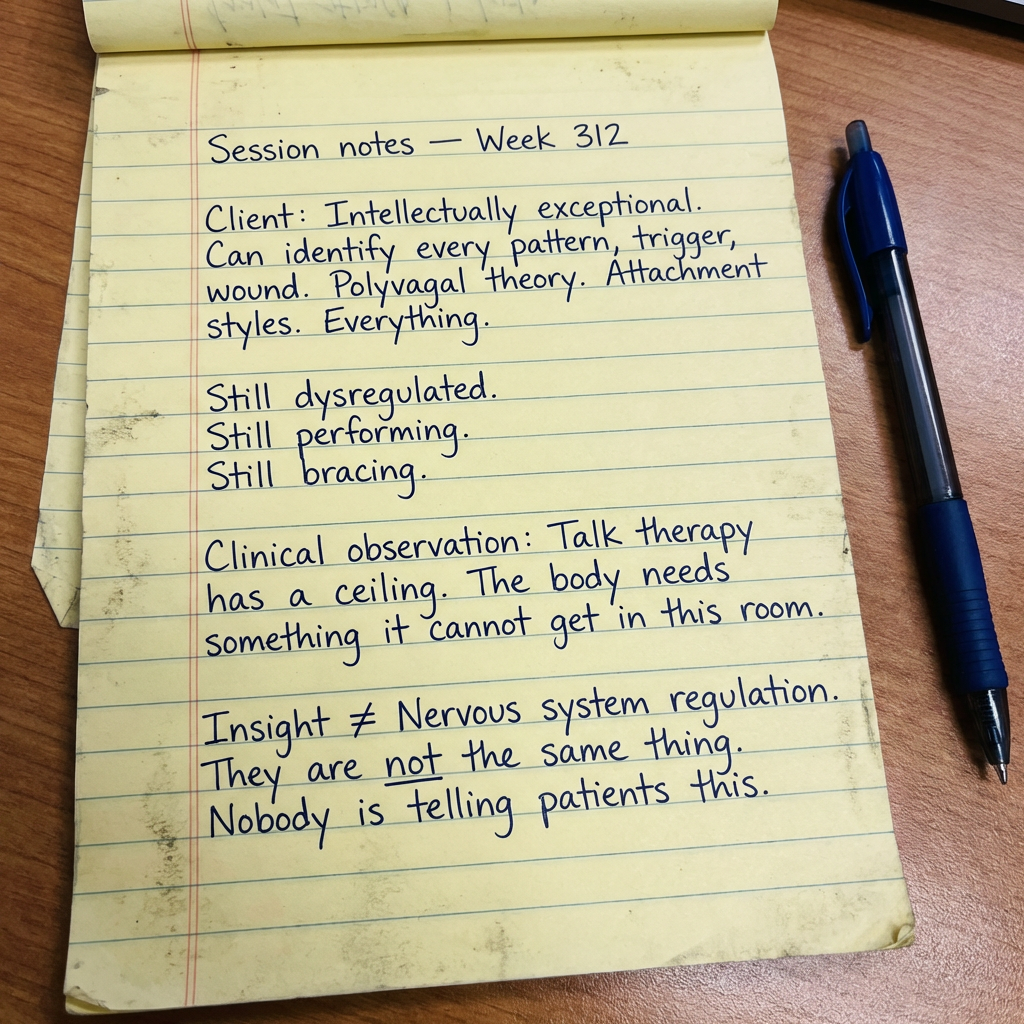
I've been a licensed therapist for sixteen years. And the way this field is built, I have almost no financial reason to tell you this. Understanding why you're hurting is billable by the hour. Releasing it has no billing code. Let me follow the money. Because I think it explains why you're reading this. There is a CPT code for cognitive behavioral therapy. For EMDR. For trauma processing. For the structured, careful work of exploring your childhood, your patterns, your wounds, the vocabulary of your own experience. My colleagues and I are paid, session after session, to help you understand yourself. That's what fits in fifty minutes. That's what has a treatment protocol. That's what insurance reimburses. There is no billing code for the morning you wake up and your jaw isn't already clenched. For the moment in a conversation when you realize you stopped managing everyone in the room and don't know exactly when that started. For the felt sense of safety that has no clinical name because nobody built a treatment protocol around it. Nobody built a revenue model around it either. So the entire field, the therapy protocols, the workbooks, the apps, the guided journals, all of it, was designed around the thing that fits in a session. We called it healing. Some of it is. I need you to hear me say that. But some of it is the diagnosis. And we kept giving you the diagnosis and never told you the treatment was a different thing entirely. I didn't know until my twelfth year. I know because of a client I'll call Ruth. She had been in therapy, on and off, for twenty-two years. She had done CBT. She had done EMDR. She had done a grief group after her husband died, a mindfulness program, breathwork, a year of somatic therapy. She had done the reading most people in my field assign. She kept a gratitude journal for three years. She had done more work on herself than anyone I had ever met in sixteen years of practice. By the time she sat across from me, she could trace every pattern in her life back to its origin. She knew where the flinching came from. She knew why she managed rooms, why she couldn't stop scanning for threat, why she woke at 3am with her heart pounding and no nightmare to explain it. She had clinical language for all of it. She was the most self-aware person I had ever worked with. And she still didn't feel better. Not in the way that counted. Not in the way she had spent twenty-two years trying to earn. One afternoon she looked at me and said something I have thought about almost every day since. "I feel like I've read every map there is. I just can't figure out why I'm still in the same place." I nodded. I said something supportive. She went home. I sat in my office after she left and looked at the chair she had been sitting in for two years. Two years of understanding. Two years of finally having language for what happened to her. She was still stuck. Not because she hadn't done the work. She had done more work than anyone. Because I had given her the wrong tool. And I had called it the only tool. That night I went looking for the research my training had never assigned me. Here is what it found. When a person talks about what hurt them, one part of the brain activates. The prefrontal cortex. The part that handles language. Narrative. Meaning. Context. Understanding. When a person releases what hurt them, something different has to happen. In a different part of the brain. The amygdala. The part that runs the survival system. The part that decides, on the basis of evidence it can actually use, whether the threat is over. Understanding your trauma and releasing your trauma are two completely different events. They happen in two completely different parts of the brain. And the survival system does not speak language. It does not read your therapy notes. It does not update because you finally understand why you brace, why you scan, why you perform okay even when you're not. It runs the protocol that was installed in you decades ago because nobody has given it the one thing that would change it. Not more understanding. Evidence. Repeated, survivable experience that the threat is over. Accumulated in small enough increments that the survival system doesn't flood. Building over time until the alarm, slowly, stops firing. Understanding is not evidence. This is why Ruth could explain her entire history in clinical terms and still wake at 3am. Still flinch at the same things. Still brace for something she couldn't name. The alarm was still running a protocol written when she was a child. It had never received evidence that the threat was gone. Because every tool she had ever been given delivered information to the understanding system. Nothing she had ever tried delivered evidence to the survival system. The tools weren't wrong. They were aimed at the wrong part of the brain. This is not a criticism of therapy. It is not. The therapists who worked with Ruth for twenty-two years were doing exactly what they were trained to do. What had a protocol. What fit the model. Nobody trained us for the gap between understanding and release. Because nobody built a billing code for what lives in that gap. The entire industry was built around one assumption that nobody stopped to check. That understanding eventually produces feeling. It doesn't. Not automatically. Not if the survival system never receives the signal it was waiting for. If you have been in therapy. If you have done the reading and the work and the processing. If you know your patterns and their origins. If you are fluent in your own psychology. And you still don't feel different. You have not failed. You have been doing exactly what the only tool you were handed was built to do. You just weren't given the second tool. The Back to You Journal is the second tool. It is not a gratitude journal. It is not a mood tracker. It is not another way to understand yourself better. It is 365 prompts built not to expand your understanding of what happened to you, but to give your survival system evidence, in graduated increments, that it is safe to stand down. Questions like this: "What do you need today that you're afraid to admit?" "What threat is your body still protecting you from?" "When no one's watching and you don't have to perform, who are you?" That is Graduated Nervous System Calibration. It is the only process built for the gap between knowing and feeling — because it doesn't try to change what you think. It changes what your body believes is safe. Therapy works above that gap. This works beneath it. Not analysis. Contact. Small, survivable contact with what the body has been holding at a distance. Each prompt builds on the last. Each one teaches the survival system, not the mind, the survival system, that going there is safe. That it can feel it and come back. That is the only thing that teaches the alarm to stop firing. Not more understanding. Accumulated evidence. I have given this journal to over two hundred clients. I have watched it passed between colleagues, handed from a therapist to a patient, given by a daughter to her mother, sent between friends. The thing I hear most often is not "I finally understand myself." It is: "I don't know how to explain it. Things have just gone quiet." That is what integration sounds like. It does not announce itself. It does not arrive as a breakthrough. Things just stop being as loud. You catch your jaw unclenched at a red light. You notice, somewhere in a conversation, that you haven't been managing the room. Your daughter calls and says you seem softer. Not better, exactly. Softer. Ruth's daughter said that to her. About four months in. "Mom, you seem different. Like you stopped bracing for something." Ruth told me she didn't know what she had stopped bracing for. She just knew that she had. I have watched women spend twenty years building the most complete understanding of themselves that I have ever seen. And then they look up and realize they have been waiting to feel different for two decades. The map was never the destination. The Back to You Journal is $39.95. That is under eleven cents a day. Less than the copay for one session of the therapy that gave you the diagnosis but not the treatment. There is no streak. Because shame does not teach the survival system anything useful, and skipping a day is not a failure to heal. There is no date. Because healing does not follow a calendar. There is no gratitude bypass. No prompt that asks you to look for the bright side before you've been allowed to look at the dark one. There is no shame for skipping. The journal waits. It does not mark your absence. There is no audience. Because you have been performing okay for other people for a very long time. This was built to be the place you stop. If it doesn't feel different within thirty days, not sound different, feel different, you don't pay. I want to be honest with you. This is not for everyone. If you are looking for a journal that tracks your progress and celebrates your streaks, this is not it. If you are looking for the place where you finally stop explaining yourself, even to yourself, and start giving your body the evidence it has been waiting for, it might be.
Where the ad sends people
heldhonest.com
Understanding Isn’t Healing
Held & Honest
Learn more: heldhonest.com(opens in a new tab)