
Active· since Mar 10, 2026
- 188
- days running
- 0
- relaunches
Ad copy
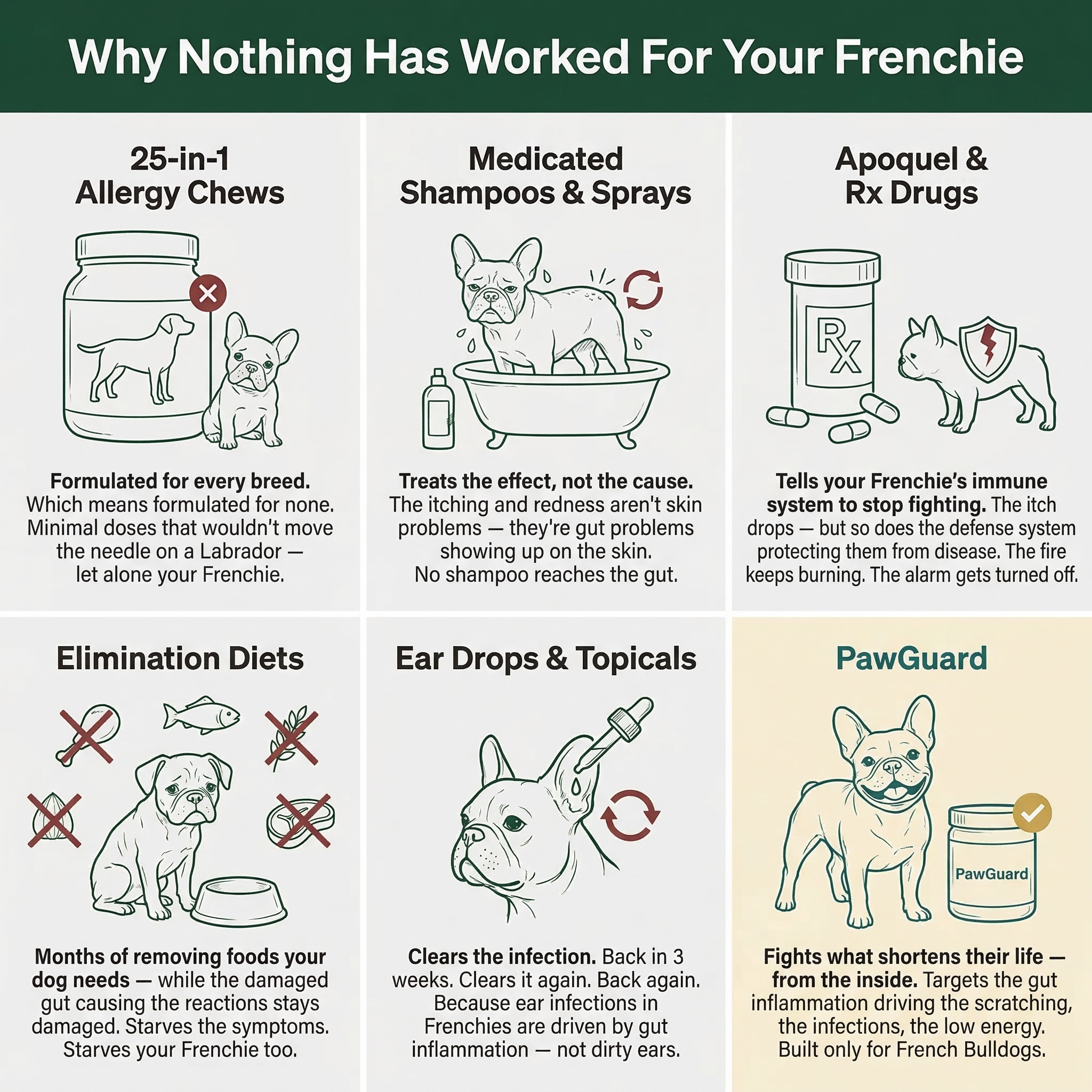
If your French Bulldog is between 2 and 5 years old and has any combination of gas that clears the room, scratching that keeps you both awake, recurring ear infections, obsessive paw licking, or a coat that's gone dull and dry — I need to tell you something that not a single one of your vets has told you. And I already know what you're thinking. You've tried everything. You've spent thousands. You've been let down by every supplement, every medicated shampoo, every prescription, and probably a few vets who just shrugged and said "that's just how Frenchies are." I get it. And I'm not going to insult you with miracle claims. But what I'm about to explain is going to make you furious. Because there's something happening inside your dog's body RIGHT NOW that is making every single one of those symptoms worse — and it's so obvious that the fact nobody has told you about it borders on negligence. I'm Dr. Sarah Mitchell. I've been a veterinary nutritionist for 12 years, and for the last several years, a significant portion of my practice has been French Bulldogs. Not because I planned it that way — but because these dogs kept showing up in my office after every other vet had failed them. And I need to tell you about my patient Penny, because her story probably sounds a lot like yours. But first — you need to understand what's actually happening. Because when you understand it, you're going to be angry. There are three things happening right now: One — Your French Bulldog has chronic gut inflammation that is driving EVERY symptom you're seeing — the scratching, the gas, the ears, the paw licking, the dull coat, the low energy — and nobody in your treatment team is looking at the gut. They're treating each symptom separately as if they're unrelated. They're not. Two — The veterinary system profits from treating each symptom individually. An ear infection every three weeks is a vet visit every three weeks. Apoquel that masks inflammation without fixing it is a permanent monthly charge. Medicated shampoo that works for two days is a product you repurchase forever. There is zero financial incentive for anyone in this system to fix the source. Three — The supplement industry is selling your French Bulldog generic "all breed" formulas with ingredient doses designed for a 60-pound Labrador. Your Frenchie weighs 25 pounds and has the most inflammation-prone genetics of any popular breed in America. Those supplements were never built for your dog. They were built for marketing. So let me tell you what happened with Penny, because her story is going to open your eyes to how this really works. Penny was a fawn French Bulldog. Belonged to a woman named Margaret, 56, a retired school librarian who lived alone in North Carolina. Penny was her everything — and I don't say that casually. Margaret's husband had passed three years earlier. Penny was the reason she got out of bed. The reason the house didn't feel empty. The reason she went for walks, talked to neighbors, smiled at all. When Margaret brought Penny to me, Penny was almost 5. By then, Margaret had been dealing with Penny's health issues for three years. And the level of detail in Margaret's records made me want to scream — not because she'd done anything wrong, but because she'd done EVERYTHING right, and nothing had worked, because everyone had been treating the wrong thing. Here's what Margaret had been through. And I want you to pay attention, because I guarantee you're going to recognize yourself somewhere in this list. Penny's gas started at age 2. Room-clearing, eye-watering gas after every single meal. Margaret mentioned it at Penny's annual checkup. The vet literally laughed. "Frenchies are gassy. That's just the breed. Try a sensitive stomach formula." Margaret switched to a premium sensitive stomach food. Expensive stuff — the kind you have to special-order, the kind with the clean label and the "veterinary recommended" badge. The gas improved for about two weeks. Then it came back. Just as bad. Margaret figured maybe that brand wasn't right. So she switched again. And again. Over the next year, she tried four different foods: A limited-ingredient chicken formula. Gas continued. A salmon-based "digestive health" formula. Gas continued. And now soft stools. A grain-free recipe someone in her Frenchie Facebook group swore by. Gas continued. She later read grain-free might actually be dangerous. A prescription hydrolyzed protein diet from her vet. Expensive as hell. The gas improved maybe 20%. Penny hated the taste. Margaret was hand-feeding her for two weeks before giving up. Four foods. Months of trial and error. Hundreds spent. Nobody suggested looking at the GUT. Because everyone — the vet, the pet store, the Facebook group — was focused on what went INTO the gut, not on what was happening INSIDE it. That gas was the first signal. Penny's gut bacteria were out of balance. Food was fermenting in her intestines instead of being properly broken down. Inflammatory compounds were beginning to leak through a compromised gut lining. The cascade had started. And everyone dismissed it as "just a Frenchie thing." At 2 and a half, the scratching started. Face rubbing on the carpet. Obsessive paw licking — twenty, thirty minutes at a time. Paws turning rust-brown from constant moisture. Scratching at her ears so hard Margaret could hear it from another room. Back to the vet. "Seasonal allergies. Very common in Frenchies." Benadryl. Twice a day. Made Penny drowsy. Did absolutely nothing for the scratching. Back to the vet again. Medicated shampoo — the kind you leave on for ten minutes, the kind that smells like a hospital. Margaret bathed Penny twice a week. Dried every fold carefully. Applied the medicated spray between baths. She was spending twenty minutes every evening on Penny's skin care. It helped for a day or two after each bath. Then the scratching resumed as if nothing had happened. Because nothing had happened. On the inside. Where the problem lived. Back to the vet AGAIN. "Let's try a different antihistamine. Zyrtec this time." Zyrtec did marginally better than Benadryl. Still scratching. Still licking. Someone in her Facebook group recommended coconut oil in the food. Margaret tried it. Made the gas worse. Someone else recommended a probiotic from Amazon. A generic one — "for all breeds," picture of a happy Golden Retriever on the label. Thirty dollars. Margaret gave it faithfully for six weeks. She couldn't tell any difference. The dose on the label said "for dogs 20-50 lbs." Penny was 24 pounds, same dose as a dog twice her size. Same dose for a breed with one of the most sensitive microbiomes in existence and a breed with one of the most robust. Someone else recommended apple cider vinegar in the water. Margaret tried it. Penny wouldn't drink the water. Someone else recommended a raw diet. Margaret spent two weeks researching, bought a hundred dollars worth of raw food, prepped meals. Penny had diarrhea for four days straight. Done. At age 3, the ear infections started. And they never stopped. Every three to four weeks. Like clockwork. Margaret could predict it — she'd see Penny shaking her head, scratching at the ear, and she'd know. Another vet visit. Another round of ear drops. Another bill. Her vet tried different antibiotics. Tried antifungals. Tried a deep ear flush under sedation — that one cost a fortune. Three weeks later, the infection was back. "Frenchies have narrow ear canals," the vet explained. "They're prone to this. You'll probably be managing ear infections for her whole life." Managing them. For her whole life. Not preventing them. Not fixing what was causing them. Managing them. As in: keep paying us every three weeks forever. What nobody told Margaret: The ear infections weren't an ear problem. They were a gut problem. The same inflammation driving the skin issues was weakening Penny's immune response in her ear canals. You can treat the infection a hundred times. If the gut is still compromised, if the immune system powered by that gut can't keep bacteria in check, the infection comes back. Always. At 3 and a half, the vet prescribed Apoquel. The scratching reduced. Maybe 40-50%. Penny seemed more comfortable. Margaret felt relief for the first time in over a year. She thought they'd finally found the answer. But something else changed. Penny was... different. Less energetic. She used to trot around the house with her toys. Spin in circles at dinnertime. Pester Margaret for walks. Now she ate her food and went to lie down. The spinning stopped. The toy-carrying stopped. "She's growing up," Margaret told herself. "She's calmer now." She wasn't calmer. Apoquel works by suppressing the immune system's inflammatory response. That's HOW it stops the itching. It tells the immune system to stop reacting. But the inflammation itself? Still there. Still running. Still damaging. The alarm was turned off. The fire kept burning. And now Penny's immune system was being actively dampened — in a breed that already has a compromised immune system. At age 4, Margaret tried more supplements. Fish oil capsules from the pharmacy — human ones, because someone said they were the same. A "coat health" chew from PetSmart. A "skin and itch" supplement from Amazon with five-star reviews and a label that said "veterinarian recommended." A biotin treat. A turmeric powder. None of them were formulated for French Bulldogs. The doses were designed for generic "all breed" marketing, not for a 24-pound dog with chronic gut inflammation and breed-specific inflammatory genetics. It's like giving a child an adult aspirin and wondering why the dosing is off. Nothing changed. Hundreds more spent. Coat stayed dull. Scratching continued. Ears kept cycling. Margaret's running total by age 4: over six thousand dollars. Apoquel alone was costing her more per month than most people spend on their own vitamins. Add the vet visits for ears. The specialty food. The shampoos. The supplements that did nothing. Six thousand dollars. And Penny was still scratching. Still gassy. Still getting infections. Still tired. And Margaret — this is the part that breaks my heart — Margaret had started to accept it. "I guess this is just what it's like to have a French Bulldog," she told me. "They're high-maintenance. That's the deal." That's not the deal. That's what happens when chronic inflammation runs unchecked for three years because everybody treated the SYMPTOMS and nobody addressed the SOURCE. So at this point, I'm furious. Not at Margaret — Margaret did everything right. She's a model pet owner. She spent more time, money, and love on that dog than most people would ever commit to. I'm furious at the system that failed her. Every vet who treated Penny's ears without ever saying the word "gut." Every supplement company that slapped "for all breeds" on a label and charged her for the privilege. Every piece of advice from every Facebook group that sent her chasing another surface treatment. Three years. Six thousand dollars. And nobody — NOBODY — looked at the gut. Here's what I need you to understand — and this is the part that should make you angry too: **First** — the gas, the scratching, the ear infections, the dull coat, the paw licking, the low energy — those are not separate problems. They are one single inflammatory cascade with one single origin: the gut. 72% of your dog's immune system lives in the gut-associated lymphoid tissue. When that gut is compromised — and in French Bulldogs, with their genetically sensitive microbiome, it almost always is — inflammatory compounds leak into the bloodstream and manifest everywhere. Skin. Ears. Joints. Coat. Energy. Immunity. Everything you've been treating separately has always been connected. And nobody told you. **Second** — everything you've tried has failed because everything you've tried treats the surface. The medicated shampoo treats the skin — the problem isn't on the skin. The ear drops treat the ears — the problem isn't in the ears. Apoquel suppresses the immune system's REACTION to inflammation — it doesn't reduce the inflammation itself. The elimination diet removes food triggers — it doesn't repair the gut damage that's already been done. The generic supplements have some decent ingredients — at doses designed for a Labrador's body chemistry, not a French Bulldog's inflammatory genetics. You haven't been doing the wrong things. You've been doing them in the wrong place. **Third** — and this is the one that should keep you up at night — every month that the gut inflammation goes unaddressed, the damage compounds. Inflammation isn't static. It accumulates. Year 1 is gas and some scratching. Year 2 is chronic skin issues and monthly ear infections. Year 3 is declining energy, dull coat, joint stiffness starting. Year 5 is a dog that doesn't play anymore. And the Frenchies that don't make it past 7 or 8 — the ones whose owners are blindsided by cancer or organ failure — most of them followed this exact timeline. Not because of bad luck. Because of chronic inflammation that was dismissed as "normal" for years until the damage was too deep to reverse. The average French Bulldog lives 10 to 12 years. A 2024 study from the Royal Veterinary College found the median is 9.8 years. Median means half die before that. Many don't make it to 8. And the ones that die young almost always followed the same path: gas at 2. Scratching at 2-3. Ear infections at 3. Medications at 3-4. Declining energy at 5. Gone before they should be. It's not genetics alone. It's genetics PLUS years of unmanaged inflammation that nobody addressed because everybody was too busy treating symptoms on the surface. I explained all of this to Margaret. Every piece of it. The gut-skin axis. The immune system. Why Apoquel was turning off the alarm while the fire burned. Why the ear infections would never stop cycling without fixing the gut. Why the timeline would continue downward unless something changed at the source. She looked at me the way every Frenchie owner looks at me when I tell them this. Exhausted eyes. Half-skeptical, half-desperate. Like — "Please don't be another person who takes my money and lets me down." I told her there was a supplement I'd recently come across through a colleague — a veterinary dermatologist who treats a lot of French Bulldogs. What caught my attention was something I'd never seen before in the pet supplement space: a chew formulated exclusively for French Bulldogs. Not "for small breeds." Not "for sensitive dogs." For French Bulldogs specifically. The brand was PawGuard. I'd never heard of it. I looked into the formula. Examined the ingredient list, the doses, the rationale. And I understood immediately why my colleague was excited. Wild Alaskan Salmon Oil — real omega-3 fatty acids. The anti-inflammatory that directly counters the chronic inflammation running through every system. Not the token fish oil you find in grocery store supplements. Not a sprinkle of omega-3 that looks good on a label but does nothing in a body. A billion CFU probiotics. A billion. Most generic supplements have 50 million, maybe 100 million. For a breed with one of the most devastated microbiomes in the canine world, 50 million CFUs is a gesture. A billion is an intervention. Glucosamine and chondroitin for joints — because French Bulldogs carry a disproportionate amount of weight on a compact frame with short legs, and by the time you see them limping, the cartilage damage is advanced. Joint support isn't optional for this breed. It's preventive maintenance that should start years before the symptoms appear. Ashwagandha and boswellia — clinically studied natural anti-inflammatories. Here's the critical difference: they work WITH the immune system, modulating inflammation at the source. They don't suppress the immune response the way Apoquel does. Your dog's immune system stays intact. The inflammation still gets addressed. This is what should have been tried BEFORE anyone reached for a prescription that costs a fortune every month and chemically dampens your dog's ability to fight disease. Cranberry and zinc for immune defense and UTI protection — because French Bulldogs are genetically prone to urinary tract infections and recurring immune challenges. Papaya digestive enzymes — to actually break down food in the gut so it's absorbed instead of fermenting. This is what stops the gas at the SOURCE. Not a food switch. Not a grain-free diet. Enzymes that do the job the compromised gut can't do on its own. Every single ingredient addressing a specific French Bulldog vulnerability. Not a generic multivitamin with a golden retriever on the label. I have no affiliation with PawGuard. No commission. No sponsorship. I told Margaret about it because the formula was exactly what I'd want to build if I were designing a daily protocol for the breed I spend most of my time treating. And because I'd watched enough French Bulldogs follow the timeline to its worst conclusion while their owners threw thousands at treatments that never touched the source. Margaret was terrified of hoping. After three years and thousands in products that didn't work, she told me: "If this doesn't help, I think I'm going to stop trying. I'll just accept that this is her life." I understood. I told her to give it 90 days. Watch for the gas first. Then the stools. Then the skin. Then the energy. If the energy returns — that's when you know the inflammation is actually dropping. She started Penny that week. Day 6 — Margaret texted me: "Dr. Mitchell — is it possible the gas is already different? She had dinner last night and... nothing. No gas. My living room doesn't smell. I'm sitting here waiting for it and it's not coming." Yes. Probiotics begin restoring bacterial balance within days. The fermentation that causes the gas starts decreasing as the gut flora shifts. That's the first domino. The fastest, most noticeable change. It's proof that something is actually changing inside. Week 2: "Her stools are completely different. Firm. Consistent. They've been soft and unpredictable for years. I didn't even realize how bad they were until they got better." Week 3: "She slept through the night. I don't mean she slept — I mean she slept without waking up to scratch. I actually got scared and went to check on her because it was so quiet. I stood in the doorway and watched her breathing and she was just... sleeping. Peacefully. I don't remember the last time that happened." Month 2: Margaret sent me a photo. Penny's coat. I almost didn't recognize her. Shiny. Actually shiny. The dry, flaky, dull coat that had been Penny's baseline for two years was transforming. Margaret wrote: "People at the park keep commenting. My neighbor asked if I got a different dog. I tell everyone it's PawGuard and they write the name down." And the ears. Seven weeks without an ear infection. After three years of one every three to four weeks. Seven weeks. Clean. No redness. No gunk. No head shaking. No vet visit. Margaret told me she almost didn't trust it. "I keep waiting for the infection to come back. I keep checking. And her ears are just... clean. I don't know what to do with myself on the weeks I used to be at the vet." Month 3 — This one changed everything. Margaret called me. Not texted — called. She was crying. "She brought me her toy. She brought me her little squeaky pig and she wanted to play. She was standing there with it in her mouth, whole body wiggling, and she hasn't done that in over a year. I sat on the floor and played with her and I just... I couldn't stop crying." Penny was playing again. Not because of a drug. Because the inflammation that had been draining her body for three years was finally being addressed at the source. Her gut was healing. Her immune system was coming back online. Her body had energy to spare for the first time since she was 2. I told Margaret what I tell every Frenchie owner at month 3: "This is where supplement becomes longevity. Months 1 and 2 fixed what was visibly broken. Month 3 and beyond — this is where you're changing the timeline. This is where daily inflammation management starts protecting against the chronic damage that compounds over years. This is why you don't stop." She understood immediately. She'd seen the timeline. She'd been living it. And now she was watching it change direction. I've now recommended PawGuard to dozens of French Bulldog owners. No affiliation. No commission. I recommend it because the pattern is remarkably consistent: A Frenchie who'd been gassy for three years — gas gone within two weeks. Her owner said the family forgot what dinnertime used to smell like. A dog with monthly ear infections for two years — seven weeks clean and counting. His owner canceled the recurring vet appointment she'd had on her calendar for eighteen months. A Frenchie on Apoquel for a year and a half — owner worked with her vet to gradually taper while on PawGuard. Three months later, the scratching was more manageable than it had been ON the drug. Without the immune suppression. A 4-year-old who'd stopped playing, stopped greeting her owner at the door, stopped climbing on the couch — running around the yard like a puppy by month 3. Her owner told me: "I didn't realize how much of her I'd lost until she came back." It keeps happening. Not because a supplement is magic. But because when you actually fix the gut — with the right ingredients at the right doses for this specific breed — the inflammatory cascade that's been driving every symptom reverses. The source gets addressed. Everything downstream improves. So let me ask you what I asked Margaret: Where is YOUR Frenchie on the timeline? Are you at year 2 — the gas, the first scratching? Still early. The gut damage is minimal. The easiest, fastest time to intervene. Are you at year 3 — the ear infections, the medications, the spending that keeps climbing? The inflammation has been running for a while. Still reversible. But getting more urgent. Are you at year 4 or 5 — the dull coat, the declining energy, the dog that doesn't play anymore, the one you keep telling yourself is "just getting older"? This is the inflection point. The point where the timeline either continues downward or changes direction. Margaret was here. She changed it. Wherever you are — the timeline doesn't have to continue the way it's going. Every day you address the gut inflammation is a day you're redirecting it. Every day you don't is a day the damage compounds. 90-day money-back guarantee. If you don't see the changes — in the gas, in the stools, in the scratching, in the coat, in the energy — send it back. Full refund. But here's the thing: one jar costs less than a single vet visit for an ear infection that's going to come back anyway. Less than a month of the prescription that suppresses your dog's immune system instead of supporting it. A fraction of what you've already spent on the shampoos, the ear drops, the generic supplements that were never built for your breed. I'm not asking you to believe me. I'm asking you to test it. Because your Frenchie can't tell you they're hurting. But every scratch, every ear infection, every bout of gas — that's them telling you the only way they can. And every day it goes unaddressed is time you can't get back. 8 years is not enough. It's not even close to enough. More healthy years together. You can get yours at ThePawGuard.com --- In short — I'm Dr. Sarah Mitchell, veterinary nutritionist, 12 years specializing in French Bulldogs. Your Frenchie's gas, scratching, ear infections, and dull coat aren't separate problems — they're one gut-driven inflammatory cascade that nobody is addressing at the source. 72% of immunity lives in the gut. Medicated shampoos treat the skin. Ear drops treat the ears. Apoquel suppresses the immune response. None of it fixes the gut. PawGuard is the first supplement I've found formulated exclusively for French Bulldogs — every ingredient targeting this breed's specific vulnerabilities. No affiliation, no commission. Gas improves in weeks. Skin calms by month 2. Month 3 is where supplement becomes longevity. 90-day guarantee. You can get yours at ThePawGuard.com
⭐⭐⭐⭐⭐ 40,000+ Happy French Bulldogs
Fights What Shortens Their Life - Because 10 Years Isn't Enough.
LEARN MORELike this ad? Make it yours.
Crush rebuilds this exact creative around your product — your brand, your colors, your offer — in about a minute.