
Inactive· since Aug 11, 2026
- 7
- days it ran
- 0
- relaunches
Ad copy
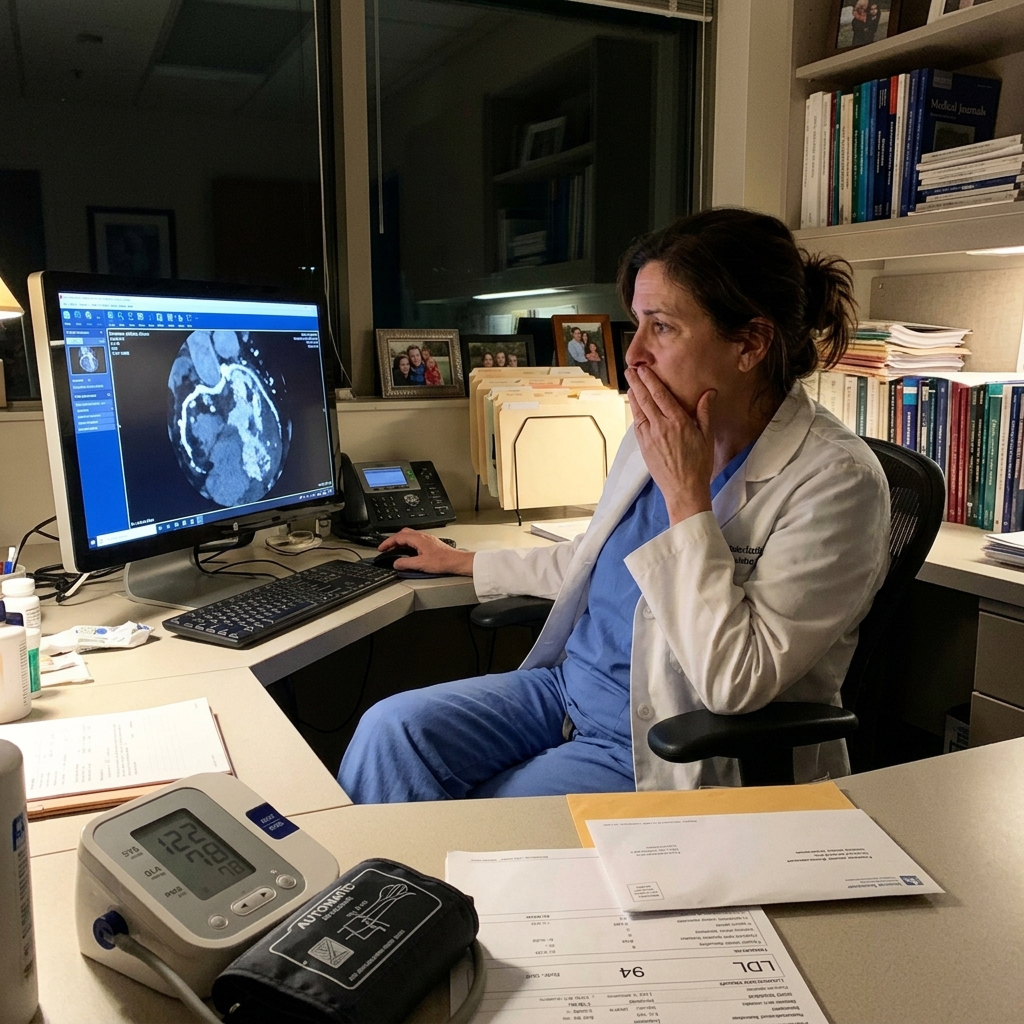
I don't give a f*ck if this upsets you. I am going to say something that nobody managing their blood pressure and cholesterol wants to hear. I placed my 1,412th coronary stent on October 3rd, 2024. Sixteen days later, at 2:47 AM on October 19th, I was on the receiving end of one. I was 58 years old. Twenty-two years of practice as a board-certified interventional cardiologist. Two stents were placed in my own left anterior descending artery by a fellow I had trained three years earlier. I coded on the table for eleven seconds. The hospital bill was $71,000. Cardiac rehab was another $9,200. They will let me operate again. My hospital privileges are intact. But I will never place a stent again without remembering that I was on that same table with someone I had trained running a wire into my own artery because everything I was taught to prescribe, everything I had personally handed to a thousand patients, had not saved me. I am writing this because I know exactly what my colleagues will say when they see it. I do not care. If you are over 50 and you manage your blood pressure or your cholesterol with medication, or someone you love does, please read the entire thing. I know it is long. I know you are scrolling. I know you have things to do. Fifteen months ago I would have given anything for someone with my credentials to sit me down and tell me what I am about to tell you. Nobody did. I was diagnosed with high blood pressure and elevated cholesterol six years ago at 52. BP 148 over 92. LDL 162. The diagnosis surprised me, and it did not. My father had died of a myocardial infarction at 64. He was managed on a blood pressure pill and a statin for eleven years, every reading dutifully logged as controlled. My mother's cholesterol was borderline for a decade before she passed, never urgent enough to escalate. I had watched the pattern in my own family for years and I had built my entire practice on treating cardiac events in patients who looked exactly like my father. I did what any cardiologist would prescribe. I started a blood pressure medication at diagnosis. My internist, a colleague at my own hospital, added a statin the following year when my LDL climbed further. Two medications. Both medications I had personally prescribed to hundreds of my own patients. I walked four miles a day. I stopped drinking. I lost 18 pounds in the first year of the diagnosis and kept it off. I ate the Mediterranean protocol I recommend to every patient after a stent placement. Lean protein. Olive oil. Leafy greens. Minimal refined carbohydrates. I ordered a coronary calcium scan on myself the year I was diagnosed. Score of 12. I checked every box on my own protocol. By last September, my blood pressure was 122 over 78. My LDL was 94. By the standard of the guidelines I had helped write for our hospital's cardiology group, I was managed. Managed. That word again. I ordered a second coronary calcium scan on myself last September, six years after the first one. I did it because a hunch would not leave me alone. The number came back at 847. For context, I have called patients over the phone with scores half that size and used the sentence, we need to talk today, not tomorrow. I called my interventionalist partner and asked her to do a stress test on me. She did. It was equivocal. She recommended a CT angiogram to be safe. I scheduled it. And then I did not go. I want to tell you why. Because sitting in my office at 6 PM staring at my own calcium score on my own screen, I recognized something I did not want to recognize. I was doing exactly what my father had done. He had been managed for eleven years before the heart attack that killed him. He had been on a blood pressure pill and a statin, dutifully, faithfully, every single day. His numbers had read fine at every visit. His numbers had been controlled right up until they weren't. And he had died at 64 in the emergency room of the hospital where I did my cardiology fellowship. I did not go to my own CT angiogram because I already knew what it would show. I did not want to see it in writing. I told myself I had time. Twenty-four days later, I woke my husband at 2 AM. The pain started in my chest at 1:52 AM. I remember the time because I looked at my bedside clock and thought, this is not indigestion. It was not. It was the pressure I had described to a thousand patients in follow-up appointments. Central. Substernal. Radiating into my left jaw. My husband, an oral surgeon, sat up before I could finish the sentence. He is not a cardiac clinician, but he has heard me describe this exact presentation at our dinner table for twenty years. He drove me. We went to a competing hospital, not my own. Because I did not want the fellows I had trained to see me on that gurney. They saw me anyway. The interventionalist on call was a woman I had trained through her fellowship in 2021. She walked into the room, saw me on the gurney, and her face did the thing. She said my name. I need a cath, I told her. LAD occlusion. Ninety-five percent or better. Get me in the lab. Yes, ma'am, she said. They wheeled me down the corridor I had walked down thousands of times going the other direction. I looked at the ceiling tiles and counted them because I did not want to look at the fellow who was about to run a wire into my heart. I coded on the table forty seconds after they got me on it. My fellow later told me my rhythm went into ventricular fibrillation, then flatlined for eleven seconds before they shocked me back. Two stents in the left anterior descending. Both in the same twenty-minute window I had done for other patients four hundred times. I was in the ICU for three days. Cardiac step-down for four. I came home on October 26th with my husband, a cane, two stents in my chest, and a shopping bag of prescriptions I had personally recommended to hundreds of patients over twenty-two years. I did not want the full workup my colleagues were suggesting. I ran it on myself anyway. Because I knew that if I did not, in eighteen months I would be reading somebody else's report from an outside institution and seeing my own name on it. The nephrology consult was with a colleague I had trained with in residency. She pulled my last four creatinine readings up on her screen. They had been climbing quietly for three years. My eGFR was 71 and had been 89 four years earlier. She used the phrase, early vascular nephropathy. Nobody had flagged it because my numbers had read managed and a creatinine of 1.1 does not trigger a nephrology referral in the standard-of-care algorithm I had signed off on for our hospital. The carotid ultrasound found measurable thickening in both arteries feeding my brain. My imaging tech had run the same scan on me two years earlier and it had been unremarkable then. Two years. That fast. The vascular consult ordered ankle-brachial index testing. Mild circulation deficit in both legs, worse on the left. I had blamed my cold feet on age for three winters running. The retinal specialist found small changes in the vessels of both my eyes, consistent with years of pressure the number on my chart had never once suggested was a problem. Every one of my vascular beds was showing the pattern I had watched in hundreds of my own patients after a first cardiac event. Same disease. Same trapped fibrin. Damage in my brain's vessels. Damage in my legs. Damage in my eyes. And finally, damage in my heart. I sat in my office on November 8th with all four reports in front of me, and I understood something I had never let myself understand before. Every drug in my medication cascade had been treating a downstream measurement. The blood pressure medication was treating my pressure reading. The statin was treating my LDL. Not one of them had touched what was doing this to four vascular beds at once. I am a cardiologist. I am supposed to be the person who knows how to prevent this. I had prescribed the exact two-drug protocol I was on to a thousand patients who looked like my father. Every one of those prescriptions had passed peer review. Every one had followed the guidelines. Every one had been the correct standard of care. And it had failed me at 58. I sat at my desk that night at 11 PM after my husband had gone to bed and I did something I had not done since medical school. I opened PubMed, and I searched for the actual mechanism. Not the management guidelines, or the drug metabolism papers. The mechanism. I read for four hours. I found what my training had covered lightly and never in the depth it deserved. Endothelial fibrin deposition. Fibrinolytic system decline with age. LDL entrapment within the fibrin matrix. Vascular resistance driven by structural narrowing, not just vasoconstriction. The mechanistic explanation for why the two medications I had been prescribing for twenty-two years managed downstream measurements without addressing the single upstream failure driving both of them at once. None of this was hidden. It sat in journals I had had access to for twenty-two years. Circulation. Atherosclerosis. The New England Journal. I had read those journals every month. I had read them for the interventional trials. I had never read them for the mechanism papers because my training had told me the mechanism was managed and the treatment was to manage the downstream measurements. My training was wrong. I closed my laptop at 3 AM. I sat at my kitchen table. I could not sleep. I understood at that moment that I had prescribed the exact protocol that failed me to hundreds of other people. And every one of them was walking around with the same trapped fibrin grinding through their vessels, waiting for their October 19th to arrive. Two weeks later, I saw a patient in follow-up who should not have been in the numbers she was in. Her name was Elena. Managed on both a blood pressure medication and a statin for twelve years. She had been my patient for three years after transferring to me following a stent placement. Her blood pressure at intake three years earlier had been 152 over 94. I pulled her chart before she came in, expecting to add another medication. Her blood pressure was 116 over 74. Her LDL was 79. She had come off her blood pressure medication twenty months earlier at her own insistence, and her numbers had not moved back up. I looked at her across the exam room and asked her what she was doing. She was quiet for a moment. Then she said, Doctor, my neighbor Ruth has been telling all of us for years. I did not bring it up because I did not think you would take it seriously. I asked her what her neighbor had told her. She wrote a name and an address on the back of my prescription pad. Ruth Bellamy. A town I had never visited, an hour outside the city. A retired lab technician with a garden nobody in my field ever mentioned. I drove there the following Saturday. I did not tell my husband where I was going. I did not tell my practice partner. I did not tell anyone in my institution that a board-certified interventional cardiologist was driving an hour to meet a 74-year-old retired lab technician because everything I had been taught in twenty-two years of practice had not saved me. I pulled into the driveway of a small ranch house at 11:40 AM. She was on the porch, going through a small stack of supplement bottles at a folding table. Small woman. Thin. Late seventies. Gray hair pulled back, sharp eyes behind reading glasses. No swollen knuckles. No brace on her wrist. Just easy, steady work. I introduced myself. Not as a cardiologist. As Sandra. She looked up and asked me why I had come. I told her. I told her I was a cardiologist. Twenty-two years in practice. That I had my own heart attack five weeks earlier. That my two medications had not saved me. That four vascular beds in my body were showing the pattern I had watched in hundreds of my own patients. That one of my patients had told me about her. She listened. She did not interrupt. When I finished, she set the bottles down and said, Come inside, doctor. Her kitchen smelled like coffee. She poured me a cup without asking. She sat across from me and said, Your medications are fighting the wrong battle. You know this. That is why you are sitting at my kitchen table. I did know it. She said, Every drug you prescribed for yourself. Every drug you prescribed for your patients. All of them work on the number on the chart. That is all. The trapped fibrin underneath — the scaffolding still sitting in your vessels every heartbeat, every year — none of them touch it. I said, I understand the mechanism. I read the papers last week. She smiled. Then you understand it clinically. You do not yet understand it in your own body. She picked up two capsules from a bottle on the table. Then set them down side by side. She set them on the table in front of me. This one is your blood pressure number. This one is your cholesterol number. She tapped each one. Same trapped fibrin. Grinding through both. Every specialist has told you they are treating two different problems. It is one problem. You already know this. But you have been trained for twenty-two years to prescribe for each of them separately. I nodded. I could not speak. She said, The blood pressure medication quiets your pressure number. The statin quiets your LDL number. Two numbers on two different chart lines. Below both, the trapped fibrin has been sitting in your endothelium. Year after year. Every heartbeat. She leaned forward. The stents your fellow placed did not touch the fibrin scaffolding. They opened a channel through a wall that is still failing underneath. If the fibrin is not dissolved, you will be back in that cath lab within four years for another vessel. This is not opinion. This is the mechanism you already understand. I said, I know. She said, Now here is what nobody taught you in medical school. For over a thousand years, people in Japan have been eating something that does this. Fermented soybeans. I am seventy-four. I have never needed a second medication added. She stood. She walked to a cabinet. She pulled down an amber bottle. Inside were capsules of a fine tan powder. Nattokinase, she said. It only forms in soybeans, and only under very specific conditions. The beans are soaked until they hydrate, steamed until they're soft enough for bacteria to actually break down the protein, then fermented in a chamber held between 38 and 42 degrees for 24 hours. That's when the enzyme actually appears. Then it's aged in the refrigerator to finish. Skip any one of those steps and you don't get the enzyme at all. Not what most people are buying at the pharmacy. Most nattokinase on shelves is a fraction of the dose the research actually used, and much of what's left gets destroyed by heat before the capsule is ever sealed. She set the bottle down. The enzyme does one thing your body needs. It dissolves the fibrin scaffolding your training tells you is just background biology and always will be. Once the scaffolding dissolves, the LDL trapped inside it stops being held against the wall. The plaque loses the foundation it has been sitting on for years and starts to shrink. She held up the bottle. And because the same scaffolding is what's narrowing your vessels and forcing your heart to work harder against them, once it dissolves, the vessels open back up. The pressure your heart has to generate against a narrowed vessel drops. One mechanism. Two numbers. One fix. She looked at me. One enzyme. From one fermented food. It fixes what's actually narrowing the vessel and trapping the cholesterol, at the same time, instead of managing two numbers separately for the rest of your life. That is why the people in that village don't end up on my table like you did. I asked her if the dose mattered. She nodded. Sumi's original research from 1987 is what first identified the enzyme's fibrinolytic activity. A study in Hypertension Research in 2008 showed measurable blood pressure changes in supplemented subjects. A separate study in Nutrition Research in 2009 confirmed the cardiovascular effect independent of any other intervention. And the Takayama study — 29,000 participants — is the largest dataset showing the association holds at scale. Most brands sell 2,000 to 4,000 FU. Research shows that dose does close to nothing. The only dose shown to actually dissolve fibrin at a measurable level is 10,800 FU, nearly three times what's on most shelves. And even at that dose, if it's heat-processed the way most manufacturers do it, the enzyme is dead before it ever reaches you. The label says one number. What's actually left inside the capsule is a different number entirely. She paused. There is a company my daughter in Ohio told me about. They test every batch for actual enzyme activity, not just label claims. Low-temperature processed the entire way through so the enzyme survives. Third-party verified. She wrote a name on the back of a receipt and slid it across the table. Healthletic. I ordered three bottles from her kitchen table before I left. I drove an hour home. I did not tell my husband where I had been. The bottles arrived the following Wednesday. I took one capsule with my breakfast the next morning. Week one. My afternoon energy returned. I had been napping in my office between afternoon consults since the heart attack, telling myself it was normal recovery fatigue. On day five, I read the medical journals I had let stack up for six weeks. I read all four in one sitting without dozing off once. I sat at my desk at 4 PM and I recognized, clearly, that I felt awake for the first time in five weeks. Week two. The mild pressure I sometimes felt across my chest, the kind I had assumed was residual scarring, began to quiet. I had been sleeping propped up on two pillows since the heart attack because lying flat felt tight. That week I slept flat for the first time. Week three. I ran a home BP cuff twice a day. My readings had been sitting at 132 over 82 since discharge. That week they moved to 118 over 74. I had not changed a single medication. Week four. I ordered my own lipid panel through my hospital's outpatient lab. LDL 68. Down significantly from my discharge labs. I ran the panel twice because I did not believe it. Both runs matched. Week six. I ran a carotid ultrasound follow-up. The thickening my imaging tech had flagged had measurably improved. Week eight. Ankle-brachial index retested. The mild circulation deficit in both legs had resolved. Week twelve. Full panel plus carotid imaging plus renal. LDL 61. Blood pressure 112 over 70. Carotid thickness back within normal limits. Creatinine back to 0.9. eGFR climbed from 71 to 84. Retinal changes stable, no further progression. Blood pressure sitting at 112 over 70 without any change to my medication. I called my nephrologist colleague back and asked her to repeat the renal panel. She did. Same numbers. I sat in my office at 6 PM staring at my own labs on my screen and I understood that I was looking at something I had not seen in a cardiology chart in twenty-two years. I brought the labs to my practice partner. Another interventional cardiologist. Fifteen years of practice. Someone I had trained. I put the discharge panel next to the twelve-week panel on her desk and I did not say anything. She read them. She looked at me. Sandra. What did you do? I told her. The retired lab technician. The kitchen table. The one enzyme. The trapped fibrin. All of it. She listened for forty minutes without interrupting. When I finished, she was quiet for a long time. Then she said, I have not been trained on this. But I want to see this in my own patients. Tell me the name of the product. I gave it to her. She has been running it with fourteen of her post-stent patients for the last three months. She called me last week. Nine of them have had their blood pressure and LDL both come down together. Three have reduced their blood pressure medication at their internists' recommendation. I am still on the two stents. I am still on my blood pressure medication at a reduced dose. My statin was discontinued at week fourteen by my internist. I climbed a full flight of stairs with my husband last week without stopping to catch my breath. My blood pressure the following morning was 110 over 70. My last LDL two weeks ago was 58. I came within eleven seconds on the table of dying at 58. I am writing this because I still have my practice. I still have my husband. And I have watched every complication in my body improve, one system at a time, in an order I could track on a spreadsheet. I have watched a colleague I trained look at my labs and say the word I had waited eleven months to hear. Improving. Not managed. Improving. I am also writing this because I know the truth about what my profession is doing, and I have known it for months now and said nothing. I did not sit at that woman's kitchen table because I wanted to. I sat there because everything my medical school and my board certification and my twenty-two years of practice had taught me about how to treat this had failed me. I placed 1,412 stents before I placed one in myself. Every one of those stents was in a person walking the same trajectory I was walking, on paper, on the exact same chart lines I was on. Every one of them left my cath lab with the same two-drug protocol I was on. Every single one of them was told, at every follow-up, that they were managed. I do not know how many of them are already back. I do not know how many of them are already gone. I know that the standard of care my hospital taught me was built on the assumption that managing two downstream numbers with two separate medications was equivalent to addressing the mechanism driving both. It is not. I have four vascular beds' worth of scan reports in my own body that prove it is not. And my father's history proves it was not for him either. If your husband, your father, your brother, your mother, or you manage blood pressure and cholesterol with medication and you have been told your numbers are managed while your body is quietly falling apart, please listen to what I am telling you. The trapped fibrin is what is doing the damage. Not the number on the chart. The blood pressure medication lowers the number. It does not dissolve the scaffolding. It does not free the vessel underneath it. It does not repair the damage the trapped fibrin has already done to your brain's vessels, your legs, your eyes, and your heart. The statin lowers the number. Same idea. Different lever. Neither one touches the scaffolding. There is one thing I know of that dissolves the scaffolding and fixes both numbers at once. Nattokinase, at the right dose, processed the right way. Together with your existing medications, at the right dose, in the right form, it repairs what my two prescriptions never touched. https://healthletic.io/products/nattokinase 10,800 FU per dose, verified for actual enzyme activity, not just label claims. Low-temperature processed so it actually survives. Third-party tested. One capsule every morning with breakfast. That is the whole protocol. 60-day money-back guarantee. If your numbers do not move, you pay nothing. The system that trained me did not give this to me when I needed it. It is reaching you now. https://healthletic.io/products/nattokinase P.S. My father was managed on a blood pressure pill and a statin for eleven years before he died in the emergency room at 64, alone, because my mother had gone home to sleep an hour earlier at his own insistence. My mother's cholesterol was borderline for a decade before she passed. I built my entire cardiology practice on the assumption that I would prevent for my patients what I could not prevent for my father. Instead, I have watched myself walk the exact same trajectory in my own body, decades later, in a hospital I helped build a reputation for. The difference is that I got the eleven-second warning my father did not get. Please do not let your family's warning be shorter than mine was. P.P.S. I do not work for Healthletic. I do not receive a penny from this, and I want that stated plainly before anyone assumes otherwise. I am writing this at 11:20 PM on a Sunday, alone in my office, because a patient came in Friday whose LDL and blood pressure had both come down together, unmistakably, and I recognized my own numbers sitting right there on her chart. She had found Healthletic on her own after reading a post from a woman named Carolyn about her husband Robert. She told me the post had been circulating quietly among people managing both conditions in her book club for months before she ever mentioned it to me. I read it that night, twice. It was the second time in six months I had recognized my own patient in a story written by a complete stranger. Please share this with anyone you love who manages blood pressure or cholesterol with medication. Even a little. Even borderline. Even if they think they are managed. I promise you they are not. Dr. Sandra Keller, MD, FACC, age 60, interventional cardiology
Managed numbers. Then a stent at 58.
Clinical-grade 10,800 FU nattokinase formula proven in studies on 30,000+ people
LEARN MORELike this ad? Make it yours.
Crush rebuilds this exact creative around your product — your brand, your colors, your offer — in about a minute.