Zoomies
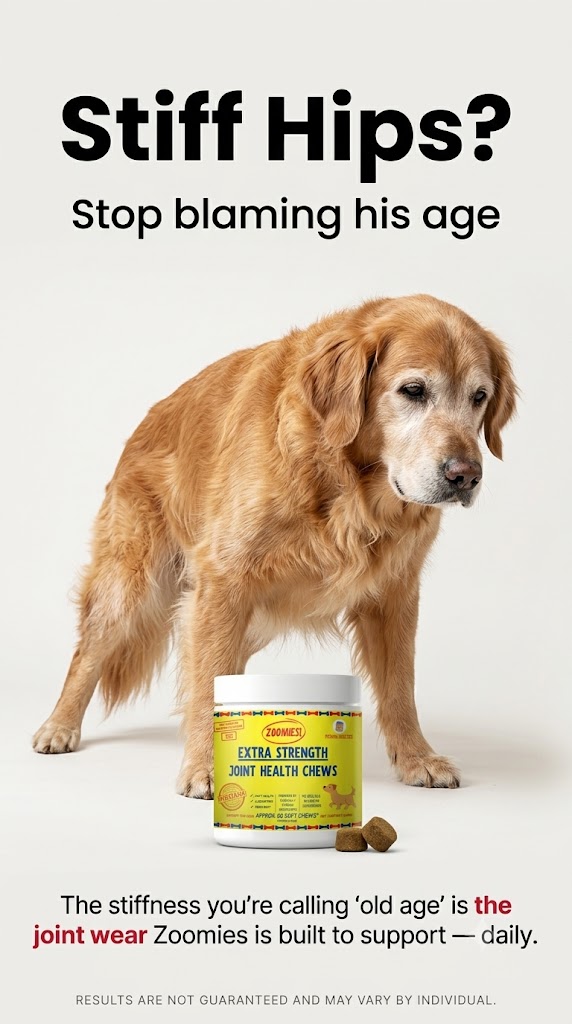
Zoomies Facebook ad: “It’s The Knee, Not The Hips”
Ran for 12 days, from August 25 to September 6, 2026, the last day Crush saw it.
Run by Zoomies on Facebook. Crush is not the advertiser and does not verify its claims. See this ad in Meta's Ad Library(opens in a new tab)
Want an ad like this for your product?
Crush makes new ad images for your product from this ad: your logo, your product photo, your offer.
Trials from $19.95 USD, then $79.95 USD a month. Cancel anytime.
About this ad
- Meta Ad Library ID
- 2180241512707762
- Platforms
- Relaunches
- 3
Ad text
You can't out-wait a Newfoundland's knees. You can't walk it off, you can't feed it off, and you can't glucosamine it off. I used to ask every new Newfoundland owner who came to me the same question. "When did he start sitting with one back leg kicked out to the side? When did he stop taking the stairs at a trot? When did he start doing that little skip-hitch on the back end coming out of a down?" After nineteen years and a few hundred of these dogs, the answer never changed. It was always earlier than they thought. It was always waved off as "he's a giant breed, they're just like that." It was always somebody who'd been told the sign didn't matter. The dogs who end up in real trouble young aren't the ones whose owners ignored the warning signs. They're the ones whose owners were told the warning signs were normal for the breed. I need to tell you something I've been carrying for years, and I'm telling you now because last month I watched my own four-year-old do the exact thing I've spent nineteen years telling other people to watch for, and I refuse to let my own dog be the cautionary tale I use on everybody else. My name is Sandra. I've coordinated Newfoundland rescue and breed health in the upper Midwest for nineteen years. I am not a veterinarian and I have never pretended to be. I'm the person who's had a few hundred of these enormous, ridiculous, water-loving dogs come through my hands, and who has watched what happens to their joints over a lifetime, up close, more times than any one vet in general practice ever will. Let me tell you what most Newfoundland owners are never told clearly enough about the way their dog sits, and the way he rises, and the little hitch in the back end. They are not just "big-dog things." They are not bad luck. They are not "what the breed is." They are evidence. Here is the specific, published, verifiable thing that almost nobody puts in front of a new Newfoundland owner. Everybody assumes a giant breed's joint problem is the hips. So everybody watches the hips. And in the Newfoundland, the single best-documented joint problem in the entire breed is not the hips. It's the knee. Specifically the cranial cruciate ligament — the same ligament an athlete blows out and calls an ACL. In 2006, Wilke and colleagues published a study in the Journal of the American Veterinary Medical Association, volume 228, pages 61 to 64, on cranial cruciate ligament rupture in Newfoundlands. In the population they studied, the prevalence was about twenty-two percent. Roughly one in five dogs. They calculated that genetics accounted for about twenty-seven percent of whether a given dog developed it — meaning it runs in the lines, it is heritable, it is not random bad luck. And the median age at diagnosis was just over four years old. Four. Not twelve. Not "an old-dog problem." The middle of a Newfoundland's life, when everybody's still calling him a young dog. I want to be careful and honest about what those numbers are and aren't, because I've watched people misuse breed statistics my whole career. That twenty-two percent is the prevalence in one studied population — it is not a prophecy that your specific dog has a one-in-five ticking clock, and plenty of Newfoundlands never have a knee problem at all. Twenty-seven percent heritability is a population figure, not a fortune told about your individual dog. And a cranial cruciate ligament sits alongside the general large-breed truth that these dogs carry real joint load — the cruciate is the best-documented, not the only, thing that can go wrong. What the research does say, cleanly, is that in this breed the knee is the joint with the genetics behind it, it tends to show up in middle age, and it is the thing that gets filed under "he's a giant breed" and never looked at. Because here's what happens. The dog starts sitting sloppy — one back leg out to the side instead of tucked under. He starts rising front-end-first, hauling the back end up after. He does a little skip on the back leg. And the owner, who has been told a hundred times that giant breeds are "just slow" and "just heavy" and "just like that," files it under the breed and waits. I have watched an owner show me a four-year-old sitting with his leg kicked out and say "oh, he's always been lazy about his sit." I've watched an owner describe a dog who'd stopped jumping into the lake — a Newfoundland, who lives for water — and call it "he's just matured out of it." I've watched people spend two years and a lot of money on a joint chew while the actual thing quietly progressed underneath it. And you know what almost every one of them says when I ask how the dog got this far? "I did everything right. I kept him lean. I walked him. I've had him on a joint supplement since he was two." Every. Single. One. Last month I watched my own four-year-old, Bear, get up out of a down and do the skip. The little back-end hitch. And I felt my stomach drop, because I've been looking at that exact movement on other people's dogs for nineteen years. My vet — who is good, and thorough — watched him, felt the knee, and said, "It's subtle. Let's keep an eye on it." And I know what "let's keep an eye on it" turns into when nobody changes anything, because I've watched it turn into it a few hundred times. So I did what I've done my whole career when something doesn't sit right. I stopped panicking and I started reading. Late, at the kitchen table, the actual papers. And here is the part that made me put the mug down, after nineteen years of doing this. The tub I'd have reached for — the tub almost every Newfoundland owner reaches for — is built around the one ingredient the research has actually buried. In 2022 a systematic review and meta-analysis in the International Journal of Molecular Sciences, volume 23, issue 18, article 10384, pooled fifty-seven articles and seventy-two trials on glucosamine and chondroitin. The published words were "a very marked non-effect." Eighty-eight point nine percent of trials showed no effect. Zero percent showed an effect. The conclusion, in print: they "should no longer be recommended." The Merck Veterinary Manual — the reference book, not a brand — says the evidence "did not support the use of" them. Zero percent. And it's the first ingredient in nearly every joint tub in America, including the one I used to hand new owners like it was part of the adoption paperwork. Now, here is why the standard tub fails even when the dog genuinely needs joint support, and it's the same three mistakes over and over. It uses the wrong lead ingredient. Glucosamine is first because it's cheap and it's been the front of the bag for thirty years, not because it works. Seventy-two trials say so. It hides the dose. Most tubs print "proprietary blend" and a single total, so you never learn how many milligrams of the good ingredient are actually in there. You print the numbers when the numbers are worth printing. You hide them when they're not. And it's aimed at the wrong clock — or no clock at all. Because there isn't one thing going on in an aging joint. There are three. The inflammation, the day-to-day ache, runs in days. The cartilage, the cushion in the gap, runs in weeks. The joint fluid, what makes the whole thing glide, is slowest of all. Three problems, three clocks, and a glucosamine tub is aimed at none of them. None of that is your fault. Nobody hands you the meta-analysis with the puppy. The pipeline that puts a cheap ingredient on the front of a bag and keeps it there for thirty years runs on habit and margin, not on evidence. You did everything you were told. You were just told the wrong things by people who were also told the wrong things. So here's what I went looking for instead, once I knew what mattered: No glucosamine and no chondroitin. Not less — none. If they're on the label, the tub was built around the failed ingredient. Something for each of the three clocks. Every dose printed on the panel in milligrams. No proprietary blend. And something underneath it for absorption, because an ingredient the dog doesn't absorb isn't in the dog, it's in the chew. Almost nothing on the shelf survives that list. One thing did. Zoomies Extra Strength Joint Chews. Twelve active ingredients, every dose printed. MSM at 200 mg and Boswellia at 100 mg for the fast, inflammatory clock — days. Eggshell membrane at 125 mg, collagen at 200 mg, omega-3s at 150 mg for the cartilage and connective tissue — weeks. Hyaluronic acid at 25 mg — a compound naturally present in healthy joint fluid — for the slowest clock. Micronized PEA at 30 mg on the discomfort signalling. Bovine plasma at 150 mg underneath it all, for absorption. Plus L-carnitine, taurine, reishi and vitamin E. No proprietary blend. No hidden numbers. No glucosamine. No chondroitin. None. Then the base — the part I'd never read aloud off any tub in nineteen years. Rice, tapioca and chickpea flour, pumpkin, coconut glycerin, coconut oil, peanut butter, sorbic acid. No seed oils — the binder is coconut, not palm or canola, which you can check on your own tub in ten seconds. No corn, no wheat, no soy, nothing artificial. Made AND sourced in the United States — not "made in the USA with globally sourced ingredients," which is the small print on most of the shelf. And the evidence, straight, with its limits, because I'm not going to do to you what that tub does to everybody. There's a randomized, double-blind, placebo-controlled trial on eggshell membrane in dogs — Ruff and colleagues, 2016, Veterinary Medicine: Research and Reports, volume 7, pages 113 to 121. Eight clinics, fifty-one dogs, six milligrams per pound once a day. At one week, the dogs on it were in 19.4% less pain than placebo (P=0.010) and moving 20.5% better (P=0.028) — both cleared significance. At six weeks, vet-assessed pain 23.6% better, quality of life 26.8% better, and a cartilage-breakdown marker called CTX-II came in 47.9% better than placebo (P=0.018) — the authors called it a profound chondroprotective effect. That's less breakdown, not regrowth; I won't tell you it rebuilds cartilage, because the study didn't measure that. The limits: one trial, fifty-one dogs, and not every endpoint cleared — the vet-scored lameness numbers at six weeks didn't, so I don't quote those and neither should anyone. The ones I gave you did. And a 2024 meta-analysis in Nutrients pooled the eggshell-membrane trials and used the phrase "strong evidence supporting the efficacy." One meta-analysis says the thing in the standard tub is a marked non-effect that should no longer be recommended. Another says this has strong evidence behind it. Same category, opposite verdicts. Now — before I tell you what happened with Bear, I have to say the most important thing in this entire post, and it's the thing a company selling you a chew usually won't. If what your Newfoundland has is an actual cranial cruciate ligament rupture — a torn ligament — no chew on earth fixes that. Not this one, not any one. A torn cruciate is a structural, mechanical failure, and the honest answer to it is a veterinary exam and, very often, surgery. The national average for the most common repair, a TPLO, runs around $3,525 per knee, per CareCredit's figures, and there is no soft chew that substitutes for it. So if your dog is suddenly holding a back leg up, if he's toe-touching lame, if the knee looks swollen, if he yelped and quit on a leg — that is a see-your-vet-now situation, not a supplement one. And because it's a Newfoundland and the odds on that knee are what they are, I would go sooner, not later. What a joint chew is honestly for is the day-to-day comfort and the osteoarthritis that comes with joint wear and that follows joint injury — the stiffness, the slow rise, the sore mornings. It is a comfort-and-mobility tool for the long grind, not a repair for a torn ligament. I want to be that clear, because the breed deserves it. Bear's, thank God, was the early, subtle, no-tear kind — I had him checked to be sure, and I'd tell you to do the same. Here's what happened once I got him off the failed ingredient and onto something aimed at the three clocks. Days one through five, nothing. Expected. Day six, he came up out of a down without the skip. Once. I made him do it again to be sure I hadn't imagined it. Week two, he was tucking the back leg under when he sat instead of kicking it out to the side. Week three, nothing new — which is exactly where people quit, so I didn't. The cartilage clock is four to six weeks out, so I'd bought the bulk option on purpose. Week five, he went back in the lake. A Newfoundland who'd started standing on the bank waded in to his chest and swam out to the dock and back, slow, and stood there dripping and pleased with himself, and I stood on the shore and did not hold it together. Month three, my vet re-checked the knee and asked what I'd changed. I told her all of it — twelve actives with the doses printed, no glucosamine, both meta-analyses, the trial in fifty-one dogs, the seven-day numbers and the endpoints that didn't clear. She asked for the citations. I sent them. She said keep doing it, and keep watching the knee, which I will, forever, because he's a Newfoundland. I've since put this in front of a lot of the owners in my breed network. The pattern is consistent and it is not a miracle. Most see something in two to four weeks; by week six to eight it's usually clear enough that somebody in the house comments. One woman's six-year-old stopped doing the sloppy sit. A man's dog started taking the deck stairs at a trot again. And — the honest one — a woman with an eleven-year-old told me flatly she saw nothing in three months and sent it back, got a full refund, no argument. That's what a ninety-day guarantee is for. If you've got a Newfoundland and you've been filing the sloppy sit, the front-end-first rise, the skip in the back end, or the day he stopped getting in the water under "he's a giant breed, they're just like that" — I want you to hear this from someone who's watched a few hundred of these dogs: don't file it. Get the knee looked at, because in this breed the knee is the joint with the genetics behind it and it shows up younger than anyone expects. And for the everyday comfort and the wear that comes with it, stop feeding the ingredient seventy-two trials buried. This is a supplement. It is not a drug. It does not cure anything, treat anything, or prevent anything, and it does nothing for a torn ligament. If your dog is on a prescription anti-inflammatory, don't change a thing about it because of a post — call your vet. The FDA's owner watch list for those drugs is worth knowing: vomiting, diarrhea, bloody or black stool, decreased appetite, decreased activity, yellowing of the whites of the eyes or the gums. Any of those, you call, today. 👉 Zoomies Extra Strength Joint Chews — [www.zoomiespethealth.com](http://www.zoomiespethealth.com) Twelve actives, every dose printed in milligrams. No proprietary blend. No glucosamine, no chondroitin, no seed oils, no corn, no wheat, no soy, nothing artificial. Made AND sourced in the United States. Ninety-day money-back guarantee, up to forty percent off on the bulk option — which is the one I'd take, because the cartilage clock is four to six weeks and one tub is exactly where people quit too early. You can't out-wait a Newfoundland's knees. But you can stop feeding the ingredient that does nothing, get the knee looked at while it's early, and give the rest of that enormous, water-logged, wonderful dog a formula that's actually aimed at the three things going wrong. Don't let "he's just a giant breed" be the sentence that costs your dog the lake. P.S. The Newfoundland's famous joint problem isn't the hips everybody watches — it's the knee, the cranial cruciate ligament, about a one-in-five prevalence in the studied population, roughly a quarter of it heritable, median age at diagnosis just over four years old (Wilke and colleagues, JAVMA, 2006). Four. If your dog is sitting with a leg kicked out or skipping on the back end, that's not him being lazy or "giant-breed slow." Get the knee checked, and read the doses on whatever you're feeding. 👉 [www.zoomiespethealth.com](http://www.zoomiespethealth.com) P.P.S. If it turns out to be an actual torn cruciate, no chew — this one included — is the answer; that's an exam and usually surgery, and I'd rather you spend nothing here and go straight to your vet. What the chew is for is the long grind of stiffness and wear around it. Two different jobs. Anybody who blurs them isn't being straight with you about your breed. 👉 [www.zoomiespethealth.com](http://www.zoomiespethealth.com)
Where the ad sends people
usa.zoomiespethealth.com
It’s The Knee, Not The Hips
“I trusted my vet for 4 years. We did Carprofen, then Adequan injections twice a week, then prednisone for the bad days. His pain was 'managed' the whole time. Then one morning he couldn't get up. The drugs never fixed anything — they just hid it while everything else fell apart.” — Robert T...
Learn more: usa.zoomiespethealth.com(opens in a new tab)