The Thyroid Journal
The Thyroid Journal Facebook ad: “The Truth About Levothyroxine & Weight Gain”

Ran for 4 days, from September 19 to September 22, 2026, the last day Crush saw it.
Run by The Thyroid Journal on Facebook. Crush is not the advertiser and does not verify its claims. See this ad in Meta's Ad Library(opens in a new tab)
Want an ad like this for your product?
Crush makes new ad images for your product from this ad: your logo, your product photo, your offer.
Trials from $19.95 USD, then $79.95 USD a month. Cancel anytime.
About this ad
- Meta Ad Library ID
- 2280080792831792
- Platforms
- Facebook, Instagram, Audience Network, WhatsApp and Threads
- Relaunches
- 0
Ad text
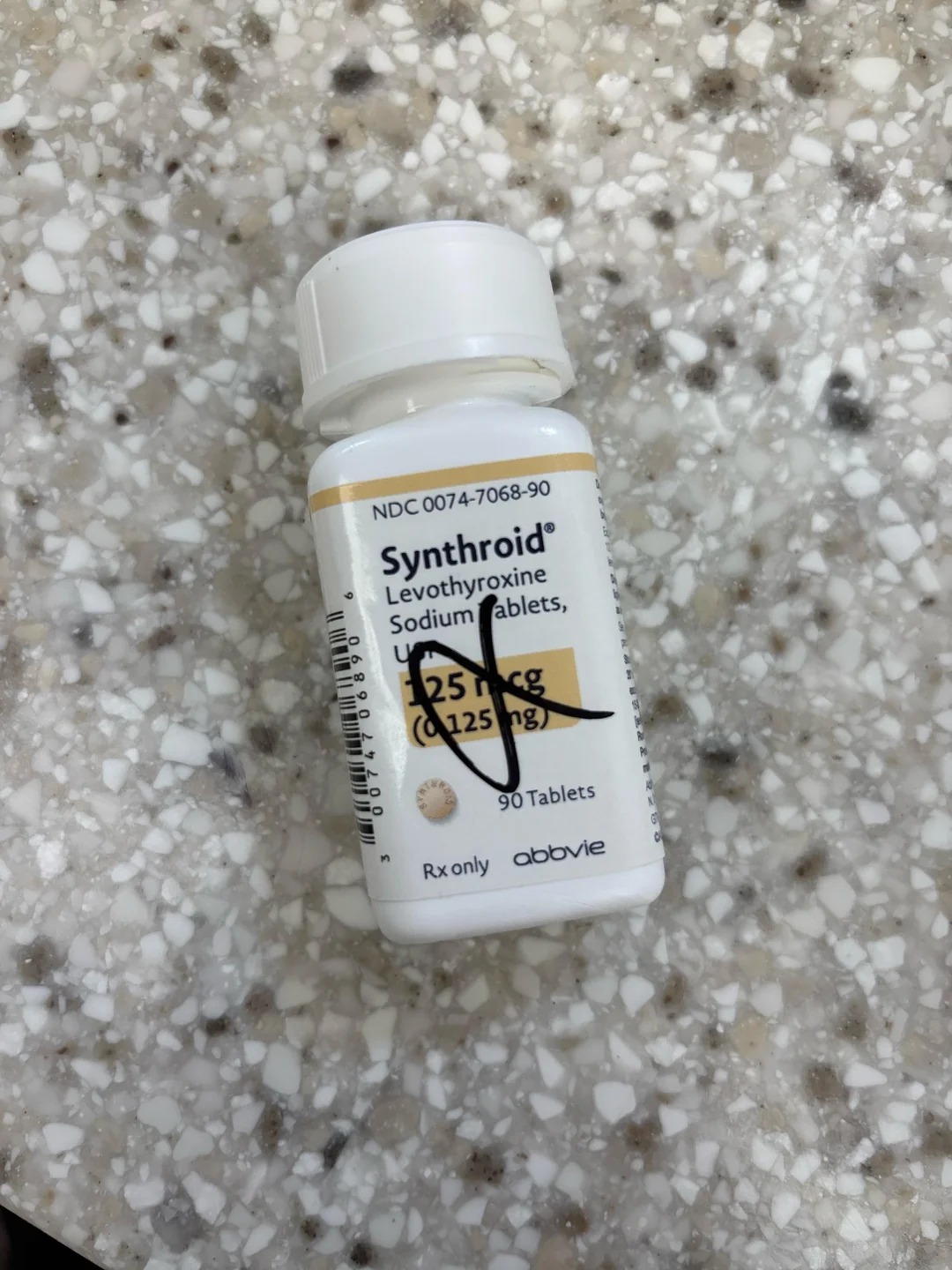
I have read too many post-mortem reports to not share this with you. If you are on levothyroxine, I need to tell you something your GP is not seeing. I have reviewed more than 5,000 cardiac cases in nineteen years as a cardiologist. I have stood over the ones who did not make it and traced backwards through their notes, and I have watched the same story write itself again and again, under different women's names. When a woman goes into her surgery for her annual thyroid check, holds out her arm for the blood test, and walks out being told she is well controlled, I already know what her scans will show five to ten years before she ever feels the first flutter in her chest. Her heart is starving. The same problem causing her weight gain and her afternoon exhaustion is silently, quietly weakening her heart muscle right now, while she is being told everything is fine. I am Dr Ruth Ellery. Cardiologist. Nineteen years. When I was diagnosed with an underactive thyroid at 47, sitting in a paper gown in a colleague's clinic, I already knew something GPs almost never tell their patients. I knew it because I had spent two decades watching where it ends. Your thyroid problem was never a thyroid problem. It is a whole-body problem. And your heart is on the list. Here is how the system is built to fail you. They test your TSH. They adjust your tablet if the number drifts. They send you home with a review in six months. That is the protocol. That is the whole protocol. They do not see you five to ten years later, lying on a table with a line running into your wrist and a monitor showing me exactly how little is reaching your heart. But I do. I see the ending they never watch. Let me tell you about two of them. The first was 54. She had been on levothyroxine for fourteen years. Her TSH was always 2.1, textbook, and her GP was pleased with her at every single appointment, the way you are pleased with a pupil who always hands her homework in on time. She came to me last spring because she had got out of breath on the stairs at her own grandson's birthday party. She had had to stop on the landing, one hand on the bannister, and wave everybody on ahead of her while she got her breath back, and she had laughed it off, and then she had lain awake that night frightened. Her echo showed changes to her heart muscle I would not expect in a woman of 54. I ordered a free T3. The test her GP had never once run in fourteen years, because in this country we almost never run it. It came back at the very bottom of the range. Her heart had been starving for the active hormone for years while a number on a different test told everybody she was fine. The second was 49. "My numbers are perfect, doctor," she told me, almost proud of it, the first time she sat down across from me. Levothyroxine for nine years. She had come in because of a pressure in her chest she kept explaining away as stress. Her results were the kind I usually see in a woman twenty years older. And when I pulled her old bloods and did the arithmetic, her T3 had been sitting at the bottom of the range the entire nine years her TSH read fine. Nobody had ever run a T3. Not once. There was nothing in nine years of careful, well-meaning appointments that would have caught it. I see both of these women in follow-up now. They are alive. They are grateful. They tell me I saved them. But I know what they lost. They had years. Years to get the active hormone to their hearts. Years to walk a different road than the one that ends on my table. Their bodies had been screaming the warning the entire time, in the weight and the cold hands and the exhaustion, and the one test everybody trusted could not hear it, and a higher dose of the tablet could not fix it. I know all of this so precisely because my own bloods eventually told me the same story. It came on slowly, the way it always does. Two stone in two years without changing a thing about how I ate. Hands so cold I started keeping a second cardigan on the back of my office door in June. A fog that rolled in every day around three o'clock that I kept calling long days, because I was a consultant and I did not have time to be a patient. My resting pulse creeping up, a beat or two a month, until one afternoon I looked at my own monitor and did not recognise the number. I went back to my GP, like you are supposed to. She looked at my file for maybe forty seconds. "Your TSH is in range. We can nudge your dose up and recheck you in eight weeks." And she was not wrong, exactly. The dose increase would have brought my TSH down. My number would have looked beautiful. That was the whole problem. That was never the point. So I did something most patients cannot do. I am a cardiologist. I ordered my own free T3, and I read it myself. Bottom of the range. Under the line I would have flagged in anybody else. A higher dose of levothyroxine would have raised the number my GP looks at and left my heart starving for the hormone it actually runs on. I would have felt reassured, right up until the day I did not. Here is what your GP does not tell you, because she genuinely does not see what I see. Your heart muscle runs on T3. Not T4. Levothyroxine is T4. T4 is the storage form. Your thyroid releases it. Your tablet replaces it. But before a single cell in your body can use it, that T4 has to be converted into T3. A large part of that conversion happens in your liver. And if the conversion is not happening, here is the cruel part: your blood still looks fine. Your TSH still looks fine. Your GP still tells you that you are well controlled, and means it. But your heart is going cold. For years. Sometimes decades. And here is what is actually switching that conversion off. Chronic stress keeps a hormone called cortisol raised. Not dramatically. Just constantly. The low, never-quite-switches-off kind that every woman holding down a job, a family and a condition that will not respond is living with every day. Constantly raised cortisol attacks that conversion in three places at once. One. It drives fat to settle around your liver. In fatty, inflamed tissue, the enzyme that turns your T4 into active T3 cannot do its job. So the hormone from your tablet sits in your blood, reads perfectly on a test, and arrives at your cells as a spare part nobody can fit. Two. It quietly turns down the signal from your brain that tells your thyroid how much to make. Often not enough to move your TSH out of normal. Enough to leave you short. Three. It floods your cells with something called reverse T3. A molecule shaped almost exactly like the active hormone. It sits in the same locks and turns none of them. A key that fits every door and opens not one. So there you are. Taking a tablet your stressed liver cannot fully convert. Running on slightly less hormone than your body needs, which no test ever flags. And what little active hormone you do make, blocked at the door by a decoy. Your bloods look perfect. Your cells are running on empty. You are not getting older. You are not just going through the menopause. You are not in need of a mindfulness app. Your cells are starving, and your heart muscle is quietly weakening, tonight, while you read this. And here is why you never feel it in time. Your soft tissues fail first, because they are forgiving. They complain. They puff and ache and drag. Your heart muscle is tougher. It absorbs the damage silently, for years, and by the time it finally breaks, the warning has been screaming into a room where nobody was listening. Women on thyroid tablets whose bloods read normal are seventeen times more likely to be taken by a heart attack before 70 than women the same age. Not twice. Not five times. Seventeen. Your thyroid was never just an inconvenience, never just the reason for the weight and the fatigue. It is an early warning. And a higher dose silences the alarm while the fire keeps burning. I did what patients do. I tried to fix it myself. A dose increase, twice. Each one gave me a fortnight of feeling slightly less awful, and then nothing, and my T3 stayed exactly where it was. Selenium. Two Brazil nuts a day, then the capsules, for six months. No change. A strict elimination diet for four months, gluten then dairy, until I was living on chicken and sweet potato. My antibodies dipped. My T3 did not move. Nothing was reversing the blockade. I could feel myself becoming the patient I had spent nineteen years watching arrive too late. But one thing kept nagging at me, some nights, on the drive home. A conversion like that does not switch itself off. Something switches it off. So what was switching off mine? The twelfth of March. Twenty to midnight. I remember the exact time because I was looking at the clock, wondering why I could not sleep, the exhaustion getting worse instead of better. I was propped up in bed with a stack of journals I had been meaning to get through, and I came across a review on stress hormones and thyroid conversion. In nineteen years, I had never once joined the two together. And here is the line that stopped me cold, that made me sit up in the dark. Rhodiola rosea is the main adaptogen approved by the European Medicines Agency's herbal committee, studied not for thyroids at all, but for one thing. Cortisol. Not another hormone to add. The thing that was blocking the hormone I already had. I sat there at twenty to midnight and the whole thing finally arranged itself into something I could see. Levothyroxine is the delivery. It arrives every morning, right on schedule. But it is like filling the tank every day while something pinches the fuel line shut. The gauge reads full. Your TSH reads the gauge. Your GP is pleased because the gauge reads full. And the engine starves. Rhodiola does not add fuel to a full tank. It works on the part of the brain that drives cortisol, and when cortisol settles, the liver can begin clearing the fat that was smothering the enzyme. The enzyme comes back online. The reverse T3 stops flooding the locks. And the T4 you have been swallowing every morning finally finishes the journey it was always meant to make. Not because the dose changed. Because the thing blocking it moved. I had been a cardiologist for nineteen years and I had never seen it laid out that simply. And I understood, sitting there, exactly why. GPs are not taught stress physiology in any depth. Cardiologists do not treat thyroids. There is no tablet to prescribe for it and no money anywhere in the system in telling a woman her stress hormones are blocking the medication she is already taking. There is money in a slightly higher dose each year. In the private clinic. In the next appointment. There is a gap between the two of us the size of an organ, and it is precisely in that gap that women like me are dying. At six minutes past midnight I ordered it. I did not wait until morning. But the plant is not the point. The specification is. The research that shows results uses rhodiola standardised to a precise ratio of its two active compounds, 3% rosavins and 1% salidroside. The tubs in the health shop just say rhodiola extract. No ratio. Ground-up plant at a dose too low to do anything. I started on the thirteenth of March. One capsule in the morning. The first fortnight, nothing. I want to be honest about that, because I had expected nothing and I very nearly stopped. The twenty-seventh of March. A fortnight in. The three o'clock fog thinned. Not gone. Thinner. Twice that week I got to five without hitting the wall, and I noticed it only afterwards, on the drive home. The tenth of April. Four weeks in. My hands were warm. My hands had been cold for two years and I had stopped noticing until suddenly they were not. I sat there actually testing it, pressing my fingers together, telling myself it was in my head. It was not. The twenty-fourth of April. Six weeks in. I was sleeping through most nights, and the afternoons had stopped being something I had to get through. That evening my husband looked at me across the kitchen table and said, "What's different?" I said, "Different approach." He said, "Whatever you're doing, keep doing it." By eight weeks the scale had moved for the first time in two years. Half a stone, slowly, on the same food. My resting pulse had come down from 86 to 79. Nothing dramatic. Nothing overnight. Just a body that had started doing something it had refused to do for two years. But feeling better was not enough for me. I wanted proof it was happening where I could not feel it. The fifth of June. Twelve weeks in. I ran my own free T3 again. It had come up into the healthy part of the range for the first time in two years. On exactly the same dose of levothyroxine I had been taking the whole time. Same tablet. Same dose. The block was gone. Not replaced. Unblocked. I printed both sets and walked them down the corridor to a colleague who has been reading this sort of thing as long as I have. She looked at the first set. Looked at me. Looked back at the second. "Ruth. Your TSH hasn't moved." "I know." "And your T3 has come up." She was quiet for a moment. Then she said, "I need to start running free T3 on every woman on levothyroxine who tells me she still feels awful. Not just the TSH." Now, I am not telling you any of this because I am against levothyroxine. I want to be very clear. It saves lives. It restores your T4. It works exactly as it was designed to work. But it does not unpinch the fuel line. It does not fix your conversion. It does not get the T3 to your heart muscle. It raises your storage hormone while your body quietly fails to use it. Keep taking it, every morning, at the dose your GP has set. Do not change your dose because of anything you have read here. Any change to your dose is a conversation with your GP. Full stop. And I am the one who sees what happens five to ten years later, when those women stop being thyroid patients and become my cardiac patients. Your thyroid is not failing you. It is warning you. The same blockade starving your tissues is starving your heart muscle right now. So you have two choices. You can mask the warning with a higher dose while your heart deteriorates behind a normal-looking number. Or you can unpinch the line. I think about what I almost did. I almost let a GP raise my dose every couple of years for the next two decades, watching my TSH stay beautiful while my heart went quiet. I almost became the woman on my own table, looking up at some cardiologist, wishing somebody had told me sooner that my thyroid meant something bigger than a tablet. Because once you need cardiac treatment, you are on medication for the rest of your life. Once you have had the heart attack, the damage to that muscle is permanent. And you do not get a second warning. Your thyroid is your first warning. It is the only one you can still act on. Every woman I meet with a thyroid history and a heart in trouble says the same sentence to me, almost word for word. "I wish someone had told me my thyroid was connected to my heart." I am telling you now. Unpinch the line. Save your metabolism. Save your heart. Or keep the TSH tidy and risk everything. Twelve weeks. That is all it took to bring my free T3 into the healthy range and turn round two years of drift. Twelve weeks of moving the block instead of raising the dose. And be patient with it, the way I very nearly was not. Nothing happened for a fortnight. The afternoons came back before anything else did. The bloods were the last thing to move, not the first. Your thyroid is giving you years of warning. Use them. Dr Ruth Ellery, Consultant Cardiologist, nineteen years https://rosewynhealth.com/pages/rhodiola-rosea P.S. The rhodiola I take is called Rosewyn. Standardised to 3% rosavins and 1% salidroside, which is the exact specification the research is built on, at a proper dose rather than a token sprinkle. There is black pepper extract in the same capsule, BioPerine, for one reason only: so the actives absorb instead of passing straight through you. A tub with the wrong ratio and nothing to carry it in is ground-up plant you excrete. One ingredient, every milligram on the label, no proprietary blend hiding how little you are actually getting. Third-party tested. Sixty days to send the tub back, empty, for a full refund, which is long enough to know whether your afternoons and your sleep have shifted, even if your bloods take a good deal longer. If you are on levothyroxine and you have not had a free T3 run in the last year, ask for one. Then give the block twelve weeks and ask again. You can always go back to waiting. But you cannot undo damage to a heart muscle that spent years trying to warn you while everybody read the gauge.
Where the ad sends people
rosewynhealth.com
The Truth About Levothyroxine & Weight Gain
Rosewyn
Learn more: rosewynhealth.com(opens in a new tab)