North Footwear
North Footwear Facebook ad: “The boot causes the blisters. The insoles treat the boot…”
Ran for 5 days, from September 30 to October 5, 2026, the last day Crush saw it.
Run by North Footwear on Facebook. Crush is not the advertiser and does not verify its claims. See this ad in Meta's Ad Library(opens in a new tab)
Want an ad like this for your product?
Crush makes new ad images for your product from this ad: your logo, your product photo, your offer.
Trials from $19.95 USD, then $79.95 USD a month. Cancel anytime.
About this ad
- Meta Ad Library ID
- 2320949005400476
- Platforms
- Facebook, Instagram, Audience Network and Threads
- Relaunches
- 0
- Niche
- Fashion & Apparel
Ad text
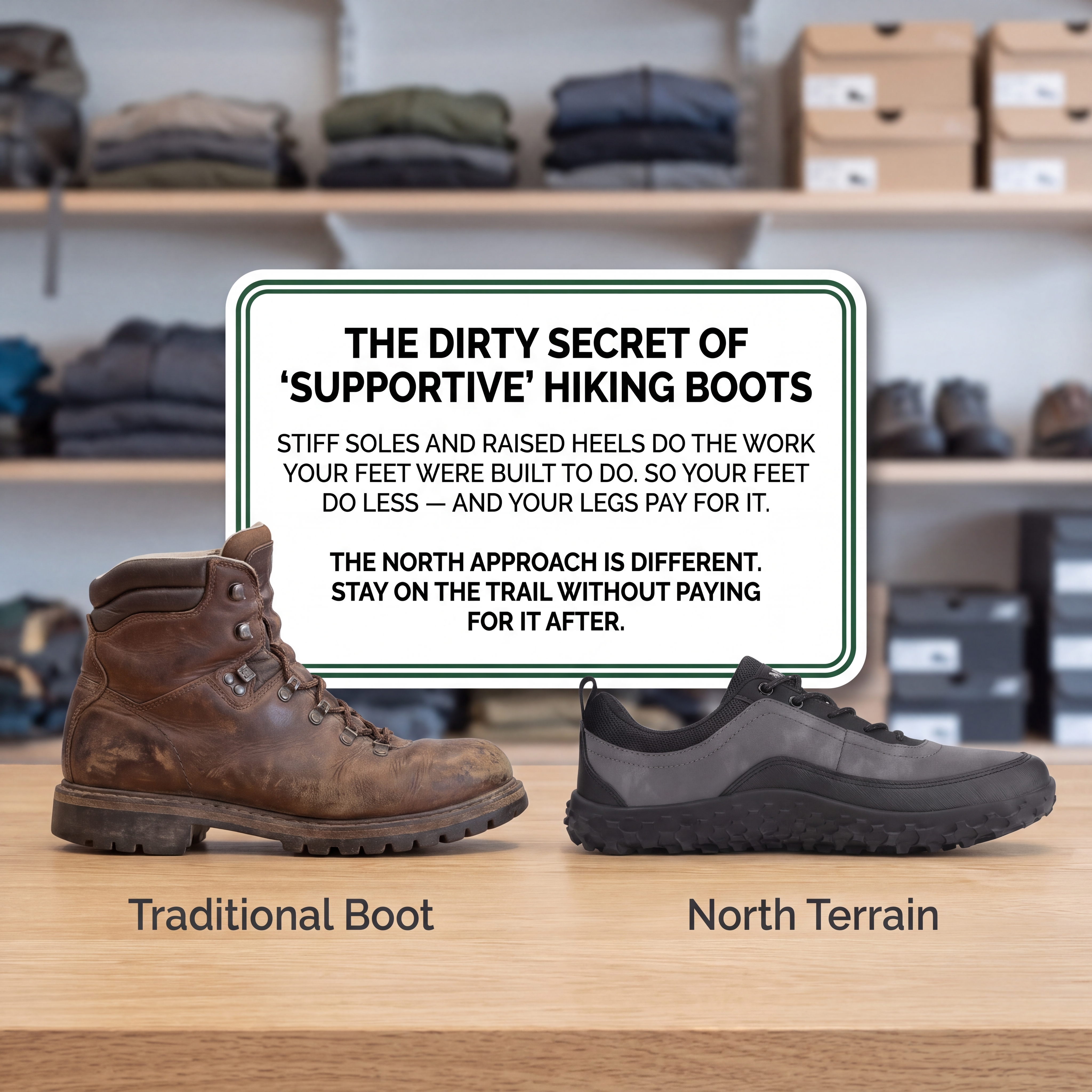
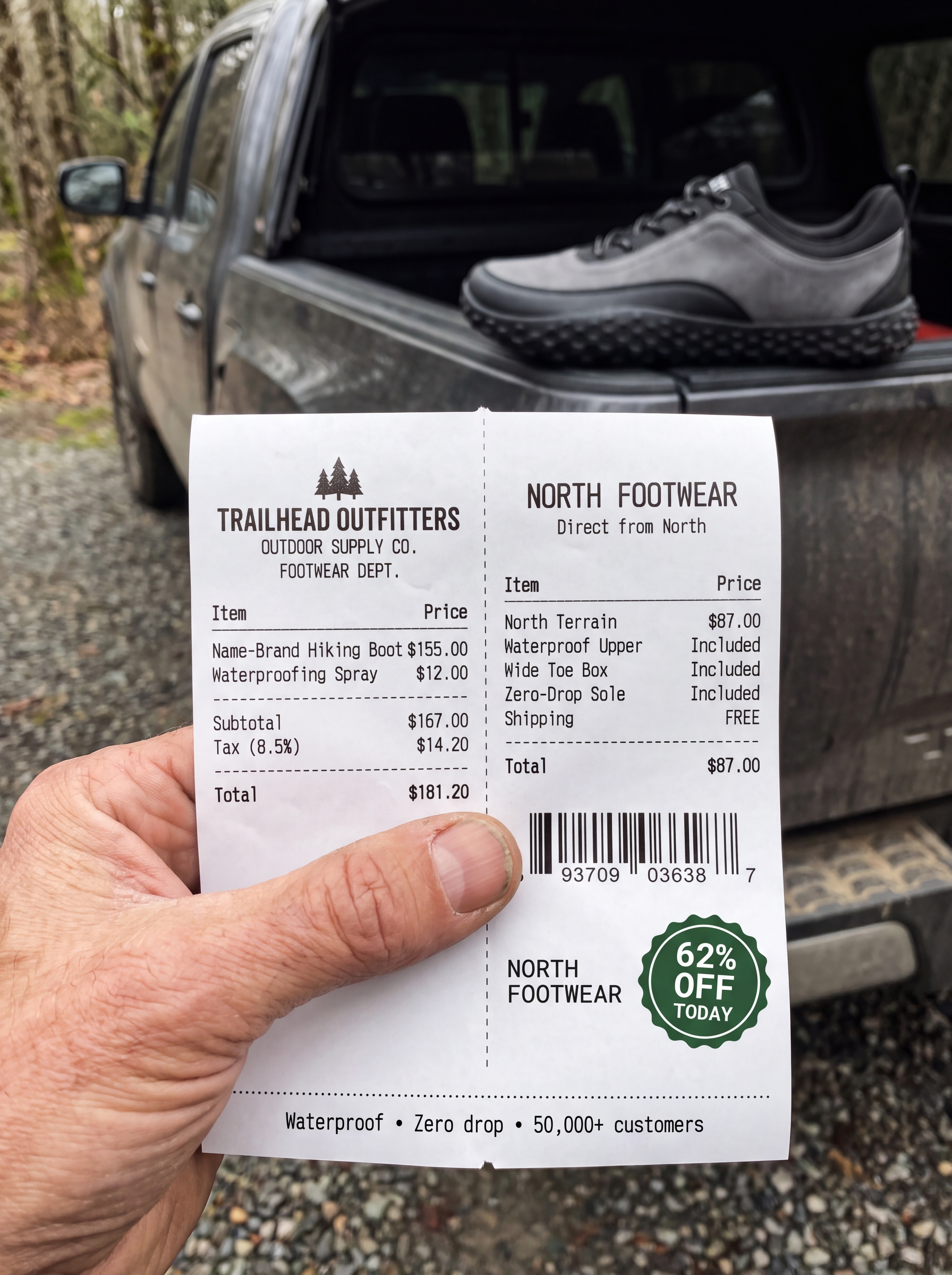
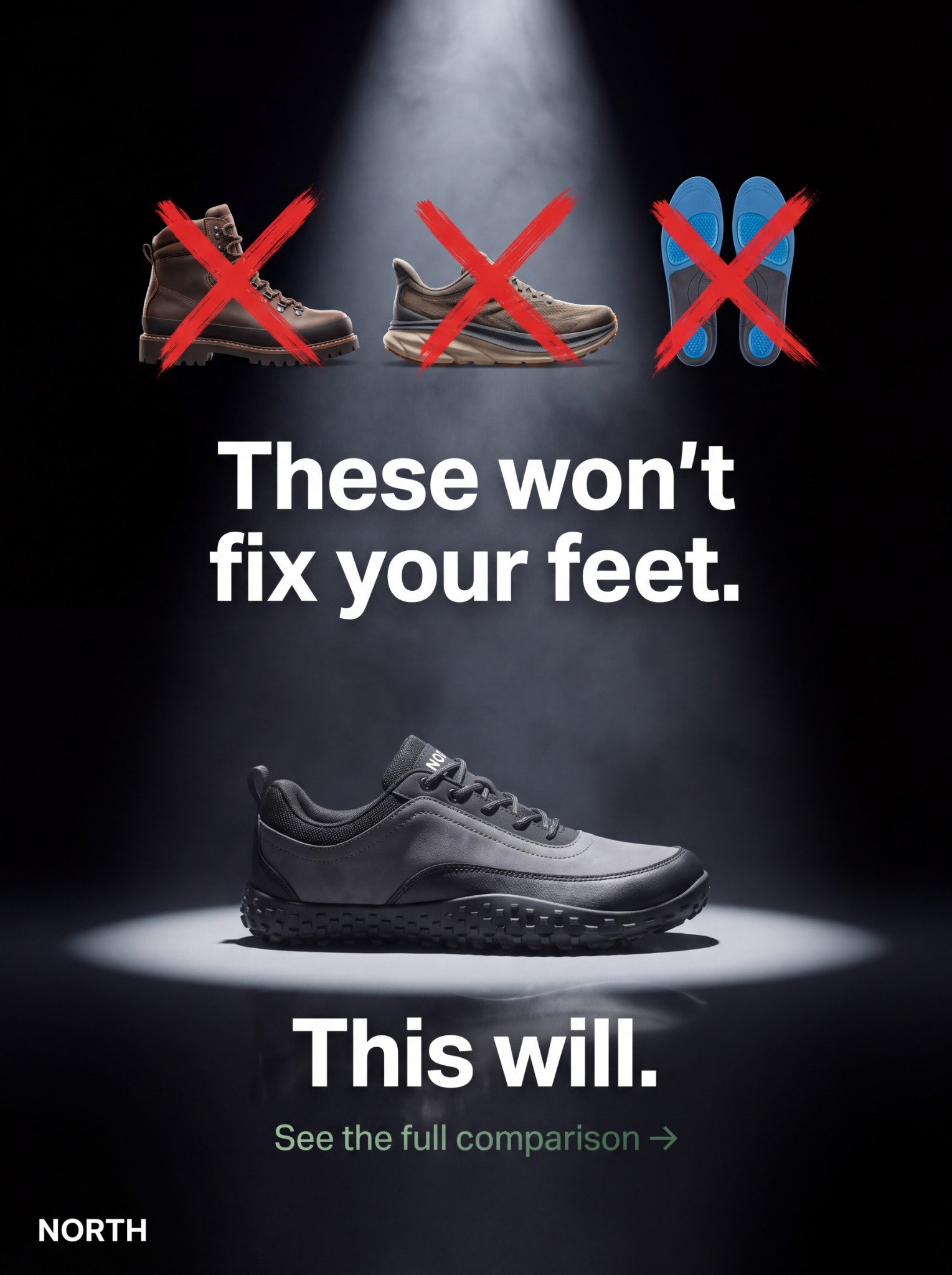
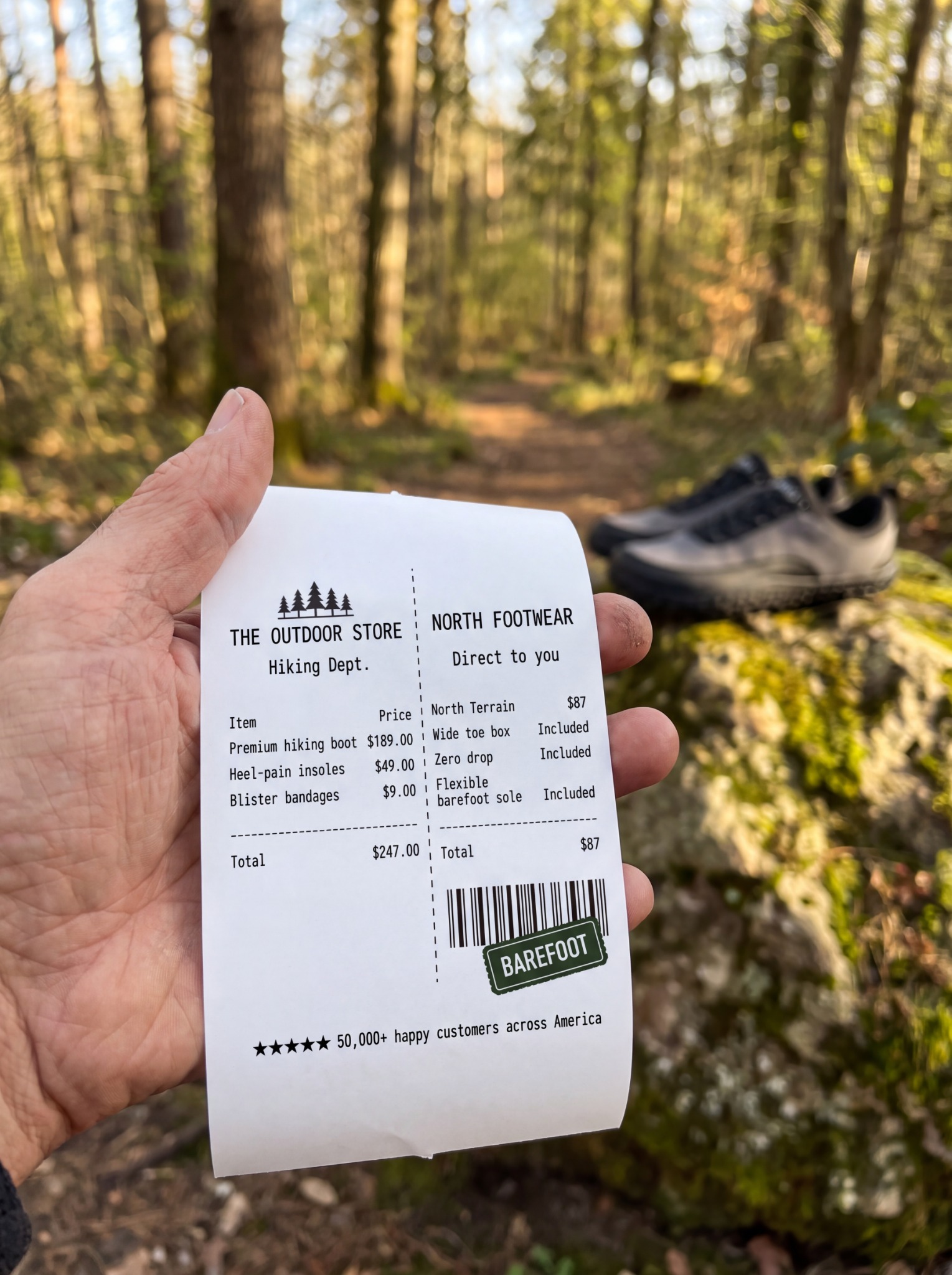
Look at the left-hand side of that receipt for a moment, because there's something odd about it that most people never notice. A premium hiking boot. A pair of heel-pain insoles. A packet of blister bandages. Three separate products, three separate prices, one transaction. But they aren't three products. They're one product and two consequences. Nobody walks into an outdoor shop intending to buy blister plasters. You buy them because the boot rubs. Nobody budgets for heel-pain insoles. You buy them because the boot hurts, or because someone behind the counter told you that a boot at that price deserves a proper footbed inside it. The boot creates the conditions. The other two items treat them. And you pay for all three at the same till, in the same minute, without anyone pointing out the relationship. That is worth sitting with, because it turns out the most expensive item on that list isn't the one with the largest number next to it. Start with the $49 line, because that's the one with a trial attached to it In 2006, a research team led by Karl Landorf at La Trobe University published a randomised controlled trial in Archives of Internal Medicine — now JAMA Internal Medicine, one of the most rigorously reviewed journals in clinical medicine. They recruited 135 people with chronic plantar heel pain. Precisely the complaint that sells insoles. They split them into three groups. The first received custom-made foot orthoses. The expensive kind, individually moulded, the sort a podiatrist prescribes. The second received prefabricated off-the-shelf orthoses. Roughly what's on that receipt. The third received a sham — a flat, soft insert with no arch support, no correction, no biomechanical function of any kind. A placebo in insole form. No participant knew which group they were in. At three months, the two genuine orthotic groups showed a small improvement in function over the sham. Modest, measurable, exactly as expected. Then the researchers kept following everyone for twelve full months. At twelve months, the difference had disappeared entirely. Custom orthotics, off-the-shelf orthotics, and a deliberately non-functional piece of foam produced statistically indistinguishable outcomes. In pain. In function. In everything measured. The paper has been cited hundreds of times. Systematic reviews since have reached broadly similar conclusions: the evidence that orthoses deliver lasting benefit over simple alternatives is weak. The $49 on that receipt buys you three months of feeling helped, and then nothing that a shaped piece of foam wouldn't have done. Now the $189 line, which is the one that actually matters The boot is sold on two things: support and protection. Both are worth examining, because the research on each points the opposite way from the marketing. Support first. The high, stiff collar is the single most repeated selling point in outdoor footwear. Hold the ankle rigid and it can't roll — it's intuitive, and it feels true when you lace it up. But reviews of ankle injury prevention have repeatedly failed to show that high-cut boots reliably reduce sprains compared with low-cut footwear. What the research does show consistently is something else: restricting the ankle joint measurably impairs proprioception. Proprioception is your body's position sense — how you know where your foot is without looking, how you correct a stumble before you consciously register it, how you stay upright on a root-crossed forest path in fading light. It runs on sensory data. Your sole holds an extraordinary density of pressure, stretch and vibration receptors. Your foot and ankle joints are packed with position receptors. Together they feed your nervous system a continuous stream of information, and it makes micro-corrections you never notice. That system is what actually keeps you upright. It needs a foot that can move and a sole that can feel. A stiff boot removes the first. A thick sole removes the second. Then the weight. In 1969, Robert Soule and Ralph Goldman at the US Army Research Institute of Environmental Medicine measured what it costs the body to carry load in different places — torso, hands, head, feet — and published the results in the Journal of Applied Physiology. Weight carried on the feet cost four to six times more energy than identical weight on the torso. Browning and colleagues confirmed the effect with modern equipment in 2007. The reason is physics. Your torso travels in a fairly straight line. Your feet accelerate from stationary to faster than walking speed and back to zero, thousands of times an hour. Every gram out there gets accelerated and decelerated on every stride. A leather hiking boot runs 600 to 800 grams per foot. A barefoot shoe, under 200. Run that through the multiplier and over a day's walking the boot asks of your legs roughly what you'd spend carrying an extra two to three kilos on your back that you never packed. At thirty-five you absorb it and call it exercise. At sixty-five it decides whether you walk on Sunday. And the $9 line, which is the most honest item on the receipt Blisters are friction. Friction is movement between your foot and the shoe. A boot that doesn't fit the shape of your foot — narrow where your forefoot is wide, rigid where your foot needs to flex — produces exactly that movement, in exactly the places the plasters are shaped for. The bandages aren't a hiking accessory. They're an admission, printed on the same receipt, that the boot doesn't fit the foot inside it. What happens when you reverse the whole thing In 2019, Sarah Ridge and colleagues at Brigham Young University published a study in Medicine & Science in Sports & Exercise that tested something deliberately simple. Three groups. One completed a structured, supervised foot-strengthening programme. One simply wore minimalist shoes during ordinary daily walking — no exercises, no instruction beyond "wear these." One changed nothing. After eight weeks they measured intrinsic foot muscle size and strength. The group that only changed their shoes showed gains comparable to the group doing the dedicated programme. No training. No physiotherapist. No equipment. They walked to the shop and walked the dog, and their feet got measurably stronger — because for the first time in decades the muscles were being asked to do something. Your foot contains 26 bones, 33 joints and more than 100 muscles, tendons and ligaments. Around twenty of those muscles begin and end inside the foot itself. Their entire job is to control the arch, spread the toes and stabilise the structure from within. They are, functionally, a built-in orthotic — active, adaptive, and responsive in real time to whatever you're standing on. They respond to load the way every muscle does. Load them and they strengthen. Unload them and they weaken. An arch support occupies the exact space those muscles are meant to work in. There's a knee finding too. In 2013, Najia Shakoor and colleagues at Rush University Medical Center published a study in Arthritis & Rheumatism in which people with knee osteoarthritis wore flat, flexible footwear six hours a day for six months. The knee adduction moment — the loading measure most strongly associated with the progression of knee osteoarthritis — fell by roughly 18%. Not from surgery. Not from injections. From flat, flexible shoes. So why does the left side of that receipt exist? Because every line on it is a product. The boot has a feature list — waterproof membranes, torsion plates, stability shanks, ankle collars — that justifies the price and a construction that wears out. The insoles are a second sale, made possible by the first. The bandages are a third. Global footwear is a market measured in hundreds of billions, and almost all of it rests on one premise: that your foot is an inadequate structure needing something added to it. A shoe that's light, flat, wide and thin has almost nothing to put on a hangtag, and no reason to be replaced next season. It's also the one the research keeps pointing at. Which brings us to the right-hand side of that receipt. North Footwear is a small Swedish company, and the design brief was subtraction rather than addition: build what the research describes and leave out everything it says is doing harm. A toe box shaped like a foot. Wide where your foot is actually wide. Toes spread and grip. The big toe and little toe act as the outriggers they're meant to be. Less internal movement means less friction — which is the $9 line dealt with at the cause. A completely flat sole — zero drop, heel to toe. No raised heel tipping you forward, no forced heel strike. The loading pattern Shakoor's team measured at the knee. A thin, flexible sole. The foot bends, the arch loads, the intrinsic muscles work at every step — the Ridge mechanism applied to walking to the shops. And the ground signal reaches your nervous system instead of being absorbed by twenty millimetres of foam. No arch support. Deliberately. The arch is a muscular structure and it gets stronger the way every muscle does. Under 200 grams. Against a 700-gram boot, that's the energetic equivalent of taking two and a half kilos out of your rucksack, over every kilometre you walk. It isn't a technological breakthrough. It's the removal of decades of technology that was never tested against the thing it claimed to improve. One honest caution, because it matters Ridge's own earlier work, published in 2013, found that runners who transitioned into minimal footwear too aggressively developed increased bone marrow oedema in the foot — the early signal of bone stress. The lesson isn't that minimal shoes are harmful. It's that feet unloaded for thirty years need time to load again. Start with an hour or two a day. Build up over several weeks. Let the muscles adapt at the pace muscles actually adapt. Anyone selling barefoot shoes who doesn't tell you this either hasn't read the literature or isn't interested in how you get on. Right now North Footwear is running 50% off the full collection with free shipping. Every pair carries a 30-day guarantee. Wear them for a month. If your feet don't feel different, send them back for a full refund. No questions. Fair warning: North is a small company and doesn't mass-produce. The last restock sold out in three days. Look at that receipt one more time. The boot didn't come with insoles and blister plasters because hiking requires them. It came with them because the boot does. 👟 Try North risk-free before this restock sells out →
Where the ad sends people
northfootwear.com
The boot causes the blisters. The insoles treat the boot. You pay for all three.
North Terrain Stop trading comfort for protection. Most footwear forces a choice: heavy, rigid boots that promise stability but punish your feet, or soft sneakers that squeeze your toes into a shape they were never meant to hold. North Terrain refuses the trade-off. At just 315 grams, it gives you t...
Shop now: northfootwear.com(opens in a new tab)