North Footwear
North Footwear Facebook ad: “The Truth About 'Supportive' Boots Revealed”
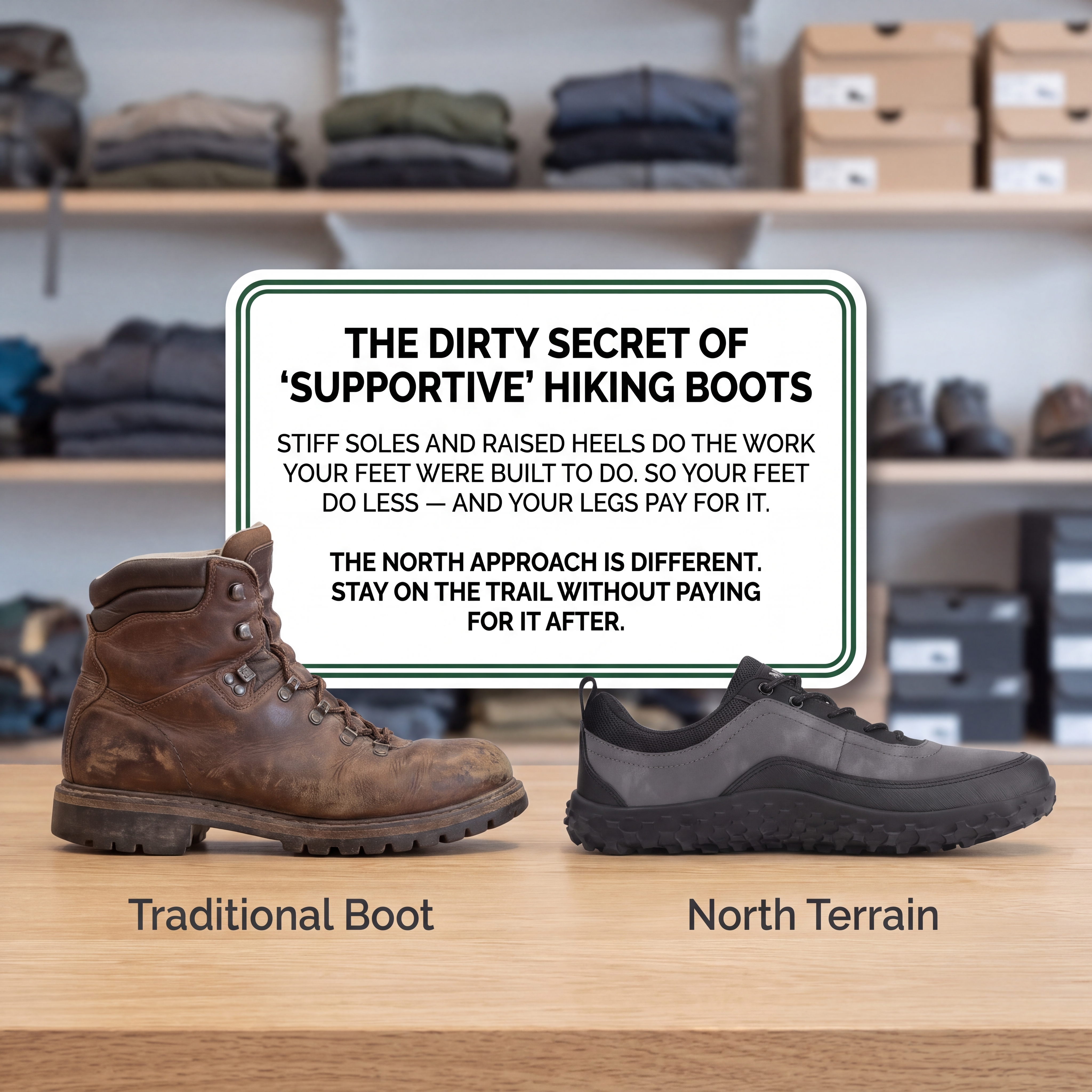
Ran for 3 days, from October 2 to October 5, 2026, the last day Crush saw it.
Run by North Footwear on Facebook. Crush is not the advertiser and does not verify its claims. See this ad in Meta's Ad Library(opens in a new tab)
Want an ad like this for your product?
Crush makes new ad images for your product from this ad: your logo, your product photo, your offer.
Trials from $19.95 USD, then $79.95 USD a month. Cancel anytime.
About this ad
- Meta Ad Library ID
- 28539390832385565
- Platforms
- Facebook, Instagram, Audience Network and Threads
- Relaunches
- 0
- Niche
- Fashion & Apparel
Ad text
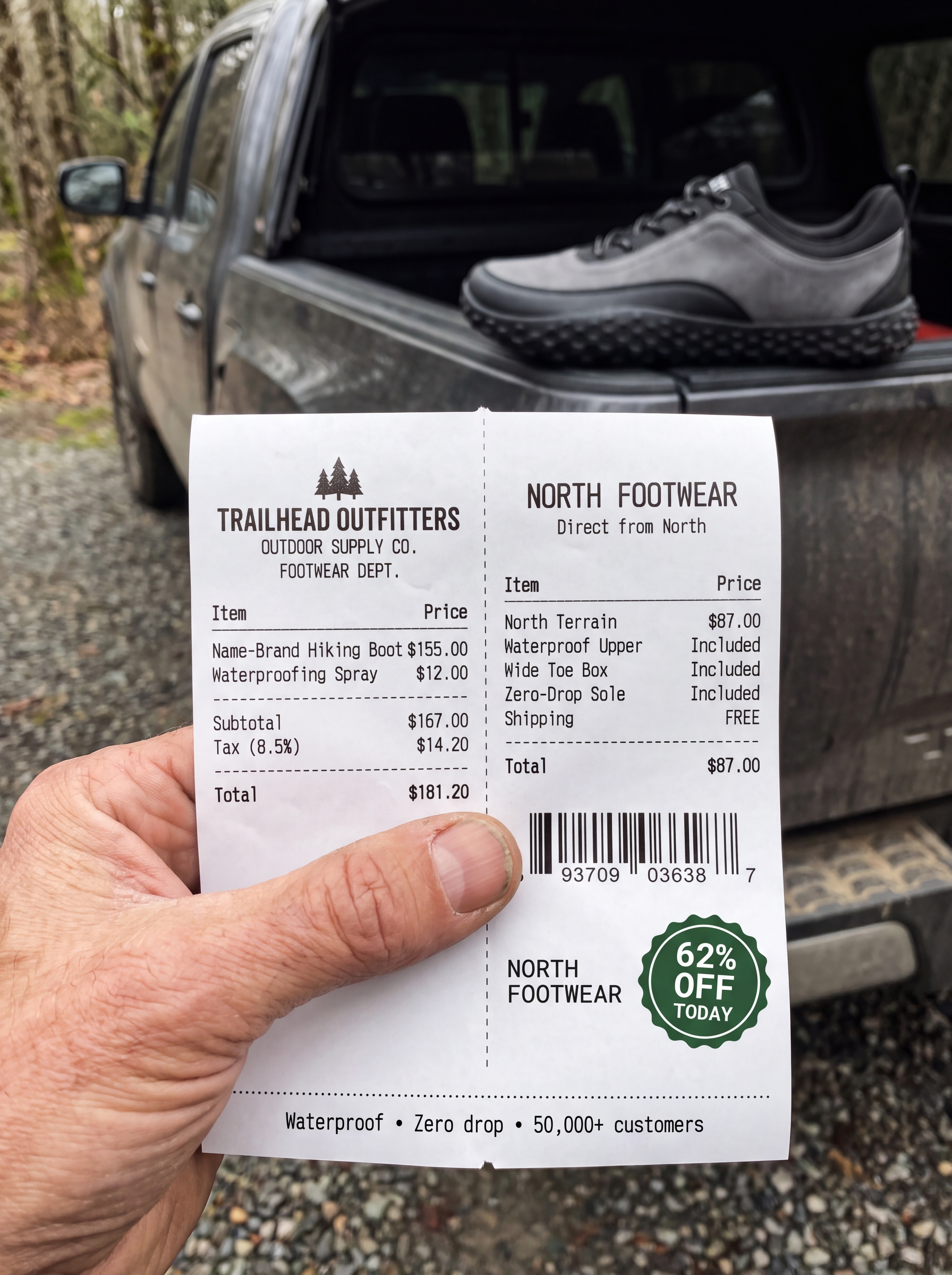
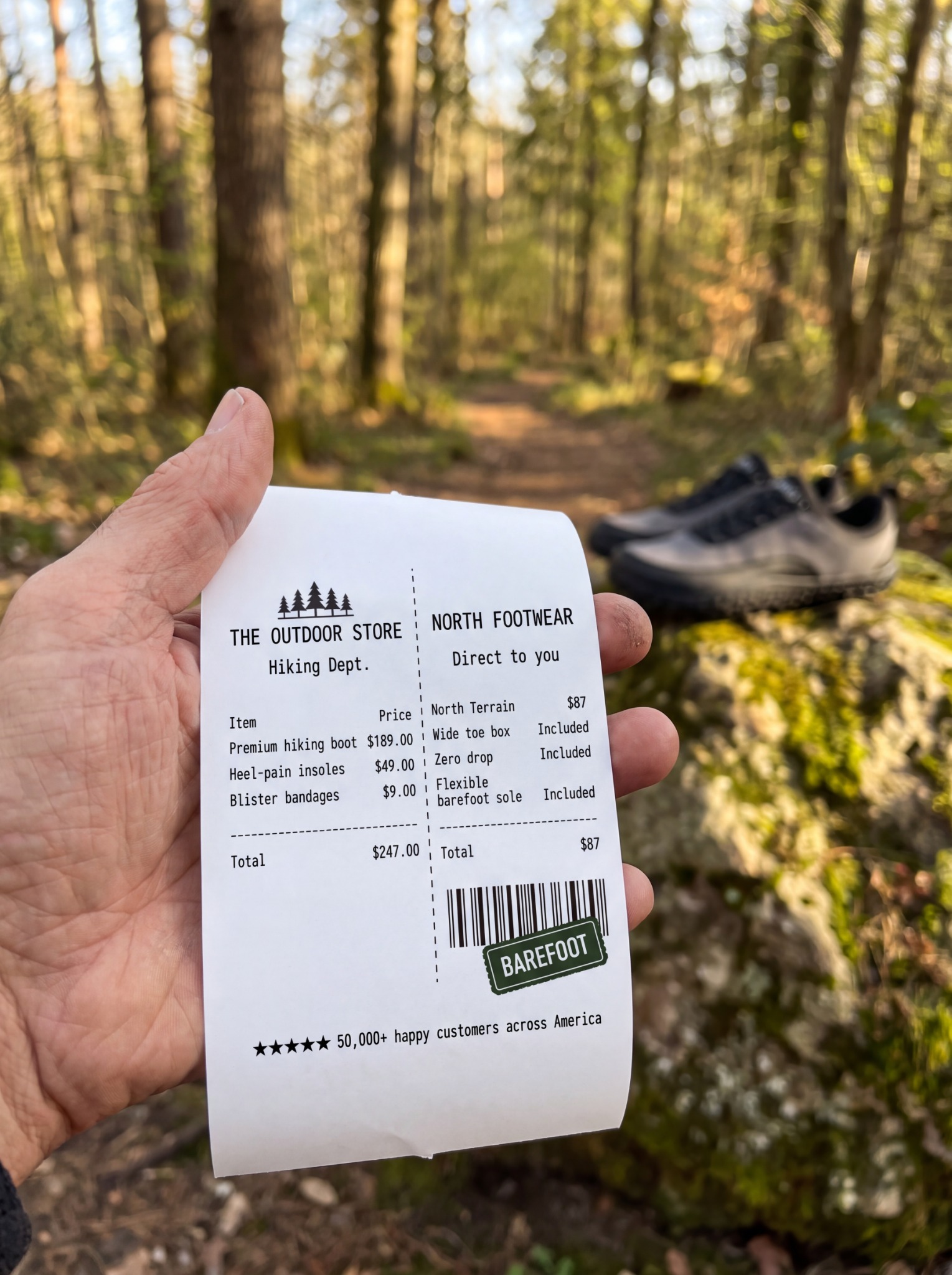
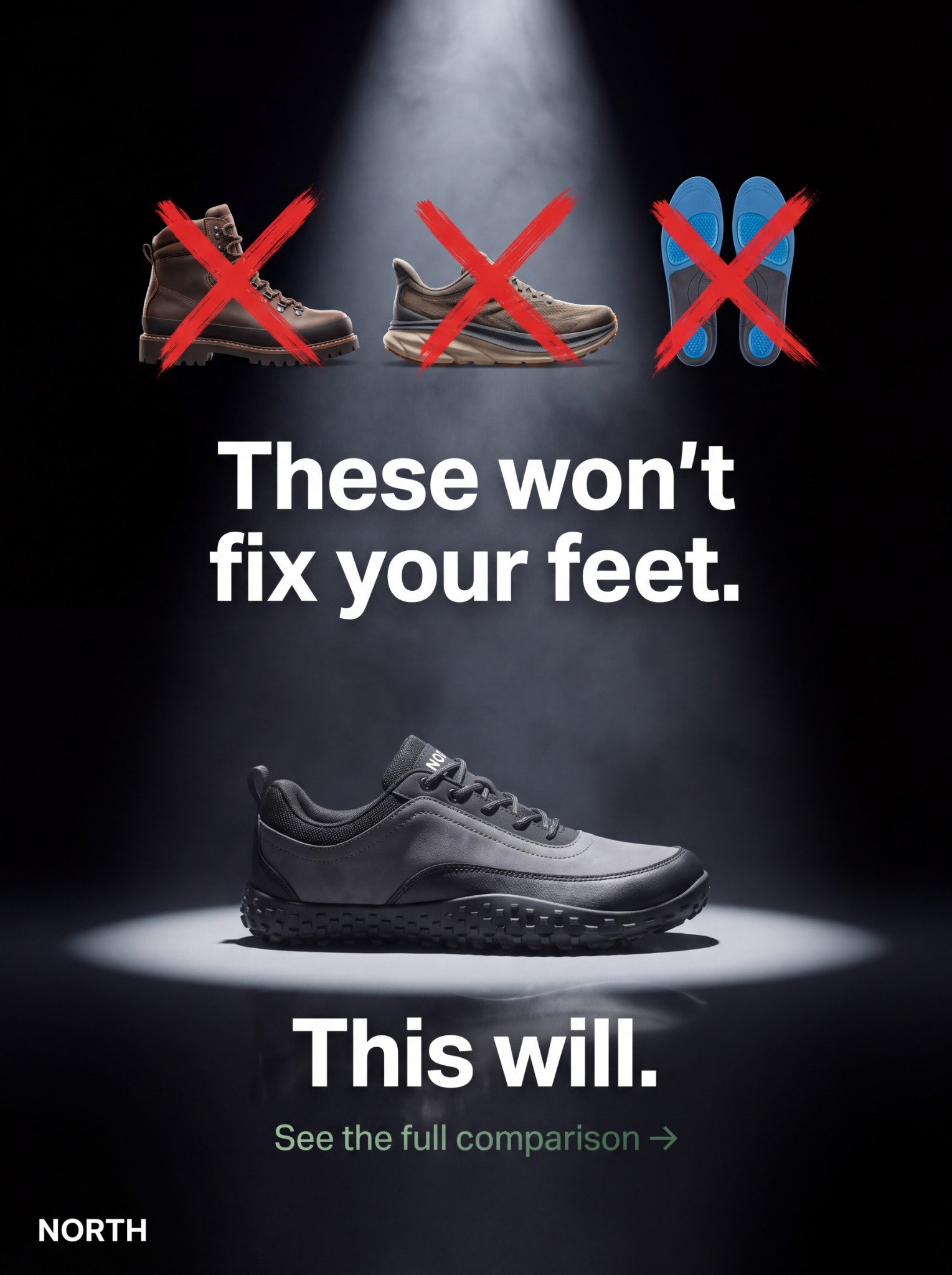
In 1969, two researchers at the US Army Research Institute of Environmental Medicine — Robert Soule and Ralph Goldman — ran an experiment that the outdoor industry has spent fifty years ignoring. They wanted to answer a question that mattered enormously to the military: does it matter where on the body a soldier carries weight? The assumption was no. A kilo is a kilo. Whether it sits in your rucksack or on your feet, your body has to move it. So they loaded volunteers with identical weights in different places — on the torso, in the hands, on the head, and on the feet — and measured their oxygen consumption while walking. The results were published in the Journal of Applied Physiology, and they were not what anyone expected. Weight carried on the feet cost between four and six times more energy than the exact same weight carried on the torso. Not four percent. Four to six times. A single kilo strapped to the feet demanded roughly as much from the body as five kilos in a backpack. The finding has been replicated repeatedly since — most notably by Browning and colleagues in 2007, who measured the same effect with modern equipment and confirmed it. The reason is mechanical and unavoidable: your torso travels in a more or less straight line when you walk. Your feet accelerate from a standstill to faster than your walking speed and back to zero again, thousands of times an hour. Every gram out there has to be accelerated and decelerated with every single stride. Which brings us to the shoe rack in that photo. A typical leather hiking boot weighs somewhere between 600 and 800 grams. Per foot. A trail shoe, 350 to 450 grams. A cushioned walking shoe with a thick midsole, around 300. A barefoot shoe, under 200. Run those numbers through Soule and Goldman's multiplier and the difference stops being a detail about comfort. Over a five-kilometre walk, the boots aren't asking for slightly more from your legs than the barefoot shoes. They're asking for the equivalent of walking that entire distance with an extra two to three kilos on your back that you didn't pack and don't need. At thirty, your body absorbs that and you call it a good workout. At sixty-five, it's the difference between coming home pleasantly tired and coming home unable to face the stairs. But weight is the smaller of the two problems. The bigger one is the thing the boots are actually sold on. Ankle support. It is the single most repeated selling point in outdoor footwear. Stiff, high-cut collars that wrap the ankle joint and hold it rigid. The promise is simple and intuitive: hold the ankle still and it can't roll. Here is what the research actually found. Multiple reviews of ankle injury prevention have failed to demonstrate that high-cut boots reliably reduce ankle sprains compared with low-cut footwear. What they do demonstrate, consistently, is something else — that restricting the ankle joint measurably impairs proprioception. Proprioception is your body's position sense. It's how you know where your foot is without looking at it, how you correct a stumble before you consciously register it, how you stay upright on a root-crossed forest path in fading light. It runs on sensory information. Your sole contains an extraordinary density of mechanoreceptors — pressure sensors, stretch receptors, vibration detectors. Your ankle and foot joints are packed with position receptors. Together they send a continuous stream of data upward, and your nervous system uses that data to make micro-corrections you never notice. That system is what actually keeps you from falling. And it needs two things to work: a foot that can move, and a sole that can feel. A stiff boot removes the first. A thick sole removes the second. So you buy the boot because you're worried about your ankles, and the boot quietly switches off the system your body uses to protect them. This is the part nobody explains to you. Picture what happens over a decade. You're fifty-five. You notice you're less sure-footed than you were. Uneven ground makes you cautious. You've had one small stumble on a gravel path that you're still thinking about. So you buy a more supportive boot. Stiffer collar. Thicker sole. More "stability." And it works — for a walk or two. You feel held. But the muscles that were doing the stabilising now have nothing to do. The intrinsic muscles of the foot — the small ones that control the arch and the toes — stop being recruited. The ankle stabilisers stop working through their range. The sensory information from your sole is muffled by twenty millimetres of foam. Muscles that aren't recruited get weaker. Sensory pathways that aren't used get less acute. This isn't controversial; it's the basic principle behind every rehabilitation programme ever written. Twelve months later you're less steady than before. So you buy a stiffer boot again. You're sixty-eight now, and your children have started using the word "rollator" in conversations you can overhear. The footwear didn't cause the ageing. But at every single step it made the choice that made things worse, and it charged you two thousand kronor for the privilege. What the research shows happens when you reverse it In 2019, Sarah Ridge and colleagues at Brigham Young University published a study in Medicine & Science in Sports & Exercise that tested something simple. They took a group of adults and split them in three. One group did a structured foot-strengthening exercise programme. One group simply walked in minimalist shoes as part of normal daily life. One group carried on as normal. After eight weeks, they measured foot muscle size and strength. The group that just walked in minimal shoes showed increases comparable to the group doing the dedicated strengthening exercises. No programme. No physiotherapist. No equipment. They changed their shoes and their feet got stronger, because the muscles were finally being asked to do the job they exist to do. This lines up with what researchers found when they looked at populations who never wore constricting footwear at all. Hollander and colleagues, publishing in Scientific Reports in 2017, examined the feet of over 800 people across habitually barefoot and habitually shod populations in South Africa and Germany. The habitually barefoot groups showed measurably different foot morphology — wider forefeet, different arch development, different toe alignment. Same species. Same anatomy at birth. Different shoes. And Daniel Lieberman's 2010 paper in Nature — still the most cited piece of work in this entire field — demonstrated that habitually barefoot walkers and runners land differently, generating a markedly smaller impact spike than people landing heel-first in a cushioned, raised-heel shoe. The pattern across all of it is the same, and it's the opposite of what the outdoor wall in any sports shop will tell you: The more the shoe does, the less the foot does. The less the foot does, the weaker and less sensitive it becomes. And it's the strength and sensitivity of the foot — not the stiffness of the boot — that determines whether you're still walking confidently at seventy-five. So why does the wall of boots exist? Because there's nothing to sell in a foot that works. The outdoor footwear market is worth tens of billions globally, and it's built on features: waterproof membranes, proprietary midsole foams, torsion plates, stability shanks, ankle collars. Each one is a reason to charge more and a reason to replace the pair you already own. A shoe that's light, flat and shaped like a foot has almost nothing to put on a hangtag. It's also, according to the research, the one your feet were built for. Which brings us to the shoes in the middle of that rack. North Footwear is a small Swedish company, and the design brief was narrow: build the shoe the research describes, and leave out everything the research says is doing harm. A toe box shaped like a foot. Wide at the front, where your foot is actually widest. Your toes spread and grip. The big toe and little toe act as the outriggers they're supposed to be. The foot becomes a stable platform instead of a narrow point. A completely flat sole. Zero drop, heel to toe. No raised heel tipping you forward, no forced heel strike, no compensating arch in the lower back with every step. A thin, flexible sole. You feel the path. The gravel, the camber, the root — your nervous system gets the data it needs and makes the corrections before you're even aware there was something to correct. Under 200 grams. Run that through Soule and Goldman's multiplier against a 700-gram boot and you're saving your legs the energetic cost of roughly two and a half kilos on your back, over every kilometre you walk. It isn't a technological breakthrough. It's the removal of fifty years of technology that was never tested against the thing it claimed to improve. Right now North Footwear is running 50% off the full collection, with free shipping. Every pair comes with a 30-day guarantee. Walk in them for a month. If your feet don't feel different — send them back for a full refund, no questions. Fair warning: North is a small company and doesn't mass-produce. The last restock sold out in three days. Soule and Goldman proved it in 1969. Ridge's team proved it again in 2019. Your feet are not failing you with age. They've been carrying five times their share, with the sensors switched off, for thirty years. Give them one month without the boot. 👟 Try North risk-free before this restock sells out →
Where the ad sends people
northfootwear.com
The Truth About 'Supportive' Boots Revealed 🛑🥾
If your feet ache after a hike — the arch, the ball of your foot, the toes, or a deep tiredness that creeps up your legs by the end of the day — I want you to hear something first: it is probably not your age, and it is probably not your feet.
Shop now: northfootwear.com(opens in a new tab)