
Inactive· since Feb 17, 2026
- 21
- days it ran
- 0
- relaunches
Ad copy
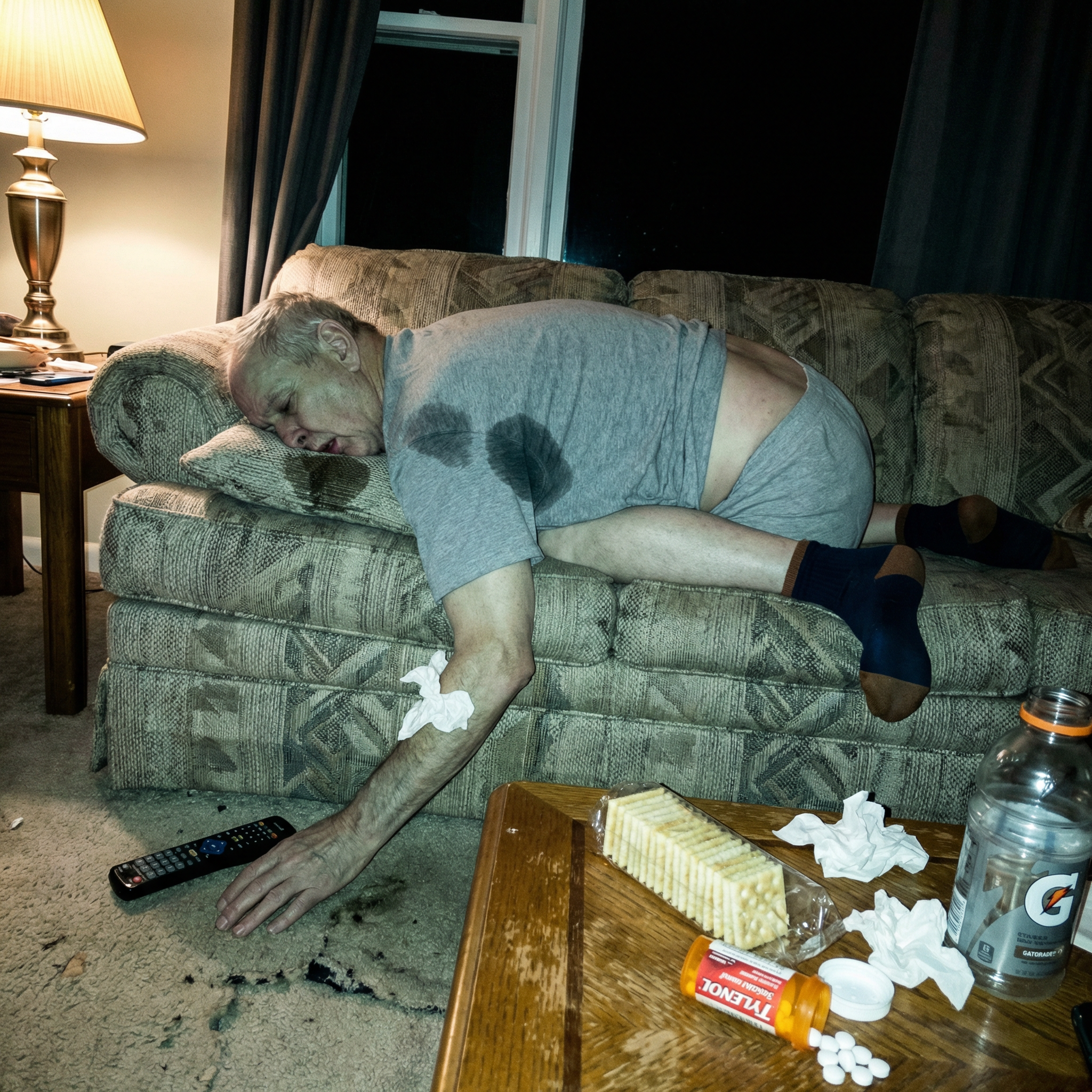
My husband died from the flu on January 14th at 2:38 AM. He was 63 years old. Got his flu shot in October. Washed his hands like a surgeon. Took his vitamins every morning. Walked three miles a day, rain or shine. The hospital bill was $47,000. The funeral was $9,400. His coffee mug is still on the kitchen counter. I can't move it. If I move it, he's really gone. I need to tell you what happened to Robert. Because I'm seeing the same posts on Facebook that I was making three weeks before he died — "my husband has a terrible cold, any tips?" — and it makes me physically ill. If you're over 55, or someone you love is, please read this entire thing. Three weeks ago I would have given anything — everything — for someone to tell me what I'm about to tell you. Robert came home from the hardware store on January 3rd with a sore throat. "Probably picked something up. I'll be fine by Monday." 38 years of marriage and that man never got sick. I could count on one hand the number of times he stayed in bed. He was proud of that. By Monday he wasn't fine. Fever of 102.6. Coughing. But still making his own coffee, still waving me off. "Stop worrying, Carolyn. It's the flu. I've had worse." I called our doctor. Tylenol. Fluids. Rest. "If it's not better in a few days, bring him in." So we waited. That will be the thing I carry for the rest of my life. The doctor said wait. And I waited. And my husband died. By Wednesday his fever was 103.4. I could hear this wet, crackling sound every time he breathed — like cellophane crinkling inside his chest. "Robert, I'm taking you to the doctor." "Carolyn. I'm FINE." He wasn't fine. He was scared. 38 years of marriage teaches you every version of a person. The stubborn version. And the scared version pretending to be the stubborn version. By Thursday morning he couldn't get out of bed. Not wouldn't. Couldn't. I brought him water and his hands were shaking so badly he spilled half of it on his chest. Didn't even react. Just lay there staring at the ceiling, breathing in these short little gasps like air being squeezed through a straw. His lips were gray. Not blue like in the movies. Gray. Like the color had just drained out of him. I called 911 at 7:14 AM. Paramedics in 8 minutes. They clipped something to his finger. Looked at the number. Looked at each other. Oxygen: 79%. Normal is 95-100%. "Ma'am, we need to transport him now." They wheeled him through the living room — past his recliner, past his bookshelf, past 38 years of our life — and he turned his head and looked at me. "Don't forget to take the trash out. It's Thursday." That was the last thing my husband said to me in our home. When the ER doctor came out, I knew before she opened her mouth. I knew from how she walked. "Mrs. Baker, your husband has Influenza A. H3N2. His lungs are severely compromised. We're moving him to the ICU." "But he got his flu shot. In October. Every year." And then she said something that will be burned into my brain until the day I die: "This year's vaccine wasn't designed for the strain your husband has. H3N2 mutated after the vaccine was manufactured. The flu shot he got in October was built for a virus that doesn't exist anymore." Robert spent 10 days in the ICU. I was there every day. 7 AM to 9 PM. I learned that the machines have different beeps. Steady beep: he's okay. Fast beep: something changed. Long beep: leave the room because people are about to rush in. I heard the long beep four times. Day 4, they talked about the ventilator. Tube down the throat. Sedation. The machine breathes for him. I signed the consent form with a hand so shaky my signature didn't look like mine. Day 6, his kidneys started failing. His face swelled. His hands. His feet. He didn't look like Robert anymore. I held his hand anyway. Day 8, he opened his eyes. Clear. Present. Like the Robert I married. "I'm sorry, Carolyn." "For what?" "For not going to the doctor sooner. You told me to go. I should have listened." I squeezed his hand and said "Don't you dare apologize to me, Robert Baker." But my face was doing something I couldn't control. And he saw it. That was the last real conversation I had with my husband. Day 10. January 14th. 1:15 AM — the long beep. Running in the hallway. 2:38 AM. A doctor I'd never seen walked in. "I'm so sorry. We did everything we could." I drove home at 4 AM. Robert's truck in the driveway. Porch light still on from ten days ago. Nobody turned it off. His reading glasses on the table. His slippers by the recliner. His coffee mug on the counter from January 3rd. I sat in his recliner and didn't move for six hours. The house was so quiet I could hear the refrigerator hum. 38 years. And now the only sound in my house was the refrigerator. The funeral was January 19th. My five-year-old granddaughter pulled on my sleeve. "Grammy, when is Pop-Pop coming home?" I told her Pop-Pop was in heaven now. She said: "Can we call him there?" I walked out of the church and screamed into my hands in the parking lot in 19-degree weather. After the funeral I couldn't stop seeing it — people my age, Robert's age, posting about being sick. "This flu is no joke." "Worst cold I've ever had." I KNEW some of them were going to end up where Robert ended up. And some were going to end up where I am now. So I started researching. Not because I wanted to. Because if Robert died for nothing — if I can't save even one person — I can't live with that. The flu shot this year is 30-40% effective against H3N2 subclade K. That's the CDC's own number. Less than a coin flip. Robert was on the wrong side of the coin. Tamiflu only works in the first 48 hours. Robert didn't get to the hospital until day 6. And I kept reading one thing over and over: the virus enters through the nose. Every respiratory virus. Flu, COVID, RSV. They land in the nasal cavity and start replicating. By the time you feel a sore throat, it's been multiplying for two or three days. The war is lost before you know it started. Robert's sore throat on January 3rd wasn't the beginning. The virus had been winning for days. And once it's in your lungs, there's nothing anyone can do except try to keep you alive. So I stopped asking "how do you treat the flu?" and started asking "how do you stop it at the door?" I went to CVS and bought everything on the shelf. $67 worth. Saline spray: just salt water. Doesn't kill anything. Flonase: day 3, blood on my pillowcase. Threw it in the trash. Sudafed: by midnight my heart was slamming so hard I could feel it in my neck. Alone. In the house where my husband just died. Holding my own wrist trying to count my pulse at 2 AM. My doctor the next morning: "Oh yes, that can happen in older adults." Not a single one of those products kills viruses. They manage symptoms while the virus does whatever it wants. I was about to give up. I sat in Robert's recliner with the TV off and the lights off and thought: this is it. This is what getting old means now. You hide. You avoid people. You don't go to the grandkids' plays. You just shrink until you're a person who lives in a house with a dead man's coffee mug and a refrigerator hum. Then my sister called. Coughing. "It's just a tickle, Carolyn, don't start." Something inside me snapped. I am not burying my sister. That night I was scrolling Facebook and almost scrolled past a comment that changed my life. A woman said her husband was an ICU nurse. 12-hour shifts all flu season. Surrounded by H3N2 patients every day. Coughed on, sneezed on, breathed on. He hadn't been sick once. Someone asked how. "Nasal iodine spray. Twice a day. Before and after every shift." Iodine. In your NOSE. My first thought: absolutely not. I know iodine. Betadine. That brown liquid that burns like fire on a cut. But that woman's husband was SURROUNDED by H3N2 every day. And he was fine. Robert walked into a hardware store for 20 minutes and was dead 11 days later. What was the difference? I kept reading. Iodine is one of the oldest antiseptics in medicine. Over 100 years. Every hospital. Every surgery. It kills viruses, bacteria, fungi — everything. Doesn't matter what strain. The virus can't develop resistance. 99% viral kill rate in 90 seconds. Robert was in the ICU for 10 days. The answer was 90 seconds. I had to leave the house. I walked around the block three times shaking. Not from cold. From the realization that my husband might be alive if we'd known about something hospitals have used for a century. But traditional iodine burns. Too harsh for nasal tissue. A company called NutraMD figured out how to combine iodine with fulvic acid — takes the harshness out without taking the virus-killing power out. No burn. No dryness. Daily use. I was skeptical. After Flonase bled my nose. After Sudafed gave me heart palpitations at 2 AM. After every nasal product I'd ever tried either hurt me or did nothing. So I called Robert's pulmonologist. The doctor who was in the ICU. Who was there on day 8 when Robert said "I'm sorry, Carolyn." Who was there when they couldn't save him. I asked him straight: "Is this real? Or am I a grieving widow grasping at straws?" He was quiet for a long time. "Carolyn, povidone-iodine has been used safely in nasal applications for decades. Hospitals. Sinus surgeries. Minimal absorption. No systemic effects." He paused. "If Robert had been using something like this daily — killing the virus at the entry point before it replicated — there is a real possibility he never would have ended up in my ICU." I was on the floor. Because a doctor just told me my husband might be alive right now. And all I could see was Robert at the kitchen counter on a Sunday morning, pouring coffee into that mug, turning to me and saying "morning, Lin" with his hair sticking up. $30. Ten seconds. Twice a day. And that Sunday morning could still be happening. I ordered it that night. I know how this sounds. I know it sounds like I'm selling something. I'm not. I don't work for NutraMD. I've never spoken to anyone at that company. I'm just a woman who lost her husband and found something that might have saved him. First spray: slight warmth. Faint iodine smell — gone in seconds. No sting. No dryness. Nothing like Flonase. Nothing like Betadine. Five weeks now. Twice a day. Ten seconds. Three weeks in, my grandkids came over. Ages 5 and 7. Both coughing. H3N2 had devastated their school. My daughter in the doorway: "Mom, are you sure?" "They're here. I'm holding them. I'm not missing any more time." Robert missed everything. I was NOT letting fear take anything else. My granddaughter sneezed directly in my face for an entire weekend. Tested positive for H3N2 the following Monday. I didn't get sick. I called my daughter. Couldn't speak for 30 seconds. "Mom? Are you okay?" "I think it works." We both cried. Because we were both thinking the same thing. If Robert had this. If we'd known. My sister — 64, high blood pressure, can't take Sudafed — three weeks on it. Sat next to a woman coughing through an entire church service. Fine. My neighbor Helen — lost her husband to H3N2 two weeks before I lost Robert. Two widows on the same street. She hadn't left her house since December. Last week she walked to the grocery store by herself. First time in two months. She grabbed my hand and said: "I'm not terrified anymore." Robert's brother — 68, diabetic — emailed me: "I just spent two weeks with sick grandkids. I'm fine. Robert would want me to tell you this is real." Here's what I know because I lived it: The flu shot is 30-40% effective right now. Robert had his. Tamiflu only works in the first 48 hours. Robert didn't get help until day 6. Everything at CVS manages symptoms. Nothing kills the virus. Once it's in your lungs, you're surviving. Robert didn't survive. The virus enters through the nose. It can be killed there in 90 seconds. 90 seconds and $30. That's the distance between where you are and where I am. The article that explained all of this is why I found NutraMD. It's the reason my grandkids still have one grandparent. Read it. Not for me. For whoever you'd leave behind. 👇 https://nutramdhealth.com/pages/article Robert used to say: "The best time to fix the roof is before it rains." It's raining. — Carolyn Baker, age 61 Naperville, IL P.S. His coffee mug is still on the counter. 33 days now. Every morning I walk into the kitchen and for one second I forget. I think he's going to pick it up and say "morning, Lin." He's not. $47,000 in hospital bills. $9,400 for the funeral. $30 for the spray his own doctor said might have kept him alive. Don't end up here. P.P.S. I don't work for NutraMD. I'm writing this at 3:17 AM because Robert's side of the bed is cold and if putting this on the internet saves one person — just one — then at least something good came from the worst thing that's ever happened to me. Share this with anyone you love over 55.
My husband is dead because nobody told us the flu shot didn't work this year.
My husband is dead because nobody told us the flu shot didn't work this year.
LEARN MORELike this ad? Make it yours.
Crush rebuilds this exact creative around your product — your brand, your colors, your offer — in about a minute.