 the.creative.chemist
the.creative.chemist Facebook ad: “Lavender (genus Lavandula) is an aromatic, evergreen herb…”
Running for 14 days since September 13, 2026. Crush last saw it on September 27, 2026.
Run by the.creative.chemist on Instagram. Crush is not the advertiser and does not verify its claims. See this ad in Meta's Ad Library(opens in a new tab)
Want an ad like this for your product?
Crush makes new ad images for your product from this ad: your logo, your product photo, your offer.
Trials from $19.95 USD, then $79.95 USD a month. Cancel anytime.
About this ad
- Meta Ad Library ID
- 2597129804049966
- Platforms
- Relaunches
- 0
Ad text
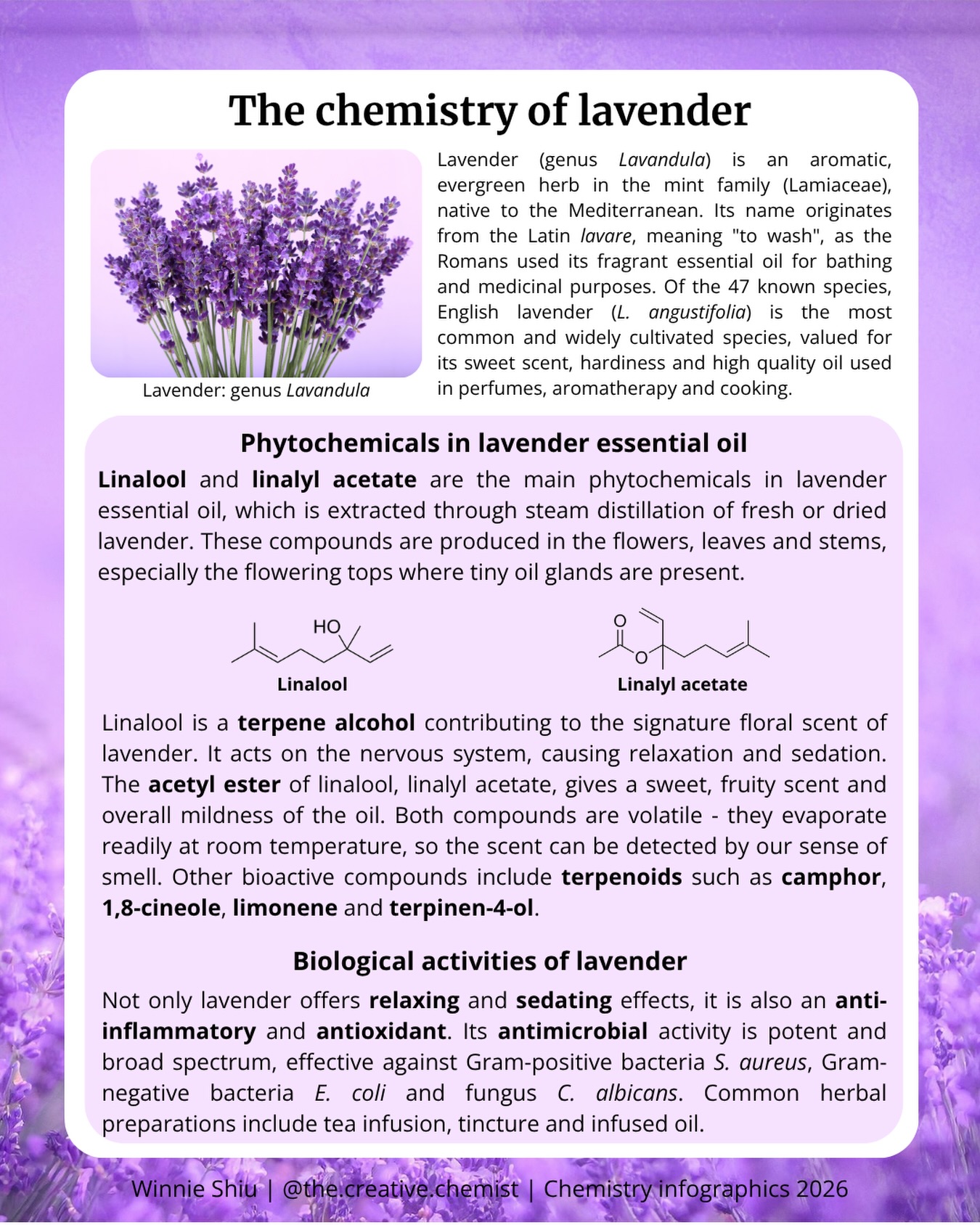
Lavender (genus Lavandula) is an aromatic, evergreen herb in the mint family (Lamiaceae), native to the Mediterranean. Its name originates from the Latin lavare, meaning "to wash", as the Romans used its fragrant essential oil for bathing and medicinal purposes. Of the 47 known species, English lavender (L. angustifolia) is the most common and widely cultivated species, valued for its sweet scent, hardiness and high quality oil used in perfumes, aromatherapy and cooking. 🌿 Phytochemicals in lavender essential oil Linalool and linalyl acetate are the main phytochemicals in lavender essential oil, which is extracted through steam distillation of fresh or dried lavender. These compounds are produced in the flowers, leaves and stems, especially the flowering tops where tiny oil glands are present. Linalool is a terpene alcohol contributing to the signature floral scent of lavender. It acts on the nervous system, causing relaxation and sedation. The acetyl ester of linalool, linalyl acetate, gives a sweet, fruity scent and overall mildness of the oil. Both compounds are volatile - they evaporate readily at room temperature, so the scent can be detected by our sense of smell. Other bioactive compounds include terpenoids such as camphor, 1,8-cineole, limonene and terpinen-4-ol. 🌿 Biological activities of lavender Not only lavender offers relaxing and sedating effects, it is also an anti-inflammatory and antioxidant. Its antimicrobial activity is potent and broad spectrum, effective against Gram-positive bacteria S. aureus, Gram-negative bacteria E. coli and fungus C. albicans. Common herbal preparations include tea infusion, tincture and infused oil. 📖 Further reading: Lavender: phytochemistry, pharmacology, cross-disciplinary applications, and clinical efficacy. Jiang et al., Phytomedicine, 2025. https://doi.org/10.1016/j.phymed.2025.157274 Lavender science chemistry | garden plant | phytochemistry natural product science communication| pharmacognosy | medicinal plant infographics | sci comm | everyday science | stem home education | aromatherapy essential oil | Dr Winnie Shiu | the creative chemist #lavender #science #chemistry #phytochemistry #scicomm