Healthdirect
Healthdirect Facebook ad: “Mullend Teeth Repair Gel combines hyaluronic acid, aloe…”
Ran for 33 days, from December 29, 2025 to January 31, 2026, the last day Crush saw it.
Run by Healthdirect on Facebook. Crush is not the advertiser and does not verify its claims. See this ad in Meta's Ad Library(opens in a new tab)
Want an ad like this for your product?
Crush makes new ad images for your product from this ad: your logo, your product photo, your offer.
Trials from $19.95 USD, then $79.95 USD a month. Cancel anytime.
About this ad
- Meta Ad Library ID
- 2637667209945862
- Platforms
- Facebook, Instagram, Audience Network, Messenger and Threads
- Relaunches
- 1
Ad text
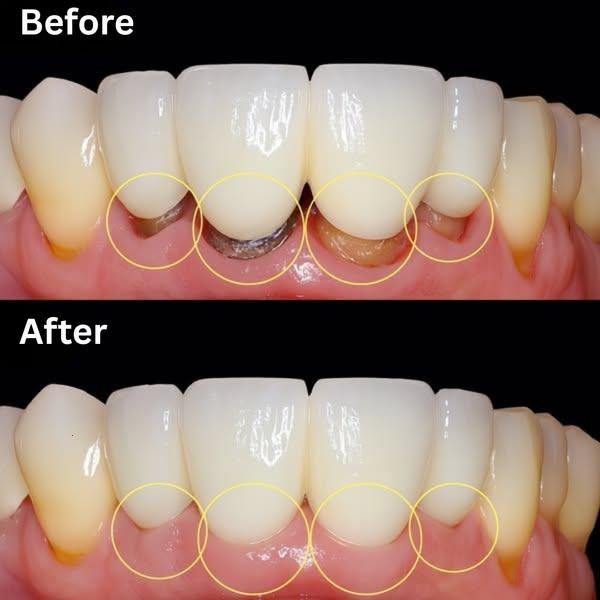
"My dentist looked at my receding gums and said, ""There's nothing we can do except monitor it"" - but she was WRONG, and what I discovered three months later made her admit she'd never learned this in dental school. I sat in that chair, numb. Not from the Novocain. From the word ""monitor."" Monitor means ""watch it get worse."" Monitor means ""come back every six months so I can measure how much you're losing."" I was 62 years old, and my dentist had just told me to accept that my gums were disappearing. The worst part? I'd been doing everything right. I brushed twice daily with expensive sensitivity toothpaste. I flossed religiously. I'd even bought the $200 electric toothbrush she recommended. I'd had three ""deep cleanings"" in eighteen months. And my gums were still pulling away from my teeth. I could see it every morning. More root exposed. That gap between my teeth getting wider. My two front teeth looked like they'd stretched half an inch longer. My daughter was getting married in four months. I started practicing my smile in the mirror—the closed-mouth kind that hides your teeth. The kind that makes you look like you're keeping a secret. The kind that makes you look old and ashamed. That's when I knew I'd already lost something more important than gum tissue. I'd lost the ability to smile without thinking about it. Two weeks later, I was eating a salad at lunch when a piece of lettuce got stuck between my teeth. The stabbing sensitivity made my eyes water. When I looked in the mirror, I saw pink on the lettuce. My gums had bled from a piece of lettuce. I stopped ordering salads. Then apples. Then anything that required biting with my front teeth. I'd cut everything into small pieces first, like I was preparing food for a child. That night, my husband asked why I was cutting my sandwich into quarters. I lied and said I wasn't that hungry. The truth was too humiliating: I was afraid my teeth couldn't handle it. I started googling at 11 PM. ""Receding gums grow back"" ""Reverse gum recession naturally"" Every article said the same thing: You can't reverse it. You can only slow it down. If it's severe, you'll need gum grafts—where they cut tissue from the roof of your mouth and stitch it to your gums. The photos made me nauseous. The price tag—$600 to $3,000 per tooth—made me want to cry. I tried everything the ""natural remedy"" websites suggested. Oil pulling with coconut oil every morning. (My jaw ached and nothing changed.) Salt water rinses. Aloe vera. Green tea. A $34 ""gum repair"" toothpaste that tasted like punishment. Nothing worked. Six weeks later, I was back in the dentist's chair. ""We're at 4 millimeters on the front two,"" she said. ""If it reaches 5, we should discuss grafting."" I asked the question that had been haunting me: ""Why is this happening? I do everything you tell me to do."" She paused. ""Some people are just more prone to it. It's genetic. And at your age, things start breaking down. It's part of getting older."" Part of getting older. Like I should just accept it. I left that appointment and cried in my car for ten minutes. Then I got angry. I'm 62. I'm not ancient. I go to yoga three times a week. I cook healthy meals. I take care of myself. Why was my body falling apart in the one place I couldn't hide? That night, I couldn't sleep. I searched something different: ""Why do gums recede after 60"" Most articles gave the same useless answers. Bacteria. Poor brushing. Genetics. Age. But one article stopped me cold. It was from a periodontal journal—dense, technical, filled with words I had to look up. But one sentence changed everything: ""Gingival recession accelerates when collagen production declines, leaving the connective tissue matrix unable to maintain structural integrity."" I read it three times. My gums weren't receding because of bacteria. They were receding because they were losing their structural foundation. Like a house where the support beams are rotting from the inside. All the brushing and flossing in the world couldn't fix that—because I wasn't addressing the actual problem. I fell down a research rabbit hole that night. Study after study confirmed it: after age 50, your body produces significantly less collagen. And your gums—the soft tissue holding your teeth in place—are made almost entirely of collagen. No wonder they felt thinner. No wonder they were pulling away. They were literally starving for the one thing they needed to stay strong. But here's what made me furious: Not one dentist had ever mentioned this to me. They treated my gums like they were infected. But they weren't infected. They were structurally collapsing. I found research on collagen peptides—the form your body can actually absorb. Studies showing Type 1 collagen specifically supports connective tissue in gums. Then I found a small European study where patients applied collagen peptides directly to their gum line during brushing. After 90 days, they measured significant improvement in gum thickness and tissue attachment. Not ""slowed recession."" Improvement. That's when I found a brand selling collagen powder. It was exactly what the study described—a brushing powder with Type 1 collagen peptides designed specifically for gum tissue support. I ordered it that night. It arrived three days later. The instructions were simple: dampen your toothbrush, dip it in the powder, brush gently along your gum line for two minutes. Do it twice daily. It felt strange at first. The powder was tasteless, almost like brushing with nothing. But I had four months until my daughter's wedding, and nothing left to lose. The first week, nothing happened. The second week, I noticed the bleeding stopped when I flossed. By week three, my gums felt different when I brushed. Less tender. Less fragile. I didn't trust it yet. But in week five, my husband said, ""Your smile looks different. Did you whiten your teeth?"" I hadn't. But when I looked closely that night, I could see it: the thin, translucent look my gums had was gone. They looked fuller. Pinker. Healthier. I touched them gently with my finger. They felt firmer. Three months later, I went back to my dentist for my cleaning. She measured my gum recession like always. Then she measured again. ""Huh,"" she said. ""What?"" I asked. ""Your numbers improved. The front two are back to 3 millimeters. That's… unusual."" I told her everything. The late-night research. The collagen study. The brushing powder I'd been using every day. She was quiet for a long moment. ""They didn't teach us that in dental school,"" she finally said. ""We focused on infection control and surgical intervention. Not on the structural component."" All those deep cleanings, all that money, all that pain— And the answer was something she'd never learned to look for. I kept using this powder every single day leading up to the wedding. By the time my daughter's big day arrived, I wasn't worried about my smile anymore. I smiled in every single photo. Not the careful, closed-mouth smile I'd been practicing. A real smile. The kind where you're not thinking about your teeth or your gums. The kind of smile that just happens when you're happy. Here's what I wish someone had told me two years ago: Your gums aren't just pulling away because you're getting older. They're pulling away because they're losing collagen—the protein that holds your teeth in place. And every day you spend treating the symptoms—buying sensitivity toothpaste, getting painful cleanings, using antibacterial rinses—is another day you're not addressing the real problem. I'm not a dentist. I'm not a scientist. I'm just someone who got desperate enough to ask a different question. If your gums are receding—if you're cutting your food into smaller pieces, if you're practicing your smile in the mirror, if you're terrified of what your dentist is going to say at your next appointment— You deserve to know what I found that night. I'll leave the link below to the brand I bought. I don't get anything from sharing this—I just know what it's like to feel hopeless about your gums. Because you shouldn't have to accept ""monitoring"" as your only option. And you definitely shouldn't have to stop smiling."
Where the ad sends people
uk.elyssencederma.com
Mullend™ Teeth Repair Gel combines hyaluronic acid, aloe vera, St. John's wort, chamomile and other natural ingredients with professional research and development technology.
SUMMARY: Experts estimate that one in two people in the world suffer from gum problems... This ingenious invention could be their natural way to treat and strengthen their gums almost instantly, stopping bleeding, preventing tooth loss and other serious dental problems... Order Mullend™ Teeth Repa...
Shop now: uk.elyssencederma.com(opens in a new tab)