Sarah Callahan
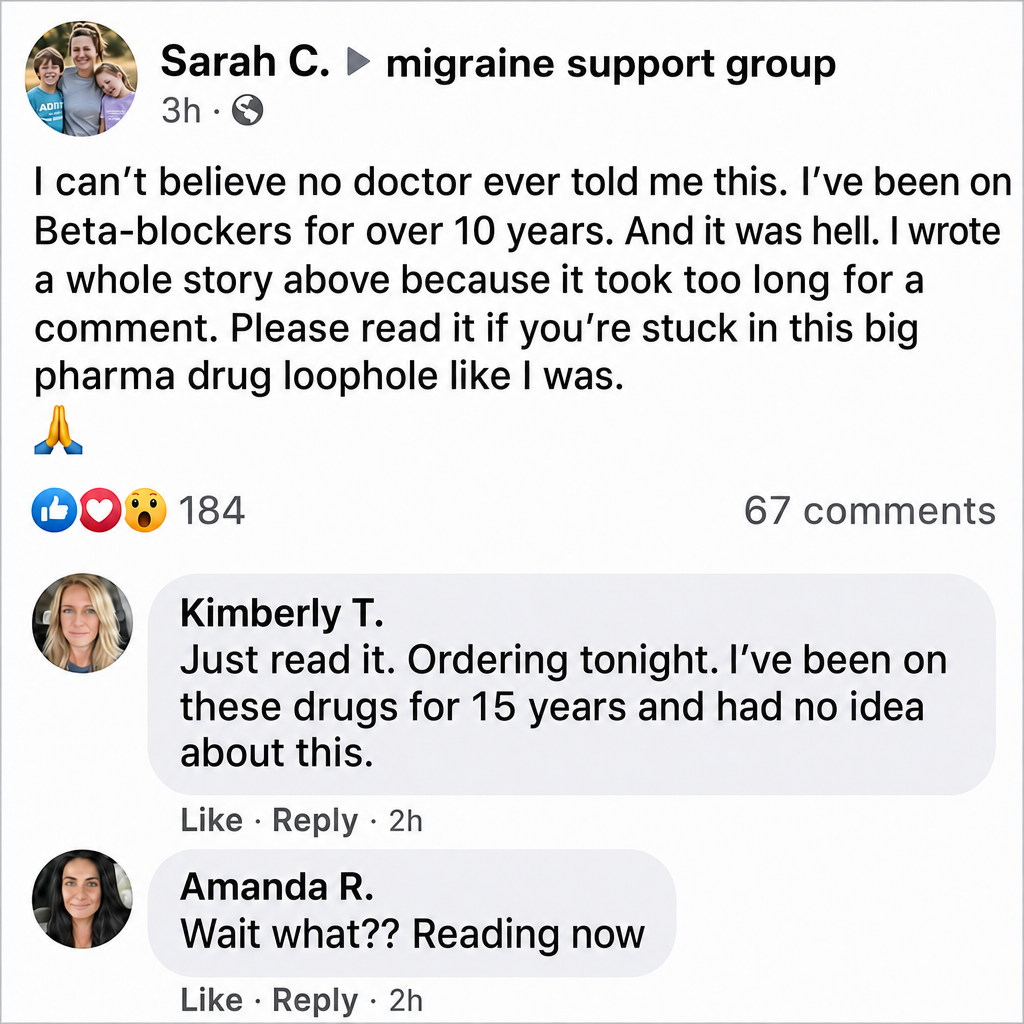
 Facebook ad: “Read this if your stuck like me”

Running for 43 days since September 21, 2026. Crush last saw it on November 3, 2026.
Run by Sarah Callahan on Facebook. Crush is not the advertiser and does not verify its claims. See this ad in Meta's Ad Library(opens in a new tab)
Make your own version of this ad
Crush makes it, launches it in your own Meta ad account, scales the winners and pauses the losers.
About this ad
- Meta Ad Library ID
- 2830817203960164
- Platforms
- Facebook, Instagram, Audience Network, Messenger, WhatsApp and Threads
- Relaunches
- 0
- Niche
- Skincare & Beauty
Ad text
I read a statistic that made me puke. Women 45+ with migraines have a 28% higher risk of cardiovascular mortality than women without. That finding came from a 2025 meta-analysis in the Journal of Headache and Pain — the largest analysis of its kind, covering nearly eight million participants across eighteen cohort studies. Not a slight elevation. 28% higher. I didn't believe it when I first read it. My sister had been in treatment for chronic migraine since she was twenty-six and not one neurologist had ever mentioned cardiovascular risk, let alone explained to her why the medications kept stopping working. But here's the truth. Your neurologist tracks your attack frequency. Your GP tracks your blood pressure. The thing that's actually driving chronic migraine — and the cardiovascular risk that comes with it — sits in the middle of all of them... and nobody is paid to look there. That's why most of us never heard this. That's why my family never heard it either. My sister Jamie was part of that statistic. Thirteen years of trying to treat migraines that wouldn't stay treated. Sumatriptan that worked for the first two years and then stopped aborting attacks reliably. Topiramate she stayed on for three years despite the word-finding problems and the twenty pounds she lost. Propranolol that flattened her heart rate and her energy. Amitriptyline that made her sleep eleven hours and still wake up exhausted. Botox injections every twelve weeks starting in year eight. CGRP inhibitors in year eleven that helped for six months and then plateaued. She stopped going to social events at 32. Stopped committing to anything — dinner plans, weekend trips, work projects with hard deadlines — because she never knew when the next attack was coming or how long it would take to recover from it. She had a cardiovascular event at 43. The doctors said the years of sustained trigeminovascular inflammation and the vascular pathology that comes with migraine with aura had contributed to the damage. She survived. But she wasn't the same. I'm 41. Last year my own neurologist told me my migraine pattern was progressing — more frequent attacks, longer postdromes, the aura symptoms appearing more consistently. Wanted to add CGRP inhibitors to the Botox I was already on. I said I wanted to look at this differently first. And what I found instead — in a research thread buried three pages deep at 2 AM — took me from someone having fourteen migraine days a month to someone who hasn't lost a full day to a migraine in over four months. No new injection. Nothing Jamie ever tried. But to understand why I was desperate enough to spend six weeks obsessively researching what everyone around me had missed, you have to know what I watched those thirteen years do to my sister. And what I didn't know they were quietly setting up in me. ======== For 13 YEARS... my sister Jamie was treated for migraines by specialists who were looking at her brain while something else entirely may have been driving what they found there. It started at twenty-six. She'd had headaches most of her adult life, the way some people do. But these were different. The visual aura that arrived thirty minutes before the pain — the zigzag lines at the edge of her vision, the blind spot that spread across the left side. Then the pain. Unilateral, pulsating, severe. Nausea. Light sensitivity so acute she'd pull every curtain in the apartment and lie on the floor. Her GP referred her to a neurologist. Migraine with aura. Very common. Very manageable. Sumatriptan for the acute attacks, and if they became too frequent, we'd talk about prevention. The first two years felt manageable. Two or three attacks a month. Sumatriptan worked most of the time. She built her life around having one rescue medication that reliably stopped an attack within two hours. By year three the sumatriptan was working less reliably. The attacks were lasting longer. The neurologist started topiramate — a preventive. She stayed on it for three years, during which time she had persistent word-finding problems she described as "reaching for a word and finding empty space." Her attack frequency did come down. Somewhat. By year five they'd switched to propranolol. Then added amitriptyline for the frequent attacks that were getting worse again. The combination made her tired in a way that was different from migraine tiredness — a background flatness that she mentioned to her neurologist and was told was "probably the medication finding its level." Her gut had been off for years. She mentioned it the way she mentioned her other non-migraine symptoms — briefly, expecting nothing. Bloating that built through the afternoon. Nausea between attacks that wasn't always migraine-related. An unpredictability about food that she'd stopped trying to explain because nobody ever connected it to the migraines. Three GPs. Same answer every time. IBS, probably. Common in migraine patients. Nobody asked why. By year eight the attacks were happening twelve to fifteen days a month. The neurologist started Botox — thirty-one injections across the scalp and neck every twelve weeks. She described the appointments as "paying someone to stick needles in my head for an hour so I can get four weeks of slightly fewer migraines." The frequency came down to eight or nine days a month. The neurologist called it a success. By year ten Jamie called me on a Saturday night and said something I wrote down. "Sarah, I've spent thirteen years doing everything they say and I have migraines ten days a month. Is this just my life? Is there a version of this that actually gets better?" I didn't have an answer. Every specialist said the same thing. "Chronic migraine is complex. We're doing everything available. Some patients just have more refractory presentations." For THIRTEEN YEARS they kept "managing." Thirteen years of medication rotations. Thirteen years of injection schedules. Thirteen years of appointments where they'd adjust the preventive or add another treatment option... but never once... not ONE TIME... did anyone say, "Maybe something is wrong that this treatment isn't fixing at the source." And then she had the cardiovascular event anyway. 43 years old. At the hospital, my mother grabbed my hand in the waiting room. "Thirteen years of doing everything they said, Sarah. And she's still here. But for how long if nothing actually changes?" I didn't have an answer. I drove home and started searching. ======== So fast forward to about a year ago. I'm 41. My own migraine pattern has been worsening for three years. Progressing from episodic to chronic — more than ten migraine days a month for the past six months. The aura appearing almost every time now. The postdrome lasting two days instead of one. I go to my neurologist for my quarterly check-in. She pulls up my chart. Reviews my attack diary. Looks at me. "Sarah, you've crossed the threshold into chronic migraine with a clear progression pattern. Given where we are and the aura frequency, I'd like to add a CGRP inhibitor to your current Botox protocol. The combination has shown good results in refractory patients." My chest tightened. Thirteen years of watching Jamie cycle through every option. Every injection protocol. Every new medication. The Botox that worked partially. The CGRP inhibitor that plateaued at six months. And then the cardiovascular event anyway. "No," I said. She looked at me. "Sarah, chronic migraine with aura carries real vascular risk. The research on progression is clear. We need to stay ahead of this." "I know all that," I said. "My sister has been on every combination you're describing for thirteen years. I watched what it did to her. And I watched her have a cardiovascular event anyway." She didn't have an answer to that. I told her to give me three months. She wasn't happy. Wrote something in my chart. I didn't care. For three months I did everything right. The migraine hygiene. Consistent sleep schedule. Hydration tracking. Magnesium glycinate. Riboflavin. CoQ10. Every evidence-based nutraceutical the migraine research supported. Regular exercise at the times that didn't trigger attacks. Three months later. Fourteen migraine days that month. The same. The progression was the same. My neurologist pulled out her prescription pad. "Sarah, I really think it's time to add the CGRP—" "Give me three more months." "Sarah, the vascular risk with aura—" "Three more months." She sighed. I drove home on a back road that took twenty minutes longer because it avoided the stretch of highway where the light did something to my eyes that I hadn't been able to explain to any doctor. ======== That night I couldn't sleep. I sat on my kitchen floor at 2 AM, looking at my migraine diary, thinking about Jamie. Same pattern she had at year seven. Same "we just need to try another layer." Same road. At 2:47 AM I gave up trying to sleep. Went to my laptop. I started searching. What actually drives chronic migraine progression. Why preventive medications work for some people and stop working for others. What the biological difference is between someone whose migraines stabilize and someone who keeps progressing no matter what the protocol says. Every mainstream site said the same thing. Take the preventives. Avoid triggers. Be consistent. Be patient. I'd done all of it. So had Jamie. So I kept digging. That's when I found the thread. A research forum post with thousands of replies. The title: "Is chronic migraine a gut problem that neurology isn't trained to look at?" I almost scrolled past. But something made me click. Study after study. Peer-reviewed. Published in journals I recognized — Frontiers in Neurology, Current Neurology and Neuroscience Reports, Neurology Neuroimmunology and Neuroinflammation. Showing that people with chronic migraine had measurably different gut microbiomes than people with episodic migraine or no migraine at all. That specific bacterial imbalances in the gut were causally linked to migraine risk — not just associated with it. That the gut-brain axis wasn't just connected to migraine. For many people, it appeared to be driving the trigeminovascular sensitization that turned episodic migraines into chronic ones. I kept reading. At 4 AM I found the study that stopped me completely. ======== I was already on my kitchen floor. A 2024 study published in Frontiers in Neurology — Zang et al., "A thorough investigation into the correlation between migraines and the gut microbiome: an in-depth analysis using Mendelian randomization studies" — laid out something I hadn't seen anywhere in thirteen years of watching Jamie's treatment. Mendelian randomization is the methodology researchers use specifically to establish causality, not just correlation. The study was designed to answer a specific question: does gut microbiota actually cause changes in migraine risk, or do they just appear together? The findings: specific gut bacterial taxa were causally associated with migraine. The gut-brain axis wasn't a coincidence alongside migraine pathology. It was a driver of it. I read that four times. Then I found the 2025 systematic review in PMC — "Unravelling the gut-brain connection: a systematic review of migraine and the gut microbiome." Published after a comprehensive search through PROSPERO-registered protocol covering every available study. The finding that stopped me: Alterations in gut microbiome composition and intestinal barrier function contribute to a chronic low-grade inflammatory state — facilitating sustained trigeminovascular sensitization. Sustained. Trigeminovascular. Sensitization. That's the mechanism behind chronic migraine. That's the process by which episodic migraine becomes chronic. That's why people with four migraines a month become people with fourteen. The trigeminal nerve stays in a state of heightened sensitization — always closer to firing, requiring less provocation each time. And the gut microbiome was contributing to that sensitization through chronic low-grade inflammation. When harmful bacteria overgrow in the small intestine — which happens after antibiotics, after chronic stress, after the kind of dietary patterns that disrupt bacterial balance — they ferment the carbohydrates you eat before your body can properly digest them. That fermentation produces hydrogen gas and inflammatory compounds that don't stay local. They enter the bloodstream. They reach the brain. They keep the trigeminovascular system in a state of chronic low-grade activation. That is why the migraines keep getting more frequent. That is why the Botox works for a while and then plateaus. That is why the CGRP inhibitor helps for six months and then stops doing enough. The medications address the trigeminovascular activation from above. The gut keeps generating the inflammatory signal from below. The treatment manages the endpoint while the source keeps running. I felt something I hadn't felt in three years of tracking fourteen migraine days a month. Not hope. Something sharper. Recognition. I was 41 years old. Three years of progression. And a peer-reviewed causal study had just explained, in Mendelian randomization language, why nothing I'd tried had reached whatever was actually driving it. I kept reading until 6 AM. ======== By 6 AM I had found the research on what actually restores a gut environment that stops generating the inflammatory signals driving trigeminovascular sensitization. Not one thing. Four. In the right sequence. Together. First: something to clear the bacterial overgrowth in the small intestine. The harmful bacteria fermenting everything you eat, producing the inflammatory compounds that enter the bloodstream and keep the trigeminovascular system in a state of chronic low-grade sensitization. Raw wildflower honey — real, unheated, unfiltered honey — contains hydrogen peroxide, phenolic acids, and defensin-1. These compounds destroy the overgrowth from multiple angles simultaneously and degrade the biofilm wall the bacteria hide behind. Pasteurized grocery-store honey has been heated above 105°F until those compounds are gone. That is not the same substance. Second: a probiotic that actually arrives where it needs to go. Standard capsule probiotics dissolve in stomach acid. Research shows up to 80% of viable cultures are dead before reaching the small intestine. A spore-forming strain builds its own protective shell, travels through stomach acid sealed, and opens in the lower gut at full potency — into the environment the honey just cleared. Third: something to coat and protect the damaged intestinal lining while the bacterial environment rebuilds underneath it. Slippery elm bark forms a thick mucilaginous gel directly on the gut lining. A physical barrier on tissue that has been inflamed and permeable. It reduces the inflammatory compounds leaking into the bloodstream. It gives the gut wall the stable environment it needs to stop generating the chronic inflammatory signal that was keeping the trigeminal nerve sensitized. Fourth: the specific fuel the gut lining cells run on as they repair themselves. Those cells replace themselves every three to five days. They run on L-Glutamine specifically. Without it the lining stays compromised. With it, the repair actually happens. The wall seals. The inflammatory load quiets. The trigeminovascular system — which had been chronically sensitized by a gut nobody had looked at — finally gets to calibrate without the signal it was receiving. I looked for a product that had all four together. Not in separate supplements. Together, in a single delivery system. Most products were missing pieces. Probiotics without the delivery mechanism to survive stomach acid. Honey that had been pasteurized until the active compounds were burned away. Slippery elm at trace amounts. One ingredient without the others. Then I found Manna Gut Repair Honey. Raw Canadian Clover Honey — never heated, never filtered, cloudy in the sachet because the living antimicrobial compounds are still intact. The compounds that destroy the harmful bacteria producing the inflammatory compounds that had been keeping my trigeminovascular system sensitized. Bacillus coagulans MTCC 5856 — a named, spore-forming probiotic strain studied in a published double-blind randomized controlled trial at the exact dose in the formula. It builds its own protective shell. Survives stomach acid completely sealed. Opens in the lower gut at full potency. Into the space the honey just cleared. Slippery elm bark at 1.7 grams — a real therapeutic dose. Forms a thick gel directly on the inflamed gut lining. A physical barrier on tissue that had been permeable and generating the inflammatory signal for years. L-Glutamine at 500 milligrams — the specific fuel the lining cells need to repair themselves every three to five days. So the wall actually seals. So the gut stops feeding the chronic inflammatory state that was sensitizing the trigeminal nerve from below. I ordered it from my kitchen floor at 6:14 AM. ======== The sachet arrived two days later. I was terrified to try it. After three years of things that managed the frequency without stopping the progression, I had stopped letting myself feel hope about anything I put in my body. But I took the first sachet that morning. Before coffee. Before food. Ten seconds. Done. Nothing happened that day. Nothing the next morning either. I almost gave up by day four. Then on day five, I noticed something I almost missed. The low-grade nausea that I carried between attacks — the one I'd accepted as just part of being a chronic migraine patient — was quieter. Not gone. Quieter. I didn't say anything to anyone. I was afraid to. By the end of week one, the attack I was expecting that Thursday didn't arrive when I expected it. It arrived the following Tuesday instead — and when it did, it was a level six instead of the level eight-nines I'd been having. Week two. The bloating that had built through every afternoon for years was lighter. I mentioned it to no one. I was tracking everything in my diary and I didn't want to jinx anything. Week three. I had the best week I'd had in over two years. Three migraine days instead of the three to four I'd been having per week. The attacks that came were shorter and didn't require me to spend the postdrome in a darkened room. Week four. My sister called. I told her I was trying something. I didn't tell her what because I was still afraid. Week five. I drove on the highway. The same stretch of road where the light had been doing something to my eyes for three years. I drove it in the early afternoon with the sun at an angle that would have sent me reaching for sunglasses and bracing within thirty seconds. Nothing happened. I drove the whole stretch. I came home and sat in my car and cried. Not because I'd survived it. Because I'd just driven a highway and it had just been a highway. Week eight. My migraine diary showed five migraine days that month. Down from fourteen. My neurologist looked at my attack diary at the end of month three. She looked at it again. "Sarah. Four migraine days last month. You were at fourteen when we last spoke. What changed?" I told her. The 2024 Frontiers in Neurology Mendelian randomization study — Zang et al. The 2025 systematic review on the gut-brain connection in migraine. The mechanism: gut dysbiosis generating chronic low-grade inflammation that facilitates sustained trigeminovascular sensitization. The reason the Botox plateaus and the CGRP inhibitor stops being enough — they address the sensitization from above while the gut keeps generating the inflammatory signal from below. The four ingredients. The sequence. She typed slowly. "I'm not familiar with this as a primary migraine intervention," she said. "But the attack diary doesn't lie. Whatever you're doing — keep doing it." I left her office and called my sister from the parking lot. "Four migraine days last month, Jamie." Long silence. "You haven't had four migraine days in a month since before I knew you had migraines," she said. "I know." "What was it?" "The gut. It was the gut the whole time." "Nobody ever looked there," she said. "No. They didn't." ======== If you're reading this, you probably see yourself in some part of my story. You've been diagnosed. Or you've watched someone you love rotate through every preventive option with the migraines getting worse rather than better. Or you're already on multiple treatments and they worked for a while and now the frequency is creeping back and the neurologist wants to add another layer and something in you knows the next layer isn't going to be different. You've tried the triptans. The preventives. The Botox. The CGRP inhibitors. The nutraceuticals. The strict migraine hygiene. None of it stopped the progression. But now you know why. You weren't addressing the source. You were treating the trigeminovascular activation while the gut — the organ generating the chronic low-grade inflammatory signal that sustains that sensitization — kept running underneath. And no preventive on earth changes what a dysbiotic gut is producing and sending to the trigeminal nerve every single day. Manna Gut Repair Honey is different. Raw Canadian Clover Honey with the antimicrobial compounds intact — not pasteurized, not heated, not stripped. Bacillus coagulans MTCC 5856 — a spore-forming probiotic strain with a published clinical trial at the exact dose in the formula, arriving alive in the lower gut because it doesn't dissolve in stomach acid. Slippery elm at 1.7 grams — a real therapeutic dose that forms a physical protective layer on the gut lining, stopping the inflammatory compounds from leaking into the bloodstream. L-Glutamine at 500mg — the specific fuel the lining cells need to repair themselves every three to five days. One sachet. Every morning before food or coffee. Ten seconds. Manna sources their honey from a single annual harvest in Alberta, Canada. When that batch is gone, it's gone until next season. They offer 100 days — not 30. Take one sachet every morning for 100 consecutive days. If the attack frequency hasn't shifted, if the progression hasn't slowed, if nothing has changed — full refund. No return required. No questions asked. ======== You're at a crossroads. One path. Add the CGRP inhibitor. Try the next combination. Hope this protocol is the one that finally interrupts the progression. Spend the next decade managing an endpoint while the gut generating the inflammatory signal that sustains the sensitization never gets addressed. The way my sister spent thirteen years, until the cardiovascular event at 43 that the research now tells us was connected to the vascular pathology that migraine with aura carries. Another path. Try what I tried. Address the gut. Let the source of the inflammatory signal quiet. Track what shifts in 100 days. See for yourself. I chose the second path. It gave me back highways. It gave me back dinner commitments. It gave me back the ability to say yes to something without a contingency plan for what happens if a migraine hits. The medical system isn't coming to find this for you. Your neurologist isn't trained to look at the gut microbiome. Your GP isn't asking whether gut dysbiosis is generating the chronic low-grade inflammation that's keeping your trigeminal nerve sensitized. Nobody is looking at the organ running the inflammatory signal the migraine preventives keep trying to compensate for. Every month you wait is another month the dysbiosis continues. Another month the inflammatory signal runs. Another month of progression. Another month of the 28% elevated cardiovascular mortality risk accumulating quietly while the attack diary gets reviewed and the prescriptions get adjusted and nobody asks where the signal is coming from. My sister carried that risk for thirteen years. I don't have to. You don't either. — Sarah H. trymannahoney.com/pages/7rw 100-day money-back guarantee. No return required. P.S. By day five, the between-attack nausea was quieter. By week three, I was having three migraine days instead of three per week. By week five, I drove a stretch of highway that had been triggering me for three years. The attack diary at month three showed four migraine days. The neurologist took the additional medication conversation off the table. Your timeline might be different. But you won't know until you try. P.P.S. I started my sister on Manna six weeks after I did. She'd been having eight to nine migraine days a month despite the full Botox protocol — the Botox that her neurologist had called a success. Eight weeks in she called me on a Sunday afternoon. "Sarah, I had two migraine days this month. I haven't had two migraine days in a single month since before I was on any medication." Long pause. "What did you find?" she asked. "The thing nobody looked at," I told her. "The gut." trymannahoney.com/pages/7rw
Where the ad sends people
trymannahoney.com/pages/7rw
Read this if your stuck like me
Manna Honey
Learn more: trymannahoney.com(opens in a new tab)