Sarah Callahan
 Facebook ad: “9 years of appointments failed to explain this”
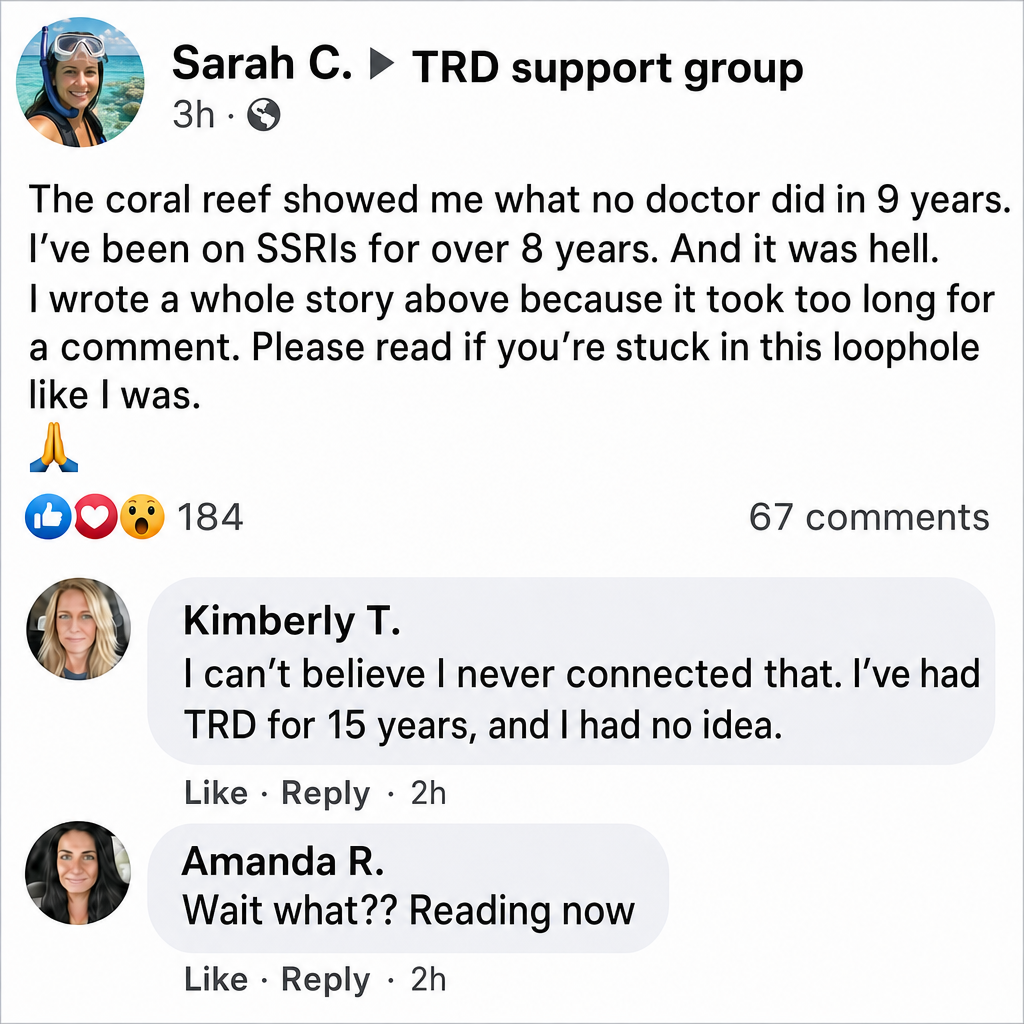
Ran for 33 days, from September 18 to October 21, 2026, the last day Crush saw it.
Run by Sarah Callahan on Facebook. Crush is not the advertiser and does not verify its claims. See this ad in Meta's Ad Library(opens in a new tab)
Make your own version of this ad
Crush makes it, launches it in your own Meta ad account, scales the winners and pauses the losers.
About this ad
- Meta Ad Library ID
- 1743985183504985
- Platforms
- Facebook, Instagram, Audience Network, Messenger, WhatsApp and Threads
- Relaunches
- 0
Ad text
I was diagnosed with treatment-resistant depression at 25. I'm 34 now. Turns out I never had treatment-resistant depression at all. I had something nobody screened me for, hiding in plain sight in the three or four "gut flare days" I had every month. For nine years, I "managed" a condition I didn't actually have. Nine years of antidepressants — Prozac first, then Lexapro when Prozac stopped holding, then Zoloft when Lexapro wasn't enough, then Wellbutrin added on top, then Effexor when the psychiatrist ran out of first-line options. Nine years of augmentation strategies. Lithium considered. Ketamine infusions proposed. Each new suggestion arriving with the same framing: "We just need to find the right combination." Nine years of therapy — CBT first, then ACT when CBT plateaued, then EMDR when the anxiety component resisted, then a mindfulness-based protocol my third therapist recommended, then group. Nine years of being handed a new supplement or lifestyle intervention: omega-3, magnesium glycinate, vitamin D, NAC, lion's mane, ashwagandha, cold exposure, morning sunlight, sleep hygiene protocols, the elimination diet, the exercise routine, the meditation app — and told to "just give it time." I did everything they asked. I stopped drinking. Then caffeine. Then anything that might dysregulate my nervous system. I did strict sleep protocols: same bedtime, same wake time, blackout curtains, white noise, no screens after 9 PM. I exercised every morning even when getting out of bed felt like climbing a cliff face. I bought every recommended supplement. Tried every evidence-based intervention I could find. I saw a psychiatrist in New York who charged nine hundred dollars for an initial consultation and had me do a full genetic panel, a methylation workup, a comprehensive thyroid panel, and a hormone profile. Everything came back "within normal range." Not abnormal. Not a clear cause. Within normal range. Which is what specialists say when they cannot find what they are looking for and do not want to admit it. She diagnosed me with treatment-resistant major depressive disorder with anxious features. She said the SSRI rotation and the augmentation strategy were the standard of care and I should also consider ketamine infusions if things didn't improve. I said I would think about it. I thought about it for two years. I could not do it. By year six I had been to four psychiatrists, two psychologists, a neurologist, a hormone specialist, an integrative medicine doctor in Connecticut who put me on a $700-a-month protocol that was mostly methylated B vitamins and liposomal glutathione. Nothing worked. I felt like I was crazy. The tests were normal. The doctors were not worried. But every single day I woke up with something heavy already sitting on my chest before I had even opened my eyes. By the time my alarm went off, I was already behind. I would lie there for a few minutes running calculations — how much I had to do, how little I felt capable of, whether I could get through the day without anyone noticing how far away I actually was. By 10 AM the brain fog would have settled. I would be sitting at my desk reading the same email three times and retaining nothing. By 2 PM the flat grey would descend. I would sit on the couch and not get back up until I had to start dinner. And the math never stopped. If I go to a social event, I need to plan an exit because I don't know how long I can hold a normal expression before it becomes work I can't afford. If I try to meet a friend for lunch, I need to choose somewhere close to home in case I need to leave. If I go to any event with a fixed end time, I need to warn whoever I'm with that I might need to go early. My housemate started covering for me everywhere. Making excuses when I cancelled. Handling things I had stopped being able to hold. He was twenty-eight years old and I was twenty-nine years old and he was quietly managing the parts of my life I had stopped being able to sustain. I resented that. Then felt awful about it. Then resented myself for being resentful. Then went back to lying on the couch waiting for the grey to lift. I stopped saying yes to anything. Trips. Gatherings. My best friend's engagement party because the idea of performing normalcy for four hours was more than I could negotiate with myself. I would be mid-sentence in a conversation and suddenly lose the thread entirely — just gone — and have to smile through it so the person I was talking to wouldn't notice. I stopped hosting anything in 2021 because I could not sustain the energy required to be present for a full evening. I also had what I called my "gut flare days" about three or four times a month. Bloating that built through the afternoon. Urgency I couldn't always predict. A dull heaviness in my abdomen that lasted maybe six hours, then faded. I would take an antacid, lie down, and it would pass. Nobody ever asked me about those flare days in nine years. I never thought to mention them. I had been told I had a mood disorder. The gut stuff felt like a separate thing. Probably IBS. Probably stress. Just life. I looked fine on the outside. Inside, something was muted and far away, and I never knew when the next flat day was coming. And every psychiatrist just nodded. "That's treatment-resistant depression. Adjust the dose. Try the augmentation. Consider the ketamine." I tried every approach. Nothing worked. I started to believe this was just my life now. That I would spend the rest of it managing the flatness and covering the distance and slowly disappearing from everything I had once been present in. Then my next-door neighbor said something no psychiatrist ever had. Elaine is retired. She spent thirty-one years as a clinical research nurse in a hospital in Providence, including fourteen years in a psychiatric unit. She saw more depression patients than I could count. We were talking over the fence one Sunday morning, and I was telling her I had missed my best friend's birthday dinner again the week before. She listened. She asked a question I have thought about a hundred times since. "James. When you get those gut flare days — the bloating, the urgency — do you notice the depression or the brain fog getting worse in the day or two that follows?" I almost laughed. "Yes. But I figured that was just from being exhausted from the gut stuff." She leaned on the fence. "Any anxiety with it? Any sense of being more wired and flat than usual the morning after?" I thought about it. "Always. But I thought that was just the disrupted sleep." She set down her coffee mug. "James. That's not a coincidence. Your depression and your gut flares are the same cascade. And the nine years of mood symptoms you've been treating as a brain chemistry problem are very likely coming from somewhere nobody looked — your gut." I stood there with my hand on the top of the fence. "What?" She walked me through it on a paper towel diagram, sitting at her kitchen table thirty minutes later. Ninety to ninety-five percent of the body's serotonin is produced in the gut — not the brain. In enterochromaffin cells embedded in the intestinal lining. When the gut environment is healthy and the bacterial balance is intact, those cells produce serotonin steadily. That serotonin regulates mood, energy, the stress response, and the sleep-wake cycle. It's the source material the brain runs on. But when harmful bacteria colonize the small intestine — which happens after antibiotics, after years of processed food, after chronic stress — they ferment everything you eat before your body can digest it. That fermentation produces hydrogen gas and inflammatory compounds. And those compounds don't stay in the gut. They enter the bloodstream. They travel up the vagus nerve — the direct highway from the intestines to the brainstem — and they reach the brain. They trigger a state of chronic low-grade neuroinflammation. They suppress BDNF — brain-derived neurotrophic factor, the compound the brain needs to maintain healthy neural connections. And simultaneously, the bacteria hijack the tryptophan pathway — diverting tryptophan away from serotonin production and into the kynurenine pathway instead, producing neurotoxic compounds like quinolinic acid that are directly implicated in depression pathology. Less serotonin at the source. More neurotoxic compounds in the brain. A nervous system locked in low-grade inflammatory emergency. That is the depression. That is the brain fog. That is the flat grey that descends by mid-morning even when nothing is wrong — because the signal coming from the gut says something is wrong, every single day, regardless of what is actually happening in your life. I sat there with my mouth open. She kept going. "Your genetic panels and thyroid panels were 'within normal range' because they were sampling systems that were structurally fine. Your brain isn't broken. It's receiving the wrong signals — inflammatory signals from below, from a gut that's been dysregulated for years. Not consistent enough to look like classic major depression with a clear biological marker. Not consistent enough to look like a hormone disorder. It looks like treatment resistance because it isn't a brain problem at all. It's the gut-brain axis." "You don't have treatment-resistant depression. You have a gut that has been sending inflammatory signals up to your brain three or four times a month for nine years — suppressing serotonin production at the source and flooding the neural environment with the compounds the inflammation produces." She told me why the antidepressants kept losing effectiveness. They work on the serotonin that already exists in synaptic clefts in the brain. They recycle what's there. But they do nothing to restore the gut's ability to produce serotonin in the first place — and nothing to clear the bacterial overgrowth that was diverting tryptophan into neurotoxic compounds and generating the neuroinflammation that suppressed BDNF. The dose goes up. It works for a while. The gut keeps deteriorating. It stops working again. The psychiatrist switches medications. At some point there is no SSRI left to try because you are not running out of medications. You are running out of serotonin capacity at the source. But there was one more thing she said that I hadn't been able to find in nine years of searching. "This isn't just about mood. The same bacterial overgrowth and gut inflammation that suppresses mood is being linked in the research to far more serious downstream effects. The gut produces inflammatory metabolites that cross into the brain. Mood disruption is just the first thing to show the problem. Adults with treatment-resistant depression are more than 200% more likely to die early — from cardiovascular disease, from suicide, from causes nobody connects to the diagnosis on the chart. The gut inflammation is doing damage everywhere. The psychiatrist is tracking the depression score. Nobody is tracking what the gut driving it is doing to the rest of the body." I went home in silence. I sat on my kitchen floor for fifteen minutes. Nine years. Four psychiatrists. Two psychologists. Thousands of dollars in panels and protocols. And nobody had ever asked me whether the three or four gut flare days I had each month might be connected to the nine years of depression I had been complaining about. I texted Elaine the next morning. "Okay. If you're right. What do I actually do?" She called me on her lunch break. "You need to address the cascade at the source. Not the mood symptoms. Not the brain signals. The gut itself — and specifically, the bacterial overgrowth that's generating the inflammation and hijacking the tryptophan." She told me why the standard approaches had all failed. The antidepressants recycled serotonin in the brain — not where the serotonin was supposed to be produced. The supplements and the methylation protocol addressed cofactors — not the bacteria generating the problem. The therapy helped me manage thoughts — not the neuroinflammatory environment generating the mood state those thoughts were responding to. And probiotics — every probiotic I'd tried — couldn't reach the problem. Standard capsule probiotics lose up to 80% of their viable cultures to stomach acid before arriving in the small intestine. And even the ones that survive arrive at a gut where the bacteria have built a fortress around themselves. A thick protective wall called biofilm that they secrete around their colonies — shielding them from the immune system, from antibiotics, from anything that passes through. The probiotic capsule bounces off the outside of that wall and the bacteria inside keep running the fermentation that keeps the inflammatory signals flooding upward. "You've been trying to treat the brain signals," she said. "That's downstream. The bacterial overgrowth is upstream of everything — the inflammation, the tryptophan hijack, the vagus nerve disruption, the serotonin suppression, the brain fog. If you can clear the overgrowth and dissolve the biofilm wall, you stop the cascade at the source." She told me about the only natural compound documented in peer-reviewed research to actually degrade the biofilm matrix itself — not suppress what's on the surface, not manage what's downstream, but dissolve the wall the bacteria are hiding behind. Raw honey. Specifically, unheated, unfiltered, never-pasteurized raw honey. Because here is what nobody had told me in nine years of supplement protocols. When honey is heated above 105 degrees Fahrenheit — which is what happens during pasteurization, which is what happens to every jar on a grocery store shelf — the specific enzymatic compounds that give it antimicrobial and biofilm-penetrating properties are destroyed. Glucose oxidase. Phenolic acids. Defensin-1. Gone. What is left is sugar. Sugar that feeds the bacteria. Raw honey — honey that has never been heated, still cloudy because the living enzymatic compounds are intact — degrades the biofilm matrix itself. The enzymes don't work around the wall. They dissolve it. The bacteria hiding behind it are exposed. And because the enzymes attack through multiple simultaneous mechanisms, no bacterial resistance to raw honey has ever been documented. There is no single point to evolve around. But dissolving the biofilm is only the first step. Once the wall comes down and the bacteria behind it are exposed and eliminated, the cleared space needs to be filled immediately with beneficial bacteria that can actually arrive and establish. A spore-forming probiotic — Bacillus coagulans MTCC 5856, a named strain with a published double-blind RCT at the exact dose — that builds its own protective shell, survives stomach acid completely sealed, and opens in the lower gut at full potency. Into the space the honey just cleared. Then the gut lining itself — which the bacteria and their biofilm have been disrupting for years — needs to be protected while it heals. Slippery elm bark forms a thick mucilaginous gel directly on the intestinal tissue. A physical protective layer on the enterochromaffin cells that produce 90-95% of the body's serotonin. The gut wall begins sealing. And the lining cells doing that repair need specific fuel. They replace themselves every three to five days and they run on L-Glutamine. Without it the lining stays damaged. With it the repair actually happens. The gut stops sending distress signals up the vagus nerve. And the brain — which had been receiving those signals for nine years — finally gets to calibrate in an environment that isn't flooded with inflammatory compounds telling it something is wrong. The formula Elaine described was Manna Gut Repair Honey. Raw Canadian Clover Honey — sourced from a single annual harvest in Alberta, never heated above the temperature of a natural hive, cloudy in the sachet because the biofilm-dissolving enzymes are still intact. The cloudiness is how you know. Clear honey has been heated and those compounds are gone. Bacillus coagulans MTCC 5856 — a named, spore-forming probiotic strain studied in a published double-blind randomized controlled trial at the exact dose in the formula. Builds its own protective shell. Survives stomach acid sealed. Arrives alive in the lower gut. Into the cleared space. Slippery elm bark at 1.7 grams — a real therapeutic dose. Forms a thick gel directly on the gut lining while the bacterial balance rebuilds underneath. L-Glutamine at 500 milligrams — the specific fuel the lining cells need to repair themselves every three to five days. So the wall seals. So the gut stops generating the signals that had been flooding the brain. One sachet. Every morning before food or coffee. I sat with that for two days. Then I ordered it. Week one: I noticed my gut flare that came on the Thursday was shorter. The bloating peaked earlier. The brain fog that followed the next morning was noticeably lighter. I noted it without letting myself read anything into it. Week two: I drove myself to my friend's house for the first time in over a year. Alone. I stayed for three hours. I followed every conversation. I drove home. Week three: I accepted an invitation to a birthday dinner. Twelve people in a restaurant. I sat through the whole evening. I did not count the exits. I did not plan my escape once. I drove home and sat in my car in the driveway for a few minutes. Not from relief at having survived it. Because I had just been to a birthday dinner and it had just been a birthday dinner. Week five: I went back to Queensland. It had been four years since I'd been there. Sarah took me out to the same spot on the reef. She handed me the gear. I went in. I stayed underwater for an hour. I did not want to come up. Week eight: I was walking in the evening. Late light, the sky doing something with color I could not have described. I stood there looking at it and something moved in my chest that I recognized from a long time ago. Not the flat thing. Something older. Week twelve: I went back to my psychiatrist. She looked at my PHQ-9 score. She asked what changed. I told her about my neighbor. The gut-brain pathway. The bacterial overgrowth generating inflammation and kynurenine compounds that traveled up the vagus nerve to the brain. The tryptophan hijack that had been starving the serotonin system at the source. The biofilm wall that every medication had been bypassing for nine years. The four-step sequence that finally reached the source. She listened. She wrote things down. She was quiet for a while. Then she said: "I am going to start asking my treatment-resistant patients about their gut. I should have been asking all along." Six months in: my best friend had a birthday dinner. I drove there. I stayed the whole evening. I helped her clean up the kitchen. I did not sit down once except to eat. She walked me out to my car at 9 PM. She hugged me for a long time. She said: "James. You were here. All of it. You were actually here." I had to sit in my car in her driveway for a few minutes because I could not stop crying. I do not have treatment-resistant depression. I never had treatment-resistant depression. I had nine years of bacterial overgrowth in my gut generating inflammatory signals that flooded my vagus nerve, suppressed serotonin production at the source, and hijacked my tryptophan into neurotoxic compounds — producing a depression that everyone, including me, had been treating as a brain chemistry problem. And not one person in a white coat had thought to ask me about my gut. If you have been diagnosed with treatment-resistant depression, or major depressive disorder with anxious features, or any label that comes with an SSRI rotation and a dose increase and an augmentation strategy. If your psychiatrist has told you your panels are "within normal range" and you should consider ketamine infusions or TMS if things don't improve. If you have stopped hosting. If you have stopped saying yes. If you sit near the exit and plan your escape before you've arrived. If you also have gut symptoms — bloating, urgency, unpredictability — three or four times a month and you have never connected them to the depression. I am not saying you definitely have gut-driven depression. I am not your doctor. I am saying I spent nine years being treated for a brain chemistry problem I did not have, while the real cause was firing from my gut every third week and nobody — not a single psychiatrist — ever asked me about the bloating I mentioned in passing. Manna is built for the cascade itself. One sachet before anything else in the morning. Four ingredients. The full breakdown — every depression treatment you have tried works downstream of the source. This one works at it. 100-day money-back guarantee. No return required. Three full months. If it does not change how you feel, every dollar comes back. After nine years of psychiatrists and antidepressants, what is three more months? trymannahoney.com/pages/7rw You don't have to keep managing a condition you might not actually have. P.S. I brought Elaine a bottle of wine last month. She refused it. She said she just wanted me to tell other people. So I am telling you. If you have been diagnosed with treatment-resistant depression and it has been years and nothing has held, please consider the possibility that your gut is the source. The depression is not separate from the gut flare days. The depression IS the neurological phase of a gut inflammatory cascade you have been having and not naming. P.P.S. There are cheap probiotic capsules everywhere that look like they should address this. They dissolve in stomach acid and never reach the small intestine. And even the ones that do arrive find the biofilm wall completely intact. Nothing reaches the bacteria. Nothing dissolves the wall. Manna uses raw honey with its biofilm-dissolving enzymatic compounds still alive — cloudy in the sachet, not clear. Clear honey has been pasteurized and those compounds are gone. Only available at trymannahoney.com/pages/7rw P.P.P.S. I drove my housemate to the airport last week. He sat in the passenger seat. He looked out the window and he did not say a word for the first ten miles. I asked him what he was thinking. He said: "I forgot what this felt like. Being driven by you." Neither of us said anything else for the rest of the drive.
Where the ad sends people
trymannahoney.com/pages/7rw
9 years of appointments failed to explain this
Manna Honey
Learn more: trymannahoney.com(opens in a new tab)