John Miller
John Miller Facebook ad: “Most dairy farms don’t have this tool in their parlor”
Ran for 44 days, from February 28 to April 13, 2026, the last day Crush saw it.
Run by John Miller on Facebook. Crush is not the advertiser and does not verify its claims. See this ad in Meta's Ad Library(opens in a new tab)
Want an ad like this for your product?
Crush makes new ad images for your product from this ad: your logo, your product photo, your offer.
Trials from $19.95 USD, then $79.95 USD a month. Cancel anytime.
About this ad
- Meta Ad Library ID
- 2929092950815188
- Platforms
- Facebook, Instagram, Audience Network and Messenger
- Relaunches
- 0
Ad text
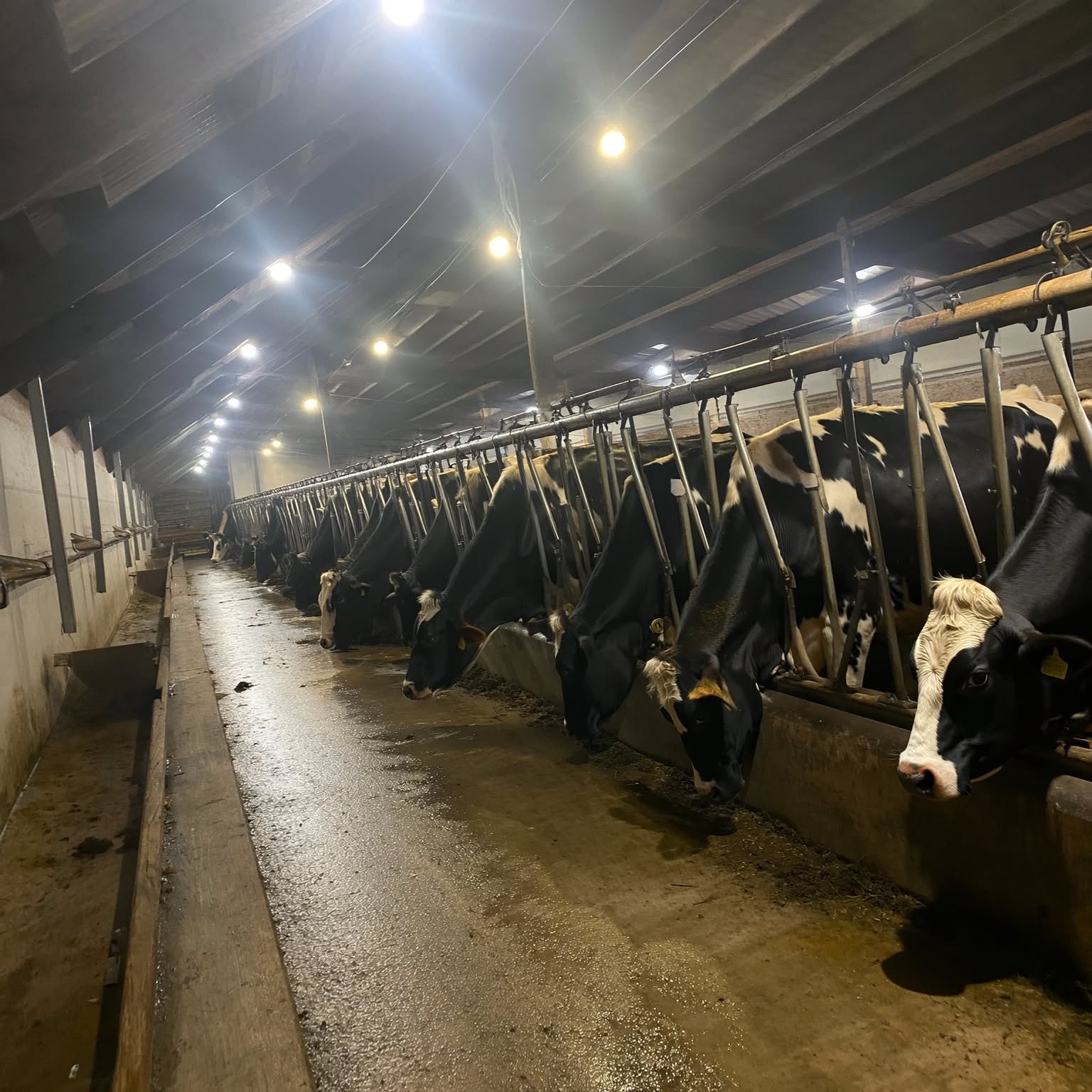
When your daughter walks away from a pharmaceutical research career in Madison to come home and milk cows, and you find her sitting on the parlor floor at 2 AM with 400 cows bellowing in the holding pen because the rotary hasn't turned in six hours and the udder pressure is building toward permanent damage, you don't want her thinking about the lab she left behind. Let me tell you what happened. We milk about 420 Holsteins on 800 acres of crop and pasture ground in the central Wisconsin dairy country. North of Marshfield where the glacial till gives way to loamy bottomland and the barns sit so close together on some roads you can smell three different operations from the same mailbox. Fourth generation. My great grandfather milked twelve cows by hand in 1941 in a barn he built from timber he felled himself. My grandfather put in the first pipeline milker. My mother built the freestall barn and installed the parallel parlor. I took over at twenty four when my mother's back couldn't handle the concrete floors anymore. My daughter Ava went to the University of Wisconsin. Biochemistry. Graduated Phi Beta Kappa. Had an offer from a pharmaceutical research company in Madison before her honors thesis defense was even scheduled. Starting salary and benefits package that would have had her earning more in her first year than this dairy has netted in any year of the last decade, and that's before you account for the health insurance that dairy farmers pretend they don't need because admitting they can't afford it would mean admitting the margins are exactly as thin as everyone says they are. She took it. Worked there two years and three months. Called me on a Saturday night in February, sitting in her apartment in Middleton watching the snow fall on a city that was clean and warm and had nothing to do with manure or milk prices, and said, "Dad, I spend my days running assays on compounds that won't reach a patient for twelve years. The work matters but I never see it matter. I want to see the work matter every day. I want to come home." She was in the parlor by Monday morning. Didn't even clean out her desk at the lab. Asked her roommate to box it up and ship it. Drove the two hours north in the dark, parked at the milk house, and walked straight into the parlor at 3:30 AM in time for first milking. Didn't change clothes. Hooked up the first cow in a blouse she'd worn to the lab the previous Friday. By the time morning milking was done she smelled like every other dairy farmer in Wisconsin and the blouse was in the trash and she was already pulling the maintenance logs on the rotary platform, cross referencing the service records with the downtime reports I'd been keeping in a notebook for the last five years. Found a pattern in the bearing temperatures that indicated the main drive gearbox was trending toward failure. Ordered the replacement parts that afternoon and scheduled the rebuild for the following dry weather window. Saved us from a catastrophic failure that would have shut down milking for three days during peak production. That's Ava. Sees the trend line, acts before the event. Here's what you need to understand about dairy. There is no season. There is no harvest window. There is no two week stretch where everything matters and the rest of the year you catch your breath. Dairy is every day. Twice a day. Three hundred and sixty five days a year. Christmas morning, the cows need milking. Your birthday, the cows need milking. The morning your mother dies, the cows need milking. There is no pause button. There is no rain delay. The biological clock of a lactating Holstein does not care about your schedule, your equipment, your finances, your grief, or your sleep. A cow produces milk continuously. The udder fills. Pressure builds. If that pressure is not relieved by milking every twelve hours, the tissue begins to suffer. Within eighteen hours, the risk of mastitis, an infection of the udder tissue, increases sharply. Mastitis causes swelling, fever, pain, and contamination of the milk with somatic cells that make it unsaleable. A severe case can destroy a quarter of the udder permanently. A cow that loses a quarter never produces at full capacity again. She becomes a three quartered cow in a four quartered economy, and the math never recovers. One missed milking is a discomfort. Two missed milkings is an emergency. Three missed milkings and you're looking at a veterinary crisis across the entire herd, with permanent production damage, treatment costs, and culled cows that represent $2,500 each in replacement value. Our rotary milking parlor handles 420 cows in roughly four hours per milking. The platform turns continuously. The cows step on, the prep crew cleans and attaches the units, the rotary carries each cow through the milking cycle, and the cow steps off at the exit gate. It's a carousel that smells like iodine and warm milk and runs on hydraulics and precision and the willingness of four hundred and twenty animals to cooperate with a machine that spins them in a slow circle while a vacuum removes the thing their bodies are built to produce. When the rotary stops, the cows don't stop producing milk. They just stop being milked. The clock starts immediately. Last November, the rotary stopped. Tuesday night. 9:47 PM. Ava was running second milking, halfway through the herd, 200 cows milked and 220 still in the holding pen, when the platform shuddered, ground against something metal, and went still. The rotary drive gearbox had a main output shaft coupling bolt that had worked loose from the constant torsional vibration of turning a 60,000 pound platform loaded with fifteen cows through 360 degrees of rotation, twenty four times per hour, fourteen hours per day, every single day since the rebuild Ava had done eight months earlier. The bolt backed out far enough that the coupling lost positive engagement, the drive shaft slipped, and the platform stopped mid rotation with cows standing on it looking confused and the holding pen full of cows that needed to be milked within the next six hours to stay inside the twelve hour window. Not a gearbox failure. Not a cracked platform or a seized bearing. A single coupling bolt. Seat it, torque it, and the shaft re engages, the coupling locks, and the rotary turns. Ava had the bolt. She always had the bolt. The month she came home, she inventoried every critical fastener on the rotary, the backup parlor, the feed mixer, the skid loader, the manure pump, and all three tractors. Built the inventory in a lab notebook format because two years of pharmaceutical research had made that the only organizational structure her brain would accept. Every bolt catalogued by equipment, assembly, thread specification, material grade, torque value, and a failure probability column generated by a statistical model she'd built using our maintenance logs as the data set. The rotary coupling bolt had the second highest failure probability on the entire farm. She'd ordered six replacements in August. They were sitting in a labeled specimen jar on the parts shelf. Pharmaceutical discipline. She managed replacement parts the way she managed reagent stocks, never below minimum, always verified, always ready for the next run. The bolt sat in a pocket between the rotary drive gearbox housing and the platform support frame. Less than an inch of clearance. Gearbox casting on one side. Support frame beam on the other. Drive belt guard bolted across the top. Milk line manifold and vacuum lines routed along the bottom. And everything was wet. Not damp. Dairy parlor wet. Milk wash, iodine solution, manure splash, and the persistent humidity of four hundred warm animals breathing in an enclosed space. Every surface was slick, warm, and smelled like the inside of a working dairy because that's exactly what it was. Ava could see the bolt hole. Could start the bolt one and a half turns with her fingertip. She spent five hours on it alone before she came to find me in the house. Five hours. That's Ava. At Wisconsin, she once spent an entire week rerunning a high performance liquid chromatography analysis that her advisor said was within acceptable parameters. Ava said acceptable parameters were a confession that you'd stopped looking for the real answer. Reran the analysis from sample prep through data processing, found a co eluting impurity that had been skewing the results for the entire research group for two semesters. Published the correction. Same refusal to accept good enough that makes a great researcher makes a daughter who will lie on a wet parlor floor until her back seizes before she admits a bolt beat her. She walked into the kitchen at 3 AM. Coveralls soaked. Hands red and raw from dairy wash chemicals and gearbox grease. A deep scrape across three knuckles on her right hand from the belt guard bracket. Iodine and manure on her boots. Hair pulled back and damp from the parlor humidity. Voice flat. Controlled. The tone she uses when the experiment has failed and the results have to be reported whether she likes them or not. "Rotary drive coupling bolt. I can thread it. I can't get a tool behind the frame to torque it. And we've got 220 cows that haven't been milked since this morning." I was in the parlor in five minutes. Bare feet in muck boots because I didn't have time for socks. Full socket set, headlamp, every extension and adapter I owned. Tried everything Ava had tried. Tried things from twenty eight years of running a dairy that pharmaceutical research doesn't prepare you for. Standard ratchet. Handle hit the platform support frame before the socket reached the bolt. Not close. And the handle was slick with milk wash. Couldn't grip it even if it had fit. Stubby ratchet. Got into the pocket. Couldn't reach the bolt depth. Short by two inches. Could see the bolt sitting in its recess behind the frame, and behind me I could hear 220 cows shifting and lowing in the holding pen, the sound of an animal that needs to be milked and isn't being milked, a sound that dairy farmers hear in their worst dreams. Flex head ratchet. Flexed into the belt guard the moment I leaned on it. No engagement. And the flex joint was slick with the film of dairy atmosphere that coats everything in a parlor. Deep socket on a long extension. Extension too wide for the gap between the gearbox and the frame. Would not enter the space. Wobble socket on a shorter extension. The wobble, combined with everything being wet and slippery, meant zero chance of centering on the bolt hex. Socket walked off three times. Fourth attempt I dropped the socket into the drain channel under the platform and spent ten minutes fishing it out of six inches of milk wash and manure water. Universal joint adapter. Torque went everywhere except the bolt. The adapter was wet, the drive was wet, my hands were wet. Couldn't feel anything. Working blind behind the frame. Like trying to tie a knot while wearing oven mitts. Crow foot wrench. Wrong profile. Body contacted the gearbox casting before the jaws could reach the bolt. And in the background, 220 cows getting louder. Getting uncomfortable. The clock running on every single udder in the building. Cut my palm on the belt guard bracket. Scraped both forearms raw on the platform frame. Pinched my ring finger between the gearbox housing and the vacuum line manifold hard enough that it went purple within the hour. Ava was beside me through every attempt. Handing tools in sequence. Methodical. Calm. The way she'd hand pipettes in the lab, precise, annotated, already knowing the result but requiring confirmation before proceeding to the next variable. Ratchet. Extension. Stubby. Flex. Wobble. Universal. Crow foot. All tested. All failed. All recorded. Zero remaining options. None of them worked. By 8 AM Wednesday, we had ten combined hours on one bolt. And 220 cows that hadn't been milked in over eighteen hours. You could hear it. Not just the bellowing. The discomfort. The shifting. The cows pressing against the holding pen rails. Udders visibly swollen. Teats distended. Some cows were already dripping milk onto the concrete, which is the body's last resort before tissue damage begins. Two hundred and twenty animals in escalating physiological distress because of one bolt we couldn't turn. That's when Ava stepped back from the gearbox. Pulled off her gloves. Sat down on the parlor floor. Wet concrete, manure, milk wash, all of it. She didn't care. Put her hands in her lap. Palms up. And looked at them. And that's when I saw it. Not on her face. Ava doesn't show things on her face. She learned that in the lab, where failed experiments are daily occurrences and emotional attachment to a hypothesis is a cardinal sin. I saw it in her hands. The way she held them open, like instruments that had exhausted their protocol. The kind of thing only a father reads. She'd turned down Madison. Walked away from the lab. Left the salary and the benefits and the climate controlled clean room and the career trajectory that had her on track for a principal investigator position by thirty five. Left the apartment in Middleton where the floors were always dry and the air never smelled like manure and nobody expected her to be awake at 3 AM. Left the man she'd been seeing, a research chemist at the same company who understood twelve hour days and never complained about the smell of laboratory solvents on her clothes. Left because she believed these cows and this ground and this parlor were worth more than any compound she could isolate in a flask. Because she believed her hands and her mind and her willingness to work every single day without a day off could keep this dairy running for one more generation in a state where three dairy farms close every single week. And here she was. Ten hours into a bolt she couldn't turn. Watching her father fail at the same one. Two hundred and twenty Holsteins in the holding pen, udders swelling, the biological clock ticking toward mastitis in every single one of them. Not a storm on the radar. Not a freeze in the forecast. Something worse. Something that doesn't care about weather or seasons. The simple, relentless, non negotiable biology of a lactating animal that has to be milked or it will be damaged, and the damage will be permanent, and the math will never recover. Called the dairy equipment dealer in Marshfield. "Our service crew is on a rotary installation job in Marathon County. Can't get anybody to you until maybe Thursday afternoon." The cows needed milking now. Called two independent dairy mechanics. First one was already on a job at a dairy near Spencer replacing a pipeline. Said maybe tomorrow. I didn't explain that tomorrow was eighteen hours too late. Second one had retired in October. His voicemail still listed his business name. I left a message anyway. That's when the muddy gray Chevy with the Dairy Farmers of Wisconsin sticker on the tailgate pulled into the milk house yard. Lyle Sorensen. Seventy nine years old. Milked cows in Clark County for fifty four years before his knees and his cardiologist jointly insisted he sell the herd. Still drove out every morning at 4 AM because fifty four years of milking at 4 AM had rewired his circadian rhythm so thoroughly that sleeping past 4:15 made him physically anxious. Somebody at the feed mill told him our rotary was down. He walked into the parlor the way old dairy men walk into parlors, eyes on the floor first checking for slip hazards, then the pipeline, then the receiver jar, then the cows, reading the entire operation in a single sweep the way his generation reads a dairy, by sound and smell and the posture of the animals. Looked at the rotary. Looked at the pocket. Looked at the tools laid out on the parlor floor like a tray of failed medications. Heard the cows in the holding pen. His face changed. Just for a second. The face of a man who has milked cows every day of his adult life hearing cows that need to be milked and aren't being milked. Then it went still again. Looked at Ava. "Madison?" he asked, nodding at the faded red W on her cap. "Pharmaceutical research. Two years at a drug company. Came home last spring." Lyle nodded. "Researchers always find the problem. Just don't always carry what reaches where it needs to go." He paused, listening to the cows. "Let's not make them wait any longer." Walked back to his truck. Came back with a flat steel tool. About 15 inches long. Thin as a ruler. Socket fitting on one end. Square drive on the other. Housing worn smooth from years of dairy parlor humidity and wash chemicals and the particular patina that accumulates on any tool that lives in a Wisconsin milk house. A strip of old milking inflator rubber wrapped around the middle where the original grip had worn through, because dairy farmers fix everything with inflator rubber and hose clamps and stainless wire. "Offset extension wrench," he said. "Fellow who sells parlor chemicals out of a warehouse in Fond du Lac put one of these in my hand back in 2015. I used it every week for the last eight years I milked. Doesn't matter if it's wet, doesn't matter if it's slippery, doesn't matter if you can't see the bolt. Goes in, seats, turns. On a dairy, that's the difference between milking and not milking." He stepped to the gearbox the way old dairy men step to anything that's standing between a cow and a milking machine, with urgency that doesn't look like urgency, speed that doesn't look like speed, the efficiency of a man who has spent fifty four years understanding that cows can't wait and everything else can. Angled the socket end into the pocket between the gearbox housing and the platform frame. Past the belt guard. Under the vacuum manifold. Into the counterbore where the bolt sat. Smooth and certain, even on the wet surface, even with parlor slick on every surface, the socket finding the bolt head the way a milking unit finds a teat, by feel, by repetition, by ten thousand milkings worth of hands that know how to work in the wet and the dark. Socket seated on the bolt head. Clean. Solid. He looked at Ava. "Your parlor. Your bolt." Ava took the drive end. Applied rotation. Steady, measured force. The same incremental, calibrated pressure she used loading a chromatography column, deliberate, precise, trusting the instrument. No sudden movement. No forcing. Bolt seated. Coupling engaged. Drive shaft locked. Platform turned. Forty seconds. Forty seconds for a bolt we'd spent ten hours fighting. While 220 cows waited. The moment the rotary started moving, Ava didn't hold the tool. Didn't examine it. Didn't say a word about chain drives or torque ratios. She put the tool down, turned to the holding pen gate, and opened it. First cow stepped onto the platform. Unit attached. Milk flowing. The sound of the vacuum pulsing and the milk hitting the receiver jar is the most ordinary sound on a dairy farm and at that moment it was the most beautiful sound either of us had ever heard. She milked for three hours straight. All 220 cows. Didn't stop. Didn't eat. Didn't sit down. Prepped, attached, stripped, dipped, every cow, checking every udder for heat and swelling as she went. Found eleven cows showing early signs of mastitis from the extended interval. Started treatment on all eleven before she took her gloves off. Then she went back to the gearbox, picked up the wrench, and held it. Turned it over in her hands. Slowly. Felt the chain transfer rotation from one end to the other. Ran her thumb along the housing. "Chain driven parallel transfer. One to one ratio. Zero arc at the output." Lyle was sitting on a milk crate by the bulk tank, drinking coffee he'd made in our milk house, watching her with the expression of a man who has just watched someone save a herd and then stop to understand how. "I've been calling it my milking miracle for eight years. That's the first time it's been diagnosed properly." Both milkings ran on schedule that day and every day since. But the damage was done. Those eleven cows with early mastitis, seven recovered fully with treatment. Four did not. Two lost function in one quarter permanently. Two others had somatic cell counts that stayed elevated for the rest of the lactation, which meant their milk had to be diverted during treatment and their production never returned to baseline. The four affected cows represented a combined production loss of roughly 9,200 pounds of milk over the remainder of the lactation, plus treatment costs, plus the reduced salvage value of two cows that had to be culled early because three quartered cows don't pencil in an operation running margins this thin. Final damage: roughly $14,000 in lost milk revenue, veterinary treatment, and premature culling costs. From one bolt we couldn't turn for ten hours on a Tuesday night. While the cows waited. That weekend, Ava ordered the same tool Lyle had brought. Ordered seven. One for the rotary parlor. One for the backup parlor. One for the feed mixer. One for the skid loader. One for the manure pump. One for the tractor. One for the milk house wall, mounted on a stainless bracket she fabricated herself with the part number engraved below it, because dairy parlor humidity and wash chemicals and ammonia will destroy any other labeling material inside of a month. Eighty nine dollars each. Adapters not included, runs a standard half inch square drive, you use your own sockets. Since then, we've used them more times than either of us can count. Three times on the rotary. That same coupling bolt again six months later, same vibration pattern. A platform bearing retainer bolt buried behind the rotary frame in a space the manufacturer apparently designed assuming dairy mechanics have arms that bend in three places. And a milk line manifold bracket bolt recessed behind the vacuum header where the service manual says to drain the entire system and remove the manifold, a four hour job that Ava did in fifteen minutes between milkings. Twice on the feed mixer. Auger drive chain tensioner bolt wedged between the mixer tub and the frame rail. Discharge door hinge bolt crammed behind the hydraulic cylinder mount in a gap that collects TMR and silage until the bolt is practically fermented into the steel. Once on the manure pump. Impeller bolt buried behind the pump housing and the discharge pipe flange. Pump went down during a full pit. Would have been a half day job to access conventionally. Ava did it in twenty minutes. Once on the skid loader. Bucket cylinder pin bolt recessed behind the loader arm and the frame. Bolt worked loose during feeding. Bucket wouldn't hold position. Four hundred cows waiting for TMR and the loader was sitting dead. Ava had it running before the cows noticed the delay. Once on my truck. Starter bolt on the old Silverado that sits between the block and the bellhousing in a space Chevy apparently designed to punish anyone who has the audacity to own a truck in dairy country. And two weeks ago, a young man who'd just taken over his family's dairy south of us near Pittsville called the milk house. First year running the operation on his own. Twenty three years old. His parlor's vacuum pump drive bolt had backed out during evening milking. Seventy cows waiting. No backup parlor. No mobile mechanic available. His voice was shaking. Not from fear. From the sound of his cows in the background. Ava didn't ask a question. Pulled the wrench off the milk house wall. Said "I'm coming" and was in her truck before he finished giving directions. Drove over. Bolt seated in under ninety seconds. Milking resumed within five minutes. The kid stood in his parlor looking at the tool. Then at Ava. Then at the tool. Then at his cows, finally being milked. "Where has this been my whole life?" Ava texted him the link from the milk house parking lot before she pulled out. Clean. No explanation. Researcher's efficiency, deliver the finding, move on. He ordered three that night. Here's what nobody tells you when your child gives up their career to come home to a dairy. This equipment isn't built for the parlor. It's engineered in climate controlled design facilities and tested in dry, well lit service bays by technicians who charge $195 an hour and are booked solid for every emergency, because on a dairy there is no season and every day is an emergency day and the cows do not stop producing milk because your equipment broke and the mechanic can't come until Thursday. Every bolt that matters is buried behind a gearbox, a frame beam, or a guard. Every breakdown is a race between your toolbox and the cow. Not the weather. Not the forecast. The cow. An animal that cannot be told to wait. An animal that will be damaged if she does wait. An animal whose biology does not negotiate with your tools or your schedule or your ability to reach a bolt in a space that was designed by someone who has never smelled the inside of a milking parlor at 3 AM. And every hour you can't fix it is another hour your daughter sits on the wet parlor floor with her hands in her lap, listening to her cows calling from the holding pen, silently measuring the distance between the career she left and the one that just stopped her cold with a bolt she can see but cannot turn while 220 animals that depend on her stand there needing the one thing she came home to provide and can't. But when you've got something that reaches into those impossible pockets. Something thin enough to slide past the casting and the guard and the frame and the manifold. Something with a chain drive inside that transfers real torque without needing swing room or an arc. Something that works wet, works slippery, works in the dark, works at 3 AM when the cows can't wait another hour. Those "pull the gearbox, call the dealer, wait two days" disasters become twenty minute parlor fixes. And parlor fixes mean the rotary turns. The cows step on. The milk flows. Your kid sees the problem solved. Sees the herd healthy. Sees that the decision to come home, the lab she walked away from, the salary she left, the future she traded for wet concrete and 3 AM alarms and the chance to keep her great grandfather's dairy alive for one more generation, all of it was right. It's called the PRO Offset Extension Wrench. About 15 inches long. Half an inch thick. Chain drive inside transfers rotation where ratchets can't swing. Adapters not included, runs a standard half inch square drive, you use your own sockets. Eighty nine dollars. Less than one bulk tank pickup of milk. Less than fifteen minutes of dealer labor. Less than one percent of what those ten hours of downtime cost us in mastitis, treatment, and culled cows. I'm not going to tell you this tool will save your herd. But there's going to come a milking. Not the worst morning of the worst season. Just a Tuesday. Just a regular Tuesday night milking. When your daughter walks into the kitchen at 3 AM with dairy wash on her hands and a photo of a bolt she can't reach. Or your son calls from the parlor with 200 cows waiting and his voice barely holding. Or you're lying on the wet concrete floor yourself, bleeding from your knuckles, reaching into some gap behind a gearbox that mocks every tool in your box, while the cows call from the holding pen and everything, the herd, the milk, the udders, the money, the kid who chose this life over the one that was waiting for them, all of it comes down to one bolt in one impossible space. When that milking comes, you either have the tool or you don't. We didn't. Now we do. Every parlor. Every mixer. Every machine on the dairy. Mounted, labeled, and exactly where you can grab it at 3 AM when the cows can't wait and one bolt is all that's standing between you and getting the milk flowing. Link's below. I hope you never need it the way we did.
Where the ad sends people
thesavary.com
Most dairy farms don’t have this tool in their parlor👆
Savary
Shop now: thesavary.com(opens in a new tab)