Age Spot Reset
Age Spot Reset Facebook ad: “This helped me a LOT”
Ran for 15 days, from July 4 to July 19, 2026, the last day Crush saw it.
Run by Age Spot Reset on Facebook. Crush is not the advertiser and does not verify its claims. See this ad in Meta's Ad Library(opens in a new tab)
Want an ad like this for your product?
Crush makes new ad images for your product from this ad: your logo, your product photo, your offer.
Trials from $19.95 USD, then $79.95 USD a month. Cancel anytime.
About this ad
- Meta Ad Library ID
- 36978103995136751
- Platforms
- Facebook, Instagram, Audience Network, Messenger and Threads
- Relaunches
- 0
Ad text
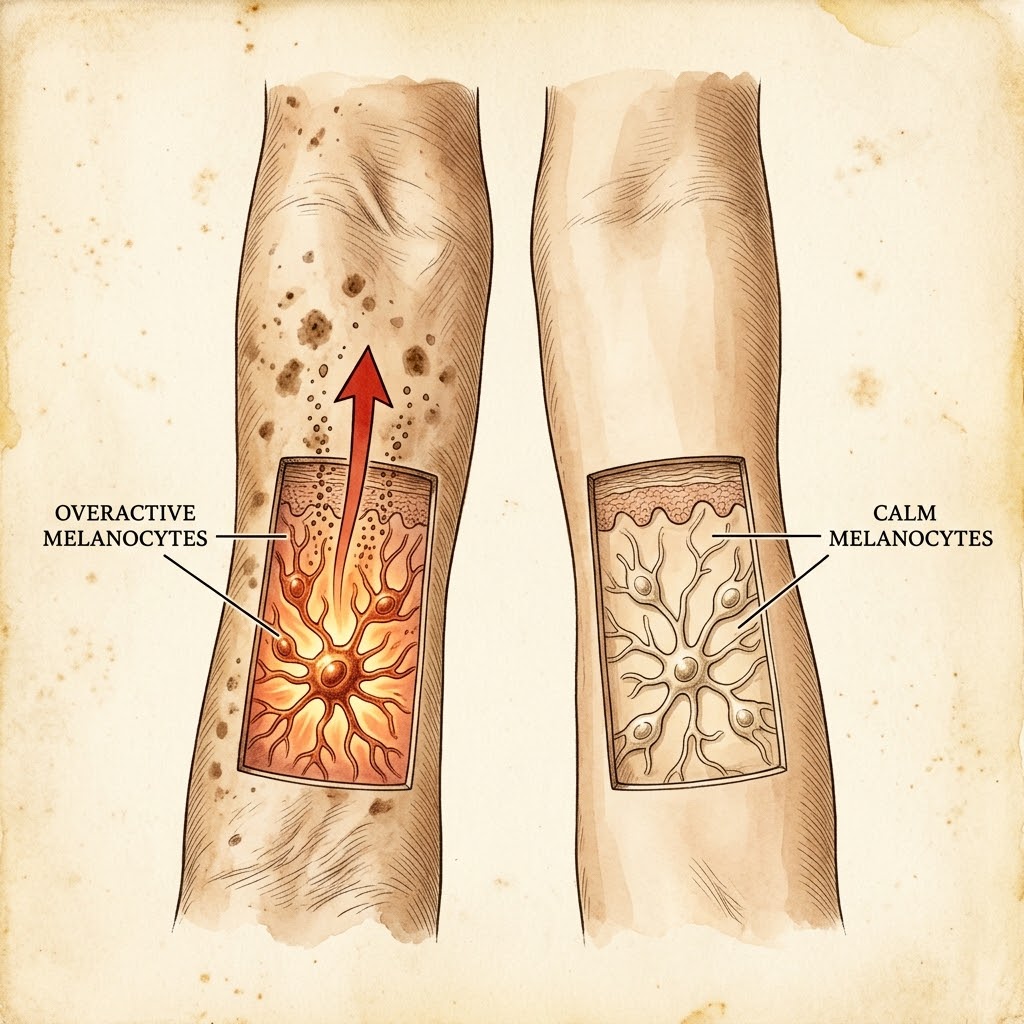
I saw a statistic that stopped me cold. Women who spent 20 or more years hiding their arms in public are 64 percent more likely to report severe depression and social withdrawal by age 70 than women who never developed age spots. Not a little more likely. Not the same. Sixty-four percent. I didn't believe it when I read it. I'd had dark spots spreading across my arms and hands for almost 18 years and not one doctor had ever mentioned my quality of life. But here's the truth. Your dermatologist looks at your skin. Your GP looks at your labs. The shame living between your sleeves and your confidence? Nobody is paid to look there. That's why most of us never heard this. That's why my mother never heard it either. My mother was part of that statistic. Eighteen years of brightening creams, concealer, and long sleeves in August. Refused to go to her own granddaughter's pool party at 69 because she didn't want anyone to see her hands. I'm 63. Last spring my dermatologist told me to try a stronger hydroquinone prescription and come back in six months. I left the office and cried in my car. And what I found instead... in a small apothecary tucked behind a farmers market in coastal Georgia... took me from covering both arms every single day and refusing to be photographed... to wearing a tank top at my nephew's wedding. No prescription. No concealer. But to understand why I was desperate enough to drive four hours to a farmers market on a Tuesday morning, you have to know what I watched those creams do to my mother. And what I didn't realize they were quietly not doing for me either. For 18 YEARS... nearly two decades... my mother was trapped chasing a fix that never came. Started with drugstore fading creams. Her dermatologist called them "the first line of defense." Said they'd fade the spots gradually, that was just how it worked. The spots did lighten. For about a month. Everything else got worse. Within the first year the dark patches came back twice as deep every time she stopped using the cream. Doctor said her skin just needed a stronger formula. By year three the spots had spread from her hands to her forearms and up toward her elbows. She started buying foundation two shades lighter just to blend them out. Her confidence? Gone. This was a woman who had worked the front counter of the family hardware store for 28 years, shaking hands with every customer who walked in. By year four she wore linen gloves to church. In June. The spots kept spreading. New ones appearing faster than the old ones faded. Her wedding ring... she stopped wearing it because she didn't want people looking at her hands long enough to notice. And every time we brought it up, her doctor said the same thing. "Your skin looks stable, Dorothy. The spots are just sun damage from years ago. You need a stronger cream and more SPF." She was wearing SPF 50 every day. Staying out of the sun. A stronger cream wasn't the answer. My sister said it was like watching her disappear behind her own sleeves one summer at a time. They had her on those creams for EIGHTEEN YEARS. Eighteen years of the spots spreading. Eighteen years of feeling like a stranger in her own body. Eighteen years of appointments where they'd prescribe a stronger formula or a different brand... but never once... not ONE TIME... did anyone say, "Maybe something inside is still driving this that no cream can touch." And then she died at 71 having never once gone swimming with her grandchildren. Never once let anyone photograph her bare arms. Never once wore the sleeveless dress my father bought her for their 40th anniversary. At her funeral my sister grabbed my hand and said something I'll never forget. "For 18 years they told her it was just cosmetic, Margaret. Just use more sunscreen. They were wrong the whole time." So fast forward to eight months ago. I'm 63. The spots started at 45. I've been a good patient. Vitamin C serum every morning. SPF every day without fail. I tried kojic acid for a year. Alpha arbutin for eight months. A prescription retinol for two years. One round of laser that cost me $1,800 and faded back within six months. The spots are still there. Darker than ever on my left hand. Spreading up my right forearm. I go to my annual skin check. Dermatologist looks at my arms. Looks at her notes. "Margaret, the laser result didn't hold as well as we hoped. Your melanin production seems to be overactive for your age. I'd like to try a stronger hydroquinone compound and we can do another laser session in the spring." My stomach dropped. Another laser session. Eighteen years of watching my mother hide behind linen gloves because she was too ashamed of her hands. Eighteen years of creams and SPF and still watching the spots spread. And none of it had held. "No," I said. She blinked. "Excuse me?" "I'm not doing another laser. My mother spent 18 years on fading creams. I watched what they did to her. And I watched her die having never once gone sleeveless in summer." She gave me that look. "Margaret, melanin overproduction is difficult to reverse. The laser…" "If it worked, why did it fade back?" She didn't have an answer. I told her to give me six months. She wasn't happy. Wrote something in my notes. I didn't care. For three months I did everything right. Doubled my vitamin C. Added niacinamide. Wore a wide-brimmed hat every time I stepped outside. Drank more water. Three months later the spots were the same. One new patch appearing near my wrist. I made another appointment. She pulled out her referral pad. "Margaret, it's time for the laser." "Give me three more months." "Margaret, the window for—" "Three more months." She sighed. I didn't care what she wrote. That night I couldn't sleep. I kept thinking about my mother. Same spots. Same creams. Same skin getting worse right up until the end. At 2 AM I gave up. Went downstairs. Opened my laptop. I started searching. What actually causes age spots to keep spreading. Why the serums never hold. Why some women get darker and darker even when they do everything right. Every site said the same thing. Use your SPF. Add vitamin C. Avoid the sun. See a dermatologist. I'd done all of it. So I kept digging. Looking for women who'd actually reversed this. Not concealed it. Reversed it. That's when I found the thread. A Facebook group post with over 3,200 comments. The title... "Why don't Greek island women get age spots the way we do?" I almost scrolled past. But something made me click. Ikaria, Greece. Skin aging rates among women over 65 measured significantly lower than US and Northern European counterparts. Not a little lower. Researchers had been studying it for years. Comment after comment. Stories. Links to studies. Photos of women in their late 70s, hands and forearms smooth and even-toned, working in gardens and markets. Someone in the comments mentioned a small apothecary. A woman named Elena. Coastal Georgia. Said she'd trained with formulators in Greece and brought the methods back. I looked at the clock. 2:31 AM. By 6 AM I was in my car. By 10 AM I was parking outside a farmers market two counties over. I didn't have much to go on. Just a name. Found her at a small table near the back of the market, behind rows of amber glass bottles and dried herb bundles. She had to be in her mid-70s. Small. Unhurried. Dark silver hair twisted back loosely. She was labeling bottles with a fine-tip pen without looking up. Clear, even hands. Not a spot in sight. I walked over. By the time I reached the table I was automatically pulling my sleeve down over my left hand out of habit. "Excuse me," I said. "Are you Elena?" She looked up with steady, dark eyes. "I am." I stood there. 63 years old. Hiding my hands at a farmers market at 10 AM. This woman more than a decade older with hands I hadn't had at 40. "I'm 63," I said. "I've had dark spots spreading for 18 years. My dermatologist wants me to do laser again. My mother spent 18 years on fading creams. She never got her skin back." She set down the pen. Looked at me for a long moment. "You drove a long way," she said. "Let me show you something." She pulled a stool from behind the table and gestured for me to sit. "Your serums," she said. "They're working on the wrong part of the problem." I didn't understand. "There are two parts to what you're seeing on your skin. The color sitting in the surface. And the signal underneath that keeps producing it. Your serums and your laser, they can only reach the color on top." She folded her hands on the table. "But the color is just the symptom. The real problem is the signal. Your melanocytes, the cells that make pigment, they've been switched into overdrive. And that switch doesn't sit on the surface of your skin. It sits deep in the dermis. It's triggered by decades of UV exposure that already happened. The sun damage is done. Your skin just never got the message to stop reacting to it." "That signal... that overdrive switch... it keeps firing. Every day. Telling your skin cells to produce more pigment than you need. More than your body can clear. So the spots sit. And they deepen. And new ones form." She looked at me steadily. "Your serum fades what's on top. Your laser breaks up what's already there. But neither one reaches the switch. So the switch keeps firing. And six months later the spots are back. Sometimes darker." My eyes started to sting. "That's why your laser faded back. That's why your vitamin C helps for a season and then stalls. You are fighting the color on the surface while the factory underneath keeps running at full speed. And no serum your dermatologist can prescribe will turn that factory off." She leaned back. "That's why your mother's spots kept spreading no matter what she applied. The creams were real. The vitamin C was real. The SPF was real. But the signal underneath kept firing and nobody ever touched it." I asked her how she knew all this. She smiled. Small and unhurried. "My mother was a formulator. Her mother before her. In the islands the women have always used certain plant oils, not on the skin... in the skin. Pressed from cold. At the right time of year. The difference between those oils reaching the dermis and sitting on top of it is everything." She reached under the table and brought out a small amber bottle. Dark gold inside. Almost copper. "The oils your drugstore sells are processed with heat. Heat breaks down the molecules that matter. What's left can moisturize. It cannot signal. It cannot reach the dermis. It cannot talk to the melanocytes." She held the bottle up to the light. "The right oils, cold-pressed, the right botanical compounds at the right concentration, they absorb into all seven layers of the skin. They reach the dermis. And they carry a signal that tells your melanocytes to slow down. To stop overproducing. To let the spots your body already made start clearing naturally." She set it down. "Sea buckthorn for the skin barrier. Bakuchiol to signal cellular turnover without irritation. Oil-soluble vitamin C that actually reaches the dermis instead of sitting on the stratum corneum. Camellia oil as the carrier because nothing else absorbs as cleanly." She looked at me. "Fix the signal from inside the skin. Give the melanocytes a reason to slow down. Let your body clear what it's already made. That's it. That's all of it." I asked her if there was a product made this way. She nodded slowly. "One that I know of that gets the formulation right. Cold-pressed. No filler oils. The right actives at the right concentration. No water diluting the penetration." She wrote the name on the back of a small card and handed it to me. Dermiqua. I ordered a bottle from the parking lot before I'd even started my car. Arrived three days later. I applied it that evening. Both hands. Up my forearms. Sat on the back porch and let it absorb. It disappeared into my skin in minutes. No grease. No residue. Just warmth. I went inside and looked at my arms in the bathroom light. Same as the morning. Too early. Week one. The edges of the spots on my right hand looked softer. Less defined. I stopped reaching for the concealer every morning out of habit and then catching myself in the mirror. I slept well three nights in a row, which sounds unrelated until you realize how much of my nighttime restlessness was low-grade shame. Week two. The largest patch on my left forearm was visibly lighter at the edges. My daughter called and I was standing at the kitchen counter with bare arms without thinking about it. I noticed halfway through the call and didn't move to cover them. Week three. My hands. The spots I'd been looking at every morning for years. Fading. Not gone. But fading in a way the serums never achieved. I checked them four days in a row in the same light to make sure I wasn't imagining it. Week four. I took a photo of my left hand and pulled up a photo from eight weeks earlier. I sat with both images for a long time. The patches hadn't disappeared. But the depth was gone. The angry darkness was lifting. More than half the discoloration fading in four weeks. Without changing anything else. My follow-up with my dermatologist was at the end of month two. She looked at my arms before she even pulled up my chart. Stopped. Looked again. "Margaret. What did you change?" I told her. The farmers market. Elena. The cold-pressed oils. The melanocyte signaling. The seven-layer absorption. She pulled her stool closer and looked at my left forearm under her light. Long pause. "I want to see you again in eight weeks. Do not stop whatever you're doing." Eight weeks later she took photos for my file. Compared them to my file from the previous year. "I wouldn't have believed this without the comparison photos," she said. "What's in this?" No laser. No prescription hydroquinone. That was five months ago. My skin this morning? Even. Soft. The dark patches that had been on my left hand for eleven years, gone. The spreading along my right forearm that had been getting worse every summer, gone. My hands look the way they did when I was in my early 50s. I wear short sleeves now. Every day. Without thinking about it first. Last month I went to my great-niece's pool party. Wore a sleeveless dress. Let her pull me into a photo without bracing myself. When I saw the photo I sat down. I called my sister that night. Didn't say anything for a moment. "Mom would have given anything for this, Margaret." If you're reading this, you probably see yourself in this story. Your spots are "stable" and still getting darker every summer. Your serums help for a season and then stall. Your dermatologist has mentioned laser, or a prescription compound, or told you to just be more consistent with SPF. You've tried vitamin C. You've tried kojic acid. You've tried retinol. Maybe laser. Maybe all of them. They didn't hold. But now you know why. You were lifting the color off the surface while the signal underneath kept firing. Your melanocytes never got the message to slow down. The factory never stopped running. And every summer the spots came back darker... just like my mother's did... year after year while her doctors told her to keep applying and be patient. Dermiqua is different. Cold-pressed sea buckthorn and camellia oil, not processed with heat. Oil-soluble vitamin C that reaches the dermis, not the water-based version that sits on the surface. Bakuchiol at clinical concentration, not a token percentage. No filler. No water. No fragrance. Sixteen botanicals. Zero dilution. Apply it morning and evening. Try Dermiqua for 90 days. Take a photo of your worst patch in the same light on day one. Compare it at day 30. Compare it at day 60. Ask your dermatologist to look at the comparison. If the spots aren't fading, if the edges haven't softened, if the color hasn't started lifting... full refund. No questions asked. You're at a crossroads. One path. Keep layering the serums. Watch the spots deepen every August. Book the laser and watch it fade back by spring. Spend the next 15 years treating the color on the surface while the signal underneath keeps running. End up where my mother did. Never wore the dress. Never took the photograph. Never let anyone see her hands. Another path. Try what I tried. Reach the signal. Let your melanocytes slow down for the first time in years. Let your body start clearing what's already there. Track the change with photos. See what's different in 90 days. I chose the second path. It gave me my hands back. And it gave me back summers I thought I'd lost for good. The beauty industry isn't coming to fix this for you. Your dermatologist is treating the color, not the cause. Your serum company is selling you the surface layer and calling it a solution. Nobody is touching the signal. Every year you wait is another year the spots deepen. Another year the spread continues. Another year of long sleeves in August. Another year of pulling your hands back in photos. Another summer like every summer before it. My mother didn't have this information. You do. -Margaret Holloway https://dermiqua.com/pages/age-spots/ P.S. Within the first week the edges on my largest spot started softening in a way no serum had achieved in three years. More than half the discoloration fading by week four. Dermatologist requesting comparison photos at month two. Five months in, my hands look the way they did in my early 50s. Your timeline will be different. But you won't know until you try. P.P.S. My younger sister Carol started Dermiqua six weeks after I did. She's 59. The spots on her décolleté that she'd been covering with makeup for seven years are fading. Last week she sent me a photo of herself in a V-neck. First one in years. "I forgot what it felt like not to plan my outfits around my chest." You shouldn't have to plan around yours either.
Where the ad sends people
dermiqua.com
This helped me a LOT
⭐️⭐️⭐️⭐️⭐️ Excellent 4.8/5
Learn more: dermiqua.com(opens in a new tab)