
Inactive· since Feb 22, 2026
- 11
- days it ran
- 2
- relaunches
Ad copy
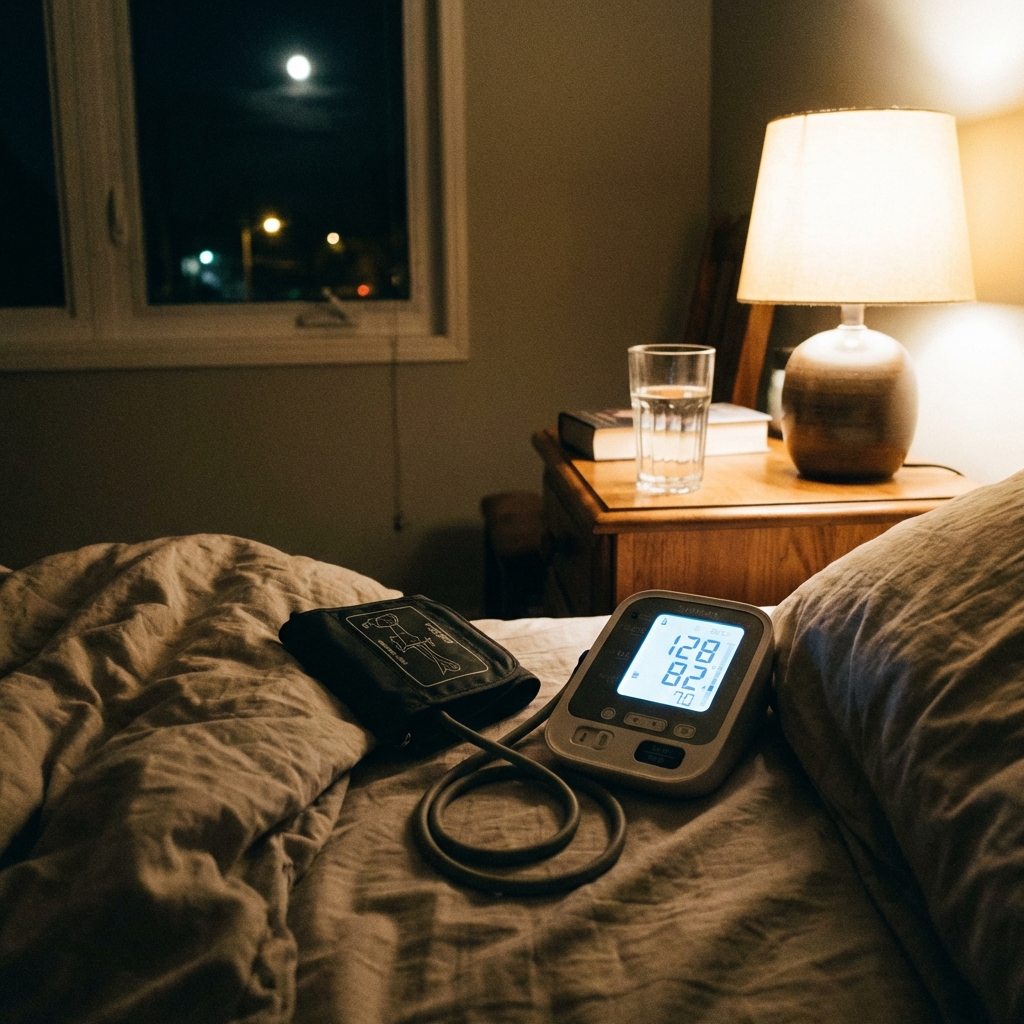
My patient’s blood pressure was 165/95 in my office and 118/76 at home so I stopped treating the number and started treating what was actually wrong. I've been a cardiologist for 22 years. I've prescribed thousands of blood pressure medications. I've read tens of thousands of readings. I've sat across from patients while they stared at a number on a screen like it was a death sentence. And for most of my career, I treated what the cuff told me. Number high? Medication. Number still high? Stronger medication. Number bouncing around? Add another pill. That's what we're trained to do. Then one afternoon, a woman named Karen sat in my exam room. I wrapped the cuff around her arm. Pumped it up. The reading flashed. 162/97. I started writing a prescription. She stopped me. "Dr. Bass please. My readings at home are 118/76. Every single day. I log them. I brought the notebook." She slid a spiral notebook across the desk. Pages and pages of readings. Morning. Afternoon. Evening. All normal. All calm. I looked at the notebook. Then I looked at the monitor. 162/97. Same woman. Same arm. Same heart. Forty-four point difference in one afternoon. Something cracked open in me that day. Because I realized I wasn't looking at a blood pressure problem. I was looking at a nervous system that had learned to panic inside my office. And I had been treating the panic like it was heart disease. If your blood pressure is fine at home but skyrockets the moment you walk into a medical building this is the most important thing you'll read this year. Because what I'm about to explain changed my practice. And it's changed the lives of hundreds of patients who were told they needed medication for a problem they didn't actually have. Stay with me. This will make sense of everything you've been going through. Karen wasn't my first patient like this. She was just the first one who made me stop and listen. After her, I started paying attention. Really paying attention. I began asking different questions during appointments. Not "what's your number?" but "what happens in your body before I even touch the cuff?" The answers shook me. "I can feel it rising before you even start." "My chest gets tight in the parking lot." "I feel this pressure behind my eyes the second I walk through the door." "I know it's going to be high. I can feel it in my neck." These people weren't describing heart disease. They were describing fear. A fear so physical, so automatic, that it produced measurable cardiovascular events on command. One patient told me: "I don't know what it is, but as soon as that cuff touches my skin, I get this surge of adrenaline that makes my BP spike horribly." Another said: "It's embarrassing. It makes me feel stupid. I don't even know why I'm scared. I'm scared of the panic, and so I panic more." I realized these patients had been trapped in a loop that none of my prescriptions could break. Anxiety about the reading → body spikes → high number confirms the fear → more anxiety next time → bigger spike next time. Every visit made it worse. Every medication I added was treating a symptom of the loop — not the loop itself. I tried telling them to relax. Take deep breaths. Think happy thoughts. It didn't help. Not because they weren't trying. But because you can't think your way out of an automatic nervous system response. That's like telling someone to stop flinching when you throw a ball at their face. Their body doesn't care what their brain wants. It reacts. I prescribed beta blockers. Propranolol. One patient fainted at the grocery store. Another felt so exhausted she could barely drive home from work. I prescribed anti-anxiety meds. Some patients felt numbed. Foggy. Disconnected. One told me the medication made her more anxious at night than she'd been during the day. I was out of tools. And my patients were getting worse. That's when I stopped treating blood pressure and started studying what was actually happening inside their bodies. Here's what I found and it changed everything I believed about "high blood pressure." These patients didn't have a cardiovascular problem. They had a nervous system problem. Their brain's alarm center a tiny structure called the amygdala had been "burned" by a medical experience. Maybe a scary reading. Maybe bad news. Maybe the painful squeeze of a cuff during a moment of vulnerability. And it filed that experience under one label: DANGER. Now, every time they walked into a clinic, smelled that antiseptic smell, or heard the cuff inflating their brain hit the panic button. Let me explain it simply. Ever burnt your tongue on hot coffee? For the next week, every time you pick up a coffee cup, what happens? You hesitate. You blow on it. You take the tiniest sip. Even if the coffee is lukewarm. Your brain is screaming: "CAREFUL! This burned you before!" That's exactly what's happening with your blood pressure in medical settings. Your brain got "burned" once. A scary number. A frightening diagnosis. A painful cuff squeeze. Now, every time you're about to get your blood pressure checked, your brain yells: "DANGER! Protect yourself!" And your body responds. Heart races. Blood vessels squeeze tight. Blood pressure shoots up. All within 2–4 minutes. You're sitting in a chair. Completely safe. But your body doesn't know that. It remembers the burn. And it's taking zero chances. Here's the part that terrified me as a doctor: Studies show 42.6% of people with white coat hypertension develop REAL, sustained high blood pressure within 10 years. Because those repeated fear-driven spikes aren't harmless. Every one of them strains the blood vessel walls. Wears them down. Inches the baseline pressure higher. The spikes aren't the disease. But they're building one. And no medication I could prescribe was going to fix a burnt tongue memory. Because medication forces the number down without addressing why it went up. It's like turning off a fire alarm while the building is still on fire. I needed something that could actually rewire the alarm. So how do you fix this? You can't fight a panic response in the moment. By the time the cuff is on your arm, the cascade is already firing. The answer isn't calming down during the appointment. It's training your body to arrive already calm. Your nervous system has two modes. Sympathetic mode (stress), fight-or-flight, high blood pressure. And parasympathetic mode (calm), rest, normal blood pressure. Right now, walking into a medical setting flips you into sympathetic mode automatically. That's the problem. The solution is to pre-activate your parasympathetic system so strongly that when the trigger appears the white coat, the cuff, the smell the panic response can't take hold. Your body is already running a different program. Think of it like muscle memory. Right now, when your body detects a medical setting, it automatically reaches for "PANIC" the same way your hand jerks back from a hot stove. You're not choosing to panic. Your body just does it. It's trained. This mechanism trains a different automatic response. So when you walk into that clinic, your body reaches for "CALM" instead the same way a pianist's fingers find the right keys without thinking. Not because you're forcing it. But because calm has become the automatic response. And here's the beautiful part: when you show up truly calm not trying to be calm, but physiologically calm your reading comes back normal. Maybe even excellent. That normal reading becomes new evidence for your brain. It goes: "Wait. I expected danger. But nothing bad happened." Each time this happens, the old fear pattern loses power. The next visit gets easier. The loop that made things worse is now running in reverse. But to make this work, your body needs raw material it's been running low on for years. After that breakthrough in understanding, I spent months searching for something anything that could support the parasympathetic shift in my patients. Something that worked with the body's own systems. Not against them. I looked at what the research said about natural parasympathetic support. One compound kept appearing across 300+ peer-reviewed studies: dietary nitrates from beetroot. Not "beetroot extract." Not beetroot-flavored powder. The actual dietary nitrates the compounds that convert into nitric oxide inside the body. Nitric oxide is the molecule your body uses to relax blood vessels and signal your nervous system to stand down. After age 40, your body produces significantly less of it. And if you're chronically stressed? Production drops even faster. So your vessels are tight, your nervous system is on high alert, and your body has lost the raw material it needs to calm itself down. I started recommending beetroot supplements to patients. Three different brands over six months. None of them worked. I was confused. The research was clear. The mechanism was sound. Why weren't my patients responding? Then I discovered something that made me furious. Most beetroot supplements use high-heat processing spray drying because it's cheap and fast. But heat destroys the active nitrate compounds. The very thing that makes beetroot work gets burned off before the capsule is sealed. The clinical studies showing real blood pressure improvements used 400 milligrams of dietary nitrates. Most supplements on the shelf? Less than 50. Some as low as 10. My patients hadn't failed the supplement. The supplement had failed them. I found one company that did it differently. BeetWise by Zenther. Cold-extracted. Not heat-blasted. The nitrates survive processing. They actually reach your bloodstream. Standardized to 400mg of verified dietary nitrates per serving the exact dose used in the clinical research. Not hidden behind a "proprietary blend." Published on a Certificate of Analysis that anyone can read. Third-party tested. Heavy metal screened. Organic. Every batch verified by independent labs. I started recommending BeetWise to my white coat hypertension patients. The ones whose readings were perfect at home and terrifying in my office. The results were unlike anything I'd seen in 22 years. Within 15–20 minutes of the first dose, patients reported a subtle shift clearer thinking, the afternoon fatigue lifting. That was the nitric oxide pathway activating. Proof it was reaching the bloodstream. Over 2–4 weeks, their in-office readings started dropping. Not because they were less nervous. But because their bodies had the support they needed to actually shift states from sympathetic overdrive into parasympathetic calm. two capsules. Once a day. No side effects. No fainting. No brain fog. No destroyed sleep. Just a body that finally had what it needed to stand down. Karen was one of the first patients I recommended it to. Two capsule every morning. Log everything. Week 1: Five days in, she called not panicked, surprised. That tight band behind her forehead she'd carried every afternoon for years? Gone within 20 minutes of her first dose. Home readings didn't move much. But she said: "I feel like my body turned the volume down on something." Week 2: Morning readings started dipping. 116/72. Then 114/70. She'd stopped checking her blood pressure before bed a nightly ritual for over a year. She hadn't even noticed. Her husband did. Week 3: Dentist appointment usually triggers the same spiral. Heart rate steady. No flush. Blood pressure in the chair: 122/76. She called me after: "I almost cried. Not because I was scared. Because I wasn't." Week 4: Karen came back for the follow-up she'd been dreading. She sat on the table. Cuff on. She was telling me about a recipe she'd tried over the weekend. Not clenching. Not bracing. 124/79. She stared at the monitor. Then she looked at me with tears in her eyes. "That's the first time in three years my number has been normal in this room." She wasn't the only one. A 44-year-old mother who used to call her husband during panic attacks after every visit texted him a photo of the monitor instead. 122/77. Three words: "I did it." You're not broken. You're not "too anxious." You're not weak. Your nervous system is stuck in a pattern it learned. And it needs support to learn a new one. That's physiology. Not willpower. If you're reading this, you already know the loop. The tightness before the cuff. The heat in your neck. The heart that won't stop pounding. Nothing you've tried has broken it because nothing gave your nervous system what it actually needs to shift. I want you to picture six weeks from now. You have a checkup. You sleep the night before. You walk in and your chest doesn't tighten. The cuff wraps around your arm and you feel… a squeeze. That's it. The number comes back normal. The nurse moves on. And so do you. No replaying it in the car. No checking your home monitor to confirm. Just a normal day. That's what I've watched happen with patient after patient once their nervous system finally had the support to learn a different response. One thing I tell every patient: if it's in stock, don't wait. Cold-extraction is slow. Batches are small. I've had patients try to reorder after their first month and find it backordered for weeks right before an appointment. Their readings spiked back up. Not because BeetWise was a crutch. Because their nervous system hadn't finished retraining. And as a doctor, I'll say this plainly: this pattern doesn't stay where it is. It starts at the doctor's office. Then the dentist. Then work. Then lying in bed at night. The 42.6% who develop real sustained hypertension within 10 years I've watched that happen. Every week in this loop, the groove gets deeper and the window to reverse it gets narrower. BeetWise comes with a full 90-day money-back guarantee. Track your readings. Test it at your next appointment. If your numbers don't improve, full refund. No questions. I've never had a patient ask for one. Karen still comes in every six months. Last visit, she was telling me about her granddaughter's soccer game while I took her reading. 122/76. She didn't flinch. Didn't even glance at the monitor. That's what "fixed" looks like. Not a dramatic moment. Just a normal Tuesday. Your nervous system just needs the support to get there. → https://zenther.co/products/beetroot/
The Reading That Changed Everything
Zenther Beetwise, 400mg verified nitrates per serving—not 5mg like most brands. Cold-extracted beetroot supplement with published lab results. 90-day guarantee. Try BeetWise today.
SHOP NOWLike this ad? Make it yours.
Crush rebuilds this exact creative around your product — your brand, your colors, your offer — in about a minute.