Margaret Holloway
Margaret Holloway Facebook ad: “If You Have Age Spots, You’ll Want To Read This”
Ran for 18 days, from July 1 to July 19, 2026, the last day Crush saw it.
Run by Margaret Holloway on Facebook. Crush is not the advertiser and does not verify its claims. See this ad in Meta's Ad Library(opens in a new tab)
Want an ad like this for your product?
Crush makes new ad images for your product from this ad: your logo, your product photo, your offer.
Trials from $19.95 USD, then $79.95 USD a month. Cancel anytime.
About this ad
- Meta Ad Library ID
- 4396541057260010
- Platforms
- Facebook, Instagram, Audience Network, Messenger and Threads
- Relaunches
- 0
Ad text
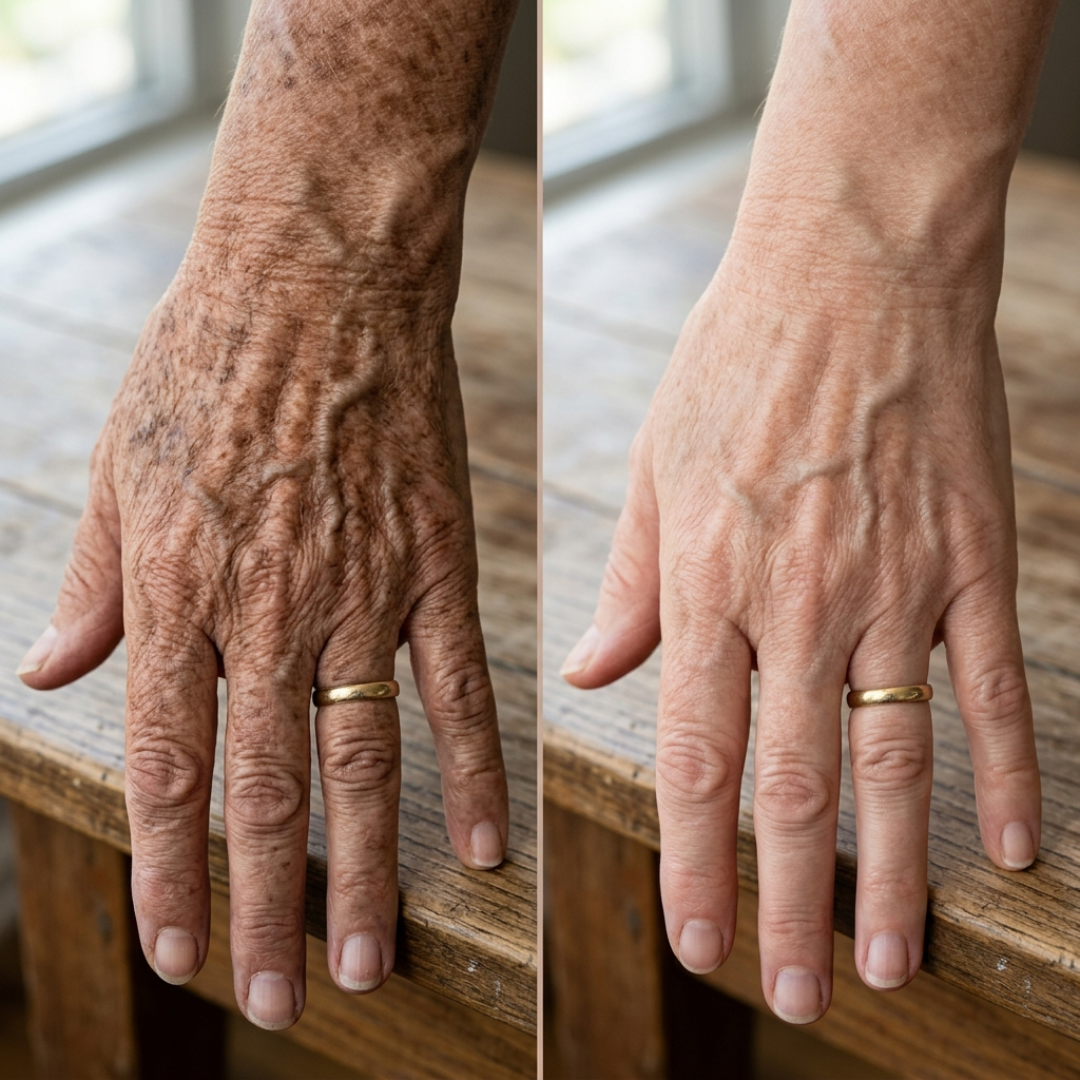
I asked 4 different skincare professionals about the dark spots on my hands and chest. Not one of them asked the question that would have saved me 3 years of wasted money. Not one. The first one said, “Use Vitamin C every morning.” The second said, “You need retinol. Give it time.” The third said, “At your age, sun damage is normal.” The fourth looked at my hands for maybe 12 seconds and said, “Laser would probably be your best option.” I was 69. Not young, obviously. But not old enough to accept that my hands, arms and chest had to look like this for the rest of my life. And I remember sitting in my car after that last appointment, gripping the steering wheel, staring at the brown spots across my hands, thinking: So this is it? I either keep hiding them, or I pay thousands for laser? Because by that point, I had already tried everything they told me to try. Vitamin C serum. Retinol hand cream. Brightening lotion. Dark spot corrector. SPF hand cream. Niacinamide body cream. The expensive department store jar. The cream my friend from church swore by. The one I bought at midnight because the reviews made me hopeful. And every single one gave me the same result. Soft skin. Same spots. That is the part nobody talks about. A cream can make your skin feel better and still do almost nothing for the way it looks. That kept me trapped for years. Because every time I started a new cream, I thought it was working. My hands felt smoother. My chest felt less dry. My arms felt softer. So I kept rubbing it in. Morning and night. Hands. Wrists. Forearms. Chest. Shoulders in the summer. Then the tube would be empty. And the same brown spots were still there. The same uneven patches. The same speckled sun damage. The same skin that made me pull my sleeves down in photos. I started thinking maybe I was the problem. Maybe I waited too long. Maybe I was too old. Maybe the sun damage was just permanent. Then one afternoon, my daughter took a photo of me with my granddaughter. We were outside. My granddaughter had grabbed my hand to pull me toward the cake. It should have been one of those photos you save forever. But when my daughter sent it to me, I didn’t look at my granddaughter first. I looked at my hand. Right there in the middle of the photo. Brown spots across the back of it. Wrinkles around my knuckles. Dry-looking skin. A hand that looked older than I felt. I cropped the photo before I saved it. That was the moment I knew this had gone too far. I was not trying to look 30. I was not scared of aging. I just wanted to stop feeling embarrassed every time sunlight touched my hands, arms or chest. A few days later, I showed the photo to a woman I knew who had worked around cosmetic dermatology for years. I expected her to recommend another cream. Instead, she asked me one question. “What kind of formula have you been using?” I said, “What do you mean?” She said, “Are they creams? Lotions? Water-based products?” I said yes. Almost all of them. She nodded like she already knew the answer. Then she said the sentence I wish someone had told me three years earlier: “You’re treating years of sun damage like dry skin.” I just stared at her. Because that was exactly what I had been doing. I was buying creams that made the surface feel better. But the spots on my hands, arms and chest were not just dryness. They were sun history. Years of driving. Years of gardening. Years of beach days. Years of walking outside. Years of sitting near windows. Years of protecting my face and forgetting everything else. Then decades later, it started showing up. First on my hands. Then my forearms. Then my chest. Then my shoulders. And every time I saw it, I rubbed on another cream. She explained that most ordinary creams are designed to feel nice. They absorb fast. They moisturize the surface. They make the skin feel soft. And that is exactly why women keep buying them. Because softness feels like progress. But softness is not the same as visible improvement. That hit me hard. Because it described my entire bathroom cabinet. Soft skin. Same spots. She told me to stop looking for another water-based dark spot cream. “Look for the explanation first,” she said. “Not the product. The explanation.” That night, I searched again. But this time I was not searching for another jar. I was searching for why the jars had failed. That is when I found the Dermiqua article. I almost skipped it because I was tired of skincare pages. But the first part sounded exactly like me. Women hiding their hands. Dark spots on the arms. Uneven patches on the chest. Creams that made the skin soft, but left the same brown spots behind. The article explained why ordinary body creams often fail people with years of sun exposure. It explained why water-based lotions can disappear too quickly. It explained why sun-exposed skin on the hands, arms, chest and shoulders often needs a different kind of care than the face. And it explained why Dermiqua was made as a Sun Damage Repair Body Oil instead of another cream. That phrase stayed with me. Sun Damage Repair Body Oil. Not a hand cream. Not a lotion. Not another pretty jar. An oil-based formula made for the places people actually hide. Hands. Arms. Chest. Shoulders. The article talked about oil-soluble Vitamin C. Bakuchiol. Sea buckthorn. Camellia oil. 16 botanicals. And for the first time, the formula actually made sense to me. Because if the problem was sun-exposed, dry, uneven-looking skin… Why had I spent years using products that disappeared in seconds? Why was I treating my hands like they just needed softness? Why was I treating my chest like it was only dry? Why was I buying cream after cream when the real issue was years of sun damage showing through? That was the first night I stopped blaming my skin. And started blaming the routine. The left side of this photo is what my skin looked like after years of “dark spot creams.” Soft. Moisturized. Still spotted. The right side is after I stopped treating sun damage like dry skin and started using a nightly oil-based routine. Not perfect. Not fake. Not 25-year-old skin. Just calmer-looking. Smoother. More even. Less harsh in the light. And for me, that was everything. Because I did not need perfect skin. I needed to stop flinching when I saw my hands in a photo. I needed to stop wearing cardigans in warm weather because my arms embarrassed me. I needed to stop choosing higher necklines because my chest looked uneven. I needed to feel like my skin was cared for again. That is what changed. Not overnight. Not in some ridiculous miracle way. But gradually. The dry, papery look softened. The skin around the spots looked healthier. The contrast did not look so harsh. My hands stopped being the first thing I tried to hide. I still remember putting my bracelet back on for the first time. That sounds small. It was not. I had stopped wearing it because it drew attention to the brown spots on the back of my hand. One morning, I put it on without thinking. Then I noticed. And I just stood there in the bathroom. Because for the first time in years, my hands did not feel like they were betraying me. If you have dark spots, you know what I mean. You know what it feels like to see them in the car. You know what it feels like when sunlight hits your hands. You know what it feels like to crop a photo before saving it. You know what it feels like to buy another cream and secretly hope this one is different. And you know the disappointment when your skin feels softer… But the spots stay exactly where they were. That is why I am telling you to read the article before you buy another jar. Not the product page. The article. The one that explains why ordinary dark spot creams often fail people like us. The one that explains why sun damage on the hands, arms, chest and shoulders is not the same as dry skin. The one that explains why an oil-based, oil-soluble formula makes more sense than another water-based cream that vanishes in thirty seconds. Because once you understand why the creams kept failing, you stop repeating the same routine. You stop thinking you are too old. You stop thinking you waited too long. You stop thinking you just need the more expensive version. You start asking the question nobody asked me: “What kind of formula am I actually putting on my skin?” If your hands look older than you feel… If your arms get darker spots every summer… If your chest has uneven patches you keep trying to cover… If your bathroom cabinet is full of creams that made your skin soft but never made you stop hiding… Read the Dermiqua article. Then decide for yourself. I wish I had found it before I spent three years buying the same promise in different packaging. I wish I had found it before I cropped my hand out of my granddaughter’s birthday photo. I wish I had found it before I sat in my car after that appointment thinking laser was my only option. Because the problem was not that my skin was hopeless. The problem was that I was using the wrong kind of formula for the wrong kind of damage. Soft skin was never enough. Sun-exposed skin needed something different. Almost forgot the link. Here it is: https://dermiqua.com/pages/age-spots/ P.S. I am not saying every spot disappears overnight. That is not real. What I am saying is that the article finally explained why my creams kept failing, and why my hands, arms and chest needed more than another water-based lotion. Read it before you buy another cream. P.P.S. This is the explanation page, not the product page. That matters. Because once I understood the difference between ordinary creams and Dermiqua’s oil-based approach, the last three years finally made sense.
Where the ad sends people
dermiqua.com
If You Have Age Spots, You’ll Want To Read This ☝️
Dermiqua
Learn more: dermiqua.com(opens in a new tab)