John Ross
 Facebook ad: “Read this if the Bible feels harder than it should.”
Ran for 25 days, from August 28 to September 22, 2026, the last day Crush saw it.
Run by John Ross on Facebook. Crush is not the advertiser and does not verify its claims. See this ad in Meta's Ad Library(opens in a new tab)
Make your own version of this ad
Crush makes it, launches it in your own Meta ad account, scales the winners and pauses the losers.
About this ad
- Meta Ad Library ID
- 4584156521873898
- Platforms
- Facebook, Instagram, Audience Network and Threads
- Relaunches
- 0
- Niche
- Parenting & Kids
Ad text
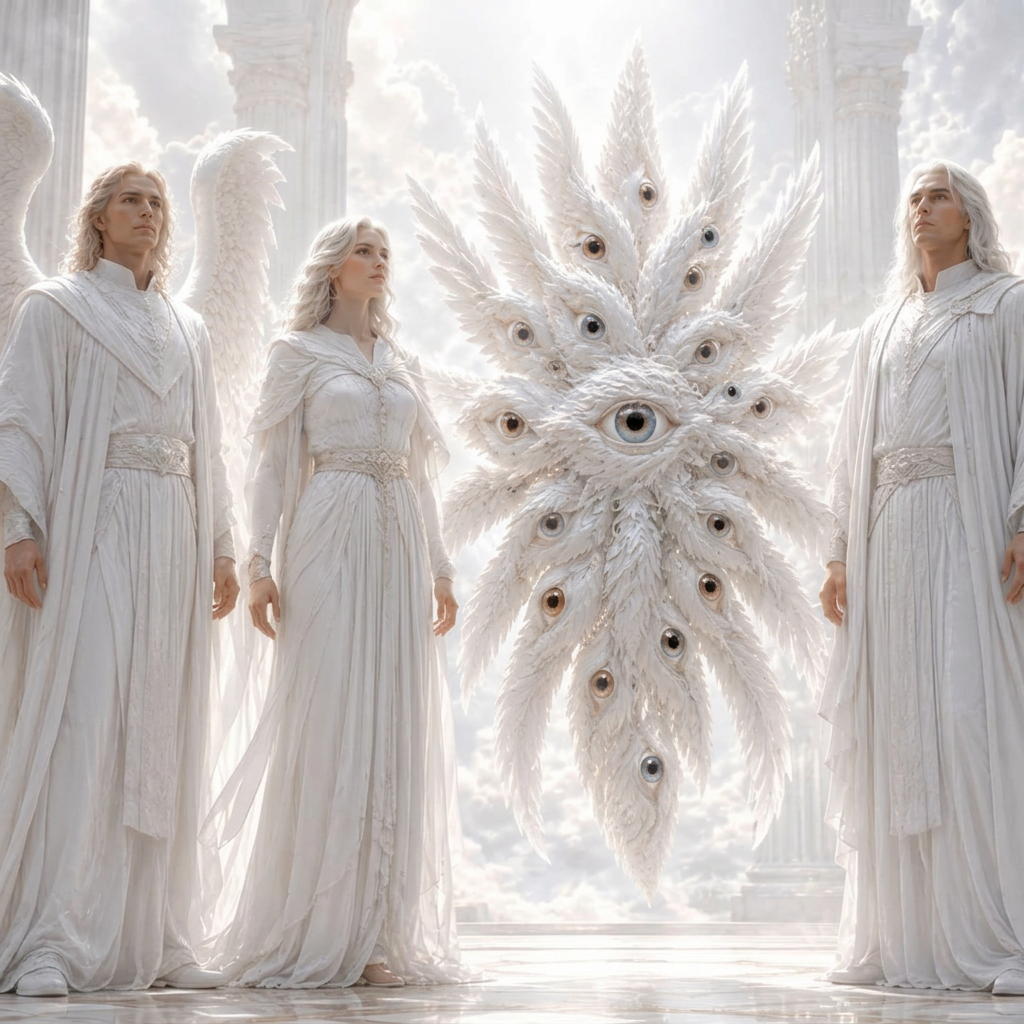
Every person on earth pictures the same thing when they hear the word "angel." White robes. Feathered wings. A gentle face. A golden halo. Maybe a harp. None of that comes from the Bible. Not the robes. Not the feathered wings. Not the halo. Not the harp. That image was invented by Renaissance painters borrowing from Greek statues and Roman mythology. It has been passed down through centuries of Christmas cards, children's Bibles, and ceramic figurines sitting on grandmothers' shelves. The Bible describes something else entirely. Here is what the prophets actually saw. Start with Ezekiel. Ezekiel chapter 1. The prophet is standing by the Kebar River in Babylon when the heavens open and he sees a vision of God's throne. Approaching him are four living creatures. Each one has four faces. Not four heads. Four faces on a single head — the face of a human in front, the face of a lion on the right, the face of an ox on the left, and the face of an eagle behind. They never turn. They do not need to. They have a face pointing in every direction. Each one has four wings. Two spread outward, two covering their bodies. Their legs are straight, their feet like the hooves of a calf, gleaming like polished bronze. And they move like bolts of lightning — darting in any direction without turning. But that is not the part that should stop you. Beside each creature is a wheel. The wheels appear to be "a wheel intersecting a wheel" — two rings crossing through each other at right angles, spinning in multiple directions simultaneously. And the rims of the wheels are covered in eyes. All the way around. Ezekiel 10:12 adds the final detail. "Their entire bodies, including their backs, their hands, and their wings, were completely full of eyes." The creatures themselves — four-faced, bronze-footed, lightning-fast — were covered head to foot in eyes. And the wheels spinning beside them were covered in eyes. Everything was watching. In every direction. At all times. This is what the Bible calls a cherub. Not the rosy infant on a Valentine's Day card. Not the chubby toddler hovering over a Nativity scene. A four-faced, eye-covered, bronze-hoofed creature moving like lightning with spinning wheels full of eyes beside it. Now read Isaiah. Isaiah chapter 6. The prophet sees the LORD seated on a throne in the Temple, and above Him are beings called seraphim. Each one has six wings. Two covering the face — they cannot look directly at what is on the throne. Two covering the feet — they shield their own bodies in the presence of God. Two for flying. They call to one another across the throne room. "Holy, holy, holy is the LORD Almighty; the whole earth is full of His glory." And at the sound of their voices, the doorposts and thresholds of the Temple shake. The word "seraphim" comes from the Hebrew root saraph. It means to burn. The seraphim are not named for their appearance. They are named for what they are. Burning ones. Isaiah's immediate response: "Woe to me. I am ruined." Now read Daniel. Daniel chapter 10. The prophet sees a figure standing before him. A body like topaz. A face like lightning. Eyes like flaming torches. Arms and legs like the gleam of burnished bronze. A voice like the roar of a multitude — not one voice, but the sound of a crowd compressed into a single mouth. Daniel's response: "I had no strength left, my face turned deathly pale, and I was helpless." He fell face-first onto the ground and dropped into a deep sleep. The men with him saw nothing but were overwhelmed by such terror that they ran. The prophet who survived the lions' den collapsed in the dirt because of what was standing in front of him. And in Revelation 4, John sees four living creatures around the throne of God — combining the features of everything Ezekiel and Isaiah described. Four faces. Six wings each. And covered with eyes all around, even under their wings. Day and night they never stop saying, "Holy, holy, holy is the Lord God Almighty, who was, and is, and is to come." They never stop. They do not rest. They do not pause. They have been saying the same three words since before time had a name. Now here is the detail that ties all of it together. "Do not be afraid." That phrase — or one nearly identical — is the single most common thing angels say when they appear to human beings in Scripture. Gabriel to Zechariah in the Temple. "Do not be afraid." Gabriel to Mary. "Do not be afraid." The angel to the shepherds on the night of the birth. "Do not be afraid." The angel at the empty tomb. "Do not be afraid." The angel to Daniel, lying face-down in the dirt. "Do not be afraid." They had to say it. Every time. Because the natural human response to seeing one of these beings was not comfort. It was not peace. It was sheer, overwhelming, physical terror. The angels of the Bible do not float gently into nurseries. They do not strum harps on clouds. They walk into a room and the first thing they have to do is talk a human being off the floor. And that is the part most people miss entirely. Because the real question is not "why do they look so terrifying?" The real question is: that is what God sends to protect you. When God dispatched a messenger to a teenage girl in Nazareth, He sent something so powerful it had to begin with "do not be afraid." When He sent a messenger to announce the resurrection, the guards at the tomb didn't just flinch — Matthew 28:4 says they "shook with fear and became like dead men." These are not comfort figures designed for a bookshelf. They are power beyond human comprehension, sent by a God who takes the assignment seriously. That is what I realized sitting across from a woman named Sharon last fall. Sharon had been a believer for thirty-five years. She taught Sunday school for two decades. She collected angel figurines — dozens of them on shelves and windowsills throughout her house. Porcelain. Crystal. Hand-painted. Beautiful, gentle, serene. She sat in my office one afternoon and said, "Pastor, someone told me the angels in the Bible don't look anything like what I've been collecting. Is that true?" I opened to Ezekiel 1 and asked her to read it. Slowly. When she got to the four faces, she stopped. When she got to the eyes covering the wheels, she put her hand over her mouth. When she got to "their entire bodies were completely full of eyes," she set the Bible in her lap and stared at me. "That is not what is on my shelf." I showed her Isaiah 6. The burning ones. The voices that shook the doorposts. I showed her Daniel 10. Lightning face. Flaming eyes. Daniel collapsing. "Why did nobody ever teach me this?" she asked. Then I told her about the phrase. "Do not be afraid." How it appears again and again. How every angel had to say it because every person who encountered one was terrified. She sat with that for a long time. "That means when God sent help," she said, "He sent something so powerful it had to announce itself gently just so the person wouldn't die of fear. That is not less comforting. That is more." She could not see it. And it was not her fault. Nobody had ever given her the roots. The next morning I started writing. And I quickly realized this was bigger than me. So I reached out to a group of Bible teachers and pastors I have trusted for years — people who have spent their lives teaching Scripture in plain language. Together, we started with Genesis. Everything someone needs to know before they read each book. Who wrote it. When. Why. What was happening. The main themes. How it connects to the larger story. Not a commentary. Not a devotional. Just the roots. Every page was written, checked, and rewritten by multiple teachers until my teenage son could read it and understand it completely on his own. Sixty-six pages. One page per book. Three months of combined decades of study distilled into plain language any believer could use on their own. No pastor required. Did you know that Hebrews 13:2 says, "Do not forget to show hospitality to strangers, for by so doing some people have entertained angels without knowing it"? The same beings Ezekiel described as four-faced and covered in eyes can also appear as ordinary travelers at your front door. Abraham served a meal to three visitors by the oaks of Mamre — and two of them turned out to be angels. The range is the point. They can look like anything. But what they actually are is something else entirely. Did you know that when the prophet Elisha's servant panicked because an enemy army had surrounded their city, Elisha prayed, "Open his eyes, LORD, so that he may see"? God opened the servant's eyes and the hillside was full of horses and chariots of fire. An invisible army — already there, already surrounding them — visible only when God allowed it. The protection was never absent. It was just unseen. Context changes everything. Every single time. I call it FaithSprout. The 66 Roots Journey. 66 pages. One for every book of the Bible. Each page gives you what you need before you read. Who wrote it. When. Why. What was happening. The key themes. The symbolism. And how it connects to your actual life today. Written in plain language. No seminary terms. No complicated theology. Just the roots that make everything you have already read suddenly land with the full weight God intended. The angels on your shelf are beautiful. The ones in your Bible are terrifying. And they had to say "Do not be afraid" every single time because the people who saw them could not stand. That is not less comforting. That is more. Because a God who sends that to protect you is not sending a suggestion. If you have ever read a passage and sensed there was something underneath it that nobody ever showed you. If you have ever wondered what you would find in God's Word if someone just gave you the context first. This is what you have been looking for. Get closer to God by actually understanding His Word. Not the version on the Christmas card. The real one. The whole story. That is what The 66 Roots Journey was created for. And you can start yours by clicking below.
Where the ad sends people
faithsprout.store
Read this if the Bible feels harder than it should. ☝️
Understand all 66 books of the Bible more easily
Shop now: faithsprout.store(opens in a new tab)