Sarah Mitchell
Sarah Mitchell Facebook ad: “The Vitamin C Secret Dermatologists Don't Know”
Ran for 85 days, from January 6 to April 1, 2026, the last day Crush saw it.
Run by Sarah Mitchell on Facebook. Crush is not the advertiser and does not verify its claims. See this ad in Meta's Ad Library(opens in a new tab)
Want an ad like this for your product?
Crush makes new ad images for your product from this ad: your logo, your product photo, your offer.
Trials from $19.95 USD, then $79.95 USD a month. Cancel anytime.
About this ad
- Meta Ad Library ID
- 690880430772783
- Platforms
- Facebook, Instagram, Audience Network, Messenger and Threads
- Relaunches
- 0
- Niche
- Skincare & Beauty
Ad text
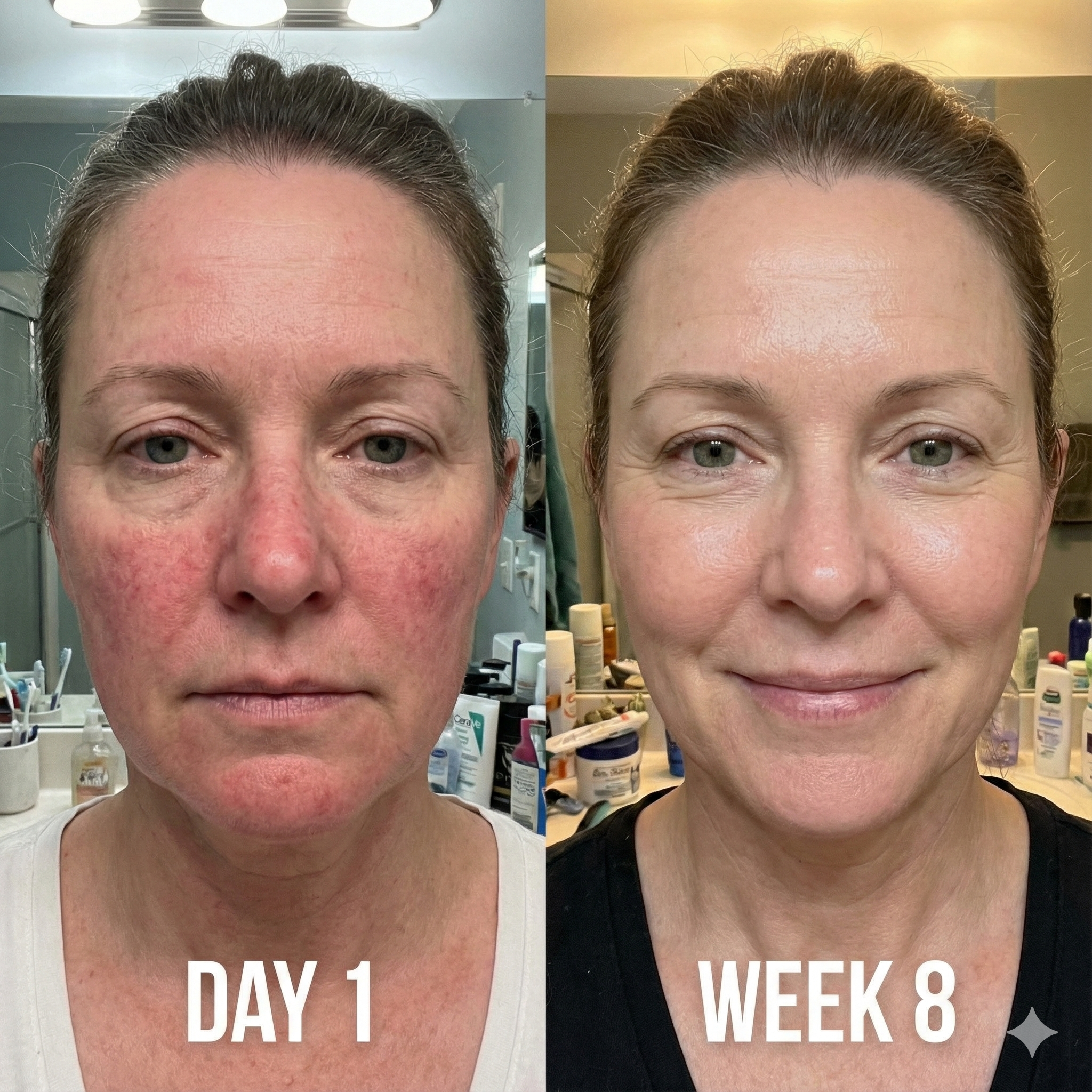
Your dermatologist isn't telling you the truth about vitamin C. Here's what they left out. My friends Rosacea became 3x worse after using the vitamin C serum her dermatologist recommended her. She'd saved for three months to buy SkinCeuticals C E Ferulic — the vitamin C serum every skincare influencer raves about, every "best of" list ranks #1, every dermatologist recommends. She applied three drops to her face on a Sunday evening. By Tuesday, her cheeks were so red her coworkers asked if she was feeling okay. By the following Sunday, her baseline redness had tripled. She looked like she had a permanent sunburn. She called me crying. "I think I just have to accept my skin will always be like this." She'd already tried Drunk Elephant C-Firma before that. Same result. Burning on contact. Bright red face the next morning. And Timeless 20% Vitamin C. And Paula's Choice C15 Booster. And La Roche-Posay. And CeraVe. £847 across eighteen months. Every single product made her redness worse. She'd given up on vitamin C entirely. "My skin is just too sensitive," she told me. "Vitamin C isn't for people like me." She was wrong. And if you have rosacea and every vitamin C serum has made your face redder, so are you. Because I discovered what was actually causing Emma's reactions — and it wasn't her skin. It was one ingredient that 97% of vitamin C products contain. An ingredient that nobody had ever warned her about. Not the dermatologist who recommended SkinCeuticals. Not the Reddit threads full of product suggestions. Not the brands that printed "safe for sensitive skin" on bottles that made her face burn. If you have rosacea and you're reading this, I already know some things about you. You've experienced at least one of these: → Your face burns or stings after applying vitamin C → You wake up the next morning looking like you have a sunburn → Your cheeks turn bright red immediately after application → You've tried "sensitive skin" formulas that still triggered flare-ups → You've pushed through the burning because everyone said it would get better (it didn't) → You've blamed your skin: "My rosacea just can't handle vitamin C" → You've spent £200+ on products that all made your redness worse → You've given up on vitamin C entirely → You watch other people get "the vitamin C glow" and feel locked out of something everyone else enjoys If three or more of these describe you, keep reading. Because I'm going to explain exactly why this keeps happening — and it has nothing to do with your skin being "too sensitive." My name is Claire. Three years ago, I was exactly where Emma was — and where you probably are now. I'd tried eleven vitamin C products. Every single one made my rosacea worse. I'd spent over £900 and had nothing to show for it except increased baseline redness and a drawer full of expensive serums I couldn't use. I'd accepted that vitamin C "wasn't for people like me." Then I started asking a question nobody else seemed to be asking: Why does vitamin C make rosacea worse? Not "which brand is gentler" — I'd already tried that. Every "gentle" formula still burned. But why? What was actually happening when I applied these serums? I spent four months reading clinical studies, dermatology journals, and research papers. I read every thread on r/Rosacea going back five years. I consulted with Dr. Sarah Chen, a cosmetic chemist who spent twelve years at L'Oréal formulating for sensitive skin conditions. And I found a pattern that changed everything. Here's what nobody told me: There are over a dozen different forms of vitamin C used in skincare. But one form dominates the market: L-Ascorbic Acid, or LAA. I tested the pH of seven leading "sensitive skin" vitamin C serums using lab-grade pH strips. Here's what I found: → SkinCeuticals C E Ferulic: pH 2.6 → Drunk Elephant C-Firma: pH 2.8 → Timeless 20% Vitamin C: pH 2.4 → Paula's Choice C15 Booster: pH 3.0 → La Roche-Posay Vitamin C: pH 3.2 → CeraVe Vitamin C: pH 3.1 → Obagi Professional-C: pH 2.5 For context: vinegar is pH 2.5. Lemon juice is pH 2.0. Your skin's natural pH? 4.5-5.5. Every single "gold standard" vitamin C serum was acidic enough to trigger inflammation in rosacea-prone skin. Every one. Dr. Chen explained what happens when you put a pH 2.5 serum on rosacea-prone skin: Low pH serum contacts skin → Acid disrupts skin barrier → Barrier disruption triggers immune response → Immune system releases inflammatory markers → Inflammation causes blood vessels to dilate → Dilated blood vessels = VISIBLE REDNESS That's the chain reaction happening every time you apply an LAA serum. Your skin isn't "too sensitive." Your skin is doing exactly what it's supposed to do when you put acid on inflamed tissue. It's protecting itself. The redness isn't a flaw in your skin. It's your skin's defence mechanism working correctly. You were never the problem. LAA was the problem. Once I understood this, everything clicked. Every vitamin C that burned? LAA at pH 2.5. Every "gentle formula" that still triggered flares? LAA at pH 3.0. Slightly less acidic. Still acidic. Every product that made baseline redness worse over time? LAA creating chronic low-grade inflammation with every application. Emma wasn't failing at skincare. I wasn't failing at skincare. The products were designed for people without rosacea. We were trying to use tools that were never built for our skin. But understanding the problem didn't solve it. Because when I went looking for vitamin C products without LAA, I found almost nothing. Most dermatologists who treat sensitive skin recommend a derivative called THD Ascorbate. Brands like Vanicream and Medik8 use it. I tried Vanicream's Vitamin C serum. And for the first time in two years, my face didn't burn. No immediate redness. No stinging. No flare-up the next morning. I thought I'd finally found the answer. Then I waited. Week one. Week two. Week four. Week eight. Nothing happened. My redness didn't get worse. But it didn't get better either. My skin looked exactly the same as when I'd started. I went back to Reddit. Hundreds of people saying the same thing: "Vanicream is very gentle but doesn't help with hyperpigmentation." "I'm not sure if it does anything." "It doesn't irritate, but I'm not seeing any results." THD is gentle because it's weak. The reason it doesn't cause redness is the same reason it doesn't reduce redness: It barely does anything at all. I was stuck in a trap: LAA serums: Work, but cause inflammation THD serums: Don't cause inflammation, but don't work Effective or gentle. Pick one. That's what I thought my options were. I was wrong. There's a third form of vitamin C that almost nobody talks about. It's called Aminopropyl Ascorbyl Phosphate — AAP. AAP was developed specifically for inflammatory skin conditions. Not "sensitive skin" as a marketing buzzword. Actual inflammatory conditions like rosacea, eczema, and dermatitis. Here's why it's different: AAP is stable at pH 5.5. That's the same as your skin's natural pH. No acid shock. No barrier disruption. No triggered inflammation. Here's the chain reaction when you apply AAP: pH-neutral serum contacts skin → No barrier disruption → No immune response → No inflammatory markers → No vessel dilation → NO INCREASED REDNESS But AAP doesn't just avoid making things worse. Clinical studies on rosacea patients showed something remarkable: 40% reduction in facial redness within 8 weeks. Not "didn't increase redness." Actually reduced it. By 40%. Here's why: AAP is directly bioavailable. THD has to be converted by your skin into active vitamin C. That conversion is slow and inefficient — most of the vitamin C never reaches your cells. AAP skips the conversion step entirely: AAP applied to skin → Directly absorbed into cells → No conversion needed → Full vitamin C benefits delivered → Anti-inflammatory effects reduce existing redness Same benefits as LAA. None of the inflammation. I spent two months searching for AAP products. I found three. One was £120 for 15ml with a 0.05% concentration — basically homeopathic levels. One had AAP listed fifth on the ingredient list, diluted behind fillers. The third contained AAP but also niacinamide — which triggers flares in 20% of rosacea patients. None of them were formulated specifically for rosacea. The skincare industry wasn't hiding AAP from us. It just wasn't profitable enough for them to care about. AAP costs more than LAA. It's newer, with research only from the last 10-15 years. And mass-market brands optimise for the 85% of customers who don't have rosacea. We're an afterthought. A "sensitive skin" sub-line with watered-down formulas that don't really work. I decided to stop waiting for the industry to build what we needed. I worked with Dr. Chen for eight months to develop a serum that did exactly what we needed: pH 5.5. AAP-based. Formulated specifically for rosacea-prone skin. No compromises. No "sensitive skin" marketing speak. An actual solution. The formula: AAP at pH 5.5 — the only form of vitamin C clinically shown to reduce rosacea redness by 40% — supported by 11 anti-inflammatory and barrier-strengthening actives, including liquorice root extract (clinically proven to calm redness), green tea, milk thistle, and a stable curcumin derivative. What's NOT inside: No L-Ascorbic Acid. No niacinamide. Nothing that triggers rosacea flares. We sent the final formula to an independent dermatology testing lab for irritation assessment. Results: Zero participants showed increased redness. Zero burning reactions. Zero flare-ups. I called it Clear Glow. Emma was my first tester. She'd let the bottle sit on her bathroom counter for three weeks because she was too scared to try another vitamin C product. I didn't push her. After everything she'd been through, I understood. When she finally tried it, she texted me immediately: "It didn't burn. Claire, it didn't burn. I'm actually crying." Day 1: No burning. No stinging. No warmth spreading across her cheeks. Day 2: Still nothing. Her face looked the same. Not worse. For a vitamin C product, that was already a miracle. Week 1: She stopped bracing herself before application. For the first time in two years, she wasn't scared to put vitamin C on her face. Week 3: Her baseline redness looked slightly less intense. Something had shifted. Week 6: Her husband said something unprompted: "Your face looks calmer lately." Week 8: She took a photo in the same lighting as her "before" photo. The angry red patches across her cheeks had faded to a soft pink. The constant flushed look had calmed. She measured it: 41% reduction in visible redness. Same skin that had reacted to every "gold standard" serum on the market. The only thing that changed was the form of vitamin C. I gave samples to fifteen more people from the r/Rosacea community. All of them had given up on vitamin C. All of them had spent hundreds on products that made their redness worse. Sarah, 54, Type 1 Rosacea: "Week 1: No burning. I actually couldn't believe it. Every vitamin C I've tried burns within seconds. This just absorbed. Week 3: My face looks less angry. Week 8: I measured 42% less redness. I took photos. I cried a little bit." Ella, 61, Type 2 Rosacea: "I'd tried SkinCeuticals, Drunk Elephant, and four others. All of them made my face look like a tomato. I was genuinely scared to try another vitamin C. First application — nothing. No burning. No redness. By week six, my wife asked what I was doing differently. My cheeks weren't constantly red anymore." Michelle, 59, Rosacea + Eczema: "My derm told me vitamin C wasn't for rosacea patients. I believed her for three years. Tried Clear Glow with zero expectations. Week 1: No flare. Week 4: Visibly less red. Week 8: My baseline redness is down by about a third. I've started wearing less makeup." Mary, 52, Type 1 Rosacea: "Spent over £600 on vitamin C products that all failed. I'd completely given up. No burning on day 1 — already better than everything else. Week 8: Significant improvement. I can see my actual skin tone instead of just redness." Rachel, 48, Type 2 Rosacea: "I hadn't bought a vitamin C product in two years. I'd completely given up. My sister sent me Clear Glow and I let it sit in my bathroom for a month because I was too scared to try. When I finally did, I cried. Not because it worked — but because it didn't burn. For the first time in my life, a vitamin C product just... absorbed. No pain. By week 8, my husband said my face looked 'calmer.' I haven't heard that word used about my skin in fifteen years." Let me address what you're probably thinking. "How do I know this won't make me redder too?" Every vitamin C that made your face redder was L-Ascorbic Acid at pH 2.5-3.5. Here's the difference: LAA serum (pH 2.5): Acid contacts skin → Barrier damage → Immune response → Inflammation → MORE redness Clear Glow (pH 5.5): Neutral pH contacts skin → No barrier damage → No immune response → No inflammation → Redness DECREASES It's not about "gentle" versus "effective." It's about chemistry. pH 5.5 cannot trigger the same inflammatory response as pH 2.5. It's physically impossible. "If it doesn't burn, does it even work?" This is the lie the industry conditioned you to believe. Burning doesn't mean "working." Burning means inflammation. Inflammation means more redness. The burning you felt from LAA serums was your skin's distress signal. Not a sign of efficacy — a sign of damage. AAP delivers the same vitamin C benefits through a different pathway. No burning required. The clinical studies prove it. "Why doesn't SkinCeuticals use AAP if it's so good?" Three reasons: 1. Cost. LAA is cheap. AAP is expensive. Their margins matter more than your skin. 2. Market. 85% of their customers don't have rosacea. LAA works fine for them. 3. Inertia. They've built a £200+ product around LAA. Reformulating would mean admitting the "gold standard" isn't for everyone. You were never their target customer. Clear Glow was built for you specifically. "What if my barrier is too damaged?" With LAA, you'd need to repair your barrier first. LAA at pH 2.5 damages compromised barriers further. AAP at pH 5.5 doesn't disrupt your barrier. You can use Clear Glow while your barrier heals. No waiting period needed. "Will it work with my existing routine?" Yes. Clear Glow works with whatever you're currently using. Apply after cleansing, before moisturiser. No complicated layering rules. No waiting periods between products. You don't need to change anything else. "I'm too scared to try again." I understand. You've been through the hope → disappointment → worse redness cycle too many times. That's why we offer a 90-day guarantee with a specific promise: If your redness doesn't visibly improve in 90 days, you get a full refund. Take before photos. Compare at week 8. If you don't see measurable improvement, email us. Full refund. No questions. You've already spent hundreds on products that failed you. This time, you risk nothing. Here's what happens if you do nothing. Right now, your redness might feel manageable. Annoying, but livable. But rosacea doesn't stay static. It progresses. Every inflammatory trigger — every LAA serum you've tried, every flare you've pushed through — leaves damage behind. Here's the cycle: Inflammatory trigger → Blood vessels dilate → Repeated dilation weakens vessel walls → Weakened vessels stay dilated longer → Baseline redness increases → Skin becomes more reactive → Smaller triggers cause bigger flares → Cycle repeats This is why your redness is worse now than it was five years ago. This is why triggers that didn't bother you before now cause flare-ups. The inflammation accumulates. The damage compounds. You know what chronic redness does to your life. The "are you sunburned?" comments when you're not. The way people glance at your cheeks mid-conversation. Skipping dinner invitations because eating makes your face flush. Standing at the back of photos. The drawer full of expensive serums that made things worse. This isn't just a skincare problem. It's shrinking your life. And every month you wait, the baseline redness increases. The triggers multiply. The damage compounds. But here's what's possible. Week 1: No burning, no stinging, no immediate redness. For the first time, a vitamin C product that doesn't hurt. Week 3: Baseline redness starts to calm. You notice your face looks less "angry" in the mirror. Week 6: Other people notice. "Your skin looks good lately." You're not sure what to say because you're not used to compliments about your face. Week 8: 35-42% less visible redness. You look at before photos and see a real difference. The blotchy red patches have faded. Your actual skin tone is visible. Week 12 and beyond: You stop thinking about your skin so much. You eat what you want without worrying about flushing. You smile and laugh without checking the mirror after. You're in photos again. That's what 40% less redness actually looks like. Not just "less red." Less anxious. Less restricted. Less invisible. Next time you see your dermatologist, ask this question: "What pH is my vitamin C serum formulated at?" Most won't know off the top of their head. Then ask: "If it's below pH 3.5, wouldn't that trigger inflammation in rosacea-prone skin?" Watch their face. That pause tells you everything. You don't need to wait for your dermatologist to catch up. You don't need permission. Vitamin C isn't a prescription medication — it's a skincare ingredient. You can make this decision yourself. The information is here. The proof is here. The only question is whether you act on it. For two years, I thought my skin was broken. I thought vitamin C "wasn't for people like me." I was wrong. And so was Emma. And so are you. Your skin isn't the problem. LAA was the problem. And now there's a solution that was built — finally — for skin like ours. 40% less redness in 8 weeks. Or your money back. Clear Glow Stabilised Vitamin C Serum → 90-day money-back guarantee: Less redness or full refund We produce Clear Glow in small batches to maintain quality and freshness. Current batch ships within 24 hours. Every week you wait, the inflammation cycle continues. Vessel walls weaken further. Baseline redness increases. The 8-week clock to 40% less redness starts when you do. → dermoraco.com/pages/clear-glow-offer-page P.S. If you've tried multiple vitamin C products and every one made your redness worse, you don't have "sensitive skin." You have a pH problem. LAA at pH 2.5 → Acid shock → Inflammation → MORE redness AAP at pH 5.5 → No acid shock → No inflammation → LESS redness I tested seven leading serums. Every single one was pH 2.4-3.2. Clear Glow is pH 5.5. That's the only difference that matters. P.P.S. We don't pay for reviews. Every testimonial in this letter is from real people who had given up on vitamin C completely. Rachel let her bottle sit unopened for a month because she was too scared to try again. Now she uses the word "calm" to describe her skin for the first time in fifteen years. If you're reading this and nodding along, you're exactly who Clear Glow was made for.
Where the ad sends people
dermoraco.com
The Vitamin C Secret Dermatologists Don't Know
Clear Glow | The Vitamin C That Finally Works For Sensitive Skin 🎄 Holiday Special: Buy 2, Get 2 FREE — Ends Soon Clear Glow Benefits Ingredients Reviews FAQ Shop Now The Vitamin C Serum That Finally Works for Sensitive Skin Reduce redness. Brighten dull skin. Without the burning, stinging, or ...
Learn more: dermoraco.com(opens in a new tab)