Dr. Michael Reed
Dr. Michael Reed Facebook ad: “I spent 8 months investigating why American men's…”
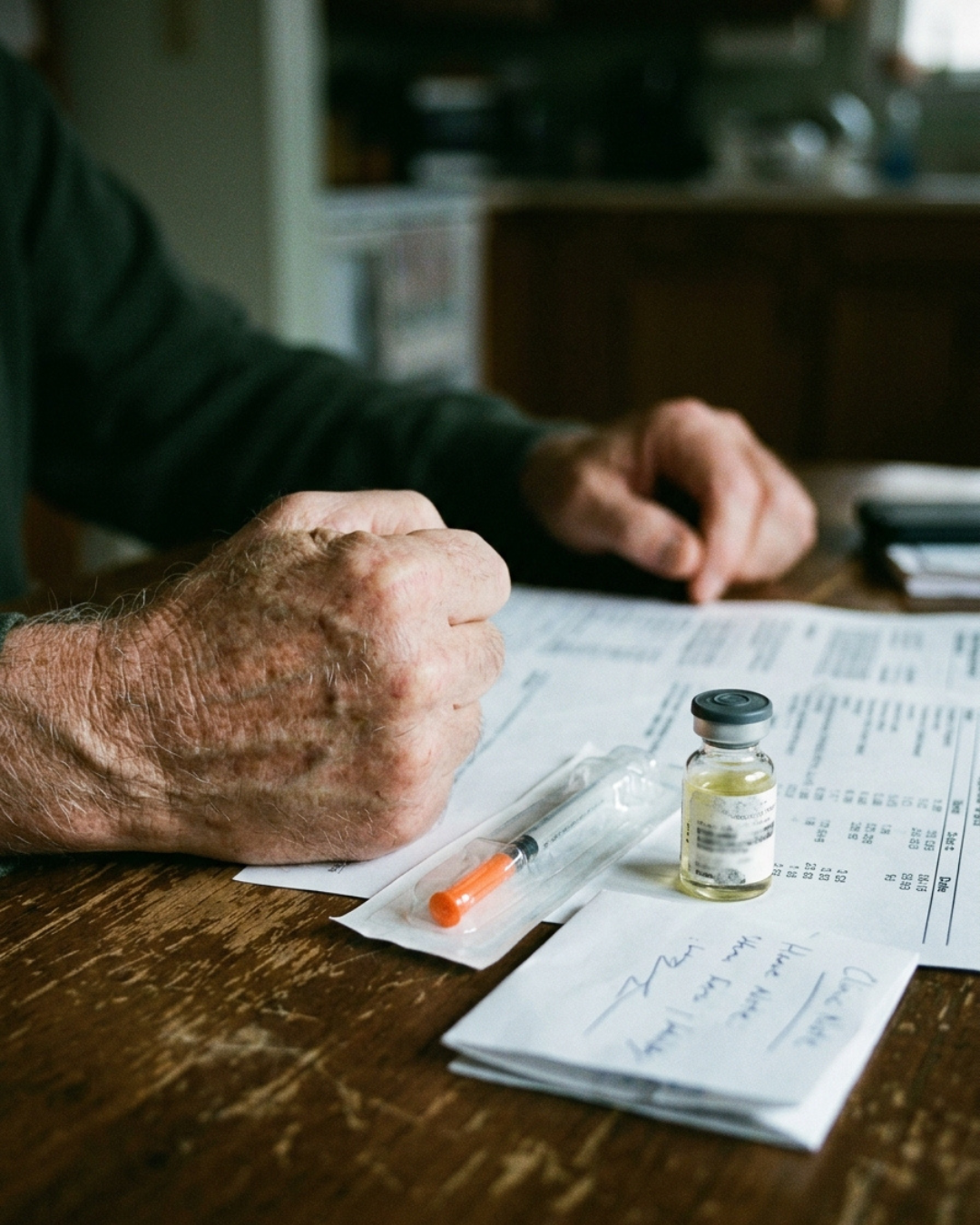
Ran for 3 days, from June 30 to July 2, 2026, the last day Crush saw it.
Run by Dr. Michael Reed on Facebook. Crush is not the advertiser and does not verify its claims. See this ad in Meta's Ad Library(opens in a new tab)
Want an ad like this for your product?
Crush makes new ad images for your product from this ad: your logo, your product photo, your offer.
Trials from $19.95 USD, then $79.95 USD a month. Cancel anytime.
About this ad
- Meta Ad Library ID
- 824875667225579
- Platforms
- Relaunches
- 0
- Niche
- Parenting & Kids
Ad text
This is a long read. I'm going to ask you for fifteen minutes. If you're a man over 40, or you love one, it may be the most useful fifteen minutes you spend this month. I spent eight months investigating why American men's testosterone has been collapsing for fifty years, why the medical system's response has been catastrophically wrong, and what a small group of endocrinologists has quietly discovered about restoring testosterone production without pharmaceuticals. What I found is worse than I expected, and the way out is simpler than anyone wants to admit. Let me start with the data, because the data is undisputed. In 2007, the New England Journal of Medicine published a longitudinal study tracking American men's testosterone levels across two decades. The finding was stark: testosterone in American men was declining at roughly 1% per year, independent of age. Meaning a 60-year-old man in 2005 had measurably lower testosterone than a 60-year-old man in 1985. The trend has continued and accelerated since. By 2020, the average American man between 40 and 60 had a testosterone level that, in 1970, would have classified him as clinically hypogonadal. Let that sit for a moment. The current "normal" is what previous generations called "abnormal." The bar has been lowered to accommodate a generational collapse. What's causing it? The mainstream medical answer is: obesity, sleep apnea, sedentary lifestyle, microplastics, endocrine disruptors in plastics and pesticides. All of these are real. All of these contribute. None of these, individually or collectively, fully explain the data. There is a deeper variable that almost nobody is discussing in public, and it has to do with the cells that make testosterone in the first place. Inside the testicles is a population of cells called Leydig cells. These are the factories. They convert cholesterol into testosterone through a multi-step enzymatic process that requires specific cofactors: zinc (in bioavailable form), vitamin A (as retinol), copper, selenium, B12, folate, and a class of signaling peptides that direct cellular function. Two things are happening to Leydig cells in modern American men. First, they are dying off. Research published in the Journal of Clinical Endocrinology and Metabolism has shown that men lose approximately 1% of their Leydig cell population per year after age 35. By the late 40s, the average American man has lost between 20% and 35% of his testosterone-producing capacity. By 60, he may have lost half. Second - and this is the part the data is just starting to catch up with - the surviving Leydig cells are increasingly nutrient-starved. They have the cellular machinery to produce testosterone, but they don't have the raw materials. Here's the part the medical establishment has structurally avoided looking at. In 1955, the average American man ate organ meat - liver, heart, kidney, and yes, testicle - approximately 12 pounds per year. By 2005, that figure had fallen to less than half a pound per year. We replaced organ meat with industrial chicken, refined grains, and seed oils. The nutrients we lost in that transition are not optional. They are the exact cofactors Leydig cells require to manufacture testosterone. Zinc bioavailability dropped. Retinol intake collapsed (because we replaced animal vitamin A with beta-carotene, which the aging liver converts at single-digit efficiency). The signaling peptides that exist only in animal gonadal and glandular tissue disappeared from the food supply entirely. We did not just lose a cuisine. We lost the nutritional inputs to male reproductive function. I want to introduce you to Dr. Marcus Halvorsen. Halvorsen is a board-certified endocrinologist who practiced for 22 years in a suburb of a major American city. He saw, by his own estimate, more than 30,000 patient visits across his career. The majority of those visits were men between 40 and 65, complaining of the same cluster of symptoms: fatigue, weight gain (particularly in the chest and abdomen), declining libido, brain fog, irritability, and erectile dysfunction. For most of his career, Halvorsen did what his training told him to do. He measured testosterone. If it came back below 300 ng/dL, he wrote a prescription for testosterone cypionate. If it came back in the 300-450 range (the "low-normal" zone), he told the patient he was "fine for his age" and to lose some weight. He estimates he wrote over 4,000 TRT prescriptions. He now believes most of them were a mistake. I spoke with Halvorsen for several hours. The turning point in his career came in 2019, when a long-term TRT patient named Bill wanted to come off the medication for personal reasons. Halvorsen tapered him carefully over six months, following standard protocol. Bill crashed catastrophically. His testosterone fell to 84 ng/dL - lower than a typical 90-year-old man's. His Leydig cells, dormant for six years of exogenous testosterone administration, had atrophied to the point that they could not restart endogenous production. Six months of post-cycle therapy did not bring them back. A year did not either. Bill is now 60 years old and on TRT permanently. Not by choice. By dependency. "I had been treating a number on a lab report," Halvorsen told me. "I had not been treating the organ. And I had been ignoring something every endocrinology textbook explicitly teaches - that exogenous testosterone suppresses endogenous production, and in a meaningful subset of patients, that suppression becomes permanent. We don't talk about it because we don't want to scare patients off treatment. But we should be talking about it." After Bill, Halvorsen changed his practice. He began studying what Leydig cells need at the cellular level to manufacture testosterone. He went back to the biochemistry textbooks he had not op ened in twenty years. He started talking with PhD nutritionists. He started reading the choline literature - Steven Zeisel at UNC, Marie Caudill at Cornell. What he found was this: the human Leydig cell needs cholesterol (its starting raw material), zinc, vitamin A in retinol form, copper, selenium, B12, folate, and a class of signaling peptides that are present in concentrated form in animal gonadal tissue and almost nowhere else in the modern American food supply. The richest known whole-food source of that complete nutrient stack is bull testicle. Followed by beef liver, beef heart, and beef bone marrow. I asked Halvorsen the obvious question. If this is real, why isn't every endocrinologist in the country recommending it? He laughed. "Three reasons. One, we're not trained in nutrition. Average med school nutrition curriculum is under twenty hours across four years. I had two lectures on it. Two, there's no pharmaceutical company funding the research because you can't patent a cow. Three, my colleagues think organ meat is gross. The same doctors who will inject a 47-year-old plumber with synthetic testosterone for the rest of his life won't recommend he eat what his grandfather ate at slaughter time. That's not science. That's squeamishness dressed up as medicine." In 2020, quietly, Halvorsen began recommending freeze-dried, grass-fed, multi-organ supplementation to a subset of his male patients - the ones whose testosterone was declining but who hadn't yet crossed into clinical hypogonadism. He didn't publish. He didn't put it on his website. He just watched what happened over 90, 120, and 180 days. What happened was that men in their late 40s and early 50s started coming back with testosterone numbers 80, 120, sometimes 180 points higher than baseline. Free testosterone climbed alongside total testosterone. Sex hormone binding globulin normalized. Their morning erections came back. Their wives noticed before they did. Their lifts went up. The 3 PM crash disappeared. None of these men were on testosterone replacement. They were on food. I asked Halvorsen for the data. He sent me a de-identified spreadsheet covering 312 of his patients across a four-year window. The average total testosterone increase at 120 days was 127 ng/dL. The average free testosterone increase was 4.2 pg/mL. The number of patients who chose to begin TRT after 120 days of nutritional intervention was 11 out of 312. In other words: 96.5% of men who would have been TRT candidates under the old protocol did not need TRT once their factories were fed. In 2022, Halvorsen stopped writing new TRT prescriptions except for the small subset of genuinely hypogonadal men - the ones whose factories were truly broken, not starved. He lost income. He gained something he hadn't felt in a decade, which is the conviction that he was practicing medicine instead of dispensing it. He gave a talk at a regional endocrinology conference last year. It was politely received and quietly ignored. The pharmaceutical reps at the back of the room did not approach him afterward. I'll be direct about what this means for you, if you're a man over 40 reading this: The standard of care for your declining testosterone is currently a needle that will shut down your own production permanently in a meaningful percentage of cases. That standard exists not because it's the best medicine, but because it's the most billable medicine. There is a parallel approach, supported by basic endocrinology textbooks, that involves supplying the testosterone-producing cell with the raw materials it has been starved of for fifty years. That approach does not require a prescription. It does not shut down your factory. It costs less than two dollars a day. It is, by every available indication, what your great-grandfather ate without thinking about it. The product Halvorsen prefers - though he is careful not to formally endorse brands - is grass-fed, freeze-dried, multi-organ, capsulated, with beef testicle in the formula. There are now several brands fitting that description. Forge Beef Organ Complex is one of them. There are others. The category is more important than the brand. If you take nothing else from these 2,000 words, take this: Your testosterone is not declining because you are aging. It is declining because the specific cells responsible for producing it are dying off at a rate of roughly 1% per year, AND the survivors are nutrient-starved. Aging is the trigger. Starvation is the accelerant. The trigger you can't stop. The accelerant you can. Your grandfather knew this without knowing the biochemistry. He just ate the food. You can do the same. [See the full investigation and the protocol →]
Where the ad sends people
secure.try-forge.com
I spent 8 months investigating why American men's testosterone is collapsing
An investigation into the generational testosterone crash - and the food that's quietly reversing it.
Shop now: secure.try-forge.com(opens in a new tab)