
Active· since Apr 13, 2026
- 157
- days running
- 0
- relaunches
Ad copy
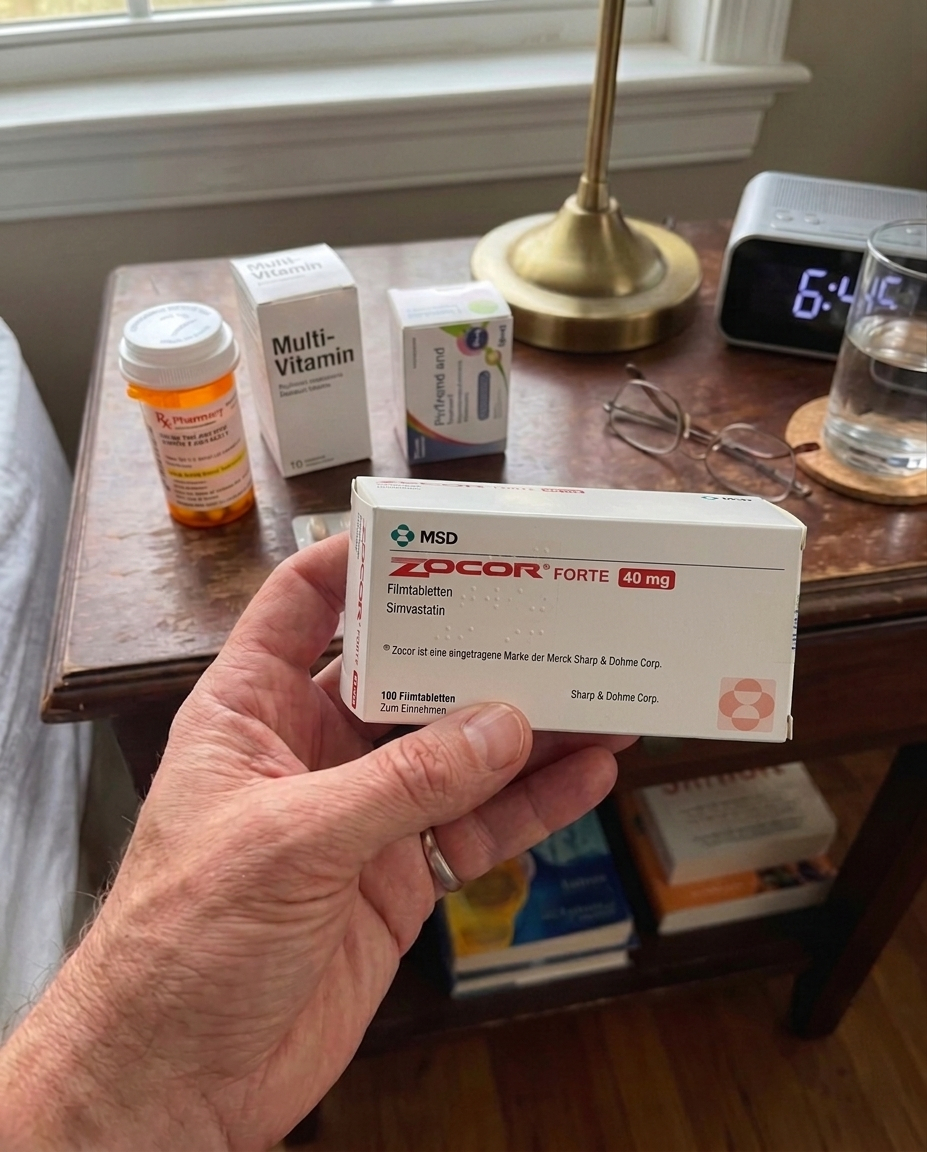
My husband is a cardiologist. He put me on Zocor when my LDL hit 176. He didn't ask. He called it in himself. Four months later, I stopped taking it. In secret. He still doesn't know. And the reason I'm writing this, the reason I'm risking everything by putting this out there, is that what I found in his own hospital's medical library contradicts everything he's spent 30 years telling his patients. I need to be careful how I say this. Not because I'm afraid of the medical establishment. Because I'm afraid of what it means for my marriage. My name is Catherine. I'm 63. I've been married to Dr. Thomas Prescott for 36 years. Thomas is a board-certified cardiologist. He has a practice of over 3,200 patients. He is on staff at two hospitals. He has been named to the regional "Top Doctors" list 7 years running. He has saved lives. Many of them. I love my husband. I need you to know that before I tell you the rest. For 36 years, I've been Dr. Prescott's wife. That's not a complaint. It's a description. When you're married to a cardiologist, his career becomes your atmosphere. You breathe it. You absorb it. You learn the language without taking the classes. I know what an ejection fraction is. I know the difference between systolic and diastolic. I can follow a conversation about left anterior descending artery stenosis at a dinner party and know when to nod. I've attended hospital galas in floor-length dresses and stood next to Thomas while he shook hands with the chief of medicine. I've hosted dinners where every guest had "M.D." after their name and the conversation was bypass grafts and stent placements and which pharmaceutical rep brought the best lunch to the office that week. I've heard Thomas on the phone with patients at 10 PM reassuring them about their medication. Calm. Confident. Authoritative. "The benefits outweigh the risks." "This is the gold standard of treatment." "Your numbers will improve. Trust the process." I've heard those phrases so many times they became the background music of our marriage. So when my own cholesterol came back high, LDL 176, total cholesterol 257, I didn't expect a conversation. I expected a prescription. And that's exactly what I got. Thomas was reading my results on his iPad at the kitchen counter. Sunday morning. Coffee. He was still in his bathrobe. Reading my lab report the way he reads hundreds of lab reports every week. Clinically. Efficiently. "Cath, your LDL is 176. I'm going to call in simvastatin. Twenty milligrams. Start it tonight." He didn't look up from the screen. Not "What do you think?" Not "Here are the options." Not "How do you feel about medication?" He prescribed me the way he prescribes his patients. Decided for me the way he decides for them. Because in his world, there is nothing to discuss. High LDL means statin. That's the algorithm. That's the training. That's the thirty years. "Okay," I said. What else do you say? Your husband is a cardiologist. He's not asking. He's informing. And the entire weight of his career, his expertise, his authority, the authority you've spent 36 years deferring to at dinner parties and hospital events and every medical decision your family has ever made, is behind that four-word sentence. I'm going to call in simvastatin. He picked up his phone. Called the pharmacy. Used his DEA number. Fifteen seconds. Done. I picked it up that afternoon. The pharmacist smiled at me. "Dr. Prescott called this in for you. You're in good hands." She meant it kindly. I took the first dose that night. Swallowed it with water while Thomas brushed his teeth next to me. He didn't watch me take it. Didn't need to. In his mind, it was handled. Problem identified. Solution prescribed. On to the next patient. Except I wasn't his next patient. I was his wife. The first month was unremarkable. Some stiffness in my shoulders. Mild. I do yoga three times a week. I assumed I'd strained something. Month two. The stiffness migrated. Shoulders to hips. Hips to knees. Getting out of bed required a negotiation with my body that hadn't existed eight weeks ago. My hands ached when I gripped the steering wheel. My fingers were stiff when I woke up. I'd flex them over and over under the covers before getting up, trying to work the tightness out before Thomas saw. Before Thomas saw. That's important. I didn't want him to see. Because I knew what he'd say. I'd heard him say it a thousand times. "Muscle symptoms are common. Usually mild. Self-limiting. The benefits outweigh the risks." Month three. The fog. It came on gradually. Not a wall, but a drift. Like someone slowly turning down a dimmer switch in my brain. I'd be reading a book and realize I'd read the same paragraph three times. I'd be driving to the grocery store, a route I've driven for 24 years, and miss my turn. I'd be talking to a friend on the phone and forget the word I was reaching for. Not an unusual word. A common one. "Kitchen." "Tuesday." "Appointment." I'd pause. Laugh it off. "Sorry, lost my train of thought." But I hadn't lost a train of thought. I'd lost the track the train runs on. I knew what this was. Not because I'm a doctor. Because I've spent 36 years listening to doctors. I've heard Thomas's patients describe this exact symptom pattern. Every week. Sometimes every day. They call the office. They come in for visits. They say: "Doctor, ever since I started the statin, I can't think clearly. My memory is worse. I'm foggy all the time." And I've heard Thomas's response. Over dinner. On the phone. In the hallway between the kitchen and his home office. "Cognitive symptoms are very rarely attributable to statin therapy. The clinical evidence doesn't support a strong causal link. It's more likely age-related. Or stress. Or sleep." He doesn't say it dismissively. He says it with genuine conviction. He believes it. He was trained to believe it. The guidelines he follows, the studies he cites, the colleagues who agree with him. They all believe it. I believed it too. For 36 years, I believed it. Until it was happening to me. The dinner party was in April. Eight guests. All physicians and their spouses. Thomas and I host these twice a year. It's part of the practice. Relationship maintenance. Referral networks. The social glue of medicine. I'd been on Zocor for three and a half months. The fog was at its worst. I'd spent twenty minutes that afternoon trying to remember the name of the woman who was coming to dinner, a woman I'd known for fifteen years. I finally found it in my phone contacts. Denise. Her name was Denise. I'd been to her daughter's wedding. Everyone was seated. Wine poured. Thomas was holding court the way he does, the natural storyteller, the room's center of gravity. He was telling a story about a patient from that week. "She comes in convinced the statin is destroying her mind. Convinced. 'Doctor Prescott, I can't remember anything. I'm foggy all the time. It started exactly when I began the medication.' So I run a full cognitive panel. MMSE. Clock drawing. Trail-making. Everything comes back normal." He paused. Took a sip of wine. The table was leaning in. "I showed her the results. Normal across the board. I said, 'Mrs. Gallagher, your cognition is intact. This is very likely not the statin. It's more common for patients to attribute existing symptoms to a new medication than for the medication to actually cause them. It's called attribution bias.'" The table laughed. Knowing nods. The cardiologist across from me said, "Every single week. Every single patient. They all think it's the statin." Thomas smiled. "I told her to stay on it. Her LDL went from 194 to 112. Those numbers don't lie." I was sitting at the end of the table. Three feet from my husband. Zocor in my bloodstream. Fog so thick that I'd spent the meal smiling at Denise and praying she wouldn't reference something I should remember because I wasn't sure I could follow it. His patient was right. Mrs. Gallagher was right. The fog was real. The medication was causing it. And my husband, the man I've loved for 36 years, the man I trust with my life, was sitting three feet away telling a room full of doctors that women like me are imagining it. I excused myself. Went to the powder room. Sat on the closed toilet lid and pressed my palms against my eyes. I couldn't tell him. I could not tell this man, this respected, accomplished, genuinely caring man who has built his entire career on the foundation that statins save lives, that his wife was experiencing the exact symptoms he dismisses in his patients every day. Because what would that mean? If I was right, he was wrong. Not wrong about me. Wrong about Mrs. Gallagher. Wrong about the thousands of patients he'd reassured over thirty years. Wrong about the fundamental approach he'd built his professional identity on. I couldn't hand him that. I couldn't walk into the kitchen after the guests left and say "Thomas, your medication is doing to me exactly what your patients keep telling you it's doing to them, and you keep telling them they're imagining it." That's not a conversation about cholesterol. That's a conversation about everything. So I said nothing. And for three more weeks, I took the pill every night and felt myself dimming and said nothing. The medical library was my rebellion. Thomas has admitting privileges at the university hospital. The medical library is on the third floor, a quiet, wood-paneled room with journals lining the walls and a handful of computer terminals along the windows. Most doctors don't use it anymore. Everything's online. But the library is still there. Still staffed. I went on a Thursday afternoon. Told Thomas I was going shopping. Parked in the hospital garage and walked through the lobby with my sunglasses on like a woman having an affair. Which, in a way, I was. An affair with information my husband hadn't authorized. I didn't know what I was looking for. I just knew that something was wrong, with the medication, with the model, with the thing Thomas believed so completely, and I needed to understand it for myself. I sat down at a terminal and typed: "statin therapy cognitive impairment mechanisms" I read for an hour. The results were mixed. Some studies showing no link, some showing clear correlation, all of them hedged with the kind of academic caution that means "we're not sure but something's here." Then I typed: "cardiovascular events despite optimal LDL statin therapy" That's when the floor shifted. Study after study showing something the field calls "residual cardiovascular risk." Heart attacks that happen in patients whose LDL is perfectly controlled by statins. Strokes that hit patients with "excellent numbers." People who did everything right, took the pill every night, got the number down, and still ended up in the emergency room. Thomas's world has an explanation for this. They call it complicated. Blame genetics. Blame other risk factors. Anything except the one thing nobody wants to say out loud: the number wasn't the real problem. But one thread, buried deep in the search results, offered a completely different answer. Oxidized LDL. "Can I help you find something?" I looked up. A woman about my age, salt-and-pepper hair pulled back, reading glasses on a chain around her neck. Her badge said "Dorothy Kim, Medical Librarian." "I'm just doing some research," I said. Carefully. She looked at my screen. Then at me. And something in her expression shifted, from professional courtesy to recognition. "Are you looking into oxidized LDL?" I nodded. She pulled a chair next to mine. Sat down. "I've been a medical librarian here for 22 years. I've watched the cardiovascular research pile up over that entire time. I catalog every new study that comes through. I've probably read more cholesterol research than most of the cardiologists in this building." She spoke quietly. Not conspiratorially. Just quietly. The way you speak in a library. "What you're finding right now is some of the most important and most ignored research in heart medicine. Here. Let me show you." She typed a search query. Pulled up a series of studies. "Your body makes cholesterol every single day. It's supposed to. Cholesterol does important jobs. It builds cells. It protects your brain. Your brain uses 25% of your body's total cholesterol. It keeps your organs running. LDL is just the delivery system. It carries cholesterol out through your blood to where it's needed. It's not dangerous on its own." She opened another study. "Here's what goes wrong. Your blood is full of unstable molecules called free radicals. They come from stress, processed food, pollution, sugar, just getting older. And they attack your cholesterol while it's traveling through your bloodstream. They damage it. And once cholesterol is damaged, it changes. It gets sticky. It clings to the inside of your artery walls. And once it's stuck, it stays stuck. More damaged cholesterol comes along and sticks right next to it. Layer after layer. That's plaque. That's the blockage. That's the heart attack." She turned to me. "And here's the part that explains why numbers keep climbing even when people do everything right. All that cholesterol stuck to the artery walls? Your body doesn't know it's stuck. It just knows it sent cholesterol out and it never came back. So it does what any good system does when a delivery goes missing. It sends more. Your body keeps making replacement cholesterol to cover what it's losing to the buildup. More gets damaged. More gets stuck. More gets replaced. A cycle that feeds itself. And the longer it runs, the higher the number climbs." My hands were in my lap. I realized they were shaking. "Statins force your liver to stop making cholesterol," she continued. "The number drops on the chart. The doctor says great. But the cholesterol still in your blood? Still getting damaged. Still getting sticky. Still building up on the artery walls. The drug lowered the amount. It didn't stop the damage. And the way it lowers production, by blocking a pathway in your liver, also blocks CoQ10. That's the molecule your heart, muscles, and brain need for energy. That's the muscle pain. The brain fog. The exhaustion. That's not aging. That's the drug." "Why doesn't anyone talk about this?" I asked. She smiled. Gently. "Because the statin does what it was designed to do. It gets the number down. Doctors can measure that. They can point to it. The whole system is built around that number. But the damage happening underneath? The cholesterol getting attacked and sticking to artery walls? Nobody's looking at that. Because there's no billion dollar drug for it." She paused. Let that sit. "But there is something that stops the damage before it starts." She pulled up another series of studies. "There's a fruit that grows in the foothills of the Himalayas called Amla. It's an ancient remedy that's been used for over 5,000 years by Himalayan healers. They called it 'the nurse.' It was the one remedy they reserved for people whose bodies were breaking down at the cellular level. People aging faster than they should. They didn't understand why it worked back then. They just watched the results happen over thousands of years." She opened a study showing antioxidant rankings. "Modern science now knows exactly why it worked. When scientists tested the antioxidant strength of over 3,000 foods, Amla ranked number 1. Not blueberries. Not turmeric. Not green tea. Amla. And it wasn't even close." She leaned forward. "Amla contains specific compounds called emblicanins. They're found only in this fruit. Emblicanins find the free radicals in your blood, the ones attacking your cholesterol and turning it into the sticky kind, and neutralize them before the damage happens. Not in your gut like oatmeal. Not on the surface like fish oil. In your bloodstream, where the damage is actually happening." She opened a clinical trial. "A 42 day study. 60 patients with high cholesterol. Head to head comparison: standardized Amla extract versus Simvastatin, one of the most widely prescribed statins in the world." She pointed at the results. "The Amla matched it. LDL dropped up to 40%. HDL, the good cholesterol, went up. Triglycerides came down. Blood pressure improved. Not by forcing your liver to shut down production. By stopping the damage at the source. When the cholesterol stops getting damaged, it stops sticking. When it stops sticking, the body stops overproducing to replace what it was losing. The cycle breaks on its own." I stared at the data. My husband's hospital. His library. His institution's research databases. The evidence was right here. "And the statin?" Dorothy said. "It blocked your liver's production and the same pathway that produces CoQ10. The energy molecule your heart and brain depend on. Amla doesn't block anything. It protects what's already there. No CoQ10 drain. No muscle pain. No brain fog. No energy crash." She closed the laptop halfway. Looked at me. "May I ask, are you researching this for personal reasons?" I hesitated. Then: "I'm on simvastatin. My husband prescribed it. He's a cardiologist here." Her expression didn't change. She didn't ask who. She didn't need to. "I've seen this before," she said quietly. "Physician families. The hardest patients to reach are the ones closest to the prescriber." She reached into her desk drawer. Wrote something on a notepad. Tore it off and slid it to me. "Alevia's Amla. Standardized extract. Most Amla products on the market are cheap fruit powders with no consistency. The active compounds vary wildly from bottle to bottle, if they're even there at all. It's the difference between chewing on willow bark and taking an aspirin. Alevia uses a pharmaceutical-grade extract, verified to contain the exact concentration of emblicanins used in the clinical trials. Same potency every time. Organic. Third-party tested for purity and potency. Made in the USA." I folded the paper and put it in my purse. "Thank you, Dorothy." "Come back anytime. The library is always here. And it doesn't require a prescription." I ordered Alevia's Amla from my phone that night. In the bathroom. With the door locked. While Thomas watched a cardiology webinar downstairs. It arrived two days later. I intercepted the package before Thomas got home. Put the bottle in my bathroom drawer, behind the tampons, behind the cotton balls, in the back where he never looks. I stopped taking Zocor that same day. Cold. Didn't taper. I know you're supposed to taper. I didn't care. The next morning, Thursday, Thomas left for the hospital at 6:40 AM. By 6:47, I was at the kitchen table. Two capsules. A glass of water. I swallowed them and sat there, staring at the morning light coming through the kitchen window. Nothing happened that first day. Or the second. On the third morning, something shifted. I was reading the newspaper at the kitchen table, and I realized I'd read an entire article, start to finish, without losing my place. Without rereading a single paragraph. Without the words dissolving halfway through a sentence the way they'd been doing for months. I set the paper down. Sat very still. That hadn't happened since before the Zocor. By the end of that first week, I realized I'd gone three full days without losing a word. Not one. I'd had a phone conversation with our daughter, scheduled a dentist appointment, read sixty pages of a novel, and recalled the name of every person I encountered without reaching. The fog that had been thickening for three and a half months was thinning. Not gone. Thinning. Like a window with condensation slowly clearing from the bottom up. I bought a home cholesterol monitor. Hid that too, in the same drawer. Tested every few days. Documented every result in a small notebook I kept inside the liner of my purse. Week one: LDL 170. Down from 176. Small. Week two: LDL 158. Week three: LDL 146. I tested three times. 146. 147. 145. Thirty points in three weeks. No statin. No prescription. No permission from a cardiologist. Week four: LDL 137. Week six: LDL 125. I was sitting at the kitchen table staring at the number, 125, when I heard the garage door open. Thomas was home early. I closed the notebook. Put it in my purse. Wiped my eyes. I hadn't realized I was crying. "Hey Cath. Good day?" "Good day," I said. My follow-up bloodwork was at eight weeks. Thomas ordered it himself, standard for any patient he'd started on a statin. He expected to see the Zocor doing its job. I let him order it. Let the lab draw the blood. And waited. The results came through his patient portal. He pulled them up on his iPad at breakfast. Wednesday morning. Coffee and oatmeal. His routine. He frowned. "Huh." "What?" "Your LDL is 122. Total cholesterol 196." He scrolled. "HDL went up, 43 to 56. That's unusual." He looked at the screen for a long time. The frown deepened. "These are excellent, Cath. Better than I'd typically expect at this stage with a 20-milligram dose." He paused. "Actually, these are better than most of my patients at eight weeks. Significantly better." He set the iPad down. Looked at me. "How are you feeling on the medication? Any side effects?" This was the moment. Thirty-six years of marriage. Thirty years of his career. Everything balanced on what I said next. "Thomas. I need to tell you something." He waited. The way he waits with patients. Attentive. Clinical. His hands still around his coffee cup. "I stopped taking the Zocor." The stillness in his face didn't change. But something behind it did. "When." "Six weeks ago." He set the coffee down. "Six weeks ago," he repeated. Not a question. A man doing math. "I was having symptoms. Brain fog. Word retrieval. I'd forget names, lose sentences in the middle of saying them. The same symptoms..." I stopped. Steadied. "The same symptoms your patients describe. The ones you tell them aren't caused by the medication." His jaw tightened. I kept going before he could answer. "I went to the medical library at the university hospital. I didn't tell you. I know I should have told you, and I didn't, and I'm sorry for that part. But I needed to understand what was happening to me without... I needed to look at it myself." "Catherine..." "Please let me finish." He was quiet. "I found the research on oxidized LDL. The studies showing that patients with 'perfect' numbers still have heart attacks because nobody is stopping the cholesterol from getting damaged in the first place. And the research on Amla, a fruit with compounds called emblicanins that stop that damage before it starts." I opened my purse and pulled out the notebook. Slid it across the table. He didn't reach for it. "I've been taking a standardized Amla extract for six weeks. That LDL, the 122, that's not the Zocor. I haven't taken the Zocor." Silence. "Amla," he said. Flat. The voice. "It stops your cholesterol from getting damaged. The free radicals that attack your LDL and turn it into the sticky kind that clings to artery walls. Emblicanins neutralize them before the damage happens. That's why patients with 'perfect' numbers still have heart attacks, Thomas. The statin lowers the number but the damage never stops. The cholesterol you still have keeps getting attacked, keeps getting sticky, keeps building up." He was looking at me. Not the notebook. Me. "A 42-day clinical trial. Head-to-head against Simvastatin. 60 patients. LDL reduction of up to 40 percent. Not by shutting down your liver. By stopping the oxidation. When the cholesterol stops getting damaged, it stops sticking. When it stops sticking, the body stops overproducing to replace what it was losing. The cycle breaks." "Catherine. You stopped a prescribed medication..." "I know." "...without telling me." "I know. I know I did. But I couldn't tell you." My voice was steady but barely. "How was I supposed to tell you? Sit down at this table and say what? 'Your medication is doing to me exactly what your patients keep reporting and you keep dismissing'? Do you understand what I'm asking you to hear right now?" He looked at the notebook. Still didn't open it. "And this isn't a weak fruit powder, Thomas. This is a standardized extract. Pharmaceutical-grade. The same concentration used in the clinical trials. Ranked number 1 antioxidant out of over 3,000 foods tested. Not number 10. Not top 5. Number 1. And you've never tested my oxidized LDL. You've never tested any of your patients' oxidized LDL." "You test total LDL. The number goes down, you declare victory. But the damage continues underneath. The cholesterol that's still circulating is still getting attacked and still getting sticky and still building up on the artery walls. And that's causing the heart attacks you've spent thirty years trying to prevent." My hands were flat on the table. I didn't know when I'd put them there. Quiet. The refrigerator hummed. Outside, a car reversed out of a neighbor's driveway. "My LDL is 122," I said. "Without the statin. My cognition is back. I can read a paragraph and remember it. I can find a word when I reach for it. I came back." He looked at the notebook again. "I'd like you to order an oxidized LDL panel," I said. "Add it to my results. And then look at all of it, the way you would look at it for any patient." He didn't answer immediately. He sat there for a long moment with his hands around a coffee that had gone cold. Then he picked up his phone and called the lab. The oxidized LDL result came back three days later. 34 U/L. Thomas pulled it up on his screen at home. Read it. Read it again. "For someone with your starting LDL of 176," he said slowly, "I'd expect an oxidized LDL in the 60 to 72 range. You're at 34." He closed his laptop. Sat back in his chair. He didn't say "you were right." He didn't say "I was wrong." He's a cardiologist. They don't talk like that. What he said was: "I'm not going to refill the simvastatin." And then he said: "I'd like to read those studies. The ones from the library." I need to be honest about what happened next and what didn't. Thomas did not become an Amla evangelist. He did not throw away his prescription pad. He did not start recommending Alevia's Amla to his 3,200 patients. He read the studies. He asked me questions, clinical questions, mechanism questions, the kind of questions he asks pharmaceutical reps when they come to his office with new drugs. I answered what I could. For the rest, I directed him to Dorothy's reading list. He was quiet about it for weeks. Thinking. Processing. Doing what cardiologists do when confronted with data that doesn't fit their model, which is to interrogate it harder than they interrogate data that confirms it. Then one evening, three weeks after he'd read the research, we were cleaning up after dinner. He was drying dishes. I was washing. The kind of quiet, domestic moment where truth sometimes slips out sideways. "I've been thinking about Mrs. Gallagher," he said. Mrs. Gallagher. The patient from the dinner party. The woman who told him the statin was causing her brain fog. The woman he diagnosed with attribution bias in front of eight laughing physicians. "What about her?" He dried a plate. Set it down. "I think she might have been right." Six words. He said them to the dish rack, not to me. But he said them. That's not a revolution. That's a crack. A hairline fracture in thirty years of certainty. But it's something. And it started because his wife, the woman who sat at the end of his dinner table absorbing his authority for three decades, quietly, secretly, stopped taking his prescription and found something better. If you're reading this, I think I know where you are. Your cholesterol is climbing. Maybe already in the danger zone. Your doctor is talking about statins, or you're already on one, and the muscle pain or the brain fog or the exhaustion is making you feel like you've aged 20 years overnight. You've tried fish oil. Oatmeal. Garlic. Niacin. Maybe berberine or plant sterols or red yeast rice. Nothing moved the needle. And nobody has ever explained to you that the real problem isn't how much cholesterol you have. It's that your cholesterol is getting damaged, getting sticky, and building up on your artery walls while every treatment you've tried addresses the amount and ignores the damage. I'm not saying Amla will work exactly the same for you as it did for me. But I spent four months on a statin without understanding that the real problem, the oxidation that turns cholesterol into the sticky kind that causes heart attacks, was never being addressed. The drug lowered a number. The damage continued underneath. And nobody told me. Alevia uses a standardized extraction process that preserves the active compounds, the emblicanins that stop the oxidation. Organic. Third-party tested for purity and potency. Made in the USA. Clinical strength in every capsule. That's the difference between a supplement that sits in your system doing nothing and one that actually stops cholesterol from getting damaged at the source. Right now, they're running a promotion with significant savings. But Alevia is a small company. They make everything in small batches to preserve the active compounds. When they sell out, it's usually weeks before the next batch is ready. Ninety days to try it. If nothing changes, full refund. No questions asked. But if it works? If by the end of that first week the fog starts thinning and you can read a full page without losing your place? If by week three your home cholesterol monitor shows a number you haven't seen in years? If two months from now you're sitting across from your doctor and they're staring at your bloodwork asking what happened? If your LDL is down, your HDL is up, and you achieved it without a single pharmaceutical side effect? If you can walk into that appointment and watch their face when they see the numbers you got on your own terms? You'll wish you started five months ago. I know I do. 👉 https://getalevia.com/amla/17 You don't have to keep lowering a number while the damage underneath keeps building.
Like this ad? Make it yours.
Crush rebuilds this exact creative around your product — your brand, your colors, your offer — in about a minute.