
Inactive· since Apr 1, 2026
- 12
- days it ran
- 2
- relaunches
Ad copy
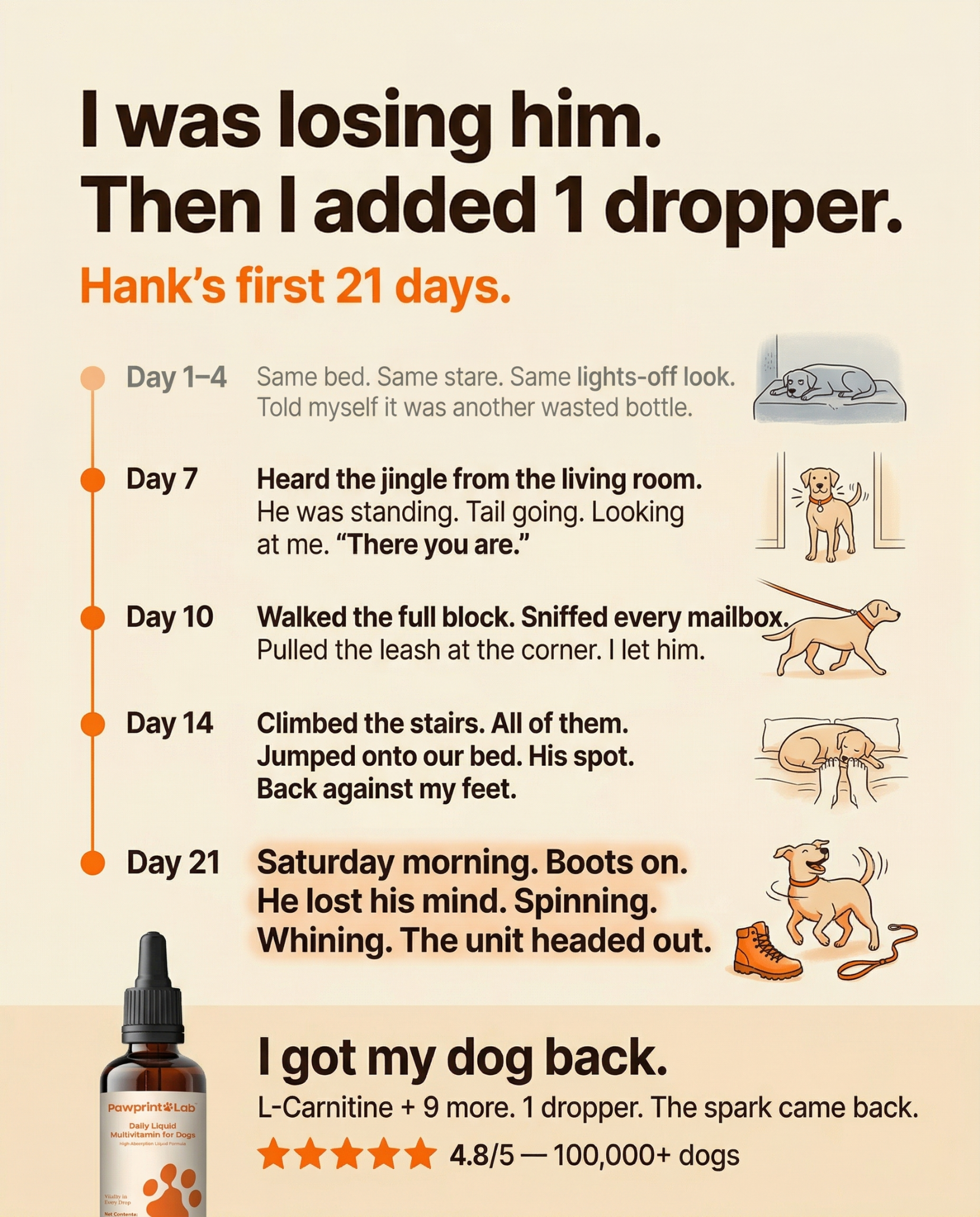
We used to hike together every weekend for six years straight, but last month I went alone for the first time and cried in the car before I even started the trail. It was a Saturday morning in September. The trailhead parking lot was half-empty. Early light coming through the pines. Cool air. Perfect conditions. I sat in the driver's seat with the engine off, staring at the empty passenger seat. There was no nose pressed against the window. No whining to get out. No leash tangled around the center console. Just a seat with a faded blanket over it and a few golden hairs still stuck in the fabric. Hank wasn't with me. Not because something happened to him. He was at home. Alive. Lying on his bed in the living room, same place he'd been lying every Saturday morning for the last eight months instead of sitting next to me in this truck, vibrating with excitement, waiting for me to open the door so he could hit the dirt running. I sat there for maybe five minutes before I started crying. Not sobbing. Just that quiet, leaking kind of crying that comes when you finally admit something you've been trying not to say out loud. I lost my hiking buddy. I lost my adventure partner. I lost the dog who made me a person who goes outside. Because here's the thing nobody tells you. A dog doesn't just change your schedule. A dog changes your identity. Who you are. How you move through the world. What you do on a Saturday morning instead of sleeping until ten. Before Hank, I wasn't a hiker. I was a guy who worked too much, watched too much TV, and said "I should get outside more" every January without doing anything about it. Hank made me someone different. The day I brought him home at twelve weeks old — this wriggling, ridiculous, seventy-dollar-adoption-fee mutt with paws the size of dinner plates — I didn't know he was about to rebuild my entire life. Within a month, I was walking two miles a day. Within three months, we were on trails. By his first birthday, we had done every trail within an hour of the house and started driving to the mountains. He was the reason I bought hiking boots. The reason I got a headlamp. The reason I started waking up at 5:30 AM on weekends — voluntarily — because the early trails were quiet and it was just us and the birds and whatever squirrel made the catastrophic decision to cross our path. My wife called us "the unit." She'd say, "The unit is heading out," when we loaded the truck on Saturday mornings. My daughter drew a picture of us in second grade — a stick figure with a backpack and a big golden blob next to it. She titled it "Dad and Hank's Mountain." It's still on the fridge. That was who I was. The guy with the dog. The hiking guy. The unit. Now I was sitting alone in a parking lot, crying into a steering wheel, because the other half of the unit couldn't make it to the end of the driveway anymore. That was the morning I stopped pretending everything was fine. For about a year, I had been watching Hank slowly leave. Not dramatically. Not all at once. It was like watching a sunset. So gradual you don't realize the light is gone until you're standing in the dark. It started with the pace. He used to lead. He was always ten feet ahead of me on the trail, pulling the leash taut, nose working overtime, tail like a metronome. Then he started falling behind. First by a step. Then by three. Then I'd look back and he'd be twenty feet behind me, head down, walking like his shoes were too tight. I told myself it was the heat. Then I told myself it was the trail. Then I told myself he was just having an off day. He had a lot of off days. Then it was the distance. We used to do six miles. Then four felt like enough. Then three was a stretch. Then one day we did a mile and a half and he sat down on the trail and looked at me and I knew — that look — he was done. Not resting. Done. I carried him the last quarter mile back to the truck. Sixty-two pounds on my shoulders. He didn't fight it. He just let me carry him, his chin resting on the top of my head, and I could feel his breath, heavy and slow, and I thought: this is wrong. This is all wrong. Then it was the mornings. He used to hear me put on my boots and come flying around the corner, collar jingling, tail destroying everything on the coffee table. That sound — the jingle and the thump of his tail against the wall — was my Saturday alarm clock. Then the jingling stopped. I'd put on my boots and he'd lift his head from his bed. Look at me. Put his head back down. Not excited. Not interested. Not even pretending. Like he knew what boots meant and he'd already decided he wasn't going. My wife noticed before I did. Or maybe I noticed and she was the first one brave enough to say it. "He's not the same dog," she said one night. We were in bed. Hank was asleep downstairs — something he'd never done before. He used to sleep at the foot of our bed, his body pressed against my feet, snoring loud enough to hear through earplugs. "He's just getting older," I said. "He's nine. Dogs slow down." "He didn't slow down," she said. "He stopped." She was right. And I hated her for saying it out loud because it made it real. He didn't slow down. He stopped. Like someone reached inside him and pulled out the part that made him Hank. The dog on the bed downstairs — the one who slept eighteen hours a day, who didn't come to the door anymore, who looked at his leash like it was a threat instead of a promise — that dog looked like Hank. Had his face, his fur, his collar. But it wasn't him. The light was gone. The thing behind his eyes that used to say "let's go, let's go, let's GO" — it was just... off. I took him to the vet. She did the exam. Bloodwork. Joint check. She pressed into his hips and he flinched. "He's overweight," she said. "Sixty-two pounds. Should be closer to forty-eight. That's almost thirty percent over." I opened my mouth to say he wasn't fat. He was "just a big dog." He was "solid." He'd always been "thick." But the words tasted like lies now because I'd been watching him deteriorate for a year and I knew — somewhere I'd been refusing to look — that the weight was part of it. "His joints are under significant stress," she said. "Every extra pound is four extra pounds of force. Fourteen pounds over means his hips and knees are absorbing over fifty-six extra pounds of pressure with every step. That's why the trails got shorter. That's why the pace dropped. That's why he stopped." Fifty-six extra pounds. On every step of every hike I'd dragged him on while telling myself he was "just having an off day." "Put him on weight management food," she said. "Reduce portions. Limit exercise to short, flat walks until we get some weight off." Limit exercise. Short, flat walks. For the dog who used to climb mountains. So I did what she said. I bought the diet food. Our pantry became a graveyard of bags I rotated through hoping one would be different. The "metabolic" formula. Thirty-eight dollars. Higher fiber, lower everything else. He ate it like it was punishment. The "weight control" blend. More fiber. Less taste. He started leaving food in the bowl — Hank, who used to inhale meals like someone was going to steal them. The prescription diet from the vet's shelf. Forty-five dollars. Measured to the gram. He lost a pound in month one. Then nothing for three months straight. A plateau so flat you could set a level on it. They all did the same thing. They cut his calories. They filled his bowl with fiber. They stripped the fat and protein his body needed. And his body responded by shutting down even further. His coat — the thick, golden, gorgeous coat my daughter used to bury her face in — went dull. Dry. Started shedding in handfuls. My wife found clumps of it on the couch, on the stairs, on every surface. His energy, already low, cratered. He went from a dog who didn't want to hike to a dog who didn't want to walk. Then to a dog who didn't want to stand. He'd lie on his bed for hours, eyes open, staring at nothing, like a light on in an empty room. The diet food wasn't saving him. It was dimming what was left. So I tried supplements. Everything the vet suggested and everything I found on my own. Joint chews from the pet store. He bit one in half, sniffed the inside, and walked away with the contempt of a restaurant critic. Fish oil capsules hidden in peanut butter. He licked the peanut butter off the capsule with the precision of an archaeologist, deposited the intact capsule on the floor, and looked at me like I'd insulted his intelligence. A "mobility" powder I stirred into his food that turned his dinner into a gray sludge he circled three times and refused to touch. A forty-dollar bag of "vitality" soft chews that were, upon inspection, mostly glycerin, maltodextrin, and natural flavor — with about as much active ingredient as a prayer. They all failed the same way. He wouldn't eat them. Or they were so stuffed with filler that the functional ingredients were ceremonial. Or the delivery system was so inefficient that whatever survived his stomach acid arrived at his joints in homeopathic quantities. It was like trying to deliver medicine by putting it in a paper airplane and throwing it out the window toward the hospital. Optimistic. Impractical. Nothing lands where it needs to. That Saturday morning in the parking lot — the first Saturday I went without him — I sat there and realized something I'd been running from for a year. I was losing him. Not to death. To disappearance. The slow, quiet kind. The kind where the body stays but the dog inside goes away. The light in his eyes. The pull on the leash. The jingle at dawn. The half of "the unit" that made the whole thing work. If I kept doing what wasn't working — the diet food that was starving him, the chews he wouldn't eat, the short flat walks that both of us hated — he was going to spend the rest of his life on that bed. And I was going to spend the rest of mine hiking alone, pretending it didn't hurt. I drove home. I didn't do the trail. I walked in the door and Hank was exactly where I'd left him. On his bed. Eyes open. Not lifting his head. I sat down next to him, put my hand on his side, and said out loud, to nobody: "I'm going to fix this." I went to my laptop. Not the forums. Not the Facebook groups where everyone trades stories about their dog slowing down and everyone says "enjoy the quiet years" like that's an acceptable answer. The quiet years. There's nothing to enjoy. The quiet is the sound of losing them. I went to the research. Veterinary nutrition papers. Canine metabolic studies. Joint degeneration data. Exercise intolerance in overweight dogs. I wanted to understand why my dog — my adventure partner, my trail buddy, my identity — was disappearing. I read all afternoon. Into the evening. Past dinner. And then I found a paper from a veterinary researcher that stopped me in my tracks. He wasn't talking about "weight management." He was talking about a metabolic shutdown. He explained that when a dog gains excess weight, two things happen simultaneously, and they feed each other in a vicious loop. First: the weight crushes the joints. Every extra pound becomes four pounds of force. Cartilage grinds. Inflammation builds. Movement becomes painful. The dog avoids movement — not because they're lazy, not because they've "slowed down," but because it hurts. Second: the metabolism stalls. There's a nutrient called L-Carnitine that acts as a shuttle inside every cell. It grabs stored fat and carries it into the mitochondria — the furnaces that convert fat to energy. Without enough L-Carnitine, fat can't reach the furnace. The body stores it instead of burning it. The dog gets heavier. The joints take more damage. The dog moves less. The cycle tightens. And here's the part that hit me like a punch: The researcher described what happens to the dog's behavior as the cycle progresses. Phase 1: The dog slows down. Shorter walks. Fewer bursts of energy. The owner says, "He's getting older." Phase 2: The dog stops initiating activity. Doesn't bring the toy. Doesn't come to the door. Doesn't react to the leash. The owner says, "He's just mellow now." Phase 3: The dog withdraws. Sleeps most of the day. Separates from the family. Stops engaging. The owner says, "He's not the same dog." Phase 4: The dog exists, but the life is gone. The personality, the spark, the identity — erased by a body that's too heavy to move and too metabolically broken to burn the weight off. I was reading a clinical description of the last twelve months of my life with Hank. Phase 1: the trails got shorter. Phase 2: he stopped coming to the door. Phase 3: he moved to the downstairs bed. Phase 4: the empty passenger seat. Every phase I'd explained away. Every phase I'd rationalized. Every phase I'd watched happen and called "getting older." It wasn't aging. It was a metabolic and structural collapse that diet food was making worse. Because diet food cuts calories without providing the tools the body needs to burn fat or rebuild joints. It's like taking the engine apart and then giving the car less gas. Less fuel, broken engine, car goes nowhere. Dog goes nowhere. Clinical research confirmed it: dogs supplemented with L-Carnitine lost significantly more body weight than dogs on calorie restriction alone. The nutrient — not the diet — was the difference. And the joints? They needed direct support. Glucosamine. Chondroitin. MSM. Hyaluronic Acid. The raw materials cartilage is made from. Without them, the joints just keep grinding under weight the body can't remove. And the inflammation? Fish Oil. Turmeric. To cool the systemic fire that excess weight creates in every system — joints, liver, immune, skin. Not diet food. Not treat chews. Not "enjoy the quiet years." Actual metabolic intervention. Fat burning restarted. Joints rebuilt. Inflammation calmed. All at once. All together. I looked at Hank. Still on his bed. Still staring at the wall. Still looking like a dog who'd forgotten he used to be someone's adventure partner. We had been starving him with diet food that stripped his body of everything it needed. We had been watching the phases tick by and calling it age. We had been throwing treat chews at a metabolic crisis like tossing coins into a fountain and wishing really hard. Nobody had tried to restart the engine. Nobody had tried to give his body back the tools it needed to burn the weight, rebuild the joints, and wake up. I felt a guilt so heavy it bent me forward in the chair. Twelve months. I'd watched my best friend disappear for twelve months and told myself it was normal. But right behind the guilt — pushing through it — was something I hadn't felt in a long time. Hope. Real, specific, mechanical hope. Not "maybe he'll have a good day" hope. The kind of hope that comes from understanding exactly what's broken and exactly what could fix it. I started searching for something that addressed the actual problem. I didn't want another bag of diet food. I didn't want treat chews packed with filler. I wanted something that could restart the fat-burning system, rebuild his joints, and calm the inflammation — in a format he'd actually take. I learned that most chewable supplements are a delivery disaster. The active ingredient gets chewed apart, dissolved by stomach acid, degraded through the intestinal wall. By the time anything reaches the bloodstream, the dose is negligible. It's theater, not therapy. I needed something that bypassed the entire chew-dissolve-and-pray system. I found a small company called Pawprint Lab. I almost scrolled past. A simple amber bottle with a dropper. No dramatic marketing. No transformation montage. No celebrity vet testimonial. But then I read the reviews. They weren't just saying "good product." They were telling my story. Our story. The unit's story. "My hiking buddy. Used to love the park. Won't even fetch anymore. Two weeks on this and he pulled me up the trail." "It's like he gave up. Wouldn't play. Wouldn't greet me. Week three, the light came back in his eyes." "I got my best friend back. I don't know how else to say it." "Remember when your dog used to be... your dog? This is how you get that back." Every single one hit me in the chest. It wasn't a treat chew. It wasn't a powder. It wasn't another bag of fiber-stuffed kibble. It was a liquid formula. Ten active ingredients in one dropper. You squeeze it onto their food or right into their mouth. It absorbs straight into the system — no pill casing, no stomach acid destroying it, no filler taking up room where real ingredients should be. L-Carnitine to restart the fat-burning shuttle his body had lost. Glucosamine HCl and Chondroitin Sulfate to rebuild the cartilage that had been grinding under the weight. MSM and Hyaluronic Acid to cushion what was left. Fish Oil and Turmeric to fight the inflammation that had been quietly locking his joints and draining his energy. Beta-Glucans and Zinc to rebuild the immune system that metabolic stress had been suppressing. Vitamin E for the coat that diet food had been starving. One dropper. Every day. On his food. Not ten bottles. Not a supplement graveyard. One amber bottle that addressed the entire collapse — metabolism, joints, inflammation, immune, coat — in a single dose. I ordered a bottle. I didn't tell my wife. I didn't tell anyone. I was tired of explaining. Tired of hope followed by nothing. I just quietly added it to his bowl and waited. When it arrived three days later, I put it on his dinner. Hank was doing his new routine — lying next to his bowl, getting up slowly, eating half, lying back down. I squeezed one dropper over his kibble and stirred it in. He sniffed it. His ears went forward. He ate the entire bowl. Pushed it with his nose across the floor. Looked at me. First time he'd finished dinner in weeks. "Okay, buddy," I said. "That's a start." I didn't get excited. Twelve months of watching him disappear had trained the optimism out of me. I told myself this was just another thing I was trying. Probably wouldn't work. Probably another bottle for the graveyard. Day one. Same dog. Same bed. Same stare. Day two. Nothing. Day four. Nothing I could see. But that night, he walked to the back door on his own and stood there waiting. He hadn't asked to go out voluntarily in weeks. I opened the door. He walked onto the patio, stood in the night air for a minute, and came back in. Small. But real. Day seven. I was putting on my shoes — regular shoes, not hiking boots — to go to the grocery store. I heard a sound from the living room. Jingle. His collar. Moving. I looked around the corner. Hank was standing. In the middle of the room. Tail going. Looking at me. Not excited. Not spinning. Just... present. Standing. Looking at me like, "Are we going somewhere?" He hadn't done that in months. My throat closed up. I knelt down and put my hands on either side of his face. His tail sped up. His tongue came out. He licked my nose. "Hey, buddy," I whispered. "There you are." Day ten. I took him for a walk. Just around the block. Not a trail. Not a hike. Just the neighborhood loop. He walked the whole thing. Slowly. But steadily. No sitting down. No planting. He sniffed every mailbox. He marked three trees. He pulled the leash — gently, barely — when we turned the corner toward the park. He pulled the leash. The thing I used to complain about. "Hank, stop pulling." The thing I would give anything to feel again. And there it was. A tug. Small. But there. Day fourteen. My wife saw it before I did. I was in the kitchen making coffee. Hank was in the living room. She was standing in the doorway, hand over her mouth, eyes shining. "Look," she whispered. I looked. Hank was standing at the bottom of the stairs. Looking up. Tail going slow. Then he put one paw on the first step. Then the other. Then he climbed. One step at a time. All the way to the top. He hadn't been upstairs in four months. He hadn't been in our bedroom since he moved to the downstairs bed. Since he left us. He walked into our bedroom, jumped onto the foot of our bed — jumped — turned twice, lay down, and groaned. Our bed. His spot. Where he used to sleep with his body pressed against my feet. My wife and I stood in the doorway and held each other and cried. The kind of crying that isn't sad. It's the kind that happens when something you thought was gone comes back. Day twenty-one. Saturday morning. I was sitting at the kitchen table, drinking coffee, not thinking about anything in particular. I heard a sound I hadn't heard in almost a year. Jingle. Jingle. Thump. Thump thump thump. His collar. And his tail. Against the hallway wall. Getting louder. Coming toward me. I looked up. Hank was standing in the kitchen doorway. Tail going hard. Body wiggling. Ears up. He looked at me. Then he looked at the back door where his leash hung on a hook. Then he looked back at me. My coffee mug froze halfway to my mouth. "You want to go?" His whole body answered. The wiggle became a full-body vibration. He spun once. His back end nearly knocked over a chair. I put the mug down. I walked to the closet. I pulled out my hiking boots. The moment he heard the boots — that sound, the sound of laces against leather, the sound that used to be his alarm clock — he lost his mind. Spinning. Whining. Jumping. Pawing at my leg. Shoving his nose into the boot while I was trying to put it on. My wife came out of the bedroom. "What's happening?" "The unit is heading out," I said. She started crying. My daughter came running down the stairs. "Can I come?" We drove to the trailhead. All of us. Hank in the passenger seat, nose against the glass, whining, fogging the window with his breath. The blanket under him. The golden hairs on the fabric. Everything exactly the way it used to be. We did two miles. Not six. Not the old distance. But two real miles on real trail, through real woods, with a real dog pulling on the leash in front of me. He led. Ten feet ahead. Nose working. Tail going. Ears catching every sound. At the top of a small ridge, he stopped and looked back at me. Tongue out. Eyes bright. Not the empty stare. Not the lights-off look. The real look. The one that says, "You coming?" I caught up to him and we stood there together, looking out over the valley, and I put my hand on his head and said, "I got you back." That was six weeks ago. He's lost almost seven pounds. I can feel his ribs. There's a waist again. The barrel body is reshaping into a dog body. His coat came back. Thick. Shiny. Golden. My daughter buries her face in it again. He sleeps on our bed every night. His body pressed against my feet. He comes to the door. Every time. With something in his mouth — a sock, a toy, once a shoe he stole from the closet. We hike every Saturday. We're up to three miles. He pulls the leash. I let him. Last weekend, at the end of a trail, my daughter took a photo of us. Me and Hank at the summit marker. She showed it to me later. I looked at it for a long time. "That's us," I said. "The unit," my wife said. I'm sharing this because I know there are thousands of dog owners right now who've lost their dog without losing their dog. Your dog is still here. Still alive. Still in the house. But the dog you knew — the one who made you a different person, a better person, a person who goes outside and does things and lives a bigger life — that dog is gone. And you've been telling yourself it's age. It's normal. Enjoy the quiet years. But you don't have to accept the quiet. Your dog didn't choose to stop. Their body stopped them. The weight crushed the joints. The metabolism stalled. The inflammation locked everything up. The spark went out because the body couldn't fuel it anymore. Stop starving them with diet food that strips the nutrients their body needs to function. Stop buying treat chews packed with filler that dissolve before they help. Stop telling yourself "he's just getting older" when what you mean is "I'm losing him and I don't know what to do." Your dog's body needs restarting. The fat-burning system. The joints. The inflammation response. All of it. Together. This little amber bottle isn't magic. It's just... the thing that was missing. It gave me back the pull on the leash. The jingle at dawn. The nose against the window. The other half of the unit. If your dog used to love the park and won't even fetch anymore... If they used to meet you at the door and now they don't lift their head... If you miss who you were when your dog was who they used to be... You need to try Pawprint Wellness Protocol. Hank gets one dropper a day. My wife calls it "the thing that brought him back." My daughter calls it "trail juice." I just call it the reason I'm not hiking alone anymore. Don't spend another Saturday in the parking lot, staring at an empty seat. Click below to see if it can bring your dog back.
Like this ad? Make it yours.
Crush rebuilds this exact creative around your product — your brand, your colors, your offer — in about a minute.