
Inactive· since May 23, 2026
- 4
- days it ran
- 0
- relaunches
- 3
- EU reach
Ad copy
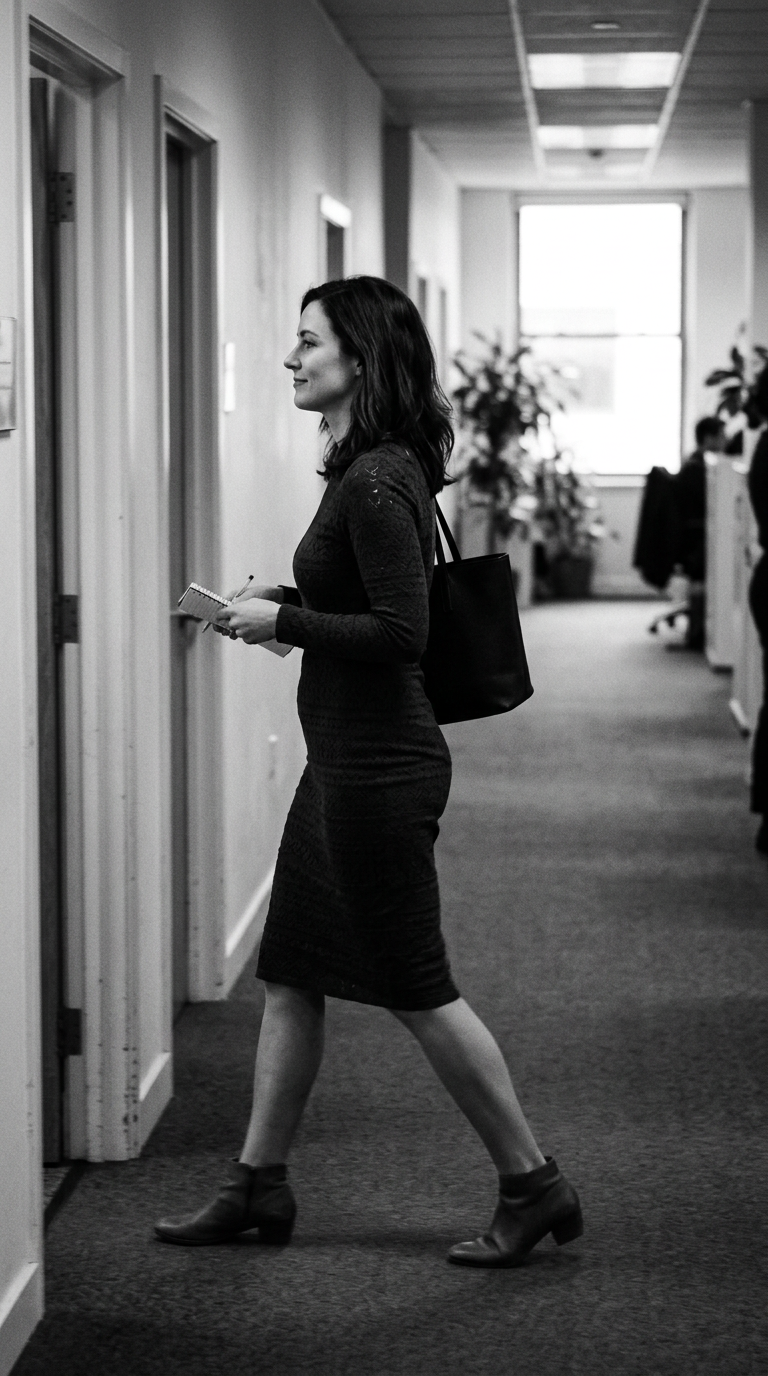
the woman in the fitted dress Lisa noticed the change on a Monday. Not because she was looking — because the change was the kind you can't not-see. The kind that interrupts a hallway the way a sound interrupts silence. Kate walked past her desk at 8:47 AM in a fitted dress and heels and a posture that didn't belong to the woman who'd been walking that hallway in an oversized sweater for the past six months. Lisa looked up from her screen and her brain did the thing brains do when stored data collides with new data — the stutter. The re-read. That can't be Kate. That's Kate. Lisa knew Kate the way office women know each other — from hallways and break rooms and the peripheral awareness of who's gaining and who's losing and who's wearing what today. Lisa knew Kate was gaining because Lisa was gaining too. They were in the same war, wearing the same uniform — the cardigans, the wide pants, the clothing designed to communicate nothing about the body inside it. Lisa had watched Kate gain the way you watch someone walk a road you're also on, a few steps behind. There's a recognition. A solidarity nobody speaks. For six months, Kate had been Lisa's silent companion in the war. The woman who was also hiding. Who also walked the hallway quickly. Who also got the look from Jessica and Amanda — the inventory, the cataloguing, the filing into the "gaining" category that office women maintain in their heads like an unofficial database. Lisa heard what happened last month. The version that traveled the office the way information travels offices — partially, distorted, through the women who saw pieces and assembled them wrong. Kate went to the doctor. Kate was sick. Kate is on a new medication. Kate had surgery. The office created its own explanation because the real one — a woman found a way to work with her nervous system and her body responded — wasn't in the office's vocabulary. What Lisa SAW was this: Kate went from sweater to dress in four weeks. Kate went from quick-walking to normal-walking. Kate went from eyes-down to eyes-forward. Kate went from the "gaining" file to a file that didn't have a label yet because nobody in the office had seen this particular trajectory — a woman who was clearly losing a war suddenly winning it without any of the usual visible weapons. No gym obsession. No meal-prep containers at lunch. No dramatic weight-loss conversation. Just a quiet, month-long shift from hiding to showing. And now Kate was leading the new project. The boss announcing it in the hallway where Jessica and Amanda stood with their blazers and their inventory system updating in real time. Kate didn't gloat. Kate said "thank you" and went to work. The absence of gloating was its own kind of power. Jessica and Amanda invited Kate to lunch. Lisa heard it from her desk. "No thanks. You two should worry about your own results." Lisa's breath caught. Not because the sentence was mean — because the sentence was the sentence of a woman who is no longer worried about being catalogued by the people she used to hide from. The sentence of someone who's left the file. Lisa waited until 4 PM. Until the office was quieter. Until she could stand at Kate's desk without Jessica and Amanda's inventory system registering the interaction. She walked to Kate's desk. In the cardigan. In the wide pants. In the uniform Kate used to wear and Lisa was still wearing. And she said the thing she'd been composing in her head since 8:47 AM. "Kate, you look amazing. So confident and full of energy. What happened?" Kate looked at her. And Lisa saw something in Kate's eyes she didn't expect — recognition. Not the office kind. The deeper kind. Kate was looking at Lisa's cardigan and Lisa's wide pants and Lisa's low ponytail and seeing something. Seeing someone she knew. "I'll tell you," Kate said. Leaning in. Quieter. "But don't tell others." Lisa leaned in. The lean of two women sharing something real in a space where most sharing is performed. "I learned how to work with my nervous system instead of against it. For years my body was stuck in survival mode — holding onto everything because it thought I was in danger. I wasn't in danger. I was just living at a speed my body read as emergency. Nobody checked it — not my doctor, not my trainer, nobody. They checked the food and the hormones and the thyroid and said 'normal.' But the nervous system wasn't normal. It was running full emergency, every day, and the emergency was overriding everything I did." "How did you fix it?" "There's an app — Liven. Neurobalance Protocol. Twenty-eight days. Nine minutes a day. It helps the nervous system come out of survival so the body can respond to the food and the training the way it's supposed to. I'll send you the link. They're running a promo right now but I don't know how long." Lisa took her phone out. Hands slightly shaking. Not from fear — from the thing that happens when a woman who's been walking a road alone meets someone who says "I was on that road and here's the exit." "Thank you, Kate. I'm starting right now." "Thank me in twenty-eight days." Lisa walked back to her desk. Sat down. Opened the link Kate texted. The quiz loaded. Three minutes. The questions were specific in a way no doctor had ever been specific: do you feel wired but tired. Does your body hold weight despite everything you do. Do you wake at 3 AM. Do you feel like you're running on emergency. Yes. Yes. Yes. Yes. Lisa had been answering yes to these questions for three years without knowing they were questions. They were just her life. Her commute. Her to-do list. Her feeling of never coming down from something she couldn't name. The quiz named it. The quiz called it a Dysregulation Score and the score was high and the score had a protocol and the protocol was twenty-eight days. She put her phone down. Looked at Kate across the office. Kate was working. Fitted dress. Straight posture. The woman who'd been in the cardigan a month ago sitting at the same desk in a different body with a different relationship to the hallway. Lisa looked down at her own cardigan. Touched the fabric. The wide, forgiving, hiding fabric. The uniform she'd been wearing for two years. Twenty-eight days, she thought. In twenty-eight days this cardigan goes in the back of the closet. She opened the app and started.
THIS IS what you need to do
LEARN MORELike this ad? Make it yours.
Crush rebuilds this exact creative around your product — your brand, your colors, your offer — in about a minute.