Dr Simmons, Hand Therapist
Dr Simmons, Hand Therapist Facebook ad: “Thumb Pain Relief for Guitarists | CMC Support Brace for…”
Ran for 15 days, from June 28 to July 13, 2026, the last day Crush saw it.
Run by Dr Simmons, Hand Therapist on Facebook. Crush is not the advertiser and does not verify its claims. See this ad in Meta's Ad Library(opens in a new tab)
Want an ad like this for your product?
Crush makes new ad images for your product from this ad: your logo, your product photo, your offer.
Trials from $19.95 USD, then $79.95 USD a month. Cancel anytime.
About this ad
- Meta Ad Library ID
- 949610281465985
- Platforms
- Facebook, Instagram, Audience Network, Messenger and Threads
- Relaunches
- 0
- EU reach
- 408
Ad text
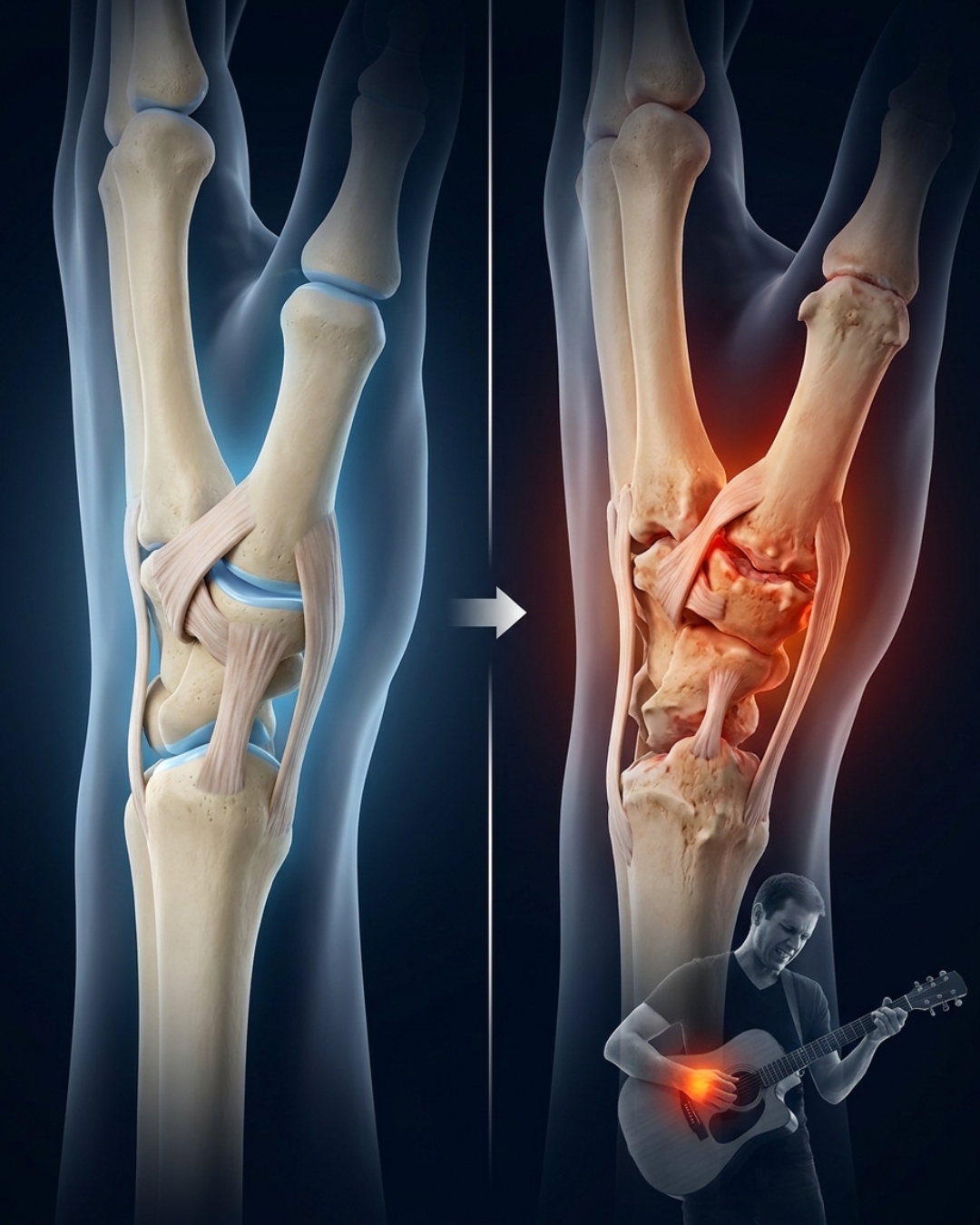
I'm a hand therapist, and what I'm about to say is going to upset a lot of doctors. If your doctor told you to "just stop playing" because of the pain at the base of your thumb, you were only given half the answer. And the missing half is what's quietly making your hand worse. My name is Dr. Simmons. I'm a hand therapist. I've spent fifteen years treating hand and wrist problems, and the fastest-growing group walking into my clinic now is musicians. Not weekend strummers. Lifers. Men and women in their fifties, sixties, and seventies who've had a guitar, a bass, a piano, or a violin in their hands since they were teenagers. People who pick the instrument up the way other people meditate. It's how they switch off at the end of the day. For a lot of them, it's the only time the noise in their head actually goes quiet. And nearly every one of them lands in my chair after seeing another doctor who told them the same thing: "Stop playing. Wear this brace. Take some ibuprofen. Come back in six weeks." That advice isn't wrong. But it's only half of it. And the gap between what these players are told and what they actually need to know is wrecking the one thing that's kept them sane for forty years. Here's what I see in my clinic every week. Two types of musicians. Both in pain. Both following their doctor's advice. Both getting worse in different ways. The first one listened. He stopped playing completely. He wore the rigid wrist brace. He rested for weeks. The sharp pain quieted down. But he never went back. The guitar sits on its stand in the corner. He walks past it every morning. He tells me he feels ridiculous for being this upset about a "hobby." But it was never just a hobby. It was the thing that emptied his head out at the end of long days for forty years. He's grieving it, and he doesn't have a word for that. The second one tried but couldn’t stop. Music is already a part of who they are and the silence in the house without playing got too loud, Five minutes in, the click starts. Ten minutes in, the burning needle behind the thumb knuckle. Fifteen minutes and the whole hand is locking up. He's stuck in a loop. Pain, rest, pain again. The window keeps shrinking. Both of these musicians are failed by the same gap in their treatment. Let me explain what that gap is. Because once you understand it, every brace you've tried and every week of rest that didn't hold will finally make sense. Playing your instrument does something to the base of your thumb that almost nothing else in your day does. Every chord. Every barre. Every reach for an octave. Your thumb is bearing a load right at the joint where it meets the wrist, hundreds of times an hour. But the real problem isn't the load itself. It's what's quietly happening to the joint underneath it. The structure at the base of your thumb is called the CMC joint. It's shaped like a saddle, not a hinge. That saddle shape is what lets your thumb wrap a neck and stretch across a keyboard. It's also the least stable joint in your hand. There's no bony lock holding it together. Just a small band of ligaments doing their best to keep the bone seated. After years of squeezing under load, those ligaments stretch. The joint stops sitting cleanly. And every time you clamp down on a barre chord, the bone slides past itself instead of pressing through the joint the way it's supposed to. The next time you fret a chord, watch the back of your thumb. You'll see it. A tiny shift in the joint every time you squeeze. Sometimes you can feel a click. Sometimes you can actually hear it, a soft dry pop near the wrist that wasn't there ten years ago. Almost nothing else in your day forces that joint to bear that exact load this many times in a row. Typing doesn't do it. Lifting groceries doesn't do it. Only the load of pressing strings, hour after hour, year after year. That click is the joint sliding. That deep burning pain at the base of your thumb fifteen minutes in is the bone grinding where it should be sitting clean. That's not "arthritis flaring up." That's a joint that's stopped holding itself in place. This is the part most musicians are never told. Playing isn't the problem. The real problem is that there's nothing holding the base of your thumb steady. The bone keeps sliding under every squeeze, in a joint that's already raw. And until something holds it in place, the grinding keeps going, and the swelling builds straight back up the moment you sit down to play again. Compression gloves squeeze the whole hand evenly. They take the edge off, but they don't hold the bone steady at the exact spot where the sliding is happening. And they cover the fingertips, the one part of your hand you read the strings with. The rigid wrist brace your doctor handed you holds your wrist. But the second you go to fret a chord, the CMC joint is still sliding. As one of my patients put it: "Feels like I'm playing in a boxing glove." That's why rest works for a while, then the pain comes straight back. The swelling settles. But the moment you pick the guitar up, the joint is sliding again. It's not because you played too long. It's because nothing was holding the one place that needed holding. So what actually works? Holding the base of the thumb steady, right where the joint is sliding. That means firm support directly over that spot. Not a brace that locks your wrist. Not a glove that buries your fingertips. Something that holds the one place that needs holding, and leaves your four fingers, your thumb tip, and your wrist completely free to play. Most thumb supports on the market are built for sports injuries, work injuries, or post-surgical recovery. They are not built for musicians. They don't account for the exact motion your thumb makes when you barre a chord. So they either restrict too much, and you can't play in them, or they miss the spot completely. The support I helped a small team design, The Hand Stabilizer, was built specifically for the way a player's thumb moves under load. It puts firm support directly over the CMC joint while leaving every fingertip, the thumb tip, and the wrist completely free. The one place that needs holding gets held. If you stopped playing and you walk past the guitar every morning without picking it up, you're not being dramatic. You did the right thing by resting. But rest only settles the swelling. It doesn't hold the joint when you go back. You deserve both halves of the answer. And if you couldn't stop, if your sessions are down to ten minutes before the burn starts, you're not weak. The problem was never that you keep playing. The problem is that nothing has been holding the base of your thumb steady. Hold that one spot, and the loop breaks. I've written up the rest of this, the five reasons the pain keeps coming back, and the third option most doctors never mention. The link is below in case you’d like to read it
Where the ad sends people
handhearth.com
Thumb Pain Relief for Guitarists | CMC Support Brace for Musicians
Struggling with thumb pain while playing guitar? This CMC thumb support brace helps stabilize the joint, reduce discomfort, and keep musicians playing longer without restricting movement.
Learn more: handhearth.com(opens in a new tab)