
Inactive· since Mar 11, 2026
- 76
- days it ran
- 0
- relaunches
Ad copy
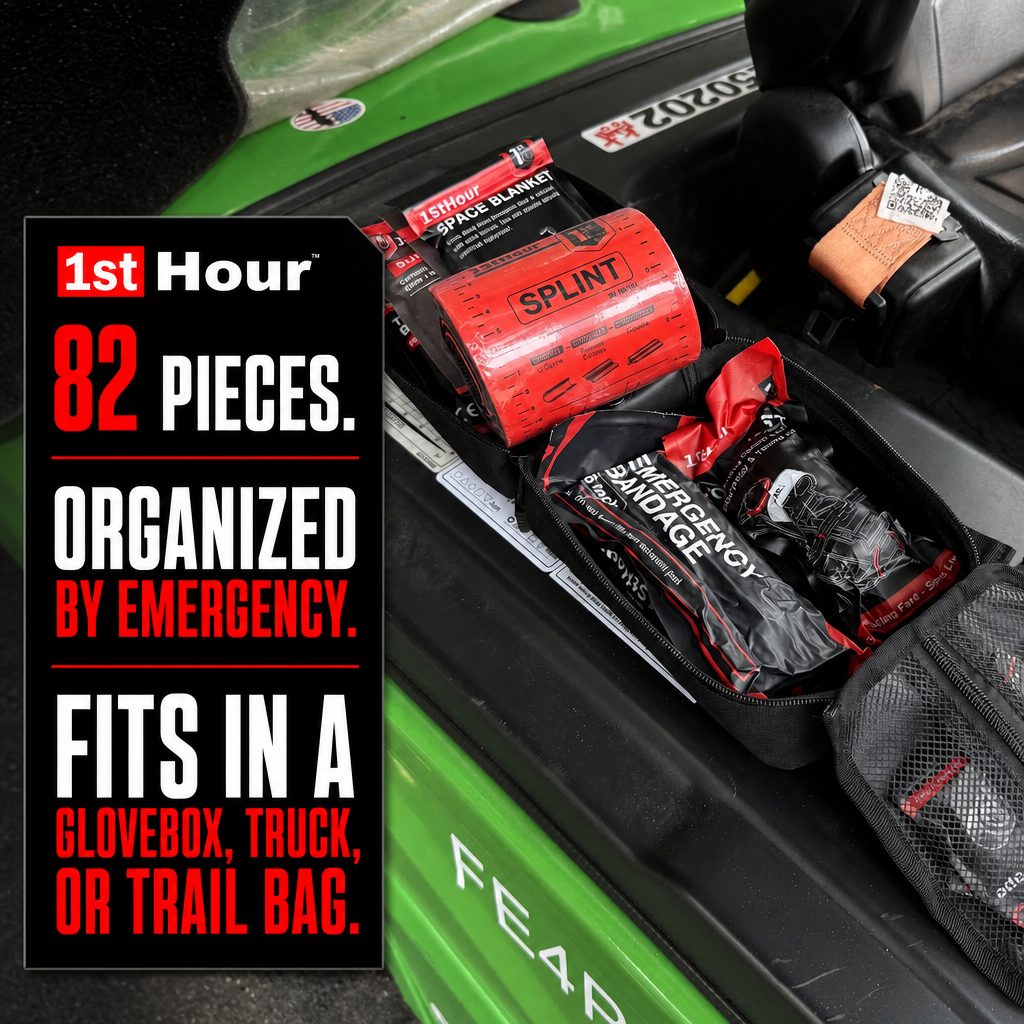
The paramedic cut away the outer wrap on my son's leg and went quiet for a second. "Who applied this?" "I did." He looked at me differently then. Not the way paramedics usually look at panicked fathers who followed the ambulance in their own car. Like someone who recognized the equipment. "Where'd you learn this?" "YouTube," I said. "About three weeks ago." He checked the pressure dome. Checked the wrap direction. "Good," he said quietly. "This is the only reason we're not looking at a very different situation right now." My son — thirty-three years old, coaches his daughter's soccer team on Saturdays — was gray. Conscious, but gray. His thigh was wrapped in what looked like a white elastic bandage with a built-in pressure cup. Three hours earlier it was sitting in a pouch on my garage shelf. Three hours earlier I wasn't sure I'd ever actually need it. I stood in that parking lot watching them load him into the ambulance and my hands wouldn't stop shaking. Not from the blood. From the realization of what almost happened. Let me go back. About three weeks before that afternoon, I was at a family reunion at my sister's farm. My nephew — twenty-two years old, works cattle on the property — was moving a metal gate that had come off its hinge. Heavy thing, rusted along the bottom edge. It slipped. The bottom corner caught his shin on the way down. Tore a gash about four inches long, deep enough that you could see it wasn't going to stop on its own. My sister ran inside for her first aid kit. She came back with a white plastic box. Must've had a hundred pieces inside. The kind with the red cross on the front that makes you feel like you're covered. Inside: band-aids. A lot of them. Alcohol wipes in foil packets. Antibiotic ointment. A thin roll of gauze. She pressed a gauze pad against the cut. Soaked through in under a minute. She added another. Then another. By the time the ambulance arrived — fourteen minutes, we're in a rural county — she'd used every piece of gauze in the box and my nephew's leg was still seeping through the stack of pads she was holding against it. He was fine. Twelve stitches. Home the same day. But I drove home that evening and couldn't stop thinking about fourteen minutes. And all we'd had were thin squares of gauze that absorbed blood without doing anything to stop it. When I got home I took out my own first aid kit — the big one I kept under the bathroom sink, the one I'd always felt good about owning — and put it on the kitchen table. I counted everything inside. One hundred and sixty-four pieces. Seventy-eight adhesive bandages. Twenty-six alcohol wipes. Fifteen sting relief pads. Three gauze pads. Each one two inches square. I sat there staring at that pile and I felt something I hadn't felt in a long time. Stupid. Not unprepared. *Stupid.* Because I'd bought that kit. I'd kept it stocked. I'd told myself I was being responsible. But the truth — the truth I couldn't look away from now — was that I'd bought a box of comfort. Not capability. If my wife was seriously bleeding in our kitchen right now, I had nothing. I started searching. "How to stop severe bleeding." "Emergency bleeding first aid." "What do paramedics actually use." And I found a video. Former Army combat medic, filmed in his garage. No production value. Just a man who'd seen enough to be done with being gentle about it. Title: *"Why Your First Aid Kit Will Get Someone Killed."* I almost kept scrolling. Seemed dramatic. But something made me click it. He held up a standard pharmacy first aid kit. "This," he said, "is designed for boo-boos. Scraped knees. Paper cuts. Bee stings." Then he held up a compact black pouch. "This is designed to keep someone alive until the ambulance gets there. These are not the same thing. And almost every American family only has one of them." He opened it. A tourniquet. Orange and black, with a rigid windlass bar you twist to tighten. A pressure bandage — he held it up and turned it slowly — with a plastic dome built right into the wrap. Compressed gauze, vacuum-sealed. Thick and serious-looking. "This is an IFAK," he said. "Individual First Aid Kit. Every soldier carries one. Every law enforcement officer has one. Every firefighter has one in the truck." He held up the pressure bandage. "This is called an Israeli bandage. Developed after the Yom Kippur War, when Israeli military surgeons kept watching soldiers die from wounds that were survivable — if the bleeding had been stopped in those first few minutes. This dome creates focused mechanical pressure directly on the wound. It doesn't just cover it. It *compresses* it. And it locks in place so your hands stay free." He demonstrated on his own arm. The wrap. The reversal. The way the dome seated directly over the wound site. So simple. So obvious. And I had never seen one in my life. "Here's what people don't understand," he said. "When someone has serious bleeding — from a car accident, a fall, a farm injury, anything that catches a vessel — you have three to five minutes before they go into hemorrhagic shock." He paused. "Average ambulance response time in the United States is seven to ten minutes. Rural areas, you're looking at fourteen or more." He let that sit. "You see the problem?" I did. For the first time in my life, I actually did. I'd spent sixty-eight years with the comfortable assumption that if something bad happened, you called 911 and help came and the waiting was just time you got through. But the math had never worked. The math had *never* worked. I spent the next four hours watching every video I could find. Learned about tourniquets — that a properly applied tourniquet stops arterial bleeding from a limb in under sixty seconds, and that anyone can learn to use one from a ten-minute video. Learned about hemostatic gauze — treated with agents that accelerate clotting, the same technology that has kept soldiers alive from wounds that would have been fatal with regular gauze. None of this was secret. None of it required medical training. It just somehow never made it onto the shelf at any drugstore I'd ever been in. I ordered a trauma kit that night. The Trauma First Aid Kit Pro. Fifty dollars. When it arrived I opened it on the kitchen table. The Israeli bandage was sealed in plastic with the instructions printed right on the package. The tourniquet was heavier than I expected — solid, built like it meant it. The hemostatic gauze was vacuum-sealed. It felt serious. Not cheerful. Not decorated with cartoon first aid symbols. Serious. I watched the tutorial videos. Practiced the tourniquet on my own leg, sitting in my kitchen, feeling a little ridiculous at sixty-eight years old. But I kept thinking about my sister's farm. About thin gauze squares soaking through one by one. About fourteen minutes and nothing useful to fill them with. I did it until my hands knew the steps without thinking. Three weeks later, on a Sunday afternoon, my son came over to help me clear brush along the back fence line. He was loading cut branches into the truck bed when his boot caught a root and he went down hard into a section of old fencing — rusted wire that had been lying flat in the overgrowth for years. I heard the sound he made and I was already moving. He'd landed on the wire. It had caught his thigh. When he rolled over and I saw the blood coming through his jeans — not seeping, *pulsing*, moving with his heartbeat — everything else went quiet. His face was white. "Dad—" "I've got it. Don't move." I didn't run. I walked fast to the garage, because I'd learned that panic costs you the seconds you need. Grabbed the pouch off the shelf. Back to him. He was pressing both hands against his leg. "Move your hands." I cut the jeans back with the trauma shears. Found the wound. Tore open the Israeli bandage. Positioned the pressure dome directly over the source of the bleeding. Wrapped once around the thigh. Reversed direction through the pressure bar and locked the compression in place, exactly the way the video showed. The pulsing slowed. Then it stopped. "Keep your leg still," I told him. "Call your wife. Tell her to meet us at the hospital." He called with a shaking hand, the wrapped leg flat on the ground. The ambulance took eleven minutes. My son kept looking at the bandage. "What is that thing?" "Military pressure bandage," I said. "Just keep still." "You just had that in the garage?" "Three weeks," I said. "Almost didn't buy it." When the paramedic saw the bandage and said what he said — about the situation we were not looking at — I felt something I hadn't expected. Not pride. Relief. Because I'd almost been the man standing over his son with a handful of gauze squares, watching them soak through one by one, for eleven minutes. Almost been the man who thought he was prepared. Almost. My son had surgery that evening. The wire had caught close to the femoral. They repaired it. Full recovery expected. The surgeon told us afterward that femoral-adjacent wounds are the ones that don't wait. "Whoever controlled that bleed did it right," he said. "Three minutes slower and we'd be having a different conversation." Three minutes. The time it takes to pour a cup of coffee. My son called me the week he came home. "I need one of those kits." "I know." I sent him the link. Ordered one for his car, one for his house, one for his wife's car. Then I called my sister. "Remember when Tommy cut his leg at the reunion?" "Of course." "I need to tell you about something." I told her everything. About the video. About the math. About what I now keep on my garage shelf. She ordered two before we hung up. Then I called my daughter. My son-in-law. My neighbor on the other side. Not because I'm paranoid. Because I finally understand something I wish someone had told me the day I bought my first white plastic kit with the red cross on the lid: The stuff in your bathroom cabinet is for the 99% of injuries that stop bleeding on their own. It was never designed for the 1% that kill people. And the 1% don't wait for you to figure that out. My son's accident was on a Sunday afternoon. Clear sky. Normal day. The kind of day nothing is supposed to happen on. The difference between him being home with his kids and a conversation I can't bring myself to imagine was thirty seconds and fifty dollars worth of equipment. That's it. Not luck. Not fate. Equipment I almost didn't buy. If you have a first aid kit — and you should — ask yourself one question: Is it designed for band-aids, or for bleeding? Because there's a paramedic somewhere who's going to arrive after something happens to someone you love. And what he says next depends entirely on what you had. *"This is why he didn't make it."* Or: *"This is the only reason he's still with you."* You get to choose. But only right now.
Save A Life For $49
Prepare for emergencies with the Tacright Trauma First Aid Kit, designed for rapid response in critical situations. This compact and durable kit includes all the essential tools needed for trauma care, making it perfect for outdoor enthusiasts, tactical professionals, and anyone who values safety an...
LEARN MORELike this ad? Make it yours.
Crush rebuilds this exact creative around your product — your brand, your colors, your offer — in about a minute.