
Key Takeaways
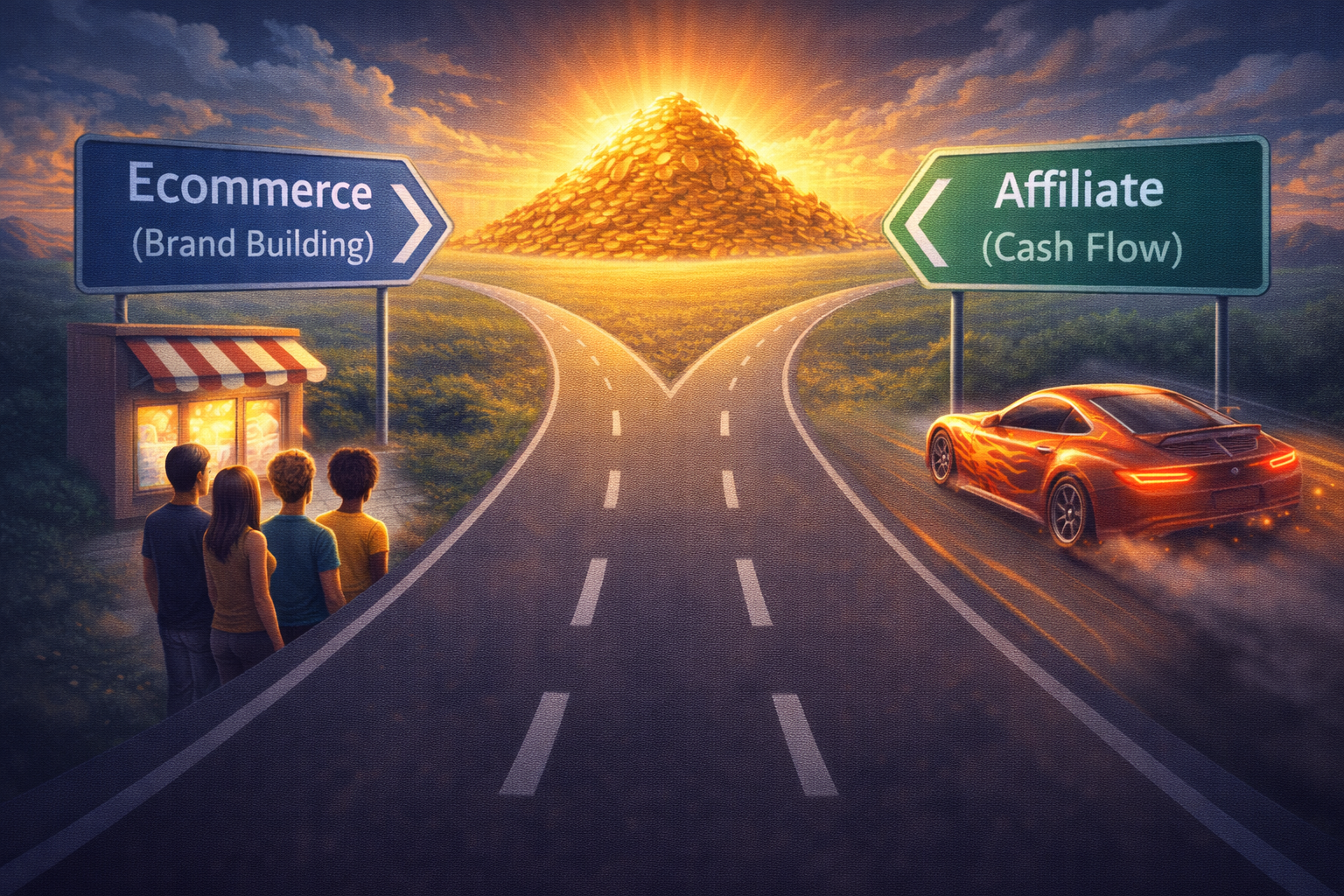
- 1Ecommerce focuses on Lifetime Value (LTV) and branding, while affiliates prioritize speed and immediate ROAS.
- 2Never direct link to affiliate offers; use bridge pages like quizzes or advertorials to prevent Facebook bans.
- 3Boost Average Order Value (AOV) through product bundling to afford higher ad costs and beat competitors.
- 4Smart entrepreneurs start with affiliate marketing for cash flow, then transition to white-label ecommerce brands.
Discover the two primary ways to make money with Facebook ads: Ecommerce and Affiliate Marketing. This guide breaks down specific strategies for both, including creative tips, funnel structures, and compliance secrets to keep your ad account safe.
There are two primary ways people make money with facebook ads.
Ecommerce: Selling your own products (Shopify, WooCommerce).
Affiliate Marketing: Selling other people's products for a commission (ClickBank, Amazon, SaaS).
Both models can make you rich. But the strategies are wildly different.
If you run an affiliate offer like an e-com brand, you will go broke. If you run an e-com brand like an affiliate offer, you will destroy your reputation.
In this guide, we will break down the playbook for both facebook ads for ecommerce and facebook ads affiliate marketing.
The Ecommerce Strategy: LTV is King
In ecommerce, you own the customer. You own the email address, the phone number, and the pixel data. This is an asset-building game.
Your goal is not just to make a profit on the first sale (Front End). It is to acquire a customer who will buy again and again (Back End). This long-term focus is critical when you look at the roadmap for scaling e-commerce ads.
The "Unit Economics" Math
Let's say your product sells for $60. Your Cost of Goods (COGS) + Shipping is $20. Your Break-Even CPA is $40.
If you spend $40 to acquire a customer, you make $0 profit on Day 1. Many beginners panic here. But if that customer comes back 3 months later and buys another $60 product (with $0 ad spend), you just made $40 pure profit.
This is why understanding target CPA vs. ROAS is vital; ROAS fluctuates, but your acquisition cost determines long-term viability.
Strategy Focus for E-com
Creative: High-end branding, storytelling, unboxing, user-generated content (UGC). The ad must feel like a "brand experience."
Funnel: Ad > Product Page > Cart > Post-Purchase Upsell (One Click Upsell).
Optimization: Optimize for Highest LTV (Lifetime Value). You can afford to pay more for a customer than your competitors if your back-end email marketing is strong.
Retention: Use SMS (Postscript/Attentive) and Email (Klaviyo) to drive the 2nd and 3rd purchase.
Success Secret: The money is in the "Bundles." Don't sell a single bottle of shampoo. Sell the "3-Month Supply" or the "Full Hair Care Kit." Increasing your AOV (Average Order Value) from $40 to $80 allows you to bid 2x higher for ads.
The Affiliate Strategy: Speed is King
In affiliate marketing, you are a digital mercenary. You do NOT own the customer. You send traffic to a vendor (like ClickBank, MaxWeb, or a SaaS partner). They pay you a commission (CPA). You never see that customer again.
The "Cash Flow" Math
If the payout is $100 and you spend $60 to get the sale, you keep $40. You need to be profitable on Day 1 (Direct Response). There is no LTV for you. You cannot "wait for the second purchase."
Strategy Focus for Affiliates
Creative: Aggressive hooks, high curiosity, "weird" angles. You aren't building a brand; you are stimulating impulse.
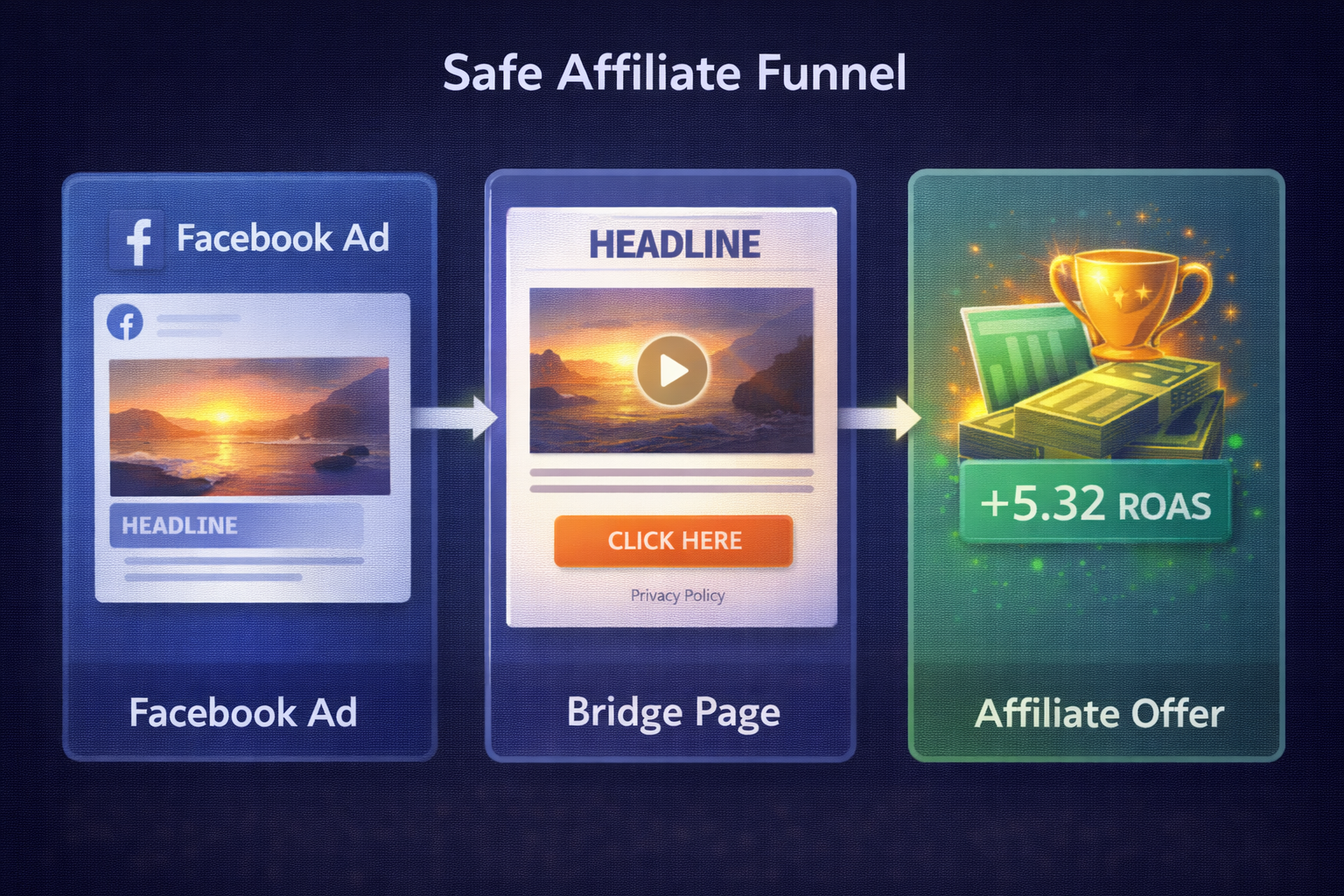
Funnel: Ad > Bridge Page (Pre-sell/Quiz) > Affiliate Offer Page.
Optimization: Day 1 ROAS. If an ad isn't profitable in 24 hours, kill it. You need to implement a strict kill switch protocol to stop wasting budget immediately.
Risk: Volatility. Offers get pulled. Ad accounts get banned. You need to be agile.
The "Bridge Page" Necessity
Never send traffic directly from Facebook to an affiliate link (e.g., bit.ly/offer). Facebook hates this and will ban you. You must send them to a landing page YOU own.
Types of Bridge Pages:
The Advertorial: A page that looks like a news article or blog post telling a story about the product. "How this mom saved $500 on electricity."
The Quiz: "What is your skin type? Take this 30-second quiz." At the end, recommend the affiliate product as the solution.
The Review: "I tested the top 5 meal delivery kits. Here is the winner."
Compliance: How to Not Get Banned
This section is crucial for affiliates.
Facebook's policy team wakes up every morning looking for reasons to ban affiliate marketers. Why? Because historically, affiliates have promoted scams, diet pills, and "get rich quick" schemes.
How to Stay Safe:
No "Before/After" Photos: Especially for weight loss or skin.
No Unrealistic Claims: "Lose 20lbs in 2 days" = Ban. "How I improved my fitness" = Safe.
Privacy Policy: Your Bridge Page MUST have a link to a Privacy Policy, Terms of Service, and a Disclaimer stating you are not Facebook.
User Experience: Ensure the Bridge Page loads fast and is mobile-optimized.
The "Hybrid" Approach: From Affiliate to Brand
The smartest entrepreneurs in 2026 are blending these two models. They start as affiliates to generate cash flow and learn media buying without the risk of inventory. Once they find a winning product niche (e.g., "Solar Gadgets"), they white-label their own product in that niche.
Why this works:
Proof of Concept: You already know the audience buys this type of product.
Cash Funded: You use affiliate commissions to pay for your first inventory order.
Pixel Data: You have already seasoned your pixel with thousands of purchase events from the affiliate offer.
This transition allows you to escape the volatility of affiliate marketing and build the long-term asset value of an ecommerce brand.
How to "Make Money with Facebook Ads" (The Universal Truth)
Whether you are selling t-shirts or software subscriptions, the equation for making money is the same.
(Traffic x Conversion Rate x AOV) - Ad Spend = Profit
To increase Traffic: Improve your Ad Creative (CTR). Don't believe the hype about "creative fatigue", often you don't need more ads, you need better iterations.
To increase Conversion Rate: Improve your Landing Page.
To increase AOV (Average Order Value): Add bundles or upsells.
To decrease Ad Spend: Stop targeting bad audiences.
Most beginners focus on "decreasing ad spend." The pros focus on "increasing AOV."
Conclusion
Ecommerce builds assets. Affiliate marketing builds cash flow.
Many entrepreneurs start with affiliate marketing to build a war chest, then invest that cash into launching their own ecommerce brand.
Whichever path you choose, respect the platform. Facebook is a partner, not an enemy. Follow the rules, provide value to the user, and the algorithm will reward you.
Need high-converting creative for your e-com or affiliate offer? Crush generates winning ad concepts for any niche.
Frequently Asked Questions
Common questions about this topic
1What is the difference between Facebook ads for ecommerce and affiliate marketing?
2How can affiliate marketers avoid getting banned on Facebook?
3What is a bridge page in affiliate marketing?
4How do you calculate profit for Facebook ads?
Written by

Rokas Steponavičius
Founder, CEORokas is the Founder and CEO of TryCrush.ai, an ex-IBM professional turned entrepreneur focused on building AI-driven growth platforms. With a strong background in ecommerce, performance marketing, media buying, and artificial intelligence, Rokas specializes in creating scalable, data-led systems that drive measurable revenue. His mission is to help modern businesses leverage AI to optimize acquisition, conversions, and long-term profitability.
Stop Guessing.
Start Crushing.
AI Ad Manager trained by world-class media buyers to generate your creatives and optimize your ads 24/7.
Learn more
Continue Reading
Proven Online Ad Examples Based on Meta Ad Longevity Data
Stop guessing what works. We analyzed millions of active campaigns to bring you the best online ad examples based on pure longevity and profitability data.
How to Add Branding to Meta Ads That Actually Convert
Most advertisers ruin their return on ad spend by overcomplicating their visual identity. Here is how to integrate branding into your creatives to drive direct response.
Scaling Dropshipping Shopify Stores: 2026 Ad Data
Most guides just show you pretty storefronts. We analyze the actual Facebook ad data that successful Shopify dropshipping stores use to scale profitability in 2026.