

Key Takeaways
- 1A healthy business needs an LTV to CAC ratio of 3:1 or higher.
- 2Rising digital ad costs require high-velocity creative testing.
- 3AI tools can automate budget scaling to lock in a lower CAC.
- 4Instantly kill losing ads to dramatically drop your blended CAC.
Customer Acquisition Cost (CAC) is the ultimate metric for business survival. Learn the true CAC meaning, the golden LTV:CAC ratio, and how AI-driven creative testing can systematically cut your acquisition costs in half.
If you were to walk into the boardroom of any rapidly scaling startup or eight-figure e-commerce brand and ask them what their most important metric is, you wouldn't hear about "likes," "impressions," or even "revenue."
The answer, almost universally, would be a three-letter acronym that dictates the life or death of a modern business.
So, what is CAC? And more importantly, how do you control it in an era where digital advertising costs seem to rise every single year?
In this article, we will dissect the true CAC meaning, explain the mathematical relationship it has with your business's survival, and reveal how advanced AI systems like TryCrush are helping brands cut their acquisition costs in half.
The True CAC Meaning: More Than Just a Metric
CAC stands for Customer Acquisition Cost. Simply put, it is the total amount of money you have to spend on marketing and sales to acquire one new paying customer.
If you spend $1,000 on Facebook ads and you get 10 new customers, your CAC is $100.
Understanding the CAC meaning is the first step toward profitable growth. It is the ultimate measure of your marketing efficiency.
However, a common mistake is looking at CAC in isolation. A $100 CAC is not inherently good or bad. Its value is entirely dependent on another metric: Lifetime Value (LTV). This is exactly why we optimize for Cost Per Acquisition rather than relying solely on vanity metrics.
The Golden Ratio: LTV to CAC
To determine if your business model is sustainable, you must compare how much it costs to acquire a customer (CAC) to how much revenue that customer will generate for your business over their lifetime (LTV).
LTV:CAC ratio of 1:1 = You are breaking even. You spend $100 to make $100. This is a recipe for bankruptcy once you factor in operating costs.
LTV:CAC ratio of 3:1 = This is the industry benchmark for a healthy business. You spend $100 to make $300.
LTV:CAC ratio of 5:1 or higher = You have a highly profitable engine and should be scaling your ad spend as aggressively as possible.
Therefore, the question "what is cac?" is really a question of leverage. How efficiently can you buy future revenue?
Why CAC is Rising (and How to Fight It)
Across almost every industry, CAC has been rising steadily for the past five years. There are three main reasons for this upward trend:
Increased Competition: There are more businesses advertising online today than ever before, driving up auction prices (CPMs) on platforms like Meta and Google.
Privacy Changes: Updates like iOS 14 made it harder to track users across the internet, reducing the efficiency of retargeting and manual audience building.
Creative Fatigue: Users are exposed to thousands of ads a day. "Banner blindness" means ads fatigue faster, requiring brands to produce significantly more content just to maintain the same CAC.
Traditional media buyers try to fight rising CAC by tweaking their bids or testing different audience demographics.
In 2026, this is a losing battle. The algorithms are too smart, and the auction is too competitive. In fact, relying on outdated manual strategies is why many realize that the traditional media buyer is dead.
The only sustainable way to lower your CAC today is through high-velocity, data-driven creative testing. And that is a job for Artificial Intelligence.
How TryCrush Cuts CAC in Half
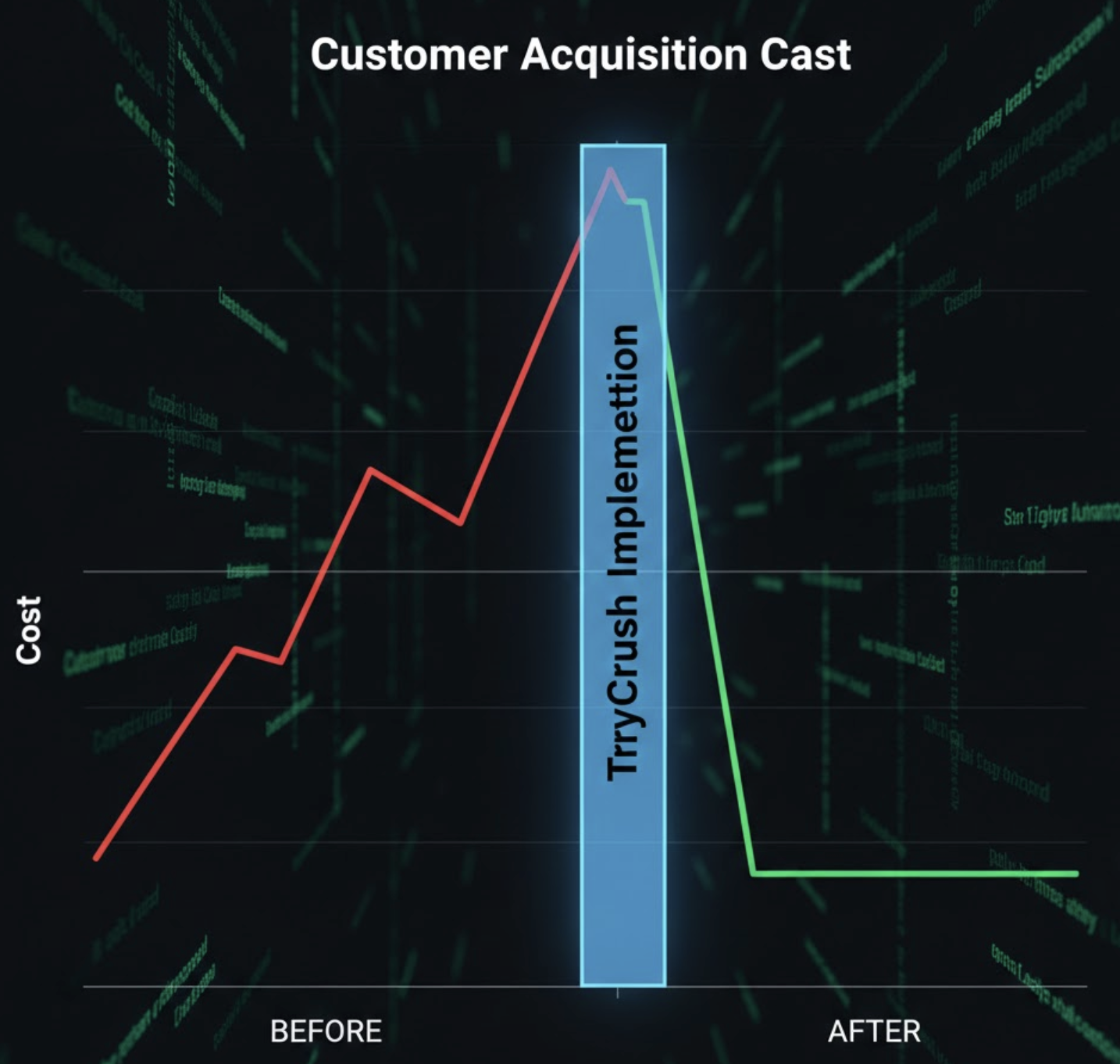
This is precisely why we built TryCrush. TryCrush is an autonomous growth engine designed with one singular objective: to lower your Customer Acquisition Cost.
When you understand the true CAC meaning, you realize that lowering it requires a systematic, mathematical approach to advertising, not just "better looking" videos. Here is how TryCrush systematically attacks and reduces your CAC:
1. Data-Informed Psychological Angles
Most brands guess what will make a user buy. TryCrush analyzes your ad account data to identify exactly which psychological hooks have historically driven the lowest CPA.
It then generates new video and image creatives based on these proven frameworks, ensuring you aren't wasting money testing angles that don't resonate. Proper testing is crucial, as poor methods are exactly why your creative testing is burning 60% of your budget.
2. Eliminating the Production Bottleneck
If you want to halve your CAC, you need to test 10 times as many creatives as your competitors.
A human team might take a week to produce 5 ad variations. TryCrush generates dozens of highly optimized variations in minutes, allowing you to test more hypotheses faster and cheaper.
3. The Ruthless Automated Kill Switch
This is where the magic happens. The biggest contributor to a high CAC is the money you waste on ads that don't work.
Human media buyers are emotional and slow to react. They might let a losing ad spend $200 before pausing it.
TryCrush acts as a ruthless financial guardian. It deploys micro-budgets to test the generated creatives. If an ad's early indicators (like Cost Per Outbound Click or Hook Rate) suggest it will not hit your target CAC, TryCrush triggers the kill switch protocol and kills the ad instantly. By cutting the losers early, your blended CAC drops dramatically.
4. Autonomous Scaling of Winners
When TryCrush identifies an ad that is acquiring customers well below your target CAC, it automatically scales the budget.
Furthermore, it takes the data from that winning ad and generates new iterations to prevent creative fatigue, locking in your low CAC for longer periods. This automation is key if you want to learn how to profit from Ads AI at scale.
Conclusion: Stop Guessing, Start Engineering
So, what is CAC? It is the ultimate metric that determines if your business will survive the next 12 months.
If you are trying to manage your Customer Acquisition Cost using spreadsheets, manual video editing, and gut feelings, you are playing a dangerous game. The market is too competitive to rely on human intuition for media buying.
To truly understand the CAC meaning for your specific business, you must embrace the systems that can control it. TryCrush removes the guesswork, automates the testing, and protects your downside, turning your advertising from an unpredictable expense into a profitable acquisition engine.
Stop paying a premium for mediocre results. Let AI engineer your growth.
Frequently Asked Questions
Common questions about this topic
1What is the meaning of CAC?
2What is a good LTV to CAC ratio?
3Why is Customer Acquisition Cost (CAC) rising?
Written by

Ignas Obulaitis
Head of ITIgnas Obulaitis is the head of IT for TryCrush.ai, leading the platform’s engineering and AI innovation. With a strong background in product-driven development, Ignas has built and scaled complex systems across fintech, SaaS, and AI-focused companies. An ex-IBM engineer and former Head of Development at Fluensure, Ignas combines deep technical expertise with a sharp product mindset to turn ambitious ideas into scalable, production-ready technology.
Stop Guessing.
Start Crushing.
AI Ad Manager trained by world-class media buyers to generate your creatives and optimize your ads 24/7.
Learn more
Related articles

Programmatic Media Buying Explained: A Guide for Modern Marketers
Programmatic media buying is no longer about manual bidding, it's about supplying AI algorithms with winning creatives. Discover how to dominate modern ad auctions, lower your CAC, and scale profitably using the latest AI-driven strategies.
Lifetime Customer Value (LTV): Why It Matters More Than CPA
Stop obsessing over Day-1 CPA and start optimizing for the metric that truly scales businesses: Lifetime Customer Value (LTV). Discover the true LTV meaning, how to increase it, and why AI-driven platforms like TryCrush outsmart traditional ad buying.

Kling AI vs TryCrush: The Ultimate Showdown for Advertisers
While Kling AI creates stunning cinematic videos, TryCrush builds profitable ad campaigns. Discover the key differences between generative video models and performance-first AI systems, and learn which tool media buyers need to lower CAC and scale revenue.

The Silent Takeover: How AI Advertising is Replacing Agencies
The Mad Men era is over. Welcome to the Math Men era, where AI advertising is rapidly replacing traditional agencies. Discover how algorithms are driving higher ROAS, testing hundreds of creatives, and transforming the future of digital marketing.