
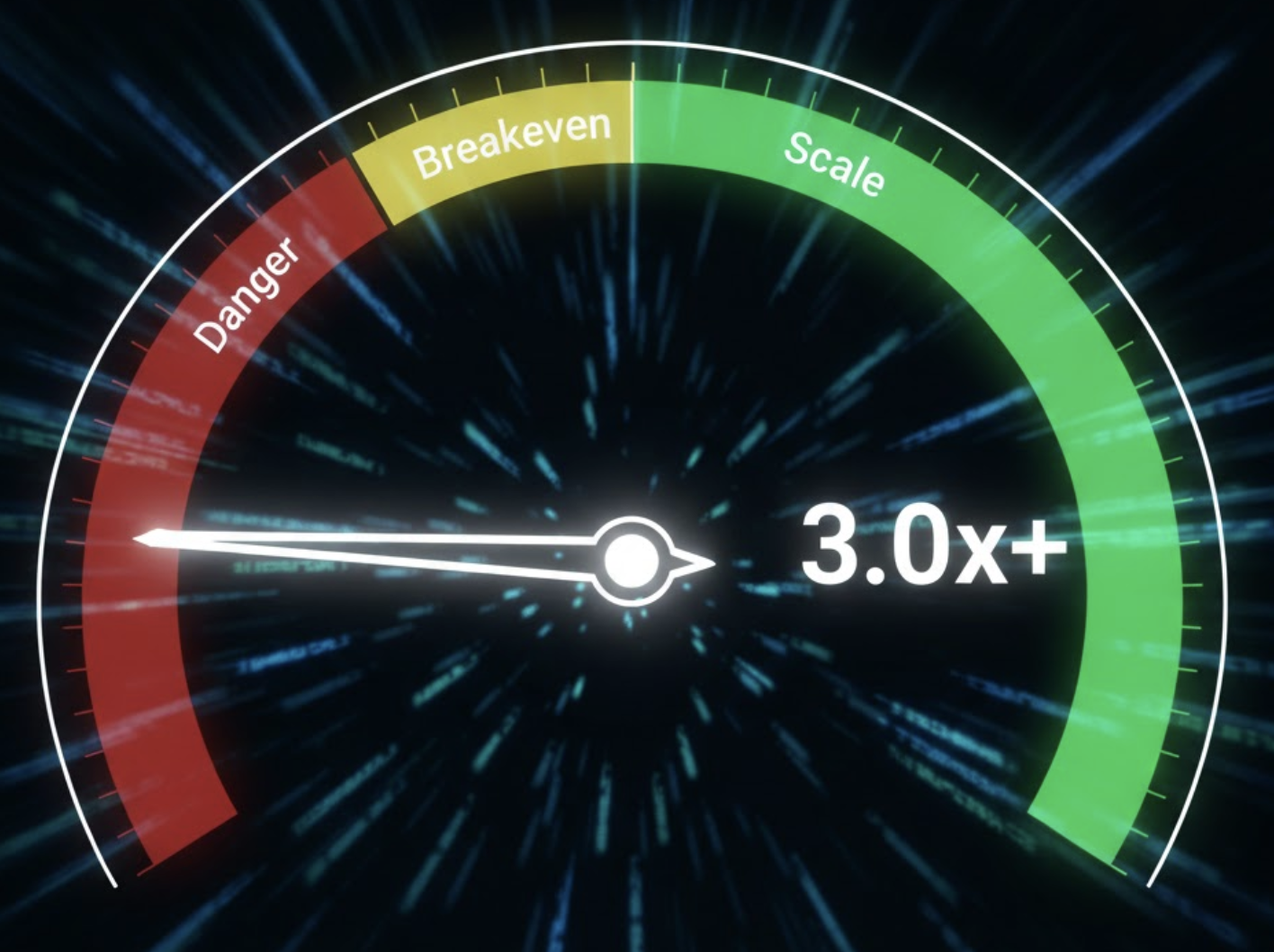
Key Takeaways
- 1Breakeven ROAS is simply 1 divided by your profit margin.
- 22026 Top of Funnel ROAS benchmarks average between 1.5 and 2.5.
- 3Prioritize LTV to cash-flow your acquisition over Day-1 ROAS.
- 4Automate ad scaling with AI kill switches to protect margins.
Looking for a universal ROAS benchmark is a trap. Discover how to calculate your true breakeven ROAS based on profit margins and lifetime value. Explore realistic 2026 ad spend benchmarks and learn how to mathematically guarantee profitability at scale.
It is the most common question in digital marketing groups, the first thing clients ask agencies, and the source of endless anxiety for e-commerce founders: what is a good roas?
The short, unhelpful answer is "it depends."
The long, profitable answer requires a deep dive into your unit economics. Looking for a universal benchmark for Return on Ad Spend (ROAS) is a trap. A 2.0 ROAS might make one business a millionaire and bankrupt another in the same week. It all comes down to margins, lifetime value, and the velocity of your cash flow.
In this guide, we will move past arbitrary benchmarks and teach you exactly how to calculate what is a good roas for your specific business model in 2026.
Understanding the Math: Breakeven ROAS
Before you can determine what a "good" ROAS is, you must calculate your Breakeven ROAS. This is the absolute minimum return you need on your advertising spend just to avoid losing money on a transaction.
The formula for Breakeven ROAS is simple: 1 / Profit Margin.
Let's look at two different businesses to see why asking "what is a good roas" in a vacuum is dangerous.
Business A: The High-Margin Software Company
Product Price: $100
Cost of Goods Sold (COGS): $10 (Server costs, support)
Profit Margin: 90% (or 0.90)
Breakeven ROAS: 1 / 0.90 = 1.11
For Business A, a ROAS of 1.5 is a license to print money. They are highly profitable and should scale aggressively.
Business B: The Low-Margin Dropshipper
Product Price: $100
COGS: $70 (Product cost, shipping)
Profit Margin: 30% (or 0.30)
Breakeven ROAS: 1 / 0.30 = 3.33
For Business B, a ROAS of 2.5, which many people would consider "good", means they are losing money on every single sale. They need a 4.0 ROAS just to see a small profit.
2026 ROAS Benchmarks (With Caveats)
While your internal math is the only math that truly matters, it is helpful to understand the landscape. Due to rising CPMs and increased competition, the days of easily achieving a 10.0 ROAS on cold traffic are largely over.
Furthermore, the shift towards broad targeting and machine learning means that media buyers have less granular control over individual ad placements. Instead, success relies heavily on supplying the algorithm with high-quality creative assets that naturally filter and attract the right customer cohorts.
When you review these numbers, remember that they are industry averages; your specific niche, product price point, and overall brand equity will heavily influence your actual performance.
Here are realistic benchmarks for 2026, assuming a standard e-commerce brand with a 50% gross margin (Breakeven ROAS of 2.0):
Top of Funnel (Cold Traffic): 1.5 - 2.5 ROAS. At the top of the funnel, breaking even or taking a slight initial loss is normal, provided your back-end retention is strong.
Middle of Funnel (Warm Traffic): 2.5 - 4.0 ROAS. These are users who have engaged but haven't bought. You should be seeing solid profitability here.
Bottom of Funnel (Hot Retargeting): 5.0 - 10.0+ ROAS. Cart abandoners should yield your highest returns.
If your blended account average is sitting between 2.5 and 3.5, and you have healthy margins, you are generally in a position to scale.
The Impact of LTV on Your Target ROAS
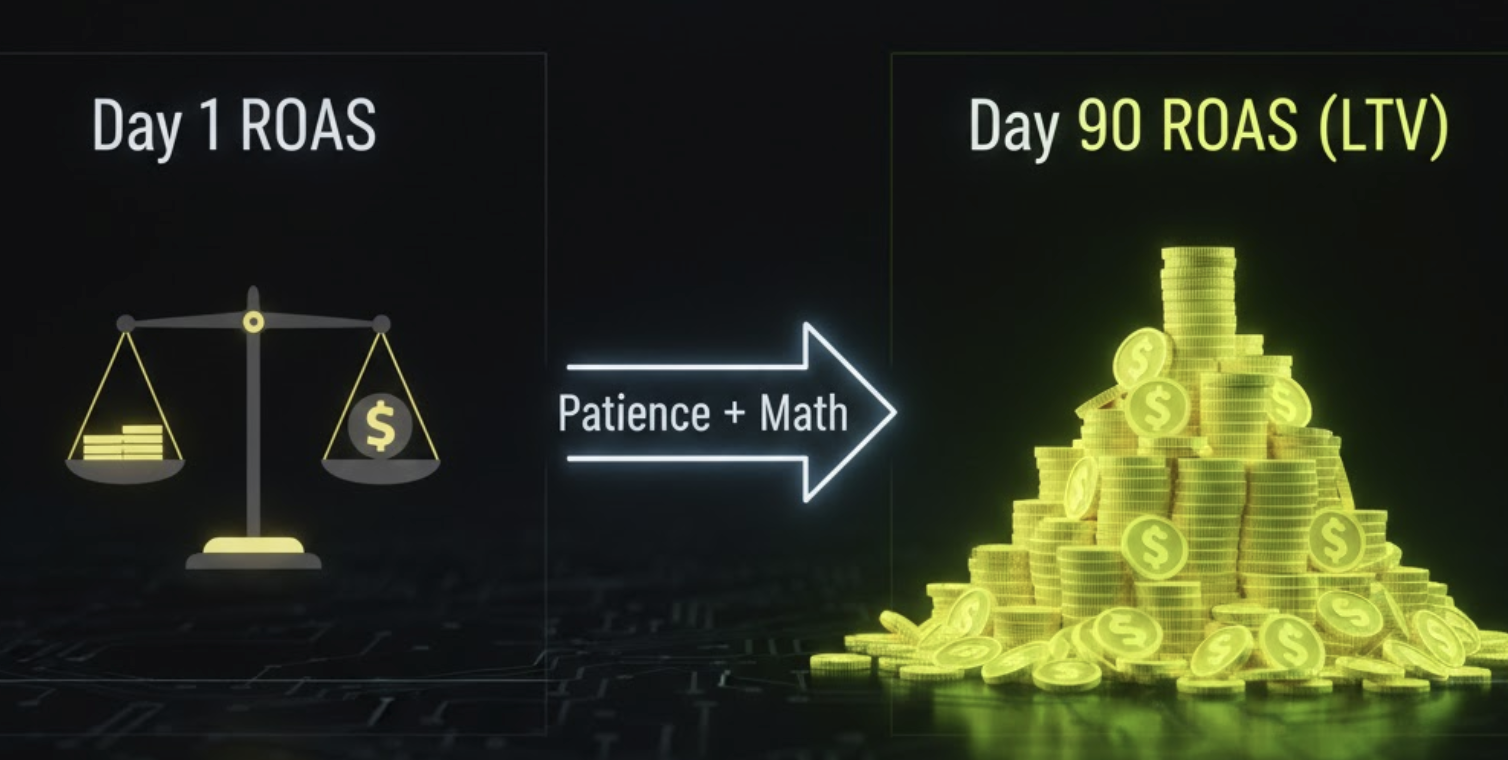
The most sophisticated media buyers in 2026 don't just look at Day-1 ROAS. They look at LTV (Lifetime Value).
If you sell a consumable product (like supplements or coffee), a customer who buys today is highly likely to buy again next month. If your Breakeven ROAS is 2.0, you might intentionally accept a 1.5 ROAS on day one, knowing that by day 60, that customer's repeat purchases will push the true ROAS to 4.0.
This is called "cash-flowing your acquisition." The brands that win are the ones that can afford to wait the longest to realize their profit.
How TryCrush Optimizes for a "Good" ROAS
Calculating your target ROAS is the easy part. Actually hitting it consistently while scaling your ad spend is the hardest job in digital marketing.
As you increase your daily budget, your ROAS will naturally degrade. This happens because the algorithm runs out of the "cheapest" conversions and has to start bidding on more expensive users.
This is why manual media buying fails at scale. To maintain a "good" ROAS as you grow, you need an autonomous system like TryCrush.
Protecting the Profit Margin
TryCrush is designed around unit economics. When you set up TryCrush, you input your target ROAS based on your specific margins. The system then takes over the execution:
Data-Driven Creative: TryCrush generates ad variations engineered to lower your Cost Per Click (CPC) and increase your Conversion Rate, the two metrics that directly influence ROAS.
The Automated Kill Switch: TryCrush acts as a financial bodyguard. If an ad drops below your required Breakeven ROAS threshold, the system automatically pauses it before it can damage your profitability.
Intelligent Scaling: When TryCrush identifies a creative that is exceeding your target ROAS, it scales the budget incrementally, ensuring the algorithm doesn't break and the ROAS remains stable at higher spends.
Conclusion
Stop asking other business owners "what is a good roas?" Their answer is irrelevant to your bank account.
Calculate your profit margins. Determine your absolute breakeven point. Factor in your customer lifetime value. Once you know the exact number you need to hit to be profitable, you can stop guessing and start engineering.
By defining your target and utilizing an AI growth engine like TryCrush to enforce that target across your ad accounts, you transition from hoping for profit to mathematically guaranteeing it.
Frequently Asked Questions
Common questions about this topic
1What is a good ROAS?
2How do you calculate breakeven ROAS?
3What are the average ROAS benchmarks for 2026?
Written by

Ignas Obulaitis
Head of ITIgnas Obulaitis is the head of IT for TryCrush.ai, leading the platform’s engineering and AI innovation. With a strong background in product-driven development, Ignas has built and scaled complex systems across fintech, SaaS, and AI-focused companies. An ex-IBM engineer and former Head of Development at Fluensure, Ignas combines deep technical expertise with a sharp product mindset to turn ambitious ideas into scalable, production-ready technology.
Stop Guessing.
Start Crushing.
AI Ad Manager trained by world-class media buyers to generate your creatives and optimize your ads 24/7.
Learn more
Continue Reading
Best Products to Dropship in 2026: Proven by Meta Ad Longevity Data
Most dropshipping guides rely on static wholesale catalogs. We rely on active ad spend data to show you exactly which products are surviving profitably on cold traffic.
Different Types of Ads: 2026 Data on What Converts
Stop guessing which ad formats work. We analyzed over 1.8 million Facebook ads to find exactly which types of ads generate profitable returns in 2026.
What Are Ad Libs? Modular Copy Formulas for Facebook Ads
An ad lib in media buying is a modular copy framework. Learn how to swap variables to test new angles and find winning campaigns without writing from scratch.