
Key Takeaways
- 1Adopt the "3-2-2 Method" (3 visuals, 2 texts, 2 headlines) for efficient, budget-friendly testing
- 2Treat creative as your primary targeting lever to let algorithms find high-intent audiences
- 3Analyze DCT performance by breaking down "Dynamic Elements" rather than looking at aggregate data
- 4Avoid the "Premature Winner" trap by checking ROAS on low-spend variations before pausing
- 5Prepare for the transition from manual DCT to Meta's automated Advantage+ Creative features
Static ads are dead. Discover how the "3-2-2" Dynamic Creative framework leverages Facebook's AI to automate testing, improve targeting, and eliminate manual guesswork.
In the Stone Age of digital marketing (circa 2018), if you wanted to test an ad, you had to be a scientist.
You would create Ad A with Headline 1. You would create Ad B with Headline 2. You would spend $100 on each. You would wait a week. You would look at a spreadsheet.
It was slow. It was expensive. And it was prone to human error.
In 2026, we don't do science. We do Dynamic Creative Ads (DCT).
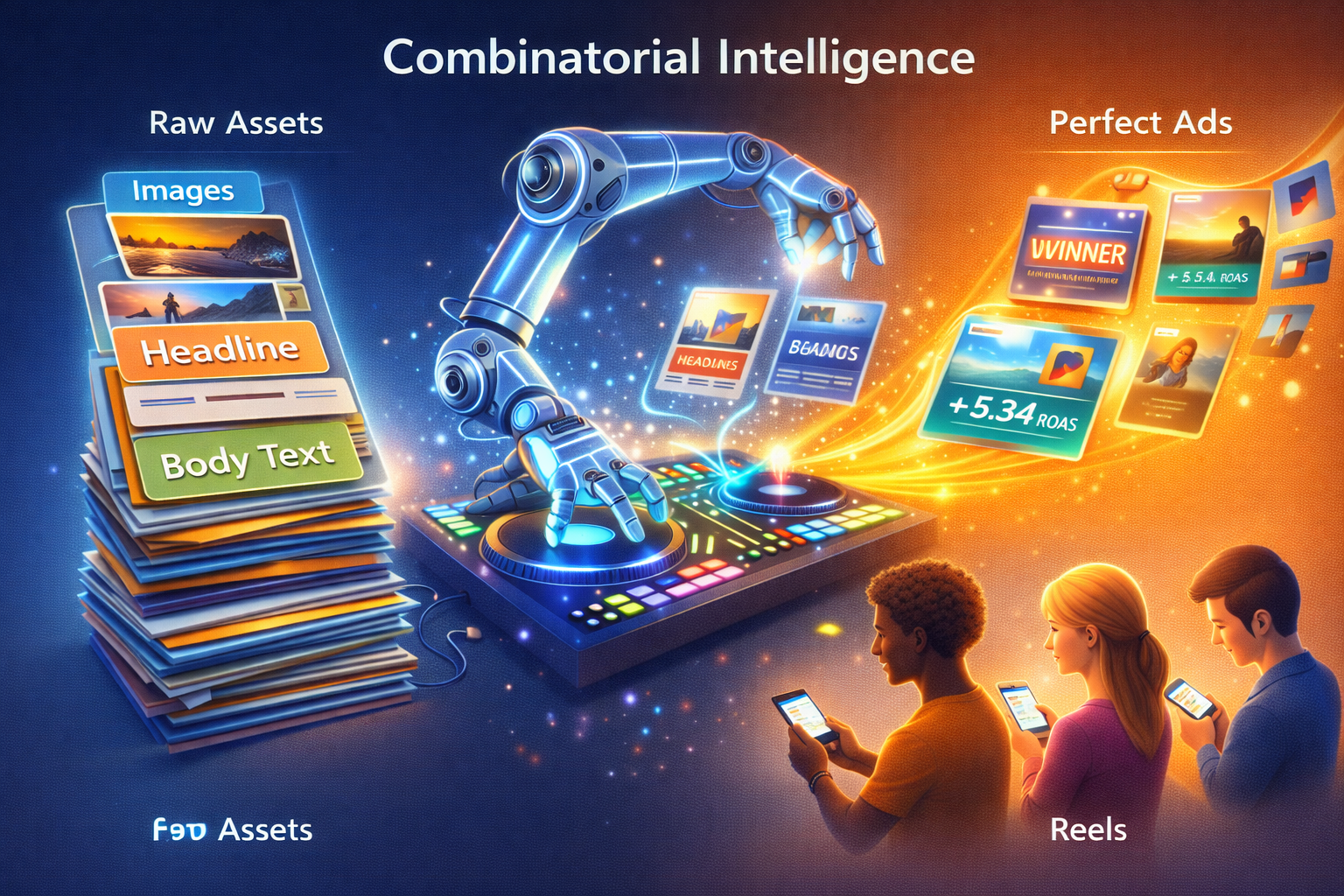
We throw all our ingredients into the pot, and we let Facebook's AI cook the perfect meal for every single user. The era where manual media buying is obsolete has arrived; now, the algorithm handles the heavy lifting.
In this guide, we will master the art of dynamic creative ads facebook. We will show you why facebook creative is the most important lever you have, and teach you the famous "3-2-2" method used by top media buyers.
What Are Dynamic Creative Ads?
Normally, an "Ad" is a fixed unit. Image A + Headline B + Text C.
A Dynamic Creative Ad is not a fixed unit. It is a container of possibilities.
You upload:
5 Images
3 Headlines
3 Primary Texts
1 Call to Action
Facebook then takes these ingredients and mixes them in real-time for every user.
The Magic of DCT Combinations
User A (who loves reading) might see the Long Text + Image 1.
User B (who scans quickly) might see the Short Headline + Image 3.
The algorithm figures out which combination works best for whom. It runs thousands of micro-tests per day, far faster than any human could.
The "3-2-2" Framework: The Gold Standard
While you can upload 10 images and 5 headlines, we don't recommend maxing it out. It dilutes your budget too much and extends the "Learning Phase" indefinitely.
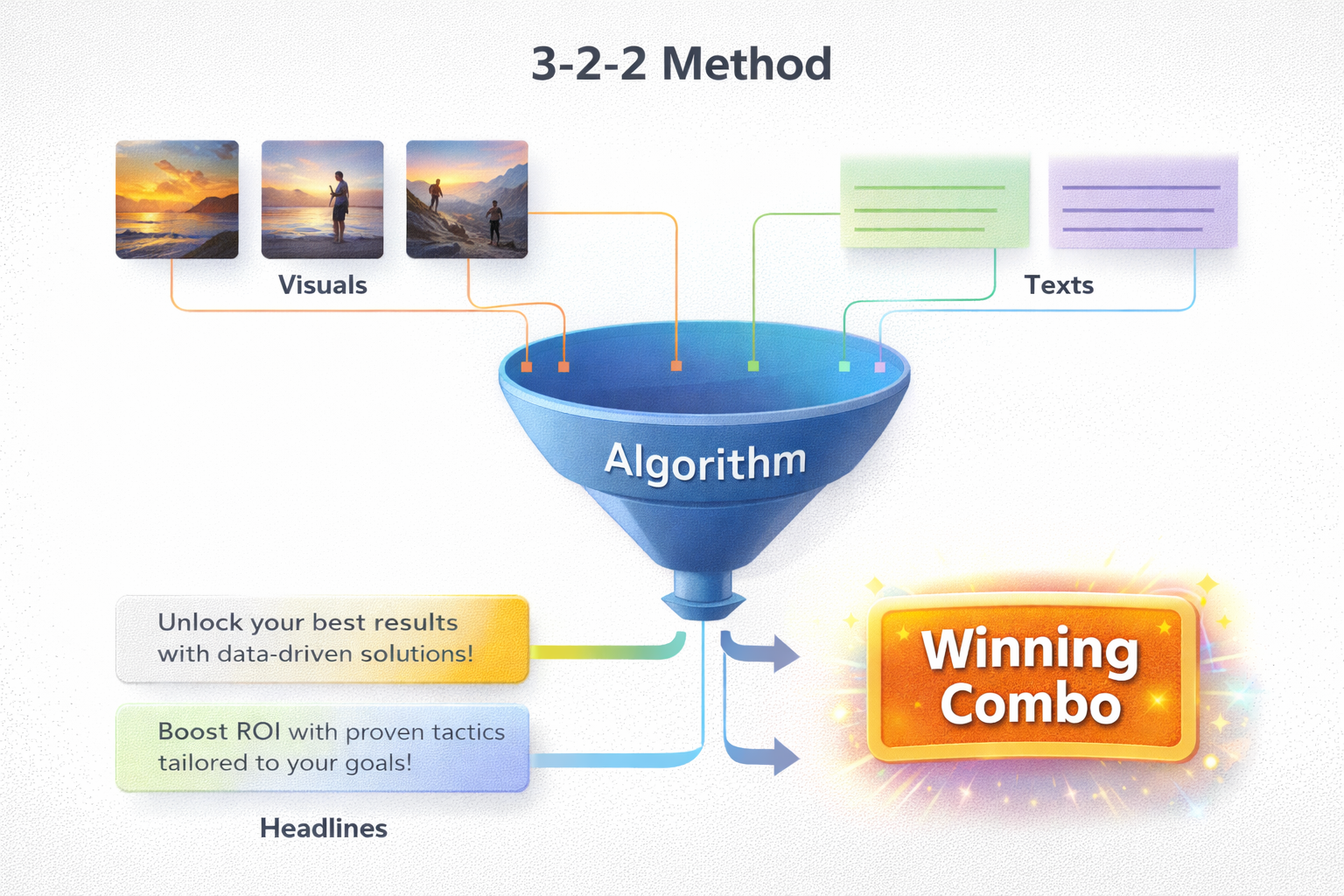
The industry standard for testing in 2026 is the 3-2-2 Method (popularized by Charlie T and the Disrupter School).
The Breakdown of 3-2-2:
3 Creatives (Visuals): These are the variables you are actually testing. Usually, you test 3 different videos or 3 different images. Crucially, they should test different concepts, not just different background colors.
2 Primary Texts: Using ad libs or modular copy formulas here makes testing different angles a breeze.
Text A: Long-form, storytelling, objection handling.
Text B: Short, punchy, benefit-driven.
2 Headlines:
Headline A: Direct offer (e.g., "Get 50% Off Today").
Headline B: Curiosity or Social Proof (e.g., "Why 10,000 People Love This").
Why 3-2-2 Works Better Than 5-5-5
If you upload 10 images, 5 texts, and 5 headlines, you have 250 possible combinations (10 x 5 x 5). To get statistically significant data on 250 variations, you would need to spend thousands of dollars.
With 3-2-2, you have only 12 combinations (3 x 2 x 2). The algorithm can cycle through these in 48 hours with a budget of $50-$100 and quickly identify the winner.
This balances volume with efficiency, aligning perfectly with the 48-Hour Rule for validating creatives.
Why Facebook Creative is the New Targeting
We have mentioned this in other articles, but it bears repeating: Your Creative IS Your Targeting.
When you run a Dynamic Creative Ad, you are casting a wide net. If you include a video about "Dog Training," the algorithm will naturally find dog owners because only dog owners will watch it.
This is why understanding the psychology of winning ads is more important than tweaking audience settings.
If you include a headline about "SaaS Metrics," the algorithm will find SaaS founders. DCT allows you to test these Creative Angles rapidly.
Creative Angle Example
Let's say you sell a coffee alternative.
Visual 1: "Stop the Jitters" (Health Angle).
Visual 2: "Save Money on Starbucks" (Financial Angle).
Visual 3: "Focus for 4 Hours" (Productivity Angle).
By putting all three in a DCT, you let the broader market decide which angle is the strongest.
How to Analyze DCT Results
This is where most media buyers get stuck. When you look at Ads Manager, a Dynamic Creative Ad looks like one single ad row.
You see the total spend and total sales, but you don't immediately see which image or headline caused the sale. To reveal the truth, you need to dig into the breakdown data.
Step-by-Step Analysis:
Navigate to the Ad Level: Make sure you are not in the Ad Set tab.
Find the Breakdown Menu: In the top right corner of the reporting table, look for the "Breakdown" button.
Select "By Dynamic Element": This option only appears if you are viewing a DCT ad.
Choose Your Variable: You can break down by:
Image, Video, and Slideshow: This is usually the most important. It tells you which visual hook worked.
Text: See if long copy or short copy is winning.
Headline: See if the Direct Offer or the Curiosity Hook drove the click.
Interpreting the Data (The "Premature Winner" Problem)
You will often see that Facebook has given 80% of the budget to one image (Image A), and only 10% to Image B and Image C.
Does this mean Image A is the best? Not always.
The algorithm is biased toward engagement (clicks and likes) early on. It might rush to spend money on the ad with the highest CTR, even if it has a lower conversion rate.
Pro Tip: Look at the CPA (Cost Per Acquisition) or ROAS of the "underdogs" (Image B and C). While many focus on ROAS, we often argue for optimizing for Cost Per Acquisition to ensure true profitability.
If Image B has very low spend but a better CPA than Image A, the algorithm might be making a mistake. In this case, you should take Image B, pull it out of the DCT, and run it in a separate "Scale" campaign to force budget into it.
The Future: Advantage+ Creative
Meta is slowly phasing out the manual "Dynamic Creative" checkbox and moving everything to Advantage+ Creative.
This includes features like:
Standard Enhancements: Automatically brightening the image.
Image Templates: Adding a banner like "Free Shipping" automatically.
Music: Adding royalty-free music to static images (turning them into videos).
Should You Use Advantage+ Features?
Generally, yes. Standard Enhancements are good. But be careful with "Music" and "Templates" as they can sometimes look cheap or off-brand. Always preview them before launching.
Conclusion
Static ads are dead. The market moves too fast for you to guess the perfect headline.
By mastering dynamic creative ads facebook, you embrace the chaos. You stop trying to be the genius, and you let the machine be the genius. Your job is just to feed the algorithm high-quality ingredients.
Want to automate your 3-2-2 testing? Crush builds and launches Dynamic Creative tests in one click.
Frequently Asked Questions
Common questions about this topic
1What is a Dynamic Creative Ad on Facebook?
2What is the 3-2-2 method for Facebook Ads?
3How do I see which image performed best in a Dynamic Creative Ad?
Written by

Rokas Steponavičius
Founder, CEORokas is the Founder and CEO of TryCrush.ai, an ex-IBM professional turned entrepreneur focused on building AI-driven growth platforms. With a strong background in ecommerce, performance marketing, media buying, and artificial intelligence, Rokas specializes in creating scalable, data-led systems that drive measurable revenue. His mission is to help modern businesses leverage AI to optimize acquisition, conversions, and long-term profitability.
Stop Guessing.
Start Crushing.
AI Ad Manager trained by world-class media buyers to generate your creatives and optimize your ads 24/7.
Learn more
Related articles

The Ultimate Facebook Advertising Strategy for 2026
Hacks don't build businesses, systems do. Discover the ultimate Facebook advertising strategy for 2026, featuring the "Super CBO" method, 3-2-2 testing, and CAPI integration to scale profit in any market condition.

Secrets of High Converting Facebook Ads: Deconstructing Top Performers
Stop burning budget on ads that don't convert. We reverse-engineered thousands of top Facebook ads to find the psychology behind the winners. Learn the "Hook, Hold, Payoff" structure and the 3 creative archetypes that drive sales on autopilot.
Mastering Media Planning and Buying for eCommerce Success
The traditional media buyer is dead, and static spreadsheets are obsolete. Learn how successful eCommerce brands scale past $1M a month by merging media planning and buying with AI, dynamic creative testing, and strict unit economics.
ABO vs. CBO: Guide to Scaling Facebook Ads in 2026
Is ABO dead? In 2026, the answer is no. Discover why you need a Hybrid Framework that leverages ABO for precise testing and CBO for massive scaling. Learn the 3-step pipeline to structure your ad account for maximum profit.