Picture this scene. It might be familiar to you.
It’s a Tuesday morning. You walk into your office (or maybe you just open your laptop at your kitchen table). You have your coffee. You take a deep breath.
And then you begin the ritual.
You open Ads Manager. You wait for it to load. You click "Campaigns." You scroll. You squint. You click into an Ad Set. You check the ROAS. You check the CPC. You frown.
You duplicate an ad set. You change the budget from $50 to $60. You change an audience. You upload a new image. You press publish.
Then you do it again. And again. And again.
By lunch, you have made 50 micro-decisions. Should I pause this? Should I scale that? Is this creative fatigued? Is this audience burnt out?
By 5:00 PM, your brain is fried. You feel "busy," but looking back at your day, what did you actually create? What value did you add to the business?
The answer, if you are honest with yourself, is: Almost nothing.
You spent the entire day acting as a human interface for a machine learning algorithm. You were a glorified button-pusher. You were a technician.
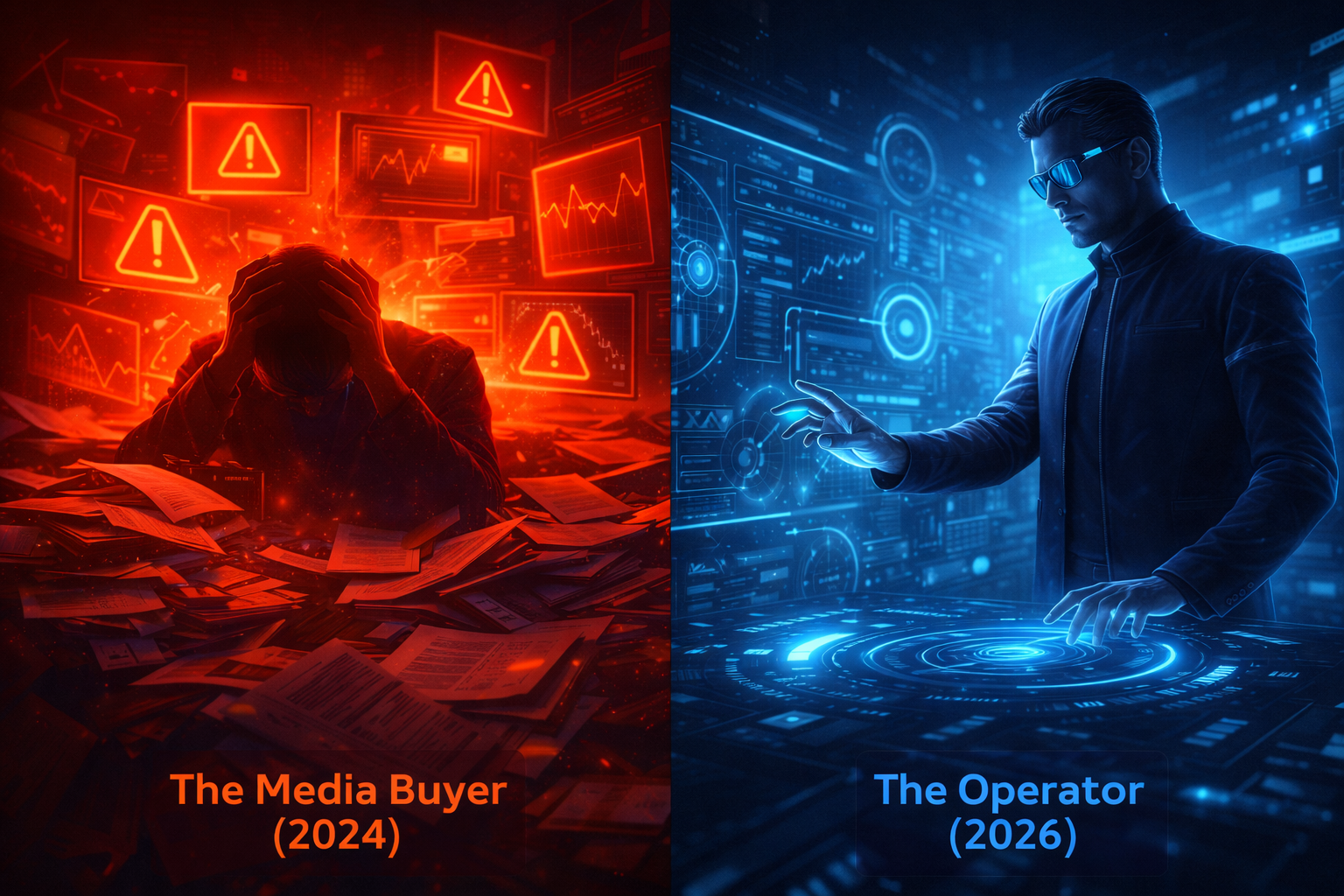
I have bad news for you: The era of the "Media Buyer" is over.
The Evolution of the Species: A Brief History
To understand why the Media Buyer is extinct, we have to look at how we got here. The history of Facebook advertising is a history of automation eating manual labor.
2014-2017: The Golden Age of the Hacker
In the early days, the algorithm was dumb. It was a blunt instrument. If you wanted to find customers, you had to manually "hack" the system. You had to scrape emails. You had to find obscure interests like "People who like wet dog food" and layer them with "People who drive Ford trucks."
The Media Buyer was a wizard. Their value came from their secret knowledge of targeting options. If you knew the hacks, you printed money. If you didn't, you failed.
2018-2021: The Age of Complexity
As the platform matured, it got more complex. We saw the rise of CBO (Campaign Budget Optimization), Dynamic Creative, and elaborate funnel structures. The Media Buyer became a pilot. They sat in a cockpit with 500 switches and dials. They had to constantly monitor bid caps, cost caps, manual placements, and exclusion lists.
Agencies boomed during this era because business owners looked at the Ads Manager interface and saw a terrifying mess. They happily paid 15% of spend just to have someone else deal with the headache.
2022-Present: The Age of the Black Box
Then came iOS14, and everything changed. The data signal degraded. In response, Meta rebuilt their entire engine around AI and machine learning (Advantage+). They removed targeting options. They removed breakdown data. They effectively said, "Give us the creative, give us the budget, and get out of the way."
The cockpit has been replaced by a "Go" button. The plane flies itself.
Meta’s AI is now infinitely smarter than you at finding customers. It doesn’t need you to tell it that "Women aged 25-34 who like Yoga" are good customers for your yoga pants brand. It already knows based on thousands of data points that you can't even see.
So, if the algorithm does the targeting, and the algorithm does the bidding, what is left for the Media Buyer?
Panic.
Most Media Buyers today are in a state of existential crisis. They clutch onto their old habits, manual bidding, complex exclusion lists, audience hacking, because it makes them feel useful. They justify their fees (or their salaries) by pointing to the "hours" they spend in the account.
But the market doesn’t care about your hours. It cares about results.
And the results show that manual interference is now a liability, not an asset.
The Technician's Trap
There is a concept in business called "The Technician's Trap" (popularized by Michael Gerber in The E-Myth). It describes a business owner who gets stuck doing the technical work (baking the pies) instead of building the business (selling the franchise).
In the world of advertising, the Media Buyer is the Technician. They are obsessed with the settings. They argue about "1-day click" vs "7-day click." They debate the merits of "Cost Caps" vs "Bid Caps" in Reddit forums.
They think this technical knowledge is their moat. But it's not a moat; it's a prison.
While the Technician is arguing about bid strategies, the algorithm is rendering their debate irrelevant. The algorithm optimizes for the objective you give it. If you give it constraints (like manual bids), you are often just handcuffing it.
The Technician feels productive because they are clicking things. But "motion" is not "progress."
Every minute you spend manually adjusting a budget is a minute you aren't spending on the things that actually matter: Creative Strategy, Offer Design, and Customer Research.
Enter The Operator
While the Media Buyer is dying out, a new predator is emerging at the top of the food chain.
We call them The Operator.
The Operator doesn’t spend their day pushing buttons. They don’t "tweak" bids. They don’t panic-refresh the dashboard.
The Operator manages a system.
Think of it like the difference between a factory worker and the factory owner. The worker stands on the line, assembling widgets by hand. The owner designs the machine that assembles the widgets faster, cheaper, and better.
The Operator leverages technology to do the heavy lifting. They understand that their time is too valuable to be spent on tasks that an algorithm can do in milliseconds.
The Operator focuses on three things:
Strategy: Who are we selling to? What is the offer? What is the Unit Economics model?
Creative: What is the message? How do we hook the audience? How do we articulate the value proposition better than anyone else?
Economics: How does the funnel back out? What is our target CPA? What is our LTV?
Everything else, the launching, the testing, the scaling, the pausing, is delegated to Crush.
How Crush Replaces the Technician
Crush is the weapon of the Operator. It is the exoskeleton that allows one person to do the work of a ten-person agency team.
Let’s look at the math.
A traditional Media Buyer can effectively manage maybe $50k/month in ad spend across 2-3 accounts before they start making mistakes. They get tired. They miss things. They forget to turn off a loser. They forget to scale a winner.
An Operator using Crush can manage $1M/month across 10 accounts without breaking a sweat.
How? By automating the Decision Loop.
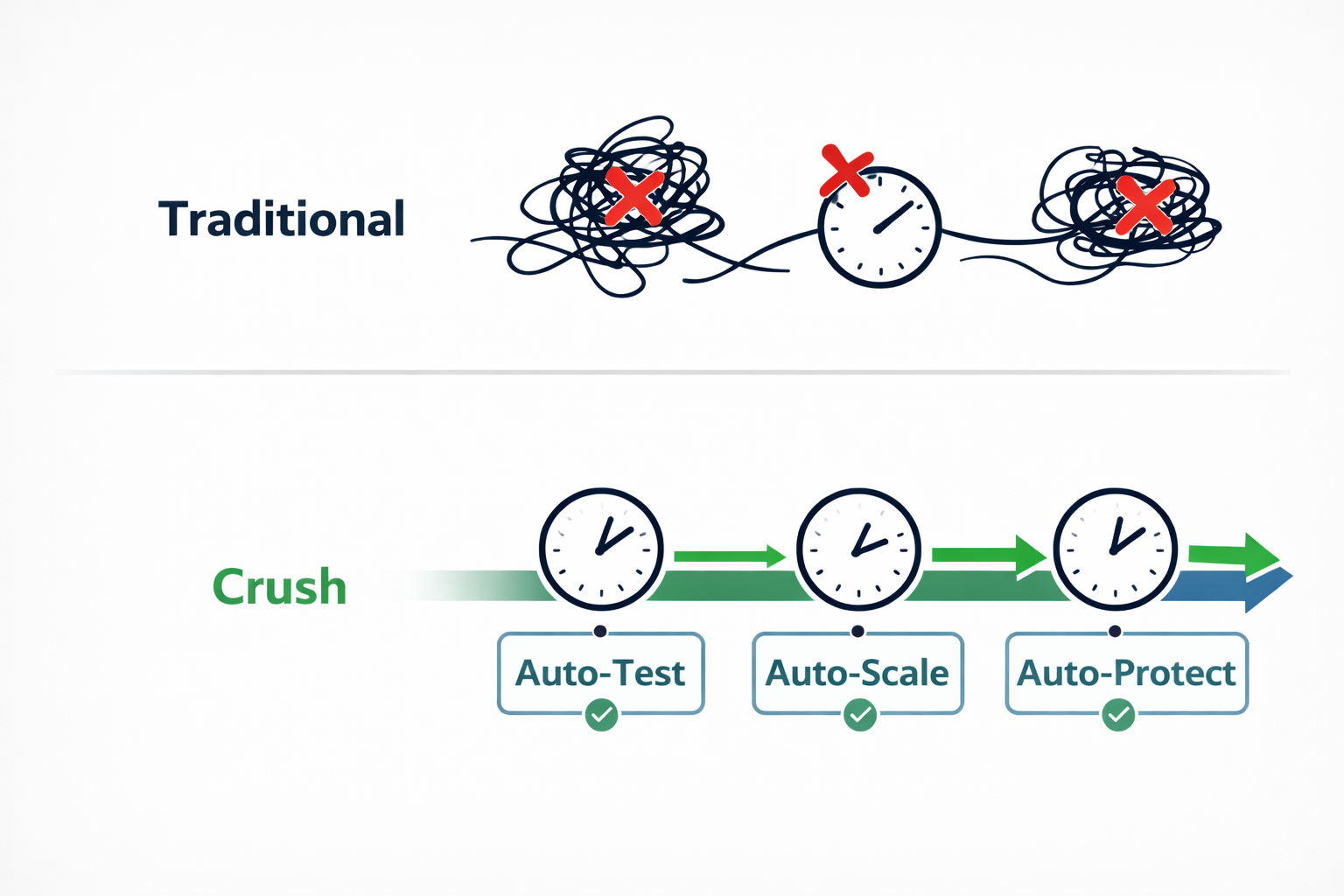
1. Automated Testing (The Grunt Work)
The Media Buyer spends hours uploading ads, naming ad sets, setting budgets. It’s boring, repetitive soul-crushing work. Because it takes so long, they often skip it or do it poorly.
The Operator uploads 50 creatives to Crush, sets a 48-hour testing protocol (e.g., "ABO, $50 budget"), and clicks "Go."
Crush builds the campaigns. Crush sets the rules. Crush launches the ads. Crush ensures that every ad gets the exact same naming convention, which keeps the data clean for future analysis.
Total time: 5 minutes.
2. Automated Optimization (The Night Shift)
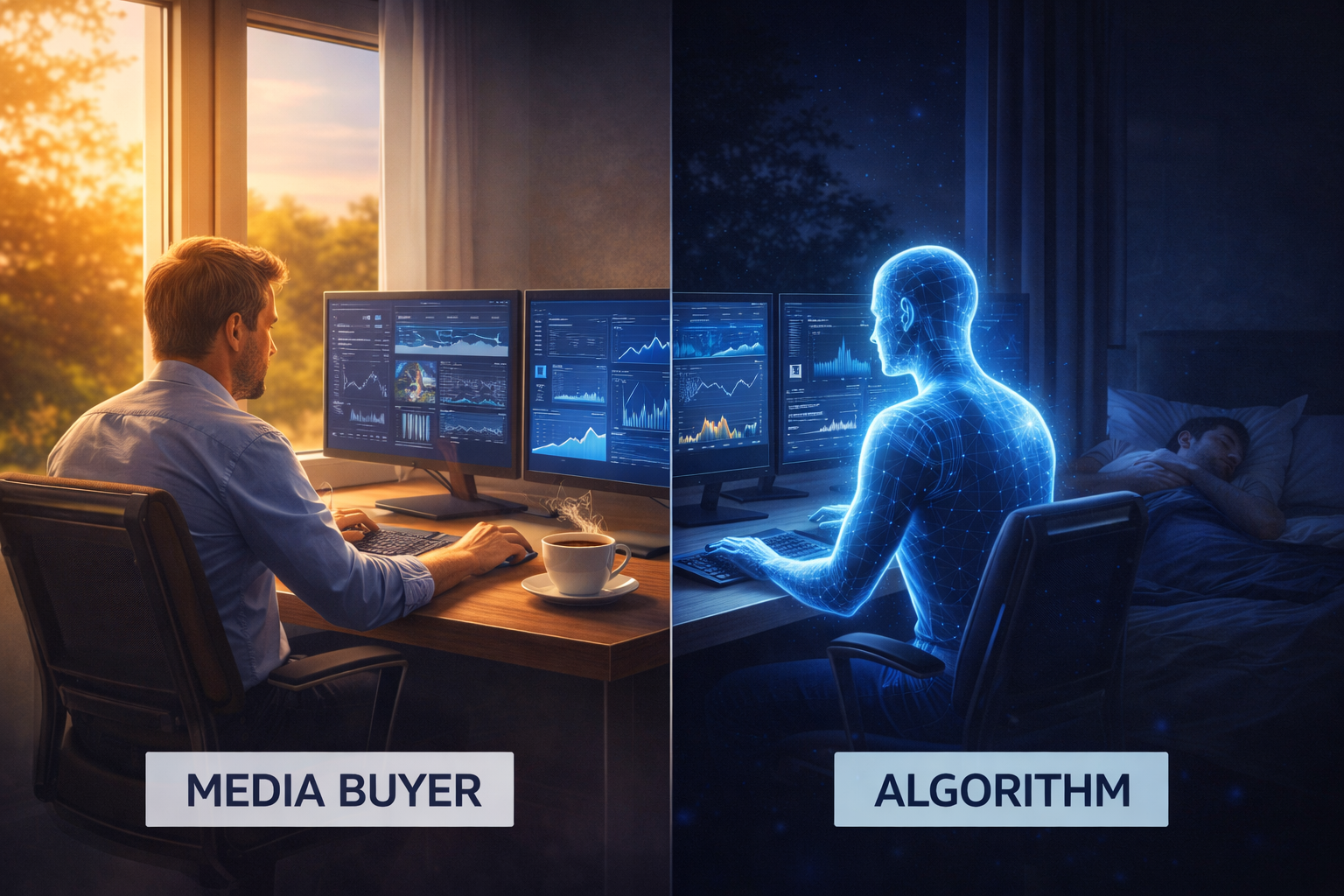
The Media Buyer goes to sleep. While they dream, their ads start tanking. Maybe a competitor launched a big sale. Maybe the news cycle shifted attention. They wake up to a $500 loss.
The Operator goes to sleep. Crush stays awake. At 3:00 AM, Crush notices an ad set has hit its CPA limit without a sale. Kill. At 4:00 AM, Crush notices a winner has emerged with a 4.0 ROAS. Flag for Scale.
The Operator wakes up to a dashboard of decisions already made, money saved, and winners identified. They start their day ahead of the game.
3. Automated Scaling (The Nerves of Steel)
The Media Buyer sees a winner. They hesitate. "Should I double the budget? What if it crashes?" They bump it 10%. Too slow. By the time they scale, the trend might be over.
The Operator has already defined the rules. "If CPA < $40 and Spend > $200, increase budget 50%." Crush executes this without fear. If performance dips, Crush pulls it back instantly via the Kill Switch.
This allows the Operator to catch "viral waves" that human buyers almost always miss because they are too slow or too scared.
A Day in the Life: Buyer vs. Operator
Let's break down a typical day to see the difference in stark reality.
The Media Buyer (The Old Way)
08:00 AM: Wake up, check phone immediately. Panic slightly at red numbers.
09:00 AM: Login to Ads Manager. Spend 2 hours manually reviewing yesterday's data.
11:00 AM: Start manually creating new ad sets for testing. Copy-paste hell.
02:00 PM: Client call. Spend an hour explaining why ROAS dropped 0.2 points.
04:00 PM: Check ads again. Tweak budgets randomly based on "gut feel."
08:00 PM: Check ads during dinner. Annoy spouse.
Result: Exhausted, stressed, minimal real progress.
The Operator (The New Way)
08:00 AM: Wake up, workout, breakfast. No phone.
09:00 AM: Login to Crush. Review the "Morning Brief." See what the algorithm killed and what it scaled.
09:30 AM: Deep dive into Creative Analysis. Notice that ads with "User Reviews" are outperforming ads with "Feature Lists."
10:30 AM: Write brief for creative team based on this insight. "Let's make 5 more variations of the Review Ad."
12:00 PM: Lunch.
02:00 PM: Strategy session on upcoming product launch. Build the offer.
04:00 PM: Upload new creative batch to Crush. Click "Launch."
05:00 PM: Close laptop. Done.
Result: Energized, strategic, high-leverage work completed.
The Psychological Shift
Becoming an Operator isn’t just about buying software. It’s about a fundamental shift in your identity.
You have to be willing to let go of the "busy work" that makes you feel productive. You have to accept that your value doesn't come from how hard you click the mouse, but from how clearly you think.
This is terrifying for many people. If you take away the manual work, what is left of them? If they aren't "managing ads," do they still have a job?
But for the ambitious, for the business owners, the growth leads, the top 1% of marketers, this is liberation.
It means you can finally stop working in the ad account and start working on the business.
You can spend your day researching customer psychology. You can spend your day writing killer copy. You can spend your day analyzing the broader market trends. You know, the things that actually move the needle.
The Media Buyer is dead because the market no longer rewards manual labor. The algorithm has commoditized the "how" of buying media.
But the "what" and the "why", the creative and the strategy, have never been more valuable.
The Choice is Yours
We are standing at a fork in the road.
Down one path lies the Media Buyer. They will continue to fight the algorithm. They will continue to burn out. They will watch their fees compress and their job security vanish as AI takes over. They will eventually be replaced by a piece of code.
Down the other path lies the Operator. Armed with Crush, they will leverage automation to scale to heights that were previously impossible for a single human.
They will run leaner, faster, and more profitable businesses. They will sleep better. They will win.
The tools are here. The framework is ready. The revolution has already started.
Are you going to be replaced? Or are you going to evolve?
Join the Operators. Get Crush.