

Key Takeaways
- 1Apply the 20% Rule every 48 hours for stable vertical scaling
- 2Use horizontal scaling (duplication) for rapid volume growth
- 3Avoid drastic budget jumps to prevent resetting the Learning Phase
- 4Combine strategies by surfing: duplicate winners then consolidate to CBO
- 5Vertical scaling maximizes stability; horizontal scaling maximizes speed
Scaling is the most dangerous phase of media buying. Discover the "20% Rule" for vertical scaling and the "Clone Army" method for horizontal scaling to grow your ad spend without killing your ROAS.
You have an ad set. It spent $50 yesterday and made $250. A 5.0 ROAS. You feel like you've just discovered a gold mine in your backyard.
Your instinct is to scream, "MORE!"
You want to change that $50 budget to $5,000. You want to buy a Lamborghini by Friday.
Please, stop. Put the mouse down.
Scaling is the most dangerous phase of media buying. It is the phase where you are most likely to take a winning campaign and turn it into a losing one. Why? Because Facebook’s algorithm is sensitive. It hates shocks. It hates drastic changes.
To scale successfully, you need to stop treating ads like a slot machine and understand the two physics of growth: Vertical Scaling and Horizontal Scaling. If you want a more scientific framework for this process, you need to move beyond gut feelings and look at predictable Facebook ad scaling.
The Physics of the Facebook Algorithm
Before we talk about how, you need to understand why scaling breaks things.
When you give Facebook $50, it looks for the "low-hanging fruit", the people most likely to buy right now. It finds them easily.
When you give Facebook $500, it has to find 10x more people. It has to reach further up the tree. These people are less likely to buy. They are more expensive to reach. Your CPA (Cost Per Acquisition) naturally rises as spend rises.
If you increase the budget too fast, the algorithm panics. It resets the "Learning Phase." It forgets who the buyers are and starts guessing again. Your 5.0 ROAS drops to 0.5 ROAS overnight.
Method 1: Vertical Scaling (The "Slow & Steady" Approach)
What is it? Simply editing the budget of an existing, winning ad set or campaign.
The Strategy: The 20% Rule
You can increase a budget by roughly 20% every 24-48 hours without resetting the learning phase.
-
Day 1: $100 Budget. (Profitable)
-
Day 3: Increase to $120.
-
Day 5: Increase to $144.
-
Day 7: Increase to $172.
Pros: It is stable. It keeps all the data and social proof in one place. It is easy to manage.
Cons: It is slow. Going from $100 to $1,000 takes weeks. If you have a seasonal product or a viral trend, you might miss the wave.
When to use it: Use Vertical Scaling for your core "Evergreen" CBO campaigns that you want to run for months or years.
Method 2: Horizontal Scaling (The "Clone Army" Approach)
What is it? Instead of giving the ad set more money, you create more ad sets.
The Strategy: Aggressive Duplication
If you have an ABO ad set at $50 that is crushing it (e.g., CPA is 50% of target), you don't wait for the 20% rule. You duplicate it.
-
Take the winning ad set.
-
Duplicate it 5 times into a new campaign (or the same one).
-
Keep the budget at $50 for each.
-
Launch them all.
Now, instead of spending $50, you are spending $300 ($50 original + 5 x $50 duplicates).
Why does this work? Facebook audiences are massive. Even "Broad" targeting has millions of people. When you launch Duplicate A, it might look for buyers in Sub-pocket A. Duplicate B looks in Sub-pocket B.
You are buying more "tickets" to the raffle. Usually, 1 or 2 of the duplicates will fail (pause them), but 3 or 4 will hook onto profitable veins of traffic.
Pros: Unlimited speed. You can scale from $100 to $10,000 in a few days.
Cons: It is messy. You end up with hundreds of ad sets. This volume requires you to know how to structure your Facebook ad account properly, or you will get lost in the data. It also requires active management to kill the duplicates that land on bad audiences.
When to use it: When you have a "Super Winner" creative and you want to maximize volume now.
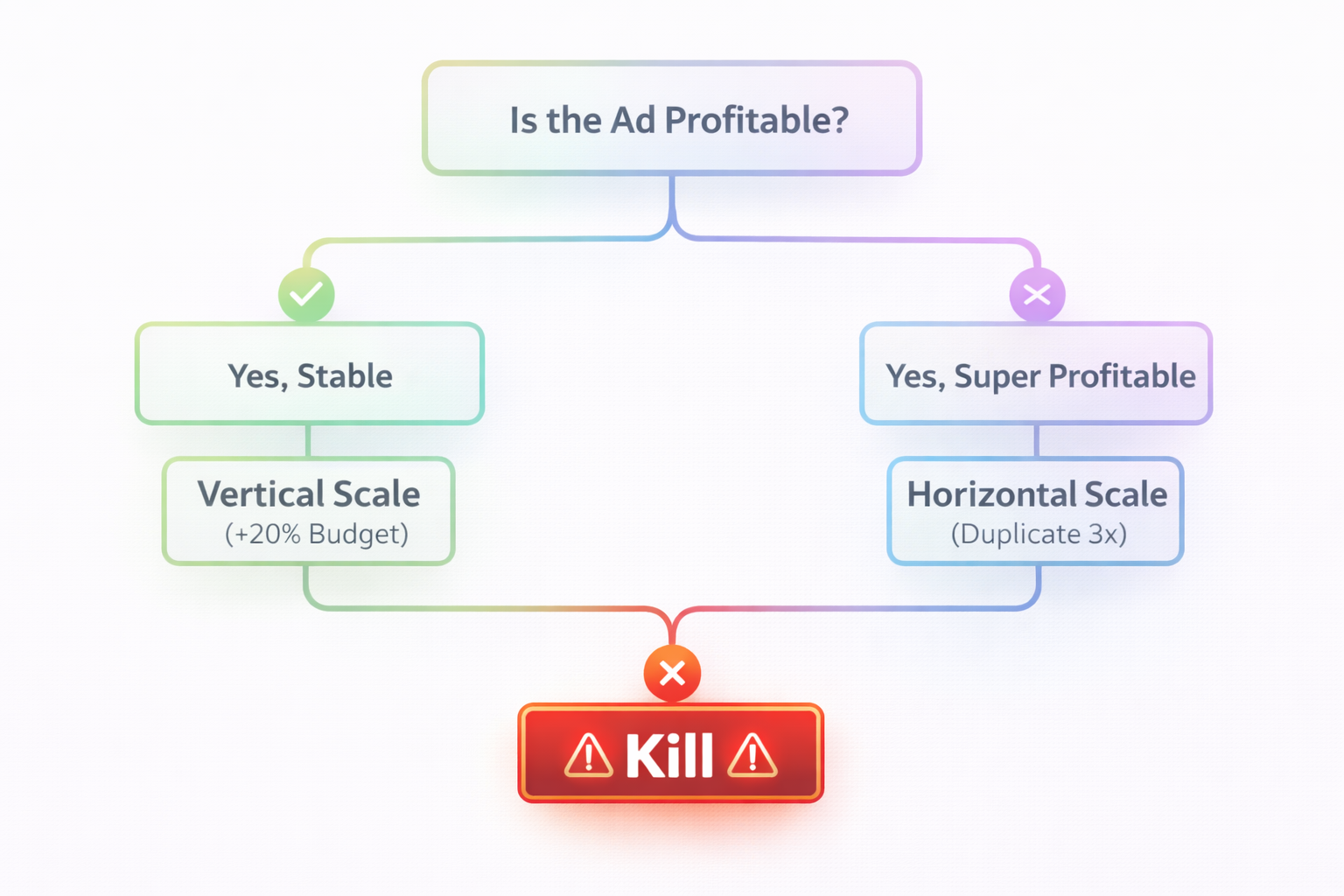
The "Surf" Strategy (Combining Both)
The best media buyers surf the waves using a hybrid approach.
-
Test in ABO. Find a winner first. Use the 48-Hour Rule to validate your creative before you spend big money.
-
Scale Horizontally first. Duplicate the winner 5 times to maximize immediate profit.
-
Consolidate later. Take the best performing creatives from the horizontal scale and move them into a high-budget CBO.
-
Scale Vertically on the CBO. Slowly push that budget up forever.
Conclusion
Scaling is about momentum management. Vertical scaling builds momentum slowly but safely, like a freight train. Horizontal scaling creates a massive surge of momentum, like a rocket launch, but it requires careful steering.
Master both, and you can throttle your ad spend up and down at will, capturing profit whenever the opportunity arises.
Frequently Asked Questions
Common questions about this topic
1What is the difference between vertical and horizontal scaling?
2How fast can I increase my Facebook ad budget?
3What is the 'Surf Strategy' in media buying?
Written by

Rokas Steponavičius
Founder, CEORokas is the Founder and CEO of TryCrush.ai, an ex-IBM professional turned entrepreneur focused on building AI-driven growth platforms. With a strong background in ecommerce, performance marketing, media buying, and artificial intelligence, Rokas specializes in creating scalable, data-led systems that drive measurable revenue. His mission is to help modern businesses leverage AI to optimize acquisition, conversions, and long-term profitability.
Stop Guessing.
Start Crushing.
AI Ad Manager trained by world-class media buyers to generate your creatives and optimize your ads 24/7.
Learn more
Related articles

From $100 to $10k/Day: The Complete Roadmap for Scaling E-commerce Ads
Scaling isn't a sprint; it's a climb. Discover the four essential phases of scaling e-commerce ads from validation to international expansion. Learn how to turn $100 budgets into $10,000 days without crashing your ROAS.

Meet Crush: The Scientific Framework for Predictable Facebook Ad Scaling
Stop treating Facebook ads like a slot machine. The Crush Framework replaces "gut feel" with data-driven precision, using scientific testing and automated kill switches to guarantee predictable scaling.
From $1k to $10k/Day: The Mathematical Path to Vertical Scaling
Hitting a wall at $1,000/day in ad spend? You're facing the efficiency vs. volume paradox. Discover how to use dynamic vertical scaling and confidence intervals to push through the glass ceiling and reach $10k/day profitably.

Facebook Ads Manager Campaign Setup: The 2026 Walkthrough
Facebook Ads Manager changes constantly. This 2026 guide walks you through every click, from selecting Sales objectives to leveraging Broad targeting, ensuring you avoid hidden settings that kill performance. Get your campaigns profitable today.