
Key Takeaways
- 1Separate testing from scaling using the "Sandbox" account philosophy
- 2Run only 3 campaigns: Testing (Lab), Scaling (Pharmacy), and Retargeting
- 3Use ABO budget for testing concepts and CBO for scaling winners
- 4Move winning creatives via Post ID to retain social proof during scaling
- 5Implement strict naming conventions to unlock specific data insights
Messy ad accounts produce messy results. Discover the "Sandbox" philosophy that separates experiments from revenue. This guide reveals the only three campaigns you need to scale your Facebook Ads to seven figures.
I want you to open your Facebook Ad Account right now. Don't clean it up first. Just open it.
What do you see? Do you see a clean, military-grade operation where every dollar is accounted for? Or do you see a graveyard of paused campaigns, random naming conventions like "Test 1 - final - REAL final", and overlap errors everywhere?
If you are like 99% of advertisers, it's the latter. Here is the hard truth: Messy accounts produce messy results.
If your account structure is chaotic, your data is chaotic. You can't tell if a creative failed because it was bad, or because it was competing against itself in three different campaigns. You can't tell if an audience is saturated or if you just accidentally excluded it.
The Crush Framework relies on a strict, "Sandboxed" account structure. It is designed to do one thing: Separate the Experiment from the Revenue.
The "Sandbox" Philosophy for Facebook Ad Structure
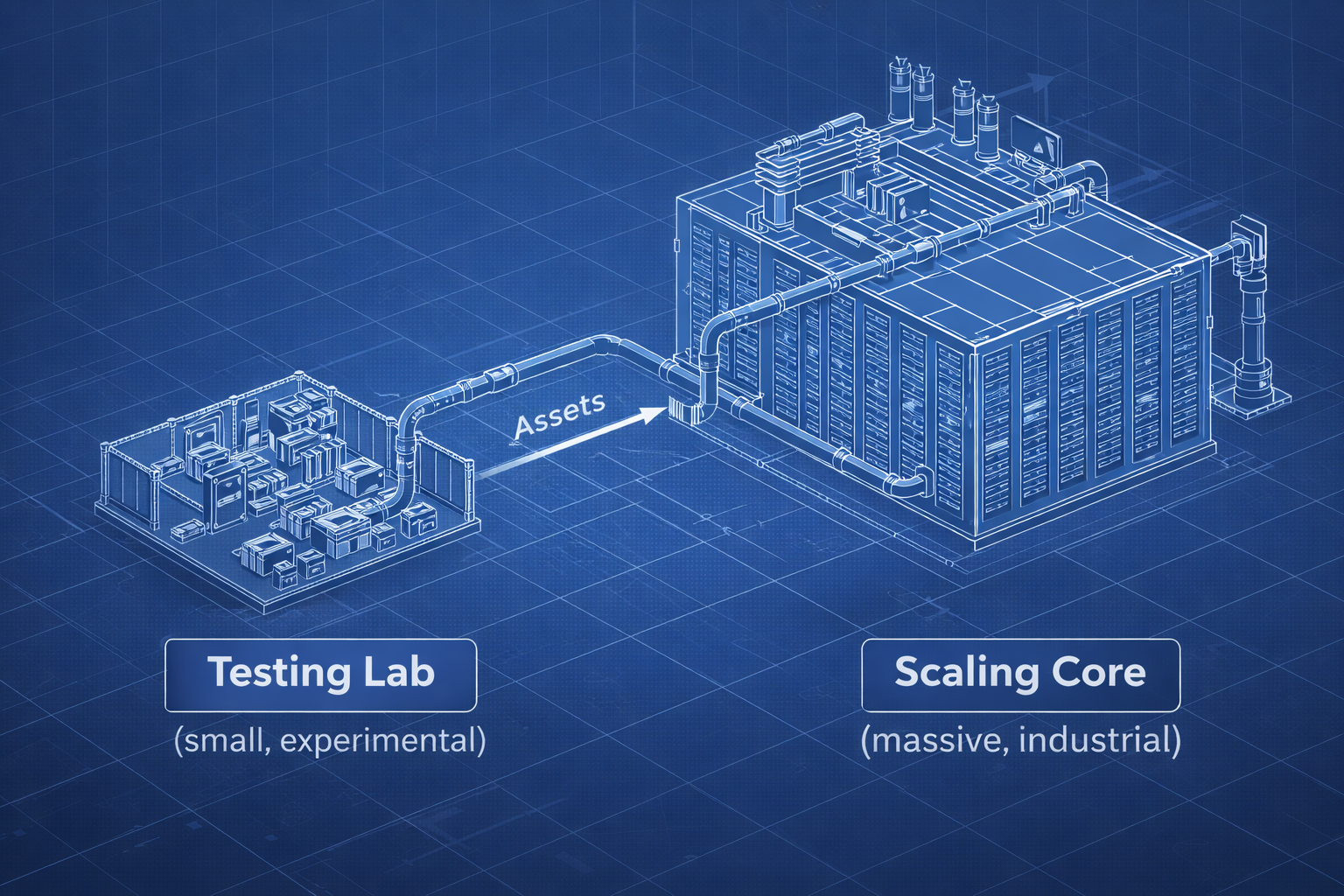
Think of your ad account like a pharmaceutical company.
- The Lab (Testing): This is where scientists test volatile, experimental drugs. It is high risk. Most experiments fail. Explosions happen. But this is where the cure for cancer is found.
- The Pharmacy (Scaling): This is where you sell the proven, FDA-approved drugs to the masses. It is low risk. It is high volume. It is boring, consistent, and profitable.
The Golden Rule: You never mix the two. You don't sell experimental drugs to the public, and you don't do dangerous experiments in the pharmacy aisle.
In Facebook terms: You never test new creatives in your Scaling Campaign. Without this separation, creative testing is burning your budget and cannibalizing your main results.
The Only 3 Facebook Campaigns You Need to Scale
You don't need 50 campaigns. To run a 7-figure ad account, you only need three core campaigns.
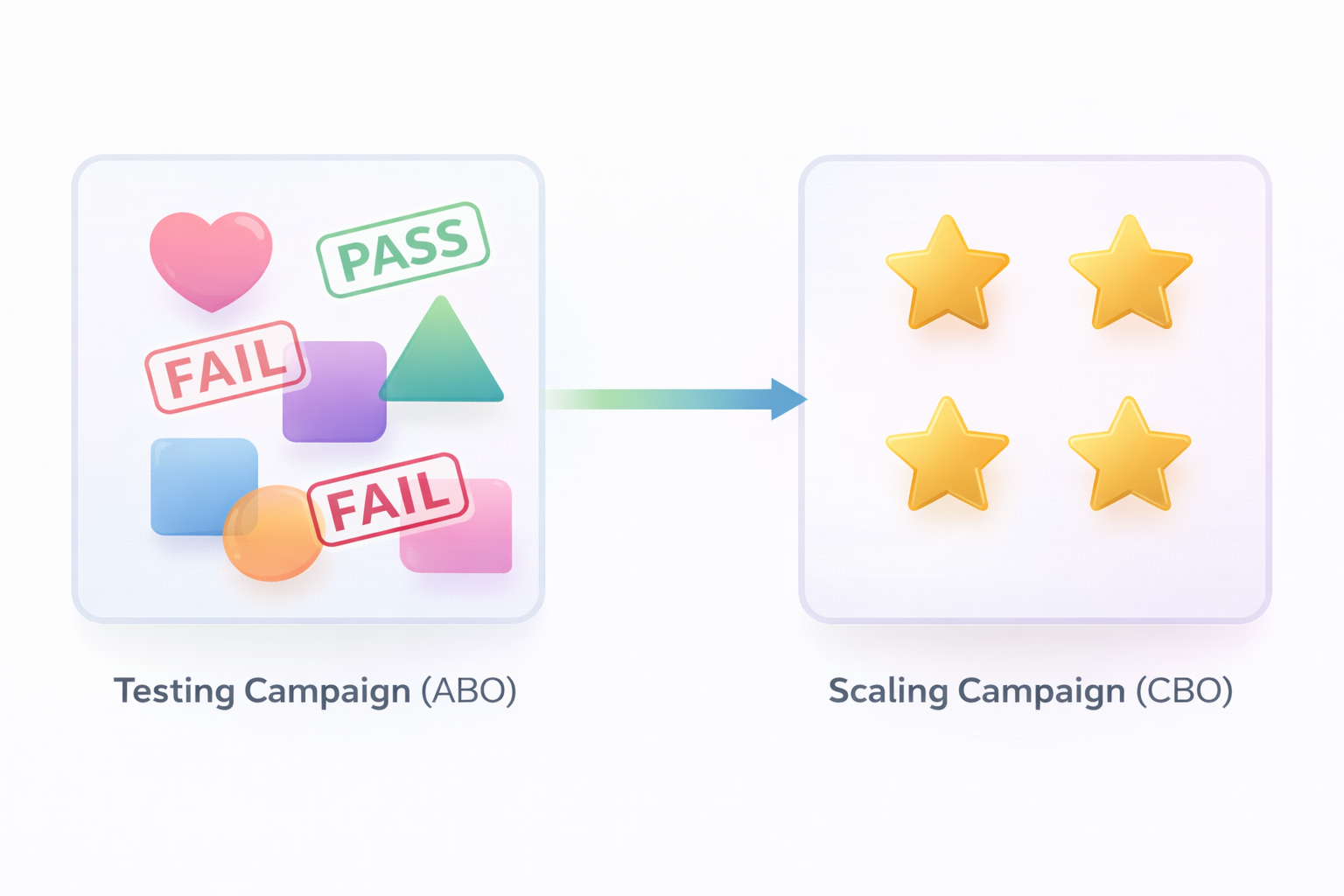
1. The Testing Campaign (The Lab)
- Goal: Validate new creatives quickly and efficiently.
- Structure: ABO (Ad Set Budget Optimization).
- Setup: One Ad Set per Creative concept.
This is where the chaos lives. Every week, you launch new ad sets here. If you have 5 new videos, you create 5 new ad sets. You set the budget to 1x CPA and let them run for 48 hours.
This campaign is a revolving door. Ads enter, get judged, and either die (get turned off) or graduate (get moved). Nothing stays here forever.
Naming Convention:[CRUSH] - TEST - [Date] - [Concept]
2. The Scaling Campaign (The Pharmacy)
- Goal: Maximize profit and volume.
- Structure: Choosing between ABO vs. CBO is simple here: always use CBO (Campaign Budget Optimization) or Advantage+ Shopping.
- Setup: 3-5 Ad Sets (Broad or Stacked Interests) containing ONLY your winning creatives.
This is your money printer. You dump your budget here. You do not touch the ads unless they fatigue. You do not test new headlines here. You treat this campaign with reverence.
When a creative wins in the Lab, you take its Post ID (so you keep the likes and comments) and you import it here. This ensures your scaling ads already have social proof.
Naming Convention:[CRUSH] - SCALE - [Product Name]
3. The Retargeting Campaign (Optional)
- Goal: Scoop up low-hanging fruit.
- Structure: CBO.
- Setup: Audiences for "Viewed Content (30d)", "Add to Cart (14d)", "Initiate Checkout (7d)".
"Wait, isn't Retargeting dead in 2026?"
Not dead, just automated. Most of your scaling campaigns will pick up retargeting traffic automatically. However, implementing a dedicated Facebook retargeting strategy for specific offers (e.g., "You forgot this! Here is 10% off") is still a high-ROI play.
Naming Convention:[CRUSH] - RET - [Offer Name]
The Importance of Naming Conventions for Data Analysis
It sounds boring, but naming your ads correctly is the secret weapon of data analysis.
If you name an ad "Video 1", you will learn nothing. If you name it UGC_Testimonial_Female_Hook3_ProblemAware, you can search your account for "Hook3" and see if that specific angle works across different videos.
You aren't just buying ads; you are buying data. Structure your account so you can actually read that data, which is critical when tracking the essential Facebook Ads KPIs that matter for your bottom line.
Conclusion: Structure Brings Clarity
Structure brings clarity. When you wake up in the morning and log in, you should know exactly where to look.
Is the Lab producing winners? Is the Pharmacy printing cash? By organizing your account into these clear buckets, you stop being a frantic firefighter and start being a strategic CEO.
Frequently Asked Questions
Common questions about this topic
1How many Facebook ad campaigns do I need to scale?
2What is the difference between testing and scaling campaigns?
3Is Facebook retargeting dead?
Written by

Albertas Pocius
Co-founder, CMOAlbertas is the Co-Founder and CMO of TryCrush.ai, bringing elite-level performance marketing expertise to the platform. With over $50M+ in combined Facebook and TikTok ad spend, Albertas has launched and scaled dozens of projects from zero, driven by a deep obsession with data and experimentation. He has trained 20+ media buyers, consulted 100+ companies, and is widely recognized as one of Europe’s early TikTok pioneers, likely the first to scale campaigns beyond $100K per day. Today, he also teaches advertising strategy at two colleges, shaping the next generation of media buyers.
Stop Guessing.
Start Crushing.
AI Ad Manager trained by world-class media buyers to generate your creatives and optimize your ads 24/7.
Learn more
Related articles

ABO vs. CBO: Guide to Scaling Facebook Ads in 2026
Is ABO dead? In 2026, the answer is no. Discover why you need a Hybrid Framework that leverages ABO for precise testing and CBO for massive scaling. Learn the 3-step pipeline to structure your ad account for maximum profit.

From $100 to $10k/Day: The Complete Roadmap for Scaling E-commerce Ads
Scaling isn't a sprint; it's a climb. Discover the four essential phases of scaling e-commerce ads from validation to international expansion. Learn how to turn $100 budgets into $10,000 days without crashing your ROAS.

The Future of Meta: Why "Manual" is the New "Broken"
Signal loss has crippled manual targeting. Meta's Advantage+ and AI tools are the new standard for scaling. Learn why sticking to manual controls is a "tax" on performance and how to pivot to an AI-first strategy.
Facebook Ads Manager Campaign Setup: The 2026 Walkthrough
Facebook Ads Manager changes constantly. This 2026 guide walks you through every click, from selecting Sales objectives to leveraging Broad targeting, ensuring you avoid hidden settings that kill performance. Get your campaigns profitable today.