

Key Takeaways
- 1Feed your AI ads generator distinct psychological angles for better ROAS
- 2Run 20-50 high-velocity micro-tests weekly to find winning combinations
- 3Implement a mathematical kill switch to instantly cut losing campaigns
- 4Automate horizontal and vertical scaling to maximize profit from ads AI
Stop using AI just to cut costs. Learn how to transform an AI ads generator into a profit-generating machine. Master high-velocity testing, ruthless kill switches, and dynamic scaling to maximize your ROAS in 2026.
The conversation around artificial intelligence in advertising has officially shifted. We are no longer asking if AI can write decent copy or generate a visually appealing image. The only question that matters for modern media buyers and business owners is: how do you actually profit from ads ai?
The gap between adopting an ai ads generator and actually seeing a positive Return on Ad Spend (ROAS) is massive. Many businesses fall into the trap of using AI merely as a cost-cutting tool, firing their copywriters and designers to save a few thousand dollars a month.
While reducing overhead is nice, the true power of AI lies in its ability to generate revenue at a scale and speed that is humanly impossible. In fact, the traditional media buyer is dead, making way for strategic operators who leverage automation.
In this comprehensive guide, we will unpack the exact methodologies, frameworks, and mindsets required to turn AI from a novelty into a relentless profit-generating machine for your business.
The Fallacy of the "Set It and Forget It" AI Ads Generator
The biggest misconception in the industry today is that an ai ads generator is a magic button. The narrative pushed by many low-tier software companies is that you can simply type in your website URL, click "generate," and watch the sales roll in.
This is fundamentally false. If you treat AI like a vending machine, you will get vending machine results.
To truly profit from ads ai, you must treat the AI as a high-speed execution engine that requires a brilliant architect. You are the architect.
An AI can generate 1,000 variations of an ad in seconds. But if those variations are based on a flawed premise, a weak offer, or a fundamental misunderstanding of your target audience's psychology, you will simply burn through your budget 1,000 times faster.
Step 1: Architecting the Feed
The output of any AI system is entirely dependent on the quality of its input. To profit from AI, you must master the art of "feeding" the machine.
Mastering Angle Engineering
Instead of giving your ai ads generator generic prompts like "make an ad for a fitness app," you need to feed it distinct, psychological angles. We call this "Angle Engineering."
Angle 1: The Identity Shift. "Stop working out to lose weight. Start training to become the athlete you were meant to be."
Angle 2: The Enemy. "The fitness industry is lying to you about cardio. Here is the actual math behind fat loss."
Angle 3: The Status Play. "The morning routine of top-tier executives always includes these 15 minutes of mobility."
When you feed these highly specific, emotionally charged angles into an advanced AI system, the resulting creatives are infinitely more likely to resonate, stop the scroll, and drive a profitable action.
Step 2: High-Velocity Micro-Testing
The traditional media buying process is slow and painful. You brainstorm an idea, brief a creative team, wait two weeks, launch the ad, and then pray it works. If it fails, you've lost precious time and money.
To profit from ads ai, you must adopt a philosophy of High-Velocity Micro-Testing. Because the cost of creative generation is now approaching zero, your competitive advantage is no longer the quality of a single ad, but the quantity of strategic tests you can run in a given timeframe.
Using a sophisticated system, you should be launching 20 to 50 distinct creative tests every single week. Learning how to launch 50 ads before breakfast using a structured methodology is now a baseline requirement for scaling.
Structuring Your Variables
Here is the critical part: these tests must be highly structured. You must isolate and test one variable at a time:
Test 5 different visual hooks with the exact same copy.
Test 5 different voiceovers on the exact same winning visual.
Test 3 different calls-to-action on the exact same winning combination.
This level of granular testing used to require a team of media buyers staring at spreadsheets all day. Now, an intelligent ai ads generator linked to an autonomous media buying system can handle this entire process programmatically.

Step 3: The Ruthless Kill Switch
Generating profit isn't just about finding winners; it's about aggressively cutting losers before they drain your ad account.
Humans naturally suffer from emotional attachment. If you spent three days editing a video, you want it to work. You will let it spend an extra $100 just to see if it "picks up." AI has no such emotional baggage.
To maximize your ROAS, your AI system must execute a ruthless kill switch protocol. If an ad does not hit a specific metric (e.g., Cost Per Outbound Click under $1.50 within the first $25 of spend), it is killed instantly.
There are no emotions and no waiting for a "learning phase" that never materializes. By protecting your downside with ruthless efficiency, you preserve your budget to scale the creatives that are actually driving profit.
Step 4: Horizontal and Vertical Scaling
Once your AI system identifies a winning combination of creative, copy, and audience, the goal shifts from testing to scaling.
Understanding the difference between vertical vs. horizontal scaling is critical to preserving your profit margins:
Vertical Scaling: Involves increasing the budget on the winning ad set. However, aggressively increasing budgets manually often breaks the algorithm and resets the learning phase.
Horizontal Scaling: Involves taking the winning creative and deploying it across new audiences, new geographies, or slightly different campaign structures.
A true AI growth engine doesn't just generate the ad; it manages the scale. It monitors the frequency cap, watches for creative fatigue, and gradually increases the budget precisely when the algorithm is most stable.
The Missing Link: TryCrush
This brings us to the core issue with the current landscape of AI tools. Most tools are just standalone ai ads generators that leave the hardest parts, the media buying, data analysis, kill switches, and scaling, entirely up to you.
If you truly want to profit from ads ai, you need an integrated ecosystem.
This is precisely why we built TryCrush. TryCrush is not just a creative factory. It is a closed-loop growth engine that generates creatives based on proven psychological frameworks, deploys them automatically, monitors micro-metrics in real-time, executes kill switches without hesitation, and scales winners dynamically.
We designed TryCrush to bridge the gap between creative generation and actual, measurable profit. To understand the exact methodology powering this system, meet Crush: the scientific framework for predictable scaling.
Conclusion: The New Era of Media Buying
The days of guessing what will work on Facebook or TikTok are over. The era of emotional media buying is officially dead.
To profit from ads ai in 2026 and beyond, you must become a master of systems. You must leverage an ai ads generator not as a shortcut to bypass hard work, but as a hyper-efficient engine to test your strategic hypotheses at the speed of light.
Stop playing the guessing game. Start building an infrastructure that guarantees mathematical profitability. Feed the machine, test aggressively, kill losers ruthlessly, and let the AI scale your winners.
Frequently Asked Questions
Common questions about this topic
1How do you actually profit from ads AI?
2What is the biggest mistake when using an AI ads generator?
3What is high-velocity micro-testing in AI media buying?
Written by

Albertas Pocius
Co-founder, CMOAlbertas is the Co-Founder and CMO of TryCrush.ai, bringing elite-level performance marketing expertise to the platform. With over $50M+ in combined Facebook and TikTok ad spend, Albertas has launched and scaled dozens of projects from zero, driven by a deep obsession with data and experimentation. He has trained 20+ media buyers, consulted 100+ companies, and is widely recognized as one of Europe’s early TikTok pioneers, likely the first to scale campaigns beyond $100K per day. Today, he also teaches advertising strategy at two colleges, shaping the next generation of media buyers.
Stop Guessing.
Start Crushing.
AI Ad Manager trained by world-class media buyers to generate your creatives and optimize your ads 24/7.
Learn more
Related articles

The "Creative Fatigue" Lie: You Don't Need More Ads, You Need Better Iterations
Think you need fresh creative every week? Discover why "Creative Fatigue" is a myth and learn the step-by-step process to iterate existing ads into high-converting winners without filming new footage.

The "Kill Switch" Protocol: How to Stop Wasting Budget on Unprofitable Ads
Your winning ad campaign can turn into a budget-draining zombie while you sleep. Learn how to automate your loss prevention with the "Kill Switch" protocol. Remove emotion from your media buying and protect your profits automatically.
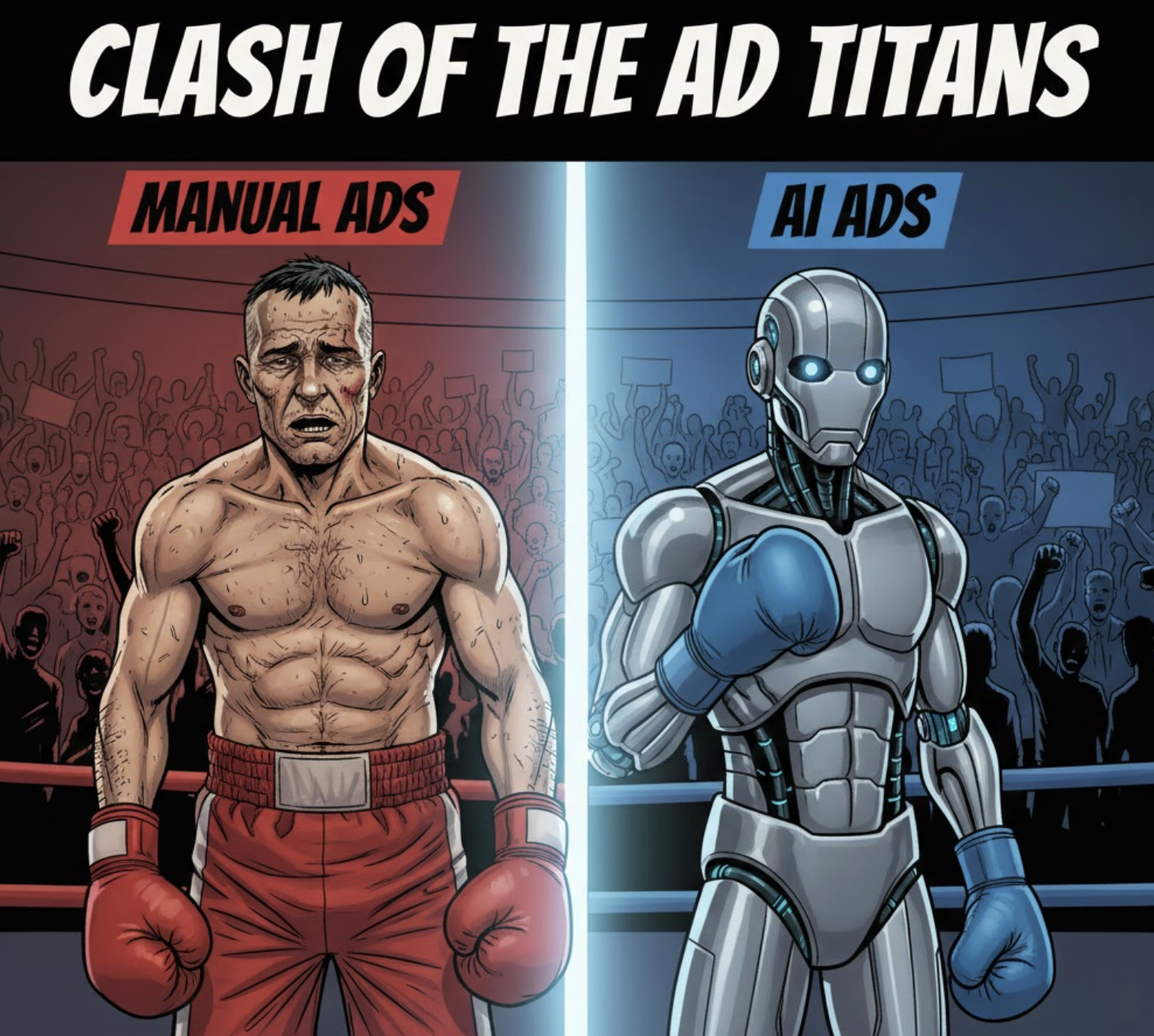
Facebook Ads vs. AI Ads: The 2026 Showdown
Manual media buying is dead. We pit traditional Facebook Ads against the new wave of AI Ads in a 5-round battle covering setup time, optimization, and scalability. Discover why autonomous agents are the future of advertising.

What is a Burn Rate and How to Prevent It From Destroying Your Ad Budget
Are losing ad tests destroying your profit margins? Learn the true definition of advertising burn rate and discover how AI-driven micro-testing can act as a financial bodyguard for your ad spend.