
Key Takeaways
- 1Shopify supports large product catalogs and cross-channel marketing but charges extra transaction fees if you bypass Shopify Payments.
- 2Squarespace offers all-in-one domain registration and responsive design templates but struggles with limited scalability and complex UI workflows.
- 3Shopify restricts staff accounts to 5 or 15 on mid-tier plans, while Squarespace includes unlimited contributors on its Core plan and above.
- 4Driving ecommerce traffic in 2026 relies on proven creatives; top ecommerce ads run an average of 143 days to build sustained conversions.
Shopify scales massive product catalogs with extensive marketing apps, while Squarespace serves creators needing simple, design-led storefronts. Your platform choice determines your operational ceiling for 2026.
Shopify scales massive product catalogs and connects directly with complex multichannel marketing setups. Squarespace serves service businesses or creators who prioritize design and need simple storefronts. Your platform choice between Squarespace vs Shopify for ecommerce determines your operational ceiling for 2026 and beyond.
How Does Shopify Support Ecommerce Growth?
Shopify provides a comprehensive ecosystem built specifically to scale online sales volume.
According to XgenTech, Shopify is an e-commerce platform that allows businesses to build, manage, and scale online stores. It handles everything from your product catalog and checkout to payments, shipping, and marketing within a single system.
User Experience and Extensibility
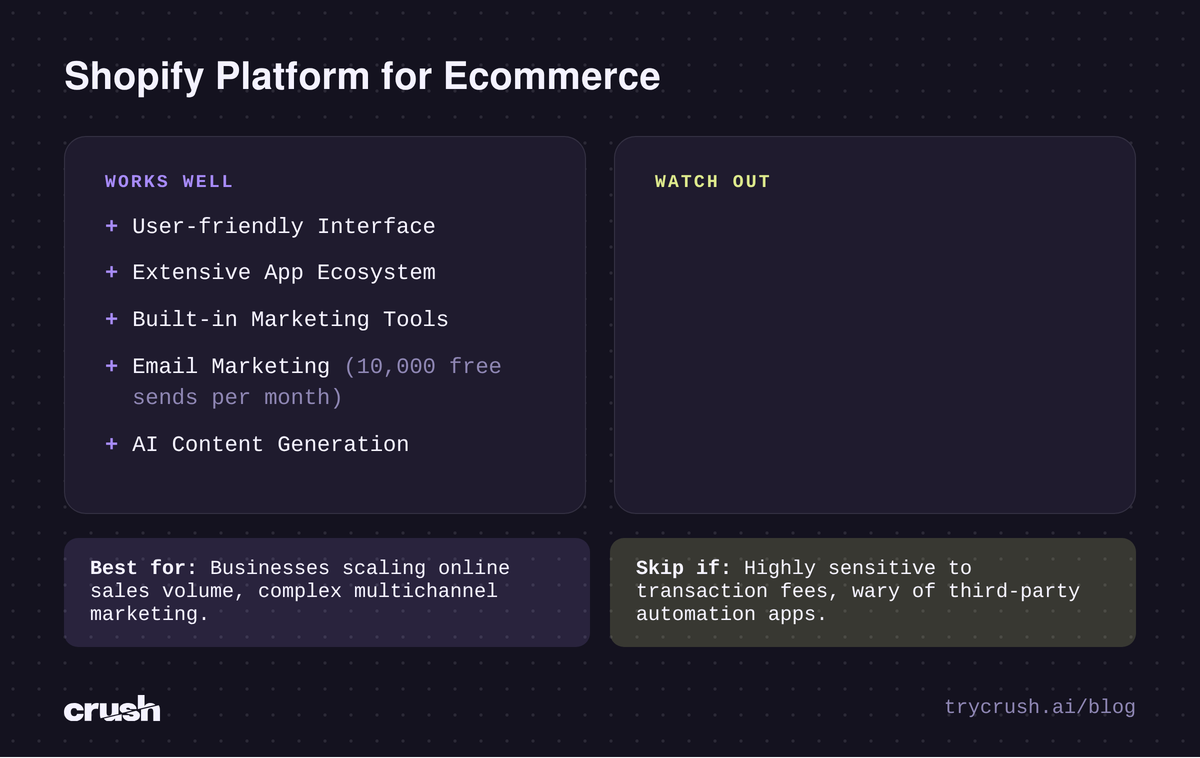
Users praise the platform for its accessibility. Reviewers on G2 Reviews highlight Shopify's user-friendly interface. They appreciate the wide range of professional themes and tools for managing products, payments, orders, and customers in one place.
You do not need advanced technical knowledge to operate a basic storefront. However, its true power lies in its integrations.
Shopify is lauded for its extensive ecosystem of apps and integrations, according to G2 Reviews. This makes it easy to connect with various marketing, payment, and logistics tools to add new features and customize the store as needed.
Built-In Marketing Tools
Acquiring customers is a core focus of the platform. Shopify's advertising tools assist in creating, managing, and optimizing online ad campaigns, per JoinBrands. These tools offer options for targeting audiences, setting budgets, and analyzing ad performance.
The platform also facilitates cross-channel marketing integration. According to the Shopify Official Website, businesses can promote and sell products natively on social platforms like Facebook, Instagram, TikTok, and YouTube.
To retain those customers, merchants leverage email and chat:
- Convertcart reports that Shopify Email allows users to create email campaigns using ready-made designs, offering 10,000 free sends per month.
- For live communication, G2 Reviews notes that Shopify Inbox addresses the need for efficient personalized customer communication. It offers real-time chat capabilities integrated with live customer data, enabling merchants to provide immediate assistance and offer discounts to increase sales.
SEO, AI, and Staff Pricing
Organic traffic tools are baked in. According to Printify, the platform offers built-in SEO features to help with writing product descriptions to improve search rankings. It also includes a Shopify blog for publishing relevant content.
Content creation is getting faster. XgenTech points out that Shopify incorporates AI-powered tools like Shopify Magic for content generation. This assists with product descriptions, email responses, and marketing copy.
Getting started requires a low initial investment. According to Commerce-UI, Shopify offers a Starter plan for $5 per month.
However, adding team members changes the math. The Shopify Help Center confirms the Starter and Basic plans have a limit of 0 staff users. The Grow plan allows 5 staff users, and the Advanced plan allows 15 staff users.
Where Does Shopify Fall Short?
High transaction fees and unreliable third-party automation apps are the primary complaints from merchants using the platform.
Payment processing costs add up quickly. According to Capterra Reviews, Shopify charges transaction fees ranging from 2.5 percent to 2.9 percent plus $0.30 per online transaction via Shopify Payments.
If you opt out of their native payment system, it costs more. Using a third-party gateway incurs an additional 0.6 percent to 2 percent fee. If you sell high volume items at a $50 target CPA, those extra percentage points severely impact net margins. In these scenarios, accurately tracking your Lifetime Customer Value (LTV) is critical to ensure ad spend remains profitable despite higher baseline fees.
Merchants must also navigate a crowded app store carefully. Users on Reddit r/shopify advise caution against apps claiming to fully automate and run Meta ads.
These users suggest that such automation apps may not be effective. They warn that a human element is likely still involved behind the scenes despite the automation claims.
What Makes Squarespace Different?
Squarespace excels at providing a unified software solution for design, domain hosting, and basic commerce.
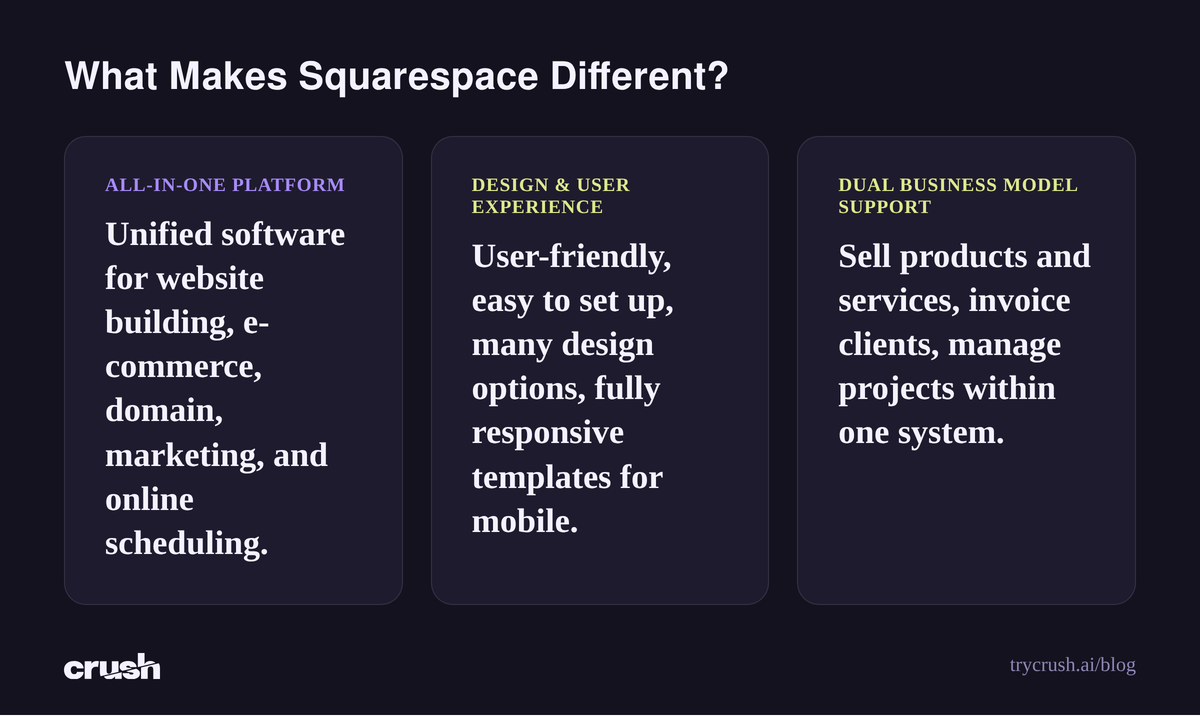
According to Squarespace - Wikipedia, the platform offers software as a service for website building, e-commerce, domain registration, marketing, and online scheduling.
It serves dual purposes for service and product businesses. The official guide on Everything you can do with Squarespace notes users can sell products and services through an online store and invoice clients while managing projects.
Infrastructure and Design Basics
The platform handles the backend infrastructure seamlessly. The same official guide states Squarespace provides functionality to register or transfer custom domains and create custom email addresses using those domains.
Design is a major selling point. Reviewers on G2 Reviews find Squarespace user-friendly and easy to set up. They appreciate the many design options suitable for small and medium businesses.
Mobile optimization is guaranteed. According to Style Factory, all Squarespace templates are fully responsive. They adapt automatically to devices like smartphones, tablets, and desktops, which also provides SEO benefits.
Favorable Pricing Variables
Testing the platform is low risk. The Squarespace Help Center confirms users can request a one-time, seven-day extension to their Squarespace website trial.
Digital product sellers must monitor their hosting tier carefully. According to Choosing the right Squarespace plan, video storage limits vary. The Basic plan offers 30 minutes, Core offers 5 hours, Plus offers 50 hours, and Advanced provides unlimited video storage.
Collaborator limits are generous. The same pricing guide confirms Squarespace's Core, Plus, and Advanced plans include unlimited contributors.
What Are the Limitations of Squarespace?
Customer support issues and scaling constraints frustrate users trying to grow large stores on the platform.
Getting help can be a challenge. Many users on Trustpilot and Reddit r/squarespace have reported poor customer service. They cite issues like a lack of clarity, slow email responses, and difficulty getting questions answered. Some reviewers explicitly noted a perceived absence of human interaction.
The backend interface is polarizing. Some users on Reddit r/squarespace have found Squarespace's workflow, UI, and design to be convoluted and unintuitive. They complain that the platform diverges from established UI conventions. This reportedly makes certain basic tasks difficult to execute efficiently.
Scaling a large product catalog is a known weakness. G2 Reviews notes Squarespace has been described as having limited scalability and integrations. This is a disadvantage for businesses aiming for rapid growth or managing a large number of products.
2026 Ecommerce Data on Driving Store Traffic
Choosing a store builder is just the foundation, but scaling in 2026 requires relentless traffic generation through winning ad creatives. Relying on accurate e-commerce benchmarks is the only way to measure if your creatives are performing at a profitable level.
This is where Crush, our platform, enters the equation. Crush is an AI Facebook-ads platform. We solve the traffic problem by fully automatically running Facebook ads, creating campaigns, scaling winners, and killing losers.
To understand what works, we track competitors' Facebook ads via the Meta Ad Library. For operators doing their own research, learning how to search the Facebook Ad Library like a pro yields massive competitive insights. Our database keeps history, including ads that were taken down. You can access our free public ad library at trycrush.ai/ad-library.
Extracting Insights from the Crush Ad Library
Our tracking scope is massive. The Crush ad library tracks 1,804,201 unique Facebook ads across niches, with 438,568 currently active. We provide longevity data showing exactly how many days an ad has been running.
We also track duplicate counts, which reveal how many times an advertiser re-launched the same creative. This is a strong winning ad signal. Within our specific 2026 dataset, 889 tracked ads match "ecommerce". Currently, 379 of those are active right now.
162 of the top 400 ecommerce Facebook ads tracked in our database ran for 90 or more days, passing the proven winner threshold.
Among these top ecommerce ads, the average run time is 143 days. The data shows clear trends in user actions. The most common CTA buttons on ecommerce ads are "learn more" at 24 percent, "whatsapp message" at 15 percent, and "shop now" at 12 percent. These actions align directly with proven call to action examples that maximize user conversion intent.
Real Examples of Winning Ecommerce Ads
- Product imagery paired with simple copy drives longevity. An ad from Justine's Jewels Mtl has been running 1666 days. It relaunched 0 times, uses the "shop now" CTA, and opens with: "Beautiful pink stone earrings in rose sterling Italian silver".
- Apparel brands leverage user generated style content. An ad from Chikigo ran 1506 days, relaunched 0 times, and used a "book travel" CTA. Its opening line read: "Spotted @__auliafitri__ in our polo knit - earthy blue 🤍 Grab yours now at our ecommerce store! 😃".
- B2B services also thrive. An ad for It Expert Service's ran 1292 days with a "message page" CTA. The opening line was: "𝘼𝙙𝙫𝙚𝙧𝙩𝙞𝙨𝙚 𝙮𝙤𝙪𝙧 𝘽𝙪𝙨𝙞𝙣𝙚𝙨𝙨 𝙖𝙣𝙙 𝙞𝙣𝙘𝙧𝙚𝙖𝙨𝙚 𝙩𝙝𝙚 𝙨𝙖𝙡𝙚𝙨 DO YOU KNOW THE SECRET TO SUCCESSFUL ONLINE BUSINESSES? YES, Facebook".
- Direct hooks capture attention instantly. An ad for Crystal Brown ran 1217 days with a "learn more" CTA, opening with: "♂️La imp🔞tencia ya no es un problema!♂️".
- Clear value propositions work for niche supplies. Apex Wilderness Tackle has been running an ad for 1186 days with a "shop now" CTA. The opening line is: "Apex Wilderness Tackle is an E-Commerce store that supplies outdoor recreation Goods & Equipment."
Crush can generate ad-creative iterations from a winning reference ad just like these. Paid plans start with a trial. You can see the current pricing at trycrush.ai/pricing.
Platform Comparison Table
Reviewing the capabilities side by side helps clarify which tools handle which parts of your business efficiently.
| Feature | Shopify | Squarespace | Crush (our product) |
|---|---|---|---|
| Primary Function | Scaling large e-commerce catalogs. | Website building and domain registration. | AI Facebook-ads platform. |
| Staff Limits | Starter/Basic: 0. Grow: 5. Advanced: 15. | Core, Plus, Advanced include unlimited. | N/A (Ad automation focus). |
| Marketing Integrations | Cross-channel (FB, Insta, TikTok, YT). | Limited external integrations. | Automatically creates and scales campaigns. |
| Email Marketing | 10,000 free sends per month via Shopify Email. | Custom email via registered domains. | N/A. |
Who Should Pick Which Platform?
Your choice between Squarespace vs Shopify for ecommerce depends entirely on inventory size and growth goals.
Shopify acts as a heavy-duty engine for operators who care more about complex logistics and third-party apps than out-of-the-box templates.
Choose Shopify if your business meets these specific criteria:
- You plan to rapidly scale a large catalog of physical products.
- You require deep cross-channel marketing integration across Facebook, Instagram, TikTok, and YouTube.
- You want to utilize live tools like Shopify Inbox with real-time customer data.
- You are comfortable paying transaction fees or using Shopify Payments.
Squarespace provides a cleaner, design-first experience for operators who value visual simplicity and unified billing over massive inventory scale.
Choose Squarespace if these scenarios apply to you:
- You run a service business that requires online scheduling alongside light product sales.
- You want to manage domain registration, web hosting, and invoicing in one exact place.
- You demand fully responsive, beautiful design templates out of the box.
- You need unlimited staff contributors without upgrading to enterprise tier pricing.
Once your storefront is built, the focus shifts to traffic. Rely on platforms suited to their specific tasks. Let Shopify or Squarespace handle the checkout, and use dedicated tools like Crush to automatically scale your customer acquisition.
How we got this data
The numbers in this article come from Crush’s ad library: 1,804,201 unique Facebook ads tracked via the Meta Ad Library, 438,568 of them active at the time of writing. Ad examples reference real advertisers and their public ads. Data queried on 2026-08-18. Third-party product facts are attributed inline to their sources.
Frequently Asked Questions
Common questions about this topic
1Is Shopify or Squarespace better for SEO?
2Can I register my domain directly through Shopify?
3How do staff user limits compare between the platforms?
4Does Squarespace limit digital product storage?
5Are there hidden transaction fees on Shopify?
Written by

Ignas Obulaitis
Head of ITIgnas Obulaitis is the head of IT for TryCrush.ai, leading the platform’s engineering and AI innovation. With a strong background in product-driven development, Ignas has built and scaled complex systems across fintech, SaaS, and AI-focused companies. An ex-IBM engineer and former Head of Development at Fluensure, Ignas combines deep technical expertise with a sharp product mindset to turn ambitious ideas into scalable, production-ready technology.
Stop Guessing.
Start Crushing.
AI Ad Manager trained by world-class media buyers to generate your creatives and optimize your ads 24/7.
Learn more
Continue Reading
Dropship.io Reviews 2026: Pricing, Features, and Accurate Data
An in-depth look at Dropship.io's features and pricing in 2026. Learn where the platform excels and why its estimated revenue metrics might cause media buyers to burn through their ad budgets.

What Is FPS Games? A 2026 Guide to Shooters and Ad Data
Learn the definition of FPS games and discover actionable Facebook ad data to scale your user acquisition campaigns in 2026.
Is PowerAdSpy Worth the Cost in 2026? Data, Pricing, and Competitors
A detailed breakdown of PowerAdSpy features, pricing, and user reviews. We compare it to AdSpy and proprietary data to see which ad intelligence tool actually helps media buyers scale.