Malik Johnson
Malik Johnson Facebook ad: “If you have hypertension read this”

Ran for 80 days, from June 23 to September 11, 2026, the last day Crush saw it.
Run by Malik Johnson on Facebook. Crush is not the advertiser and does not verify its claims. See this ad in Meta's Ad Library(opens in a new tab)
Want an ad like this for your product?
Crush makes new ad images for your product from this ad: your logo, your product photo, your offer.
Trials from $19.95 USD, then $79.95 USD a month. Cancel anytime.
About this ad
- Meta Ad Library ID
- 1007041642241062
- Platforms
- Facebook, Instagram, Audience Network, Messenger and Threads
- Relaunches
- 4
Ad text
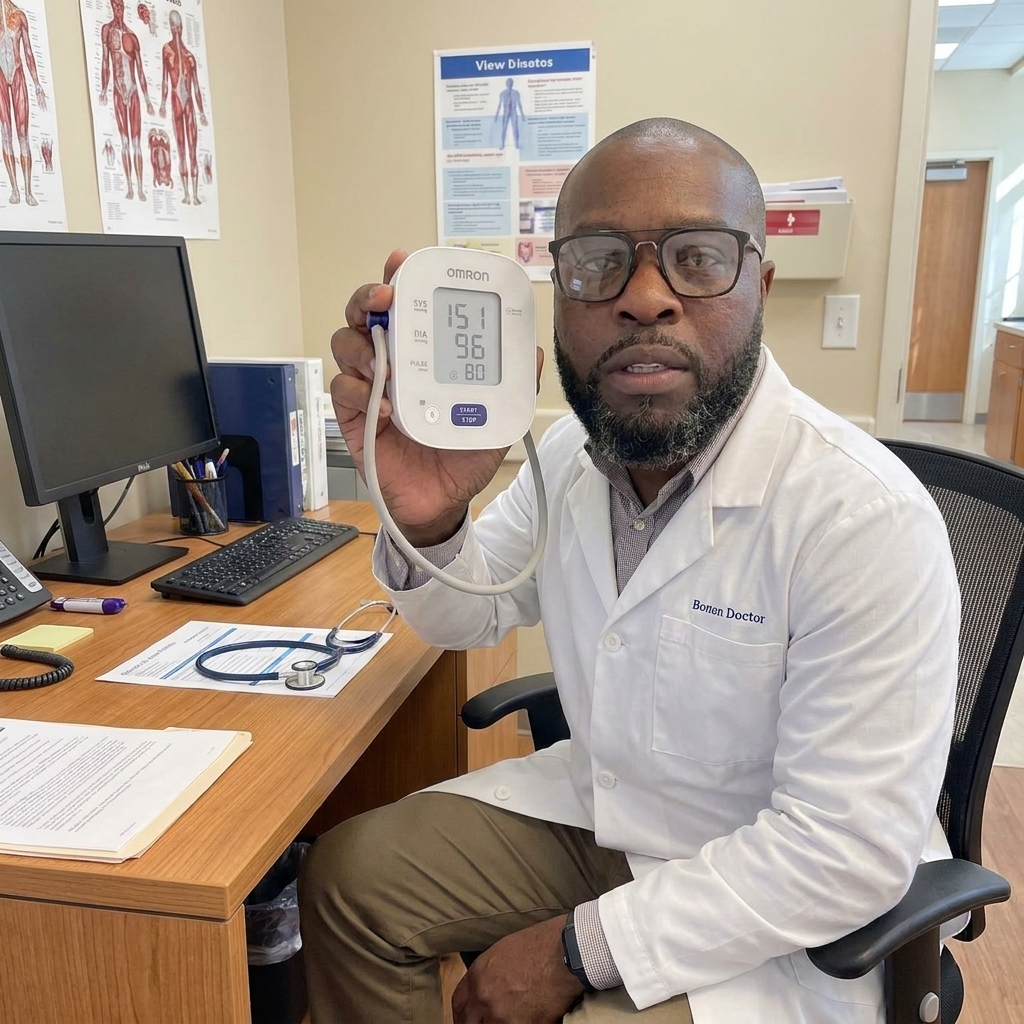
I'm a black cardiologist. My BP hit 151/96 and I refused to take the medication I prescribe every day. Here's what actually moved my numbers. My name is Dr. Malik Johnson. I am 54 years old. I've been a practicing internal medicine physician for 24 years, and high blood pressure is the single most common thing I treat. I grew up watching my father manage his blood pressure the same way most Black men in America do. Mostly by ignoring it until he couldn't. He died of a stroke at 58. My uncle, his younger brother, had one at 61. I became a doctor because of those funerals. Because I needed to believe there was something I could do about what was coming for our family. For two decades I sat across from patients and explained the same things. The morning headaches at the base of the skull. The dizzy spell when you stand up too fast. The numbers that creep no matter how clean you eat. I'd sit across from Black patients specifically, men who went to the gym five days a week, who switched from red meat to fish, who hadn't added salt to a plate in fifteen years, and their numbers were still sitting at 140, 145, 150 over 90. I knew why. I told them what I'd been taught. Genetics. Salt sensitivity. Allostatic load. The cumulative weight of stress that doesn't show up on any bloodwork panel but wears the body down year by year. And when lifestyle wasn't enough, which it often wasn't, I wrote the prescription. Lisinopril. Amlodipine. Hydrochlorothiazide. I wrote those prescriptions thousands of times. I watched what they did to people. The dry cough from lisinopril that wakes you up at 3 AM. The swollen ankles from amlodipine that make your shoes tight by noon. The constant bathroom trips from HCTZ that leave you exhausted no matter how much you drink. I watched my patients come back again and again. Adding pills. Adjusting doses. Tolerating side effects that became their new normal. Some of them were on three medications and their numbers were still creeping. I wrote those prescriptions anyway. Because I didn't know what else to give them. Three years ago, it happened to me. I'd been watching my own numbers for a long time. Borderline readings. High normal. I told myself I was managing it. Then my morning readings stopped being borderline. 147/93 one Tuesday. 149/94 the same week. 151/96 the following Monday. I sat at my kitchen table at 6 AM staring at that cuff and I felt something I hadn't expected. Not medical concern. Fear. The same fear I'd watched on the faces of my patients for twenty-four years. I knew exactly what those numbers meant. I knew what they became if you ignored them. I'd given the eulogy at my father's funeral at 26 years old. I was not going to stand in that same place. My own physician wanted to start me on lisinopril. 10 milligrams to start. I sat in that chair, the patient's chair, not the doctor's, and heard the exact conversation I'd had with hundreds of my own patients. I told her I'd think about it. But I wasn't going to take it. I prescribe lisinopril every week. I know the mechanism cold. I also know what it does to people over twenty years. My father was never on blood pressure medication because he never went to the doctor long enough to get the conversation. But I've watched what happens to the ones who do. Pill after pill. Year after year. Numbers managed but never reversed. I wasn't doing that to myself. So I did what I tell every patient to do first. Cut sodium under 1,500 milligrams a day. Started doing cardio six mornings a week. Dropped twelve pounds over three months. My numbers moved six points. Still sitting at 145/90 most mornings. I tried beetroot. The research on dietary nitrates is solid. I've pointed patients toward it for years. I bought a powder from Amazon, one of the top-rated ones. Took it every morning for eight weeks. Nothing moved. Tried a different brand. Six weeks. Same result. I figured my physiology was just too compromised for nitrates to make a dent. That was my conclusion. I was wrong about why. About six months ago, one of my regular patients came in for a follow-up. He's 61. Black man. Been dealing with Stage 2 hypertension for over a decade. He'd been on two medications for years and his numbers had plateaued. I pulled up his chart and stopped. His morning reading was 127/80. I asked him if he'd changed his medications. He hadn't. I asked him what he'd added. He reached into his coat pocket and set a small bottle on my desk. Beetroot capsules. "I didn't want to bother you with it, Doc. I know you probably think supplements are a waste of time." I did think that. Mostly. But his chart was right in front of me. And I knew him well enough to know he wasn't inflating his home readings. He said: "The regular ones don't work. You have to get the one that's cold-extracted. My wife found it. There's a difference." I thanked him. That night my own reading was 150/95. I sat at the kitchen counter with my laptop and I went deeper into the beetroot research than I ever had before. Here's what I found. The active compound in beets is dietary nitrates. Your body converts them to nitric oxide through a pathway called the enterosalivary cycle. Nitric oxide signals your blood vessel walls to relax and dilate. When they open, blood flows with less resistance and pressure drops. That's the whole mechanism. The clinical studies that demonstrated blood pressure reductions used 300 to 500 milligrams of dietary nitrates per serving. Then I went and looked at the powder I'd been taking. Sixty milligrams of nitrates per serving. The gummy brand I'd tried before that: around 40 milligrams. The clinical studies used five to eight times the dose I'd been taking. No wonder I wasn't seeing results. I kept reading. The second problem is the processing. Most beetroot supplements are manufactured using high-heat spray drying. It's fast. It's cheap. It also destroys dietary nitrates. Heat breaks the chemical structure that makes the nitrate bioactive. By the time the powder is in the bottle, most of the active compound is gone. So a label that says "1,200mg beetroot extract" can have almost no functional nitrates inside. You're paying for powder. You're not getting the mechanism. I thought about my patients. All the times I'd said "the research on beetroot is interesting" and they'd gone out and bought whatever was on the shelf. None of them were getting close to the clinical dose. None of them were taking a cold-extracted product. No wonder it hadn't worked. No wonder I had written it off. I started looking for any beetroot supplement that was cold-extracted, not heat-processed, standardized to at least 300 milligrams of dietary nitrates per serving, and third-party tested with a published Certificate of Analysis. One brand kept coming up in the research forums, in the supplement review threads, and I remembered then, in my patient's coat pocket. BeetWise. I ordered it that night. When it arrived I checked the Certificate of Analysis on their website before I opened the bottle. 400 milligrams of dietary nitrates per serving, verified by an independent lab. Cold-extracted. No spray drying. No fillers. Capsule form. I took the first dose that Monday morning with breakfast. Day 7: My morning reading was 145/91. Lower than it had been in weeks. I checked it twice. Day 14: 139/87. The morning headaches were gone. I noticed I was sleeping through the night without waking up tense at 3 AM. Day 30: 132/83. I hadn't seen that number in three years. I checked it four times in a row just to be certain. Day 60: 126/79. Normal range. The same range I'd been trying to reach for three years with diet, exercise, and a twelve-pound weight loss. I sat at my kitchen table and I didn't move for a long time. Twenty-four years as a physician. And a patient had to teach me something about what actually works. I've quietly mentioned BeetWise to eleven of my Black patients since then. Because I know what happens when their numbers don't move. I know the conversation that comes next. More pills. Higher doses. Side effects that become their new baseline. I've watched that road. I've watched it go nowhere for people who deserved better from the system that was supposed to be helping them. The ones who've actually ordered it have come back with better numbers. One man, 57, been on amlodipine for six years, came back at his follow-up with a morning average of 131/82. He'd been stuck above 145 for two years on medication. He said: "Doc, I feel like I got some years back." I think about my father when he says that. Here's what I wish someone had told me sooner. The beetroot research is real. But most of what's on the shelf is processed at temperatures that kill the active compound before it ever reaches you. And what survives the processing is usually dosed at a fraction of what the clinical studies actually used. BeetWise is cold-extracted, standardized to 400 milligrams of dietary nitrates per serving, and third-party verified. That's the difference. I wasted eight months on products that couldn't work. If my patient hadn't put that bottle on my desk, I'd still be managing a number that was slowly grinding toward what my father's number became. I'm sharing this because I know who's reading it. You've been doing the work. The gym. The diet. The cutting salt at every meal. And your number is still sitting there. Stubborn. Familiar. Inherited. There is a reason. It isn't that you can't beat this. It's that the thing you've been using to fight it wasn't built to work. Here's where I got mine: https://zenther.co/pages/listicle (They're running a discount right now. I ordered three bottles.) ~ Dr. Malik Johnson P.S. A few things I wish I'd known before I ordered. BeetWise comes with a 90-day money-back guarantee. If your numbers don't move, you get a full refund. No questions. I wish I'd known that before I spent eight months and over $150 on products that were dead before they reached my bloodstream. Right now they're running a discount that brings the cost down significantly. That's how I was able to grab three bottles at once. The catch: BeetWise is a small operation. Cold extraction takes four times longer than spray drying, and they only source from one third-party tested supplier. They sell out. I've had patients reach out asking when it's back in stock. If the page shows out of stock when you click, the email notification is worth signing up for. If you've been doing everything right and your number won't move, if you've watched this play out in your family and you're not willing to be the next one, grab a bottle before they're gone. I went from 151/96 to 126/79 in sixty days. Without the medication I prescribe every day. If there's any chance it works for you the way it worked for me, it's worth sixty days to find out. Check if BeetWise is in stock here: https://zenther.co/pages/listicle
Where the ad sends people
zenther.co
If you have hypertension read this
Zenther Beetwise, 400mg verified nitrates per serving not 5mg like most brands. Cold-extracted beetroot supplement with published lab results. 90-day guarantee. Try BeetWise today.
Learn more: zenther.co(opens in a new tab)