
Active· since May 28, 2026
- 111
- days running
- 19
- relaunches
Ad copy
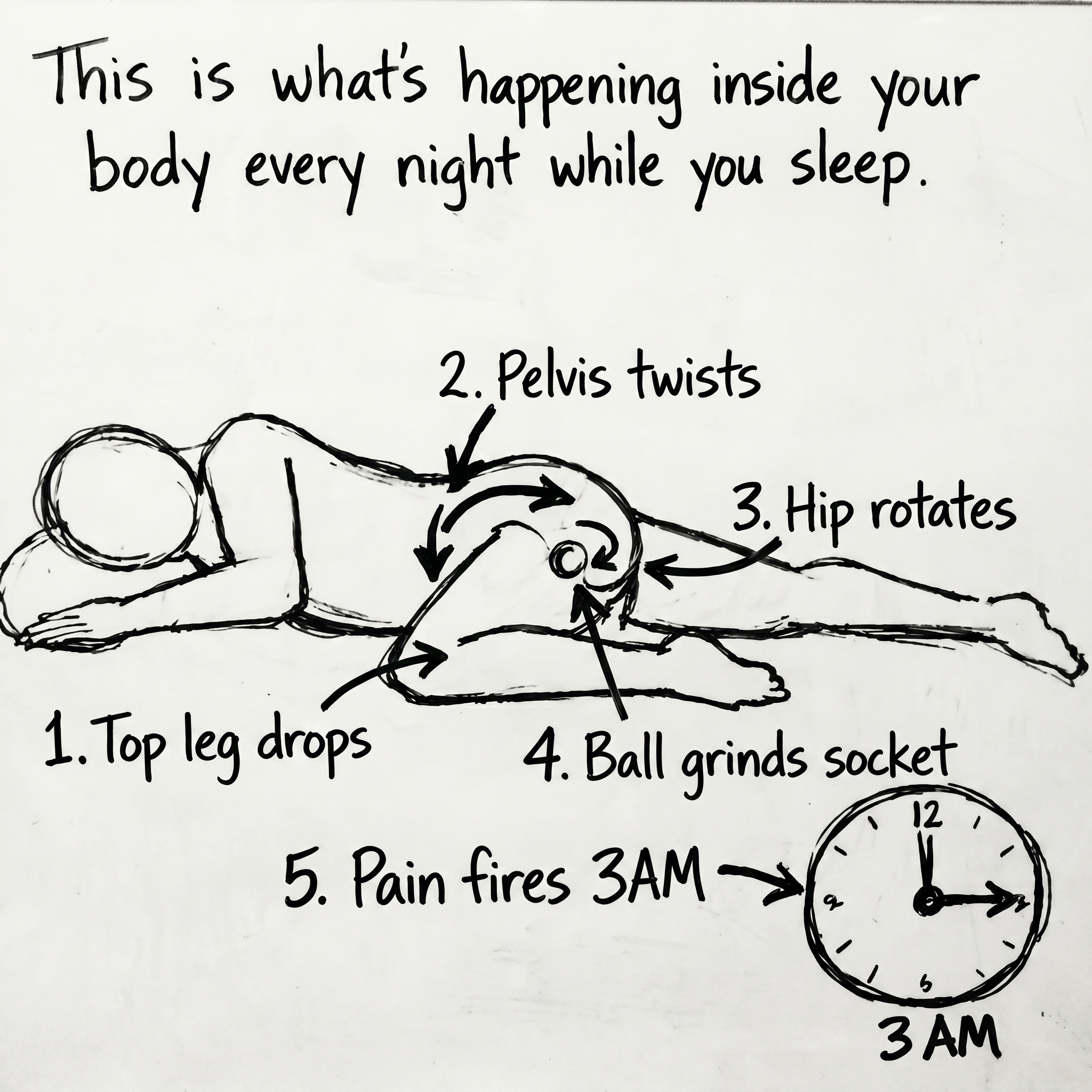
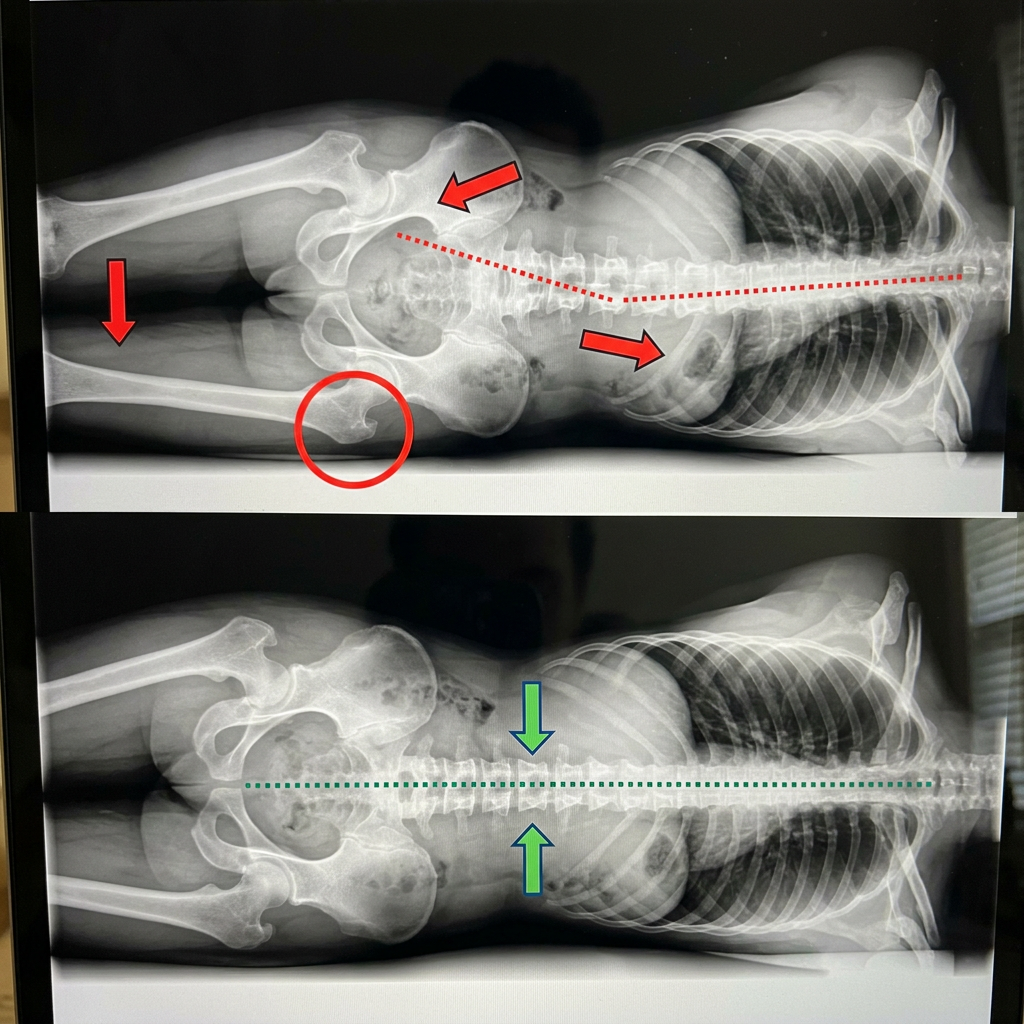
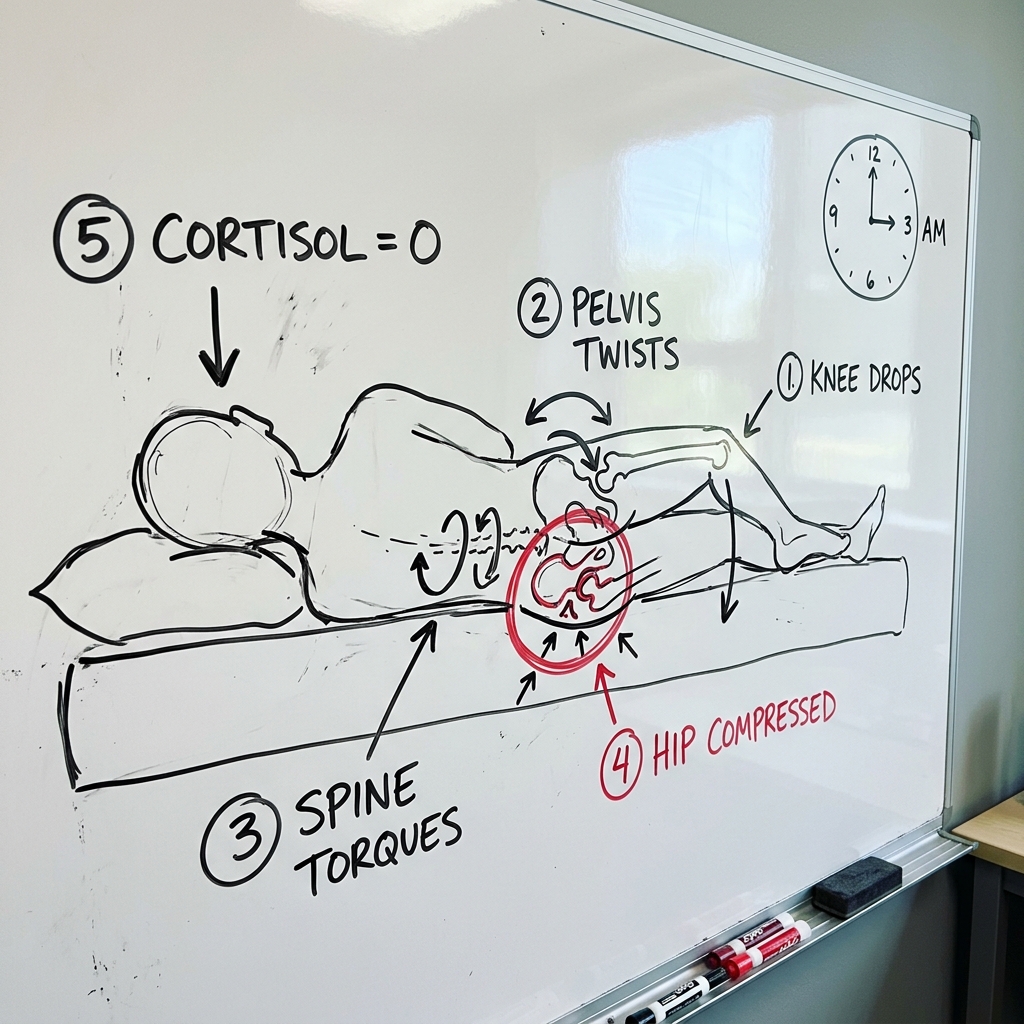
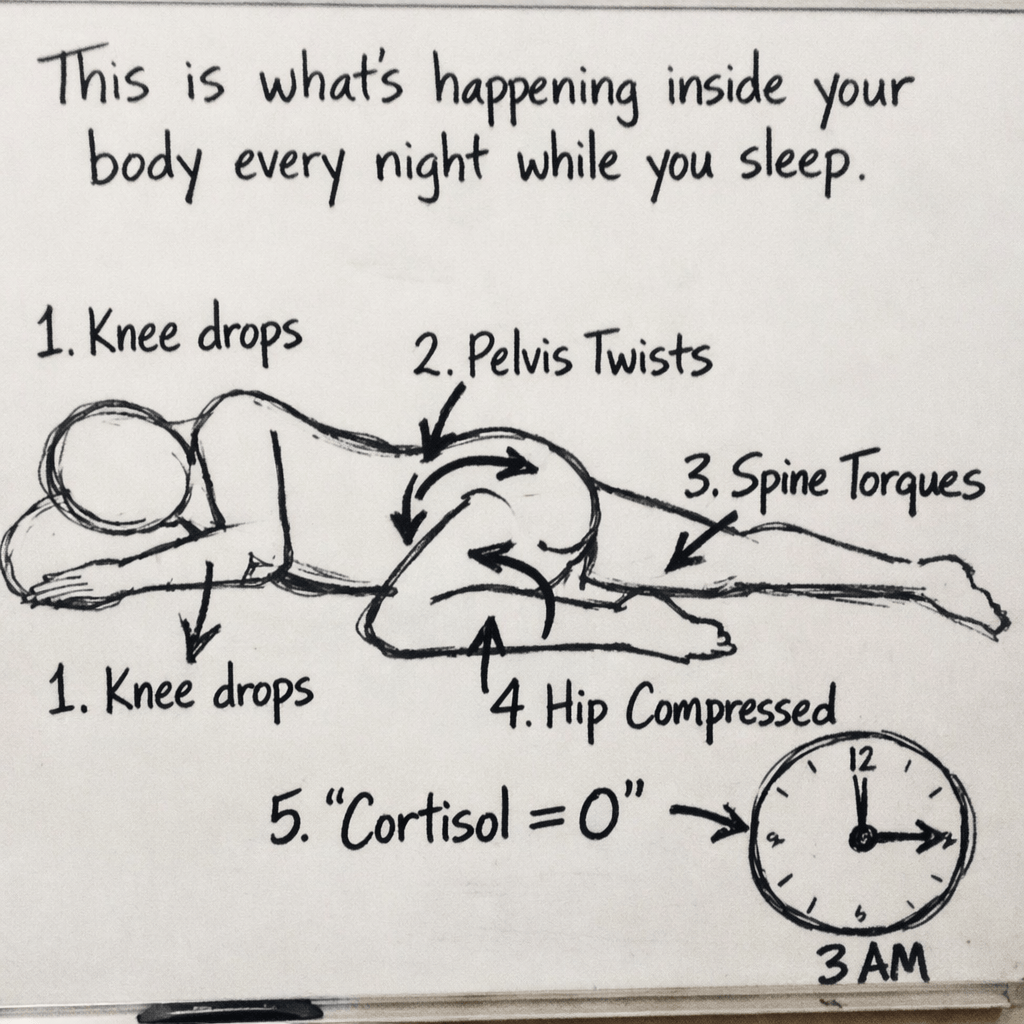
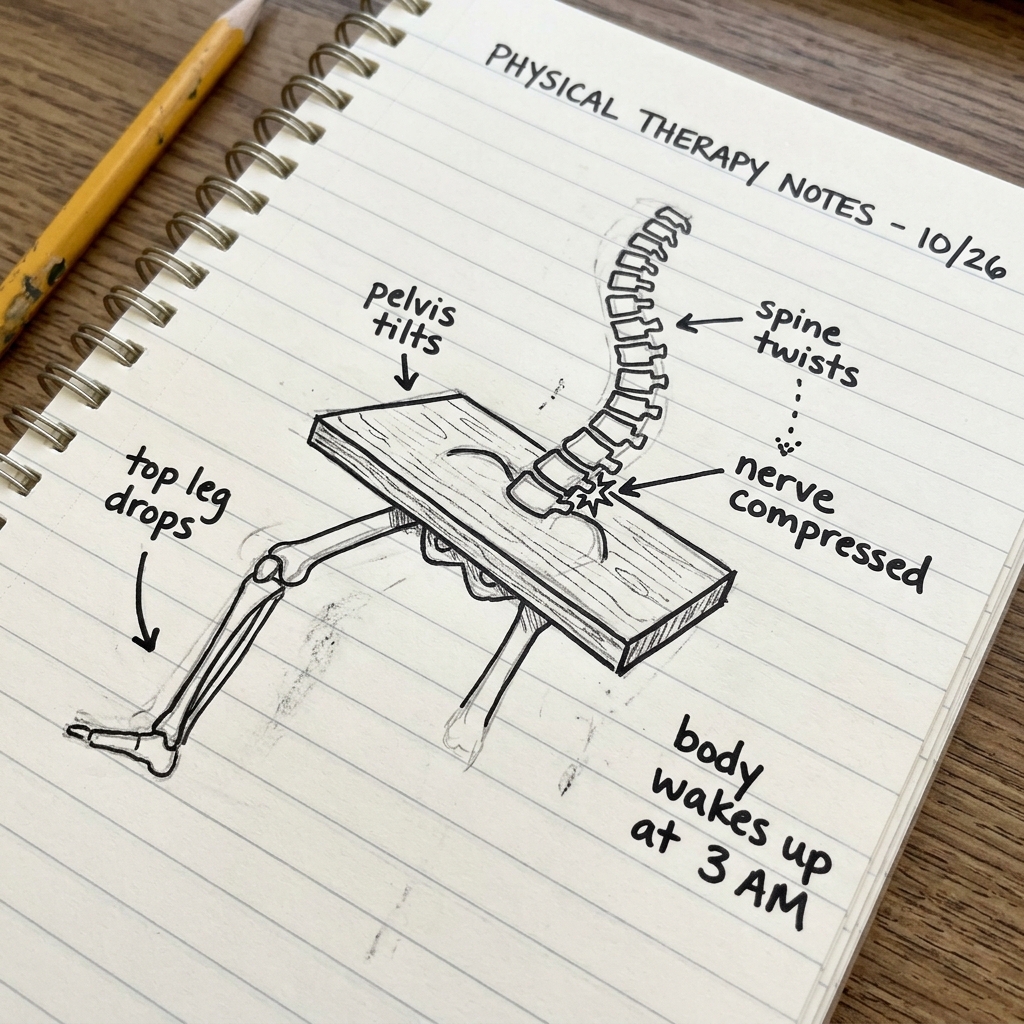
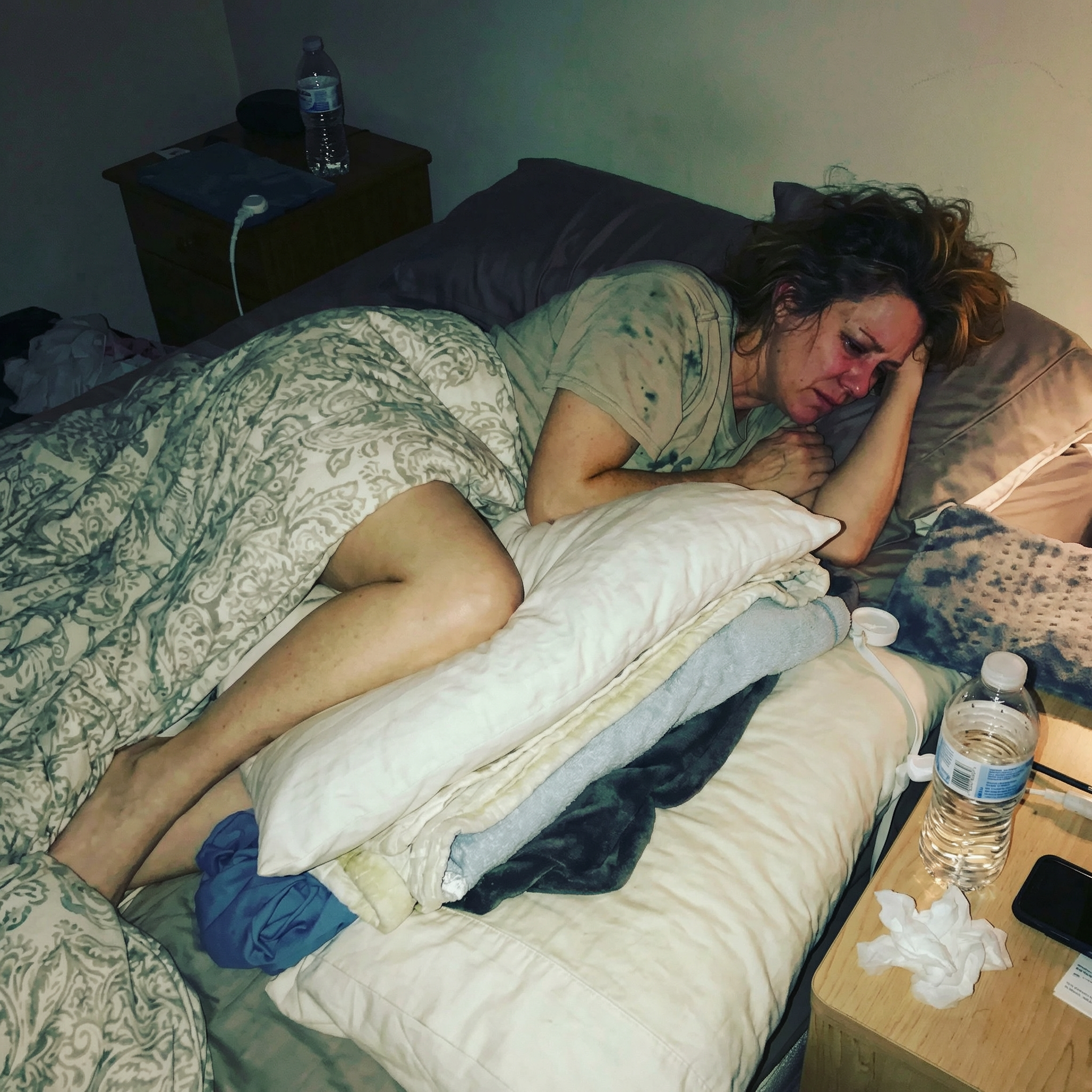
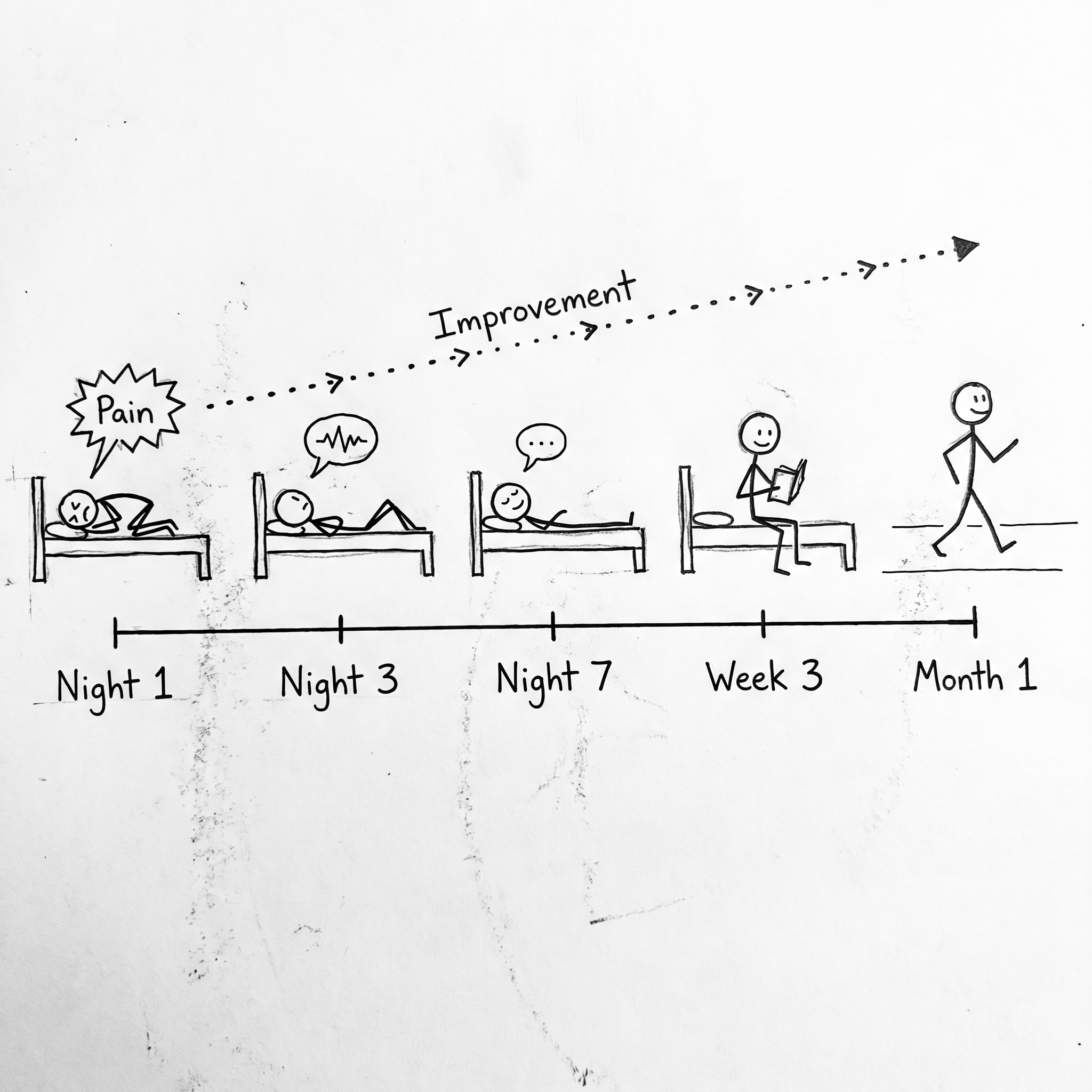
Your physical therapist uses a specific positioning technique for side sleepers with hip and lower back pain. It's not a stretch. It's not an exercise. And it's not something most doctors bother to mention. It's the difference between waking up 4 times a night and sleeping straight through. And it takes about 5 seconds to set up before bed. You know exactly how tonight is going to go. You'll fall asleep fine. The house is quiet. You're tired enough. Sleep comes. And then, in the middle of the night, your hip wakes you up. Not a sharp pain. Just that deep, grinding ache that starts in the joint and spreads into your lower back like someone is pressing a fist into the base of your spine. You shift to the other side. You tuck the blanket between your knees. You hold still for a minute, waiting. For a few minutes, the pressure lets up. Then it rebuilds. So you flip again. And again. And somewhere around 3 AM you stop trying to get comfortable and start doing math. Your husband is sleeping soundly next to you. He doesn't know you've been awake for hours. He won't know until morning, when he sees you limping to the bathroom and asks if you're okay. You'll say you're fine. By 6 AM you're not rested. You're just done fighting. And then comes the part nobody talks about. You don't just get out of bed. You negotiate with your body every day just to start the day. First, you sit on the edge. Then the first step. That moment where you hold the nightstand, the wall, because you genuinely don't know if your legs can hold you. Limping out of bed. That's what your mornings have become. You're not being dramatic. Your hips are killing you. And you've been carrying that quietly for longer than you'd ever admit. You probably tried everything. The mattress went first. Weeks of research. Hundreds of reviews. More than $2,800 on the one that was supposed to fix everything. The salesperson said "lumbar support" and "pressure relief" and you believed it because what else were you going to believe? It helped for about a month. Then the 3 AM waking came back on a mattress you were still paying for. You tried the memory foam topper. $300. It contoured to your body exactly the way it was supposed to. But it didn't change the waking. Then the body pillow. Took over half the bed and still pushes your husband to the edge almost falling off. Didn't help for long. Chiropractor. $150 a visit. Twice a week. Six weeks. That's $1,800 and your spine cracking like a walnut every single session. You'd walk out feeling looser. Almost hopeful. Two days for the stiffness to come back like always. Cortisone injections. Three rounds. $500 each. The first one worked. Five weeks of genuine relief. You slept through the night and woke up without bracing and you almost cried because you'd forgotten what that felt like. The second one lasted about ten days. The third one, you couldn't tell it happened. People keep giving you advice. "Have you tried yoga?" "My sister swears by magnesium." "You should really try sleeping on your back." "I think that's just part of getting older." Here is what nobody told you before: Waking up at 3 AM is just a symptom. Your misaligned hip is the problem. This was never a sleep disorder. You don't have insomnia. You don't need melatonin or a sleep tracker or a better nighttime routine. You have a mechanical problem. It happens while you're unconscious. And not a single thing you've tried has ever addressed it. When you lie on your side, your top leg is unsupported. It weighs ten, eleven, twelve pounds. And gravity doesn't take a night off. Over the first hour of sleep, that leg collapses forward. Slowly. Silently. It falls inward, and as it falls, it drags your pelvis with it. Your hip rotates. Your lower spine twists to take the strain. The muscles along your lower back clench to hold a position your bones can't hold alone. And this doesn't last for a few minutes. It lasts for the rest of the night. Six to eight hours, every single night, your pelvis is held in a twisted position that squeezes your hip joint on one side, loads your lower spine unevenly, and pulls at everything from your tailbone to your mid-back. Your body fights this while you sleep. That's the tossing. That's the turning. That's the 1 AM, 3 AM, 5 AM waking. Your nervous system is trying to escape a position it can't fix. So it does the only thing it knows how to do. It wakes you up. Again. And again. And again. Your top leg is dead weight. About 12 pounds pulling your hip forward all night long. That's enough force to twist your pelvis, but so slowly you never feel it happening. You only feel the result in the morning. Researchers at USC measured what happens the moment you shift from standing to lying on your side. On average, your lumbar spine loses 11.9 degrees of its natural curve. Instantly. Not over an hour. The second your weight hits the mattress. If that curve never gets restored because your pelvis is locked in that twisted position, you wake up stiff. You wake up sore. You spend ten minutes every morning warming up a body that never got to rest. Your spine is supposed to recover while you sleep. When your pelvis is twisted, that recovery never happens properly. You wake up more locked up than when you went to bed. That's not aging. That's physics. And the reason nobody told you this isn't a conspiracy, it's simple: The mattress industry is profiting right now because you think the problem is your mattress. That's more than a $2,800 sale. Sleep supplement companies are profiting from the same misbelief, that the problem is your brain chemistry. That's a $45 bottle every month. Your chiropractor is profiting from treating the consequence of the rotation, the tight muscles, the compressed joints, the stiffness. Adjust the spine, relieve the symptom, see you Thursday. The business model works as long as you're a repeat patient. Nobody in that chain makes money by telling you the whole problem starts with your top leg falling forward while you sleep. Your doctor isn't hiding it from you. She has 12 minutes per appointment. She doesn't have time to explain what your leg does to your pelvis across eight hours of lying on your side. She does what she can. She prescribes cortisone. She refers you to orthopedics. She moves to the next patient. So the information sits in physical therapy textbooks and biomechanics journals and clinical training that PTs get in their third year of school. And it never makes it into the conversation you're having with anyone who's billing you. You spend thousands on solutions that treat the symptom. The cause keeps operating, every night, between your knees. Now, here is what happens when you stop that twist every night: When there's a contoured wedge between your knees, sized to the actual gap between your thigh and your knee, the top leg doesn't fall forward. It can't. The wedge holds the femurs parallel. The pelvis stays level. The lumbar curve holds. And the rotation that's been waking you up for years, stops. Here's what actually happens. Night one. The wedge between your knees feels unfamiliar. You're aware of it. You might shift once or twice. But instead of waking up four times, you wake up once. Maybe twice. And when you do, the ache is duller. Not gone. Duller. Night three. You stop noticing the wedge is there. You sleep six hours straight. You wake up and you lie there for a second, confused, because the pain didn't come the way it usually does. Night seven. Your husband mentions it before you do. He says you weren't tossing last night. You think about it. He's right. You don't remember turning over. Week three. You're reaching for the ibuprofen before bed and your hand stops. You think about when you last took it. Tuesday. Last Tuesday. You didn't decide to stop. You just forgot, because nothing reminded you. First month. You swing your legs off the bed and stand up. You walk to the bathroom. You're halfway down the hall before you realize what just happened. No bracing. No warm-up. No limping. You just got up. Every other solution you've tried required something from you. The chiropractor required two appointments a week and an hour of driving round trip. The cortisone required a referral, a waiting room, and a prayer that this round would hold longer than the last. The mattress required $2,800 and a month of hoping you didn't waste it. The body pillow required your husband to give up half the bed and pretend he didn't mind. This requires you to place a wedge between your knees before bed. That's it. Five seconds. The strap loops around your thigh. When you roll over, it rolls with you. When you shift at 2 AM, it shifts with you. You wake up and it's still exactly where you put it. That's what "stays in place all night" actually means. Not stays put if you lie perfectly still. Stays put through a real night of real sleep, the kind where you move, and turn, and shift, and never have to think about it. I've been recommending this to people for over a year now. Women who've spent more on mattresses and chiropractors than they'd ever admit. Women who take ibuprofen every night and know it's not a solution. Women who told their families they're fine when they're not fine. And every time I mention what actually stops the rotation, I get the same reaction. Wide eyes. A pause. "Wait... a pillow?" "Like... a knee pillow?" "The thing they sell on Amazon for $15?" And honestly, I get it. How could a pillow do what a $2,800 mattress and $1,800 of chiropractic work and $1,500 in cortisone couldn't? Because the mattress was trying to cushion the rotation. The chiropractor was trying to undo it. The cortisone was trying to numb it. None of them stopped it. The only thing that stops pelvic rotation during side-sleeping is something that physically holds your top leg in place. That's not an opinion. That's how levers work. I spent months testing knee pillows. Watched people buy the cheapest one on Amazon, use it for three weeks, and give up because it went flat or slipped off the bed the first night. The only one I've found that actually works through the whole night is called the Nourial Knee Alignment Pillow. It's a contoured memory foam wedge. Wider at the thigh, narrower at the knee, because your legs aren't the same width all the way down. Most knee pillows are shaped like a dumbbell, same thickness on both ends. Your leg isn't shaped like that. The foam is high-density. It doesn't go flat. "Pillow goes flat" is the single most common complaint across the entire knee pillow category. This one is rated for 3,000+ nights of compressive load because it was built for nightly use, not occasional napping. The strap has reinforced anchor points. Breathable bamboo-blend cover. Washable. No chemical smell. It doesn't take over the bed. It fits between your knees and that's the only space it occupies. Your husband stays where he is. Your pillows stay where they are. Nothing about your sleep setup changes except the one thing that was causing the problem. Dr. Karen Holloway is a physical therapist who has been treating side-sleeper back pain for fifteen years. She recommends this shape to nine out of ten of her patients with lower back pain. Not as a brand endorsement. As the clinical protocol she actually uses. When the femurs are held parallel, the pelvis levels. That's not marketing. That's what she tells her patients on the exam table. A 2024 study out of Cureus looked at 375 patients with chronic lower back pain. 64% female. Average age 51. 87% of them preferred to sleep on their side. 77% of them reported sleep disturbance from their pain. 92% said they had difficulty getting up in the morning. You probably just recognized yourself in three numbers from a study you've never heard of. That's not a coincidence. And now, thousands of side sleepers are doing the same thing every night. "I slept through the night. Five and a half hours without waking up once. I didn't know I could still do that." "Pain-free morning. The first one in years. I just stood there in the kitchen making coffee and realized I wasn't waiting for the pain to start." "It stays in place all night. That's what I couldn't believe. Every other pillow I've ever tried ended up on the floor. This one was still between my knees when I woke up." The Nourial Knee Alignment Pillow comes with a 60-night money-back guarantee. Use it every night for two full months. If you're still waking at 3 AM, if your mornings still start with ten minutes of bracing and shuffling, send it back. No questions. Most people don't send it back. The problem is that they manufacture in small batches. The last restock sold through in 11 days. When it's gone, the next shipment is 3 to 4 weeks out. And I'm only saying that because I've seen people come back weeks later and find the page showing out of stock. So if you're tired of waking up at 3 AM knowing nothing is going to change... If you've already spent more than you'd ever admit on solutions that treated everything except the cause... If you're ready to find out what happens when the twist finally stops... This is what your chiropractor never told you, your mattress company will never tell you, and your doctor doesn't have time to explain. Not because anyone is hiding it. Because nobody in the system profits from a positioning fix. Click below and see if they still have it in stock.
If you're a side sleeper, read this 👆
Discover the science behind the only pillow engineered for STRUCTURAL ALIGNMENT — not just cushioning. Every week, thousands are replacing their "fluffy" leg pillows with a solution designed to keep the spine neutral all night — and they never go back.
LEARN MORELike this ad? Make it yours.
Crush rebuilds this exact creative around your product — your brand, your colors, your offer — in about a minute.