Dr Meryl Moore MD PhD - Menopause Specialist
Dr Meryl Moore MD PhD - Menopause Specialist Facebook ad: “I Compared Every Major Menopause Supplement on the Market…”
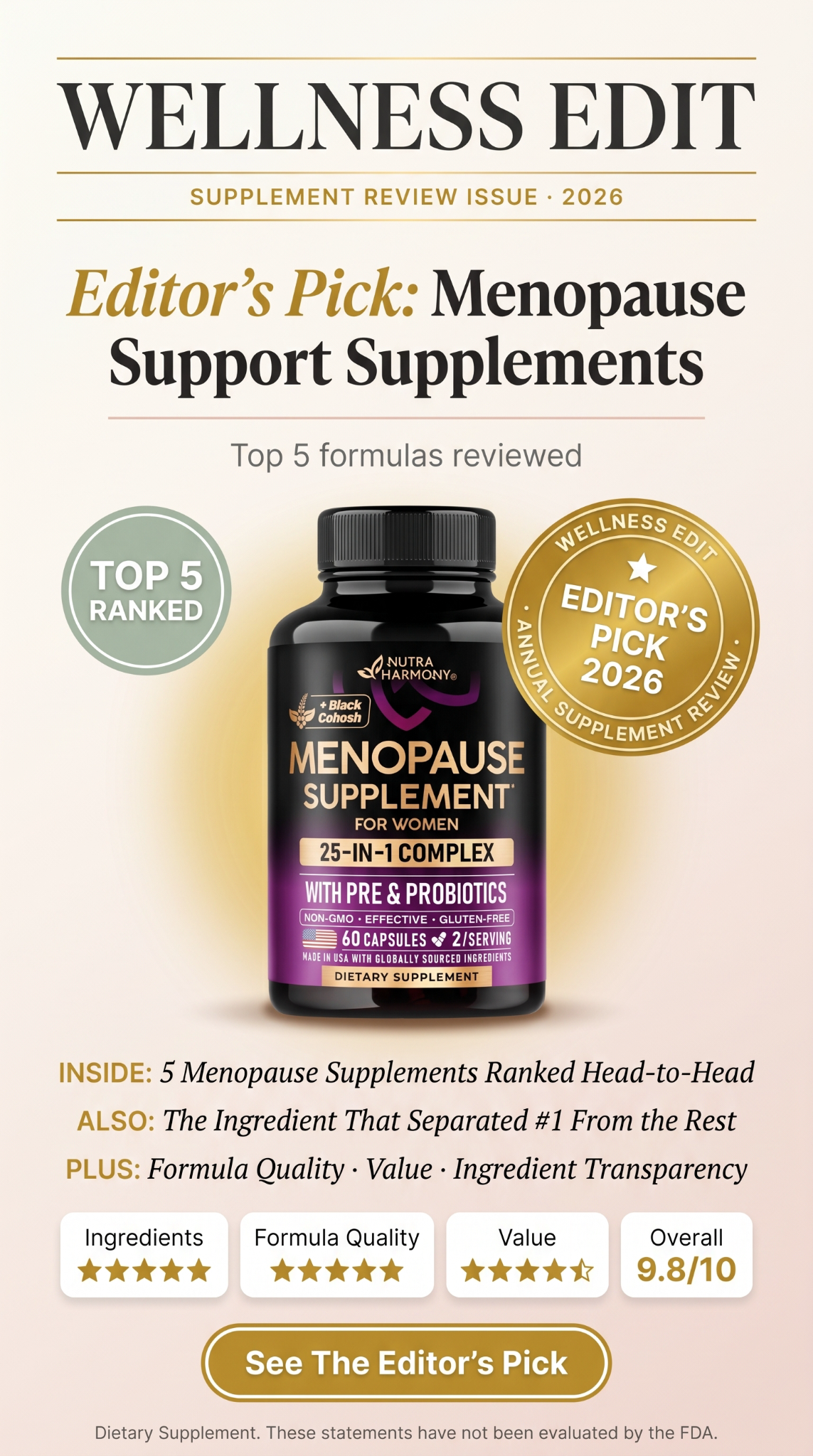
Ran for 76 days, from July 14 to September 28, 2026, the last day Crush saw it.
Run by Dr Meryl Moore MD PhD - Menopause Specialist on Facebook. Crush is not the advertiser and does not verify its claims. See this ad in Meta's Ad Library(opens in a new tab)
Want an ad like this for your product?
Crush makes new ad images for your product from this ad: your logo, your product photo, your offer.
Trials from $19.95 USD, then $79.95 USD a month. Cancel anytime.
About this ad
- Meta Ad Library ID
- 1024638390276741
- Platforms
- Facebook, Instagram, Messenger and Threads
- Relaunches
- 0
Ad text
I turned fifty-three last month. My mother went through menopause at fifty-one and spent the next decade trying everything her doctor offered. I have been thinking about that for a year. I'm a woman, and I'm fifty-three. I started noticing the signs six months ago. It didn't arrive dramatically. It came the way most things come — slowly, on its own schedule, waking me up at 2am, making me forget what I walked into a room for, making me feel like a stranger in my own body. For the months after that, I mostly kept trying to push through. I should have paid attention sooner. My mother is seventy-eight now. She still hosts her book club on Thursdays. She still tends her garden every morning. She also spent most of her fifties cycling through prescription after prescription — synthetic hormones, antidepressants, sleep aids — before she found something that actually worked with her body instead of against it. She is, by every measure, someone who figured it out the hard way. I am her only daughter. She has been telling me, in one form or another, for the last five years, that when my time came, I should not do what she did. Which was wait, then guess, then hand everything over to whatever a doctor had a sample of that week. I had been half-listening. I am a teacher by training and a school administrator by trade. I work long days in a district outside of Columbus. My husband, Ray, is fifty-six. We have two teenage daughters still at home and one son in college. We have, between us, a full life and not a lot of margin. But last spring, somewhere in the middle of my fifty-second year, I started listening to my mother differently. She mentioned, in passing, that she wished the conversation around menopause had been different when she was going through it. She said it without self-pity. She said: The options they gave me were blunt instruments. I want better for you. And then she asked about the girls. I sat with that sentence for the rest of the week. I went to my gynecologist in September. I told her the symptoms had been building. The hot flashes. The nights I couldn't sleep. The brain fog that was starting to affect my work. The weight that had moved and settled somewhere it hadn't been before. She nodded. She told me my hormone levels confirmed what I already knew. She went through the options. HRT was on the table. She told me the risks were lower than they used to be thought. She also told me they weren't zero, and that given my mother's history with synthetic hormones, it was reasonable to want to try something else first. She told me to come back in three months. I drove home and sat at my kitchen table for a long time. Then I started reading. I am an administrator. I know how to evaluate evidence. I read for two weeks. What I was looking for was something that took the full picture seriously — not just the hot flashes, not just the sleep, but the whole system. The hormones. The metabolism. The brain. The bones. The parts of menopause nobody puts in the brochure. I found NutraHarmony's Menopause Support Formula. And then, because I had been reading, I found the competitors. I want to tell you what I found honestly. Because the options are genuinely different, and you deserve to know how. What I looked at, and what I found: The first thing I looked at was Estroven. It's the name most women recognize. It's been on shelves for decades. What I found was a single-herb approach built around black cohosh — one ingredient, working one pathway. For some women that's enough. For women whose menopause is affecting sleep, weight, brain function, and mood simultaneously, one pathway is not the whole picture. The second thing I looked at was Amberen. It markets itself as clinically studied. What I found when I read the actual studies was that they were small, short-term, and conducted by the company. The formula is proprietary, which means you cannot see what doses you are getting. I have spent twenty years in education. I know the difference between a study and a press release. The third thing I looked at was Menopace. Popular in the UK. Solid vitamin and mineral base. But it stops there — it is essentially a multivitamin for menopausal women, without the botanical and adaptogenic support that addresses the hormonal mechanisms directly. The fourth thing I looked at was Happy Mammoth Hormone Harmony. Closer to what I was looking for. A broader formula, some good ingredients. But the doses on several key botanicals — including ashwagandha and DIM — came in below the levels used in the clinical research I had been reading. Then I looked at NutraHarmony. 25 ingredients. Not 4 or 6 or 8. Twenty-five, chosen to work across the full range of what menopause actually does to a body. Black cohosh for hot flashes. Ashwagandha at a clinically relevant dose for cortisol and sleep. DIM to support healthy estrogen metabolism — the detox pathway that affects mood, bloating, and brain fog. Maca for energy and libido. Chasteberry for hormonal balance. Magnesium for sleep architecture. B6 for mood. Evening primrose for skin and inflammation. Red clover isoflavones. Valerian. Rhodiola. And NAD+ precursors — because menopause coincides with the decline in cellular energy that nobody talks about until you're exhausted by 3pm and can't explain why. It is not a single-herb product. It is not a proprietary blend where you cannot see the doses. It is a 25-ingredient formula built for the full picture. Now — and this is the part of this letter that matters most — before I added anything, I called my doctor's office. I told the nurse what I was considering. She pulled up my chart. She confirmed there was nothing in my current medications that would conflict. She told me to go ahead and that we would revisit at my three-month follow-up. I want to say this clearly, the way I say things to my own daughters. Before you add anything new — anything at all — call your doctor or your pharmacist. If you are on any prescription medication, this is not optional. The people who know your chart will tell you in two minutes whether what you are considering makes sense for you. I called my doctor. I would call again tomorrow if I were adding anything else. I started on a Monday. The first two weeks I noticed nothing in particular. I want to be honest with you about that, because the temptation in a letter like this one is to tell you something dramatic happened by day five. Nothing dramatic happened by day five. Around week three, I slept through the night. I had not slept through the night in four months. I woke up and lay there for a moment trying to figure out what was different. Then I realized I had simply slept. Around week five, the hot flashes were still happening, but less. Not gone. Less. Less frequent. Less intense. More like weather than like emergency. Around week seven, I got through a full Thursday — our hardest day, back-to-back meetings — and drove home without the hollow exhausted feeling that had become my normal. Ray noticed before I said anything. He said: You seem like you're doing better. I asked him what he meant. He said: You've been yourself this week. I had not realized I had not been myself. I want to be careful with what I am saying here. I was sleeping more consistently. I had stopped the evening glass of wine I had been using to take the edge off. I was walking in the mornings again. I was doing the things a fifty-three-year-old woman with her mother's history should be doing. There were several things changing at once. All I am telling you is that I added one formula to a long list of things I was already doing. I kept everything else the same. And the months that followed were qualitatively different from the months that came before. That is the honest version. I went back to my doctor at the three-month mark. She ran the bloodwork she wanted. Numbers where she wanted them. She told me to keep doing what I was doing. I called my mother that night. She was quiet for a moment. Then she said: I am glad you didn't do it the way I did it. If you are a woman in perimenopause or menopause who has been doing what I was doing — pushing through, waving it off, waiting to feel like yourself again — I want to say a few things carefully. I don't know your symptoms or your history or what your doctor has already told you. Bodies are different. Some women notice something in the first few weeks. Some take longer. Some have symptoms that need clinical intervention that no supplement will address. That is the honest version. Anyone offering you a cleaner one is working harder to sell you than I am. Here is how I think about NutraHarmony now, in the words I would actually use. It is a formula built for the full picture of menopause — not one symptom, not one pathway, not one herb at a homeopathic dose. It is not a replacement for your doctor. It is not HRT. It is one serious option for women who want to support their body's own systems through this transition, with ingredients that have been studied, at doses that reflect the research. Please call your doctor or pharmacist before you add it. If you are on any hormone therapy, blood pressure medication, or antidepressant, this conversation is not optional. They have your whole picture. I have written you a letter. There is a difference, and the difference matters. NutraHarmony offers a satisfaction guarantee. If it isn't right for you — for any reason — you can get your money back. No bloodwork required. No proof of anything. Just a company that stands behind what it makes. That is the whole policy. That is all I have. I hope something here was useful to you. And I hope, somewhere today, the woman in your life who has been telling you to pay attention — to your body, to your symptoms, to yourself — hears that you finally did. — Meryl P.S. Call your doctor first. I said it once. I meant it every time. P.P.S. The formula is 25 ingredients working together. That is the point. Not one herb. The whole picture. P.P.P.S. You have been pushing through long enough. That is the whole reason I wrote this. — M.
Where the ad sends people
news.officialmenopausereport.com
I Compared Every Major Menopause Supplement on the Market. Here's the Honest Truth About What I Found.
Menopause is one of the most significant — and most underestimated — transitions a woman can go through. Hot flashes that interrupt sleep. Mood swings that arrive without warning. Brain fog, low energy, unwanted weight gain, and a body that suddenly feels unfamiliar. For millions of women naviga...
Learn more: news.officialmenopausereport.com(opens in a new tab)