
Inactive· since Jul 24, 2026
- 10
- days it ran
- 0
- relaunches
Ad copy
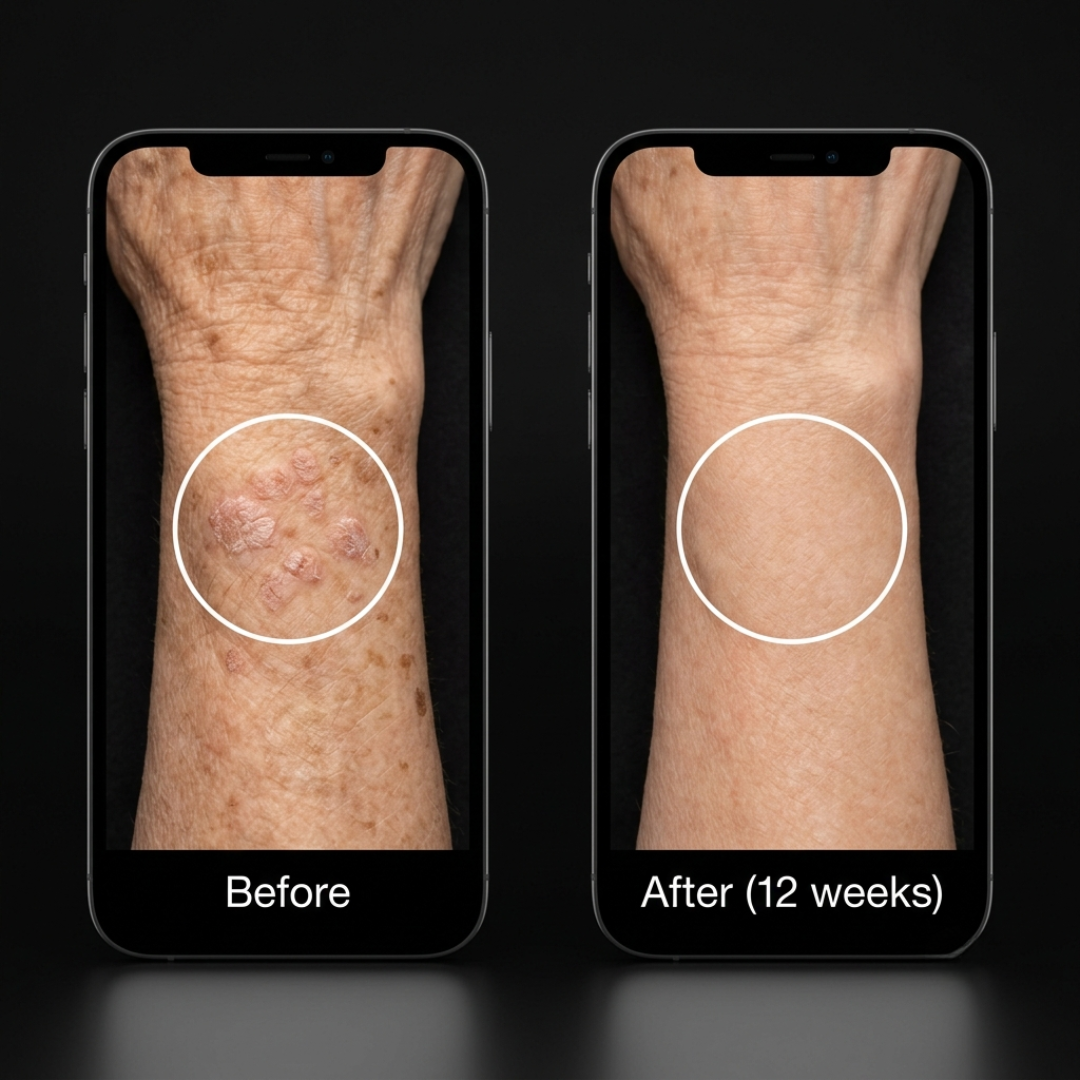
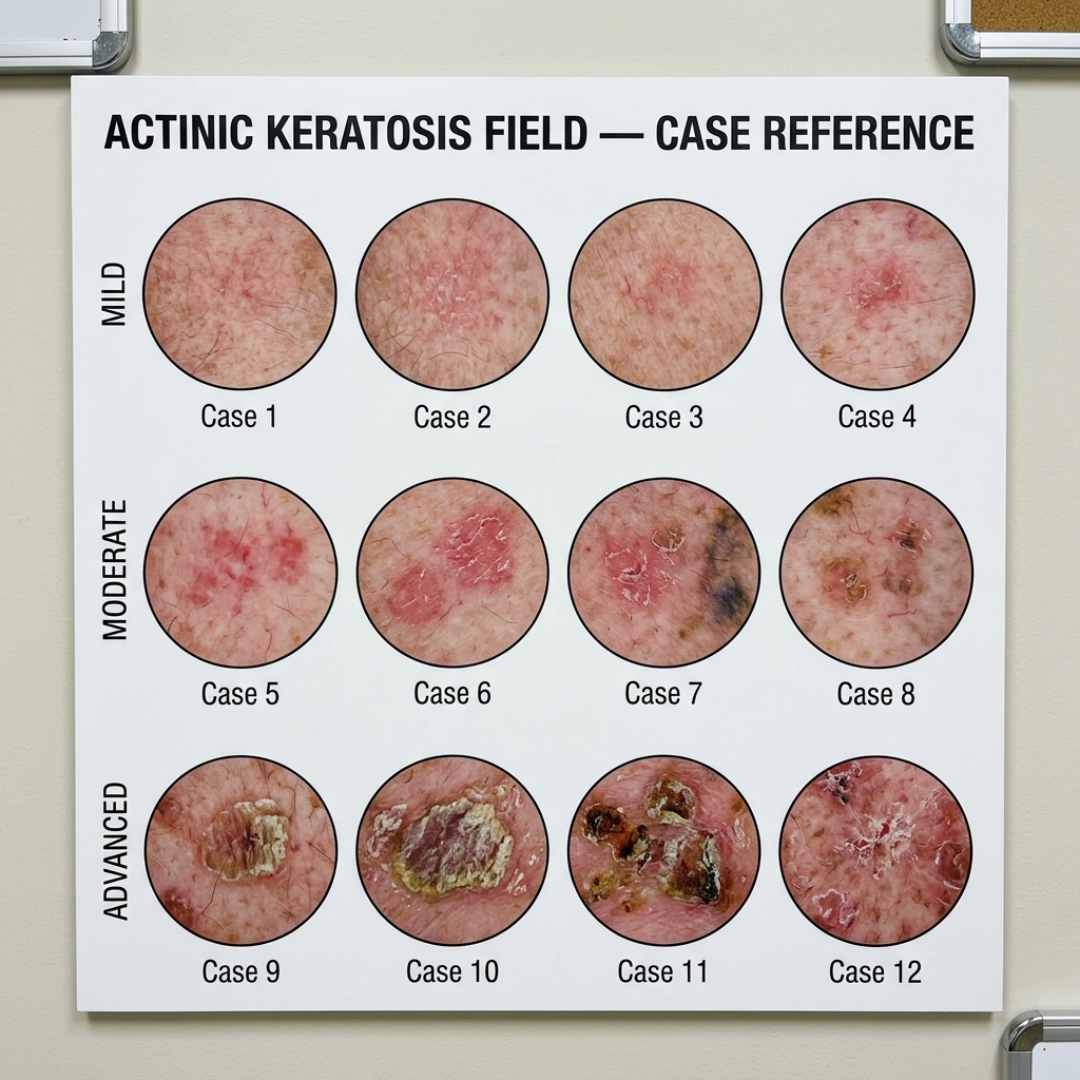
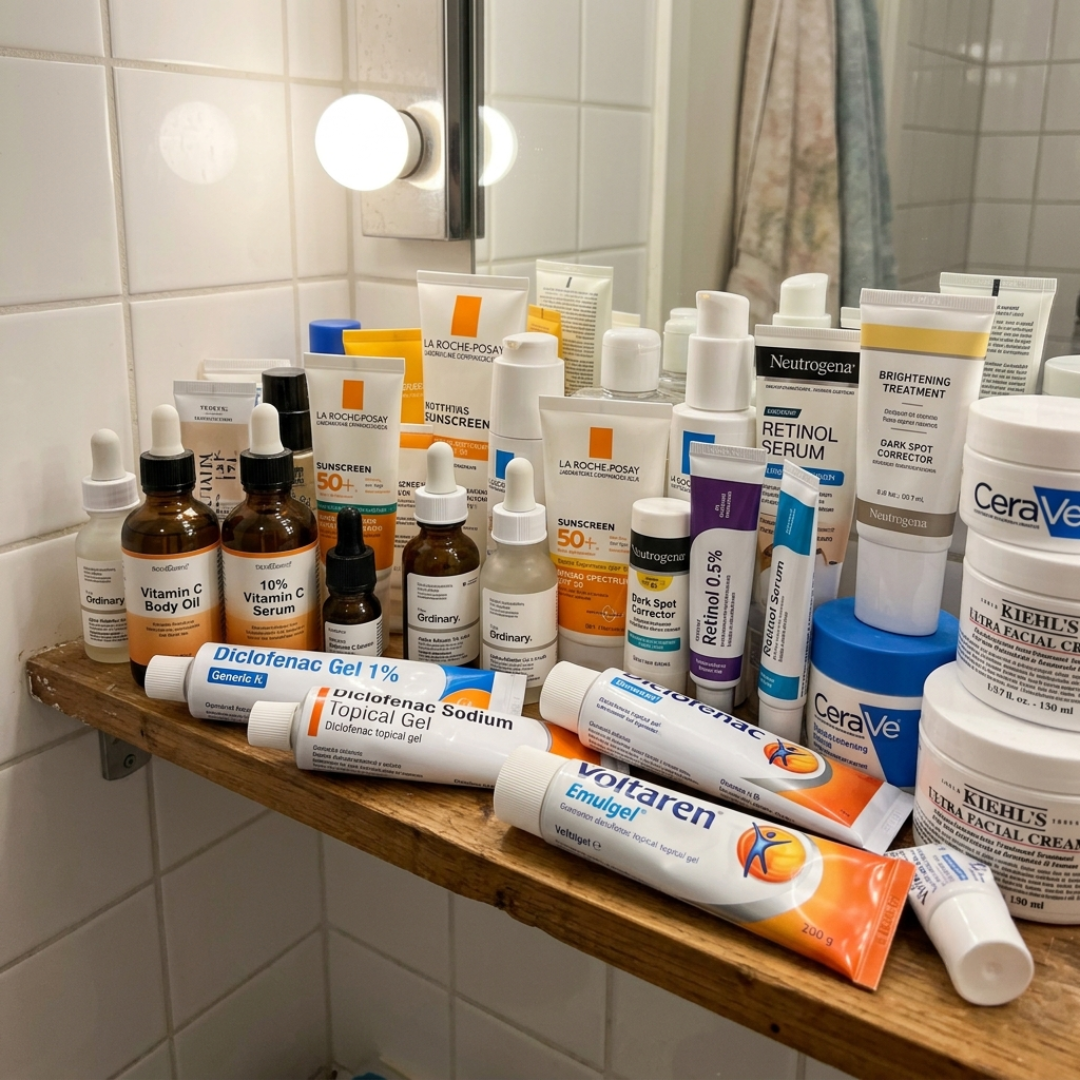
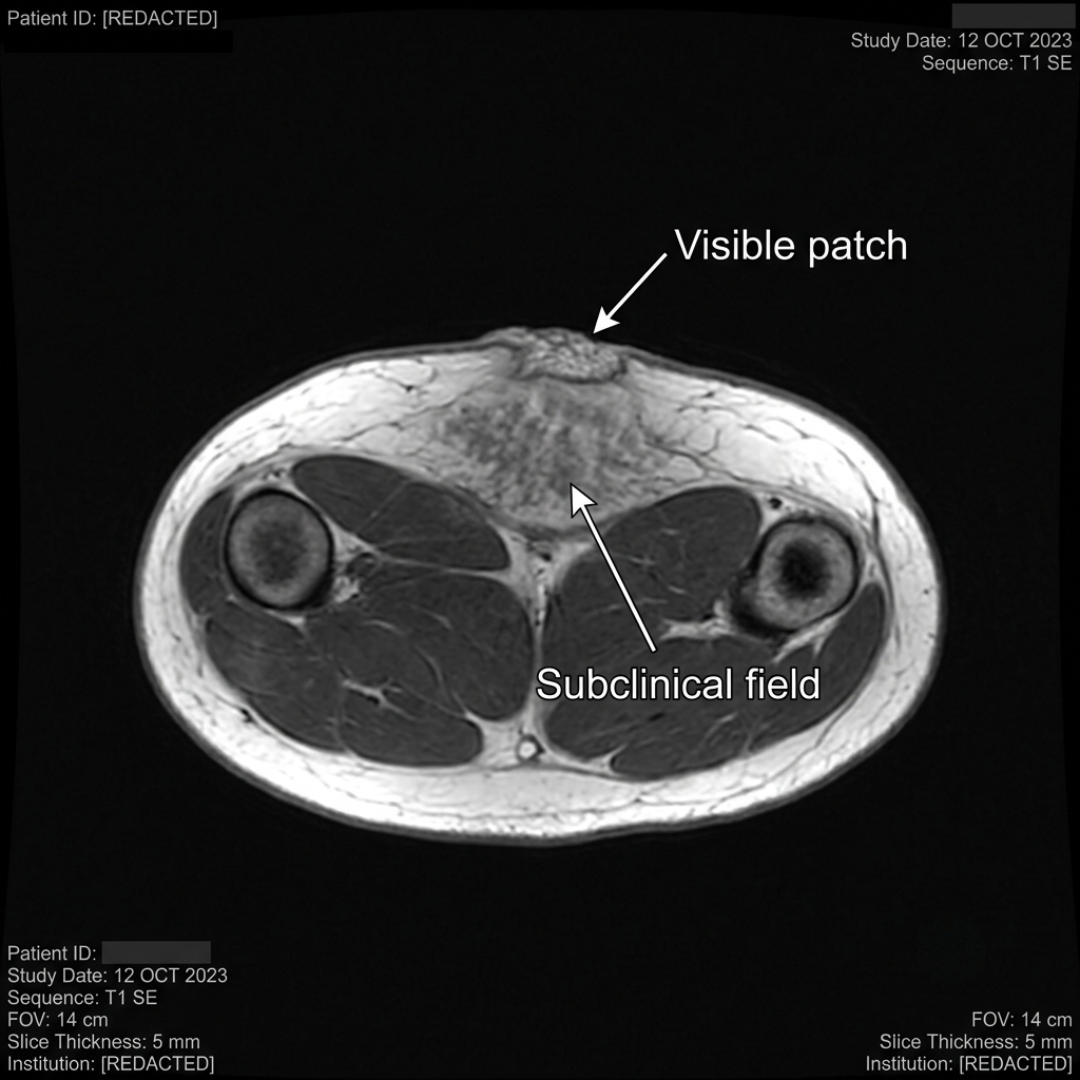
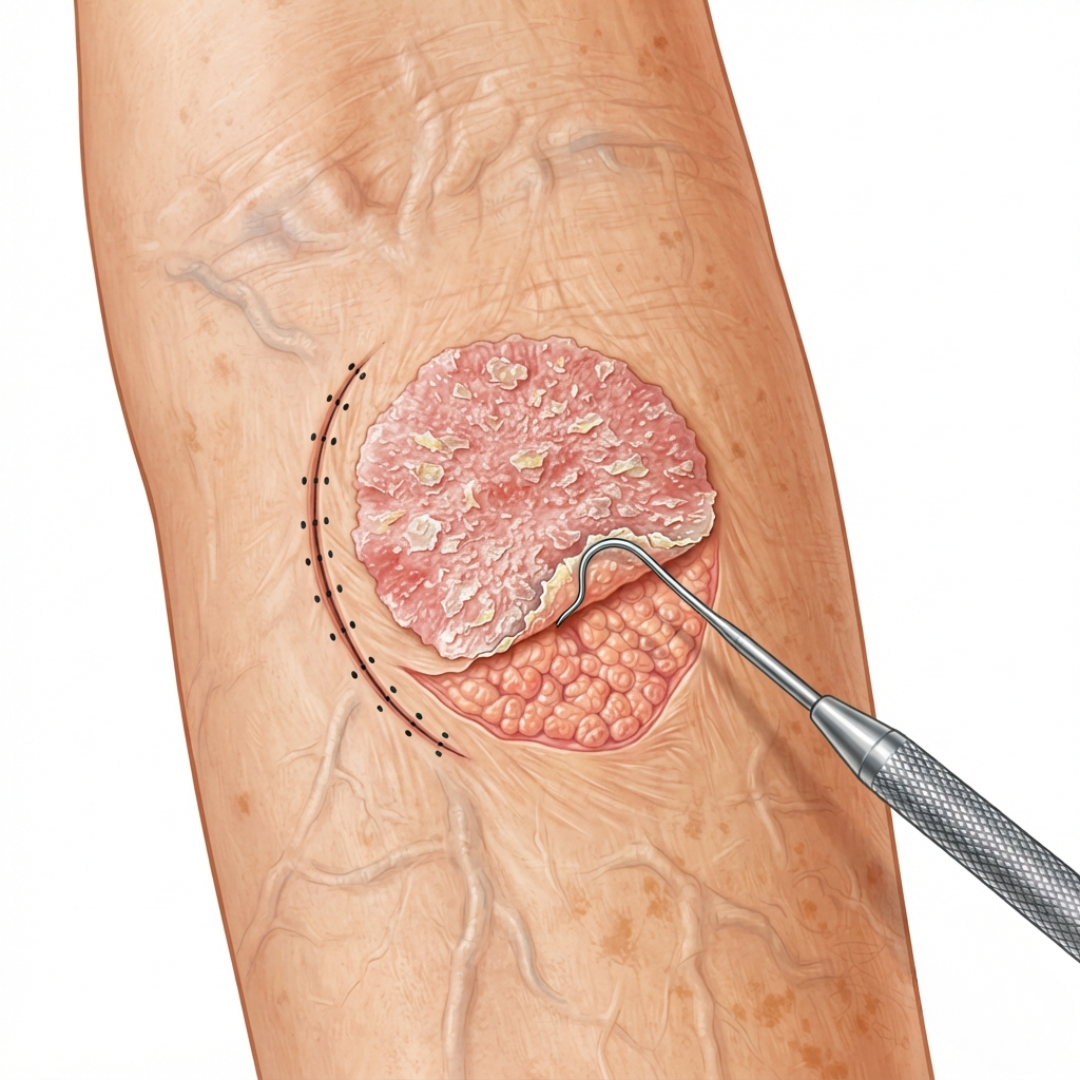
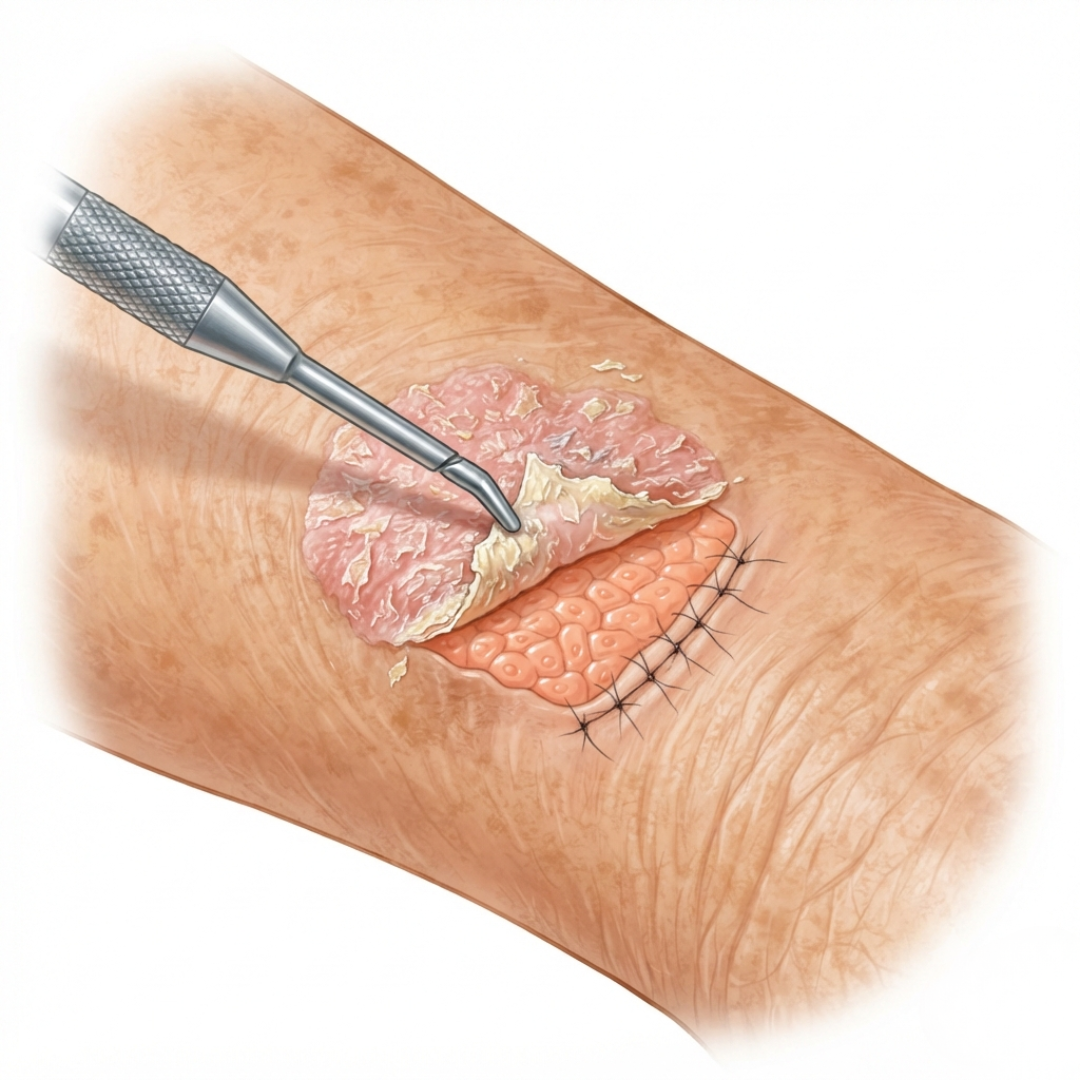
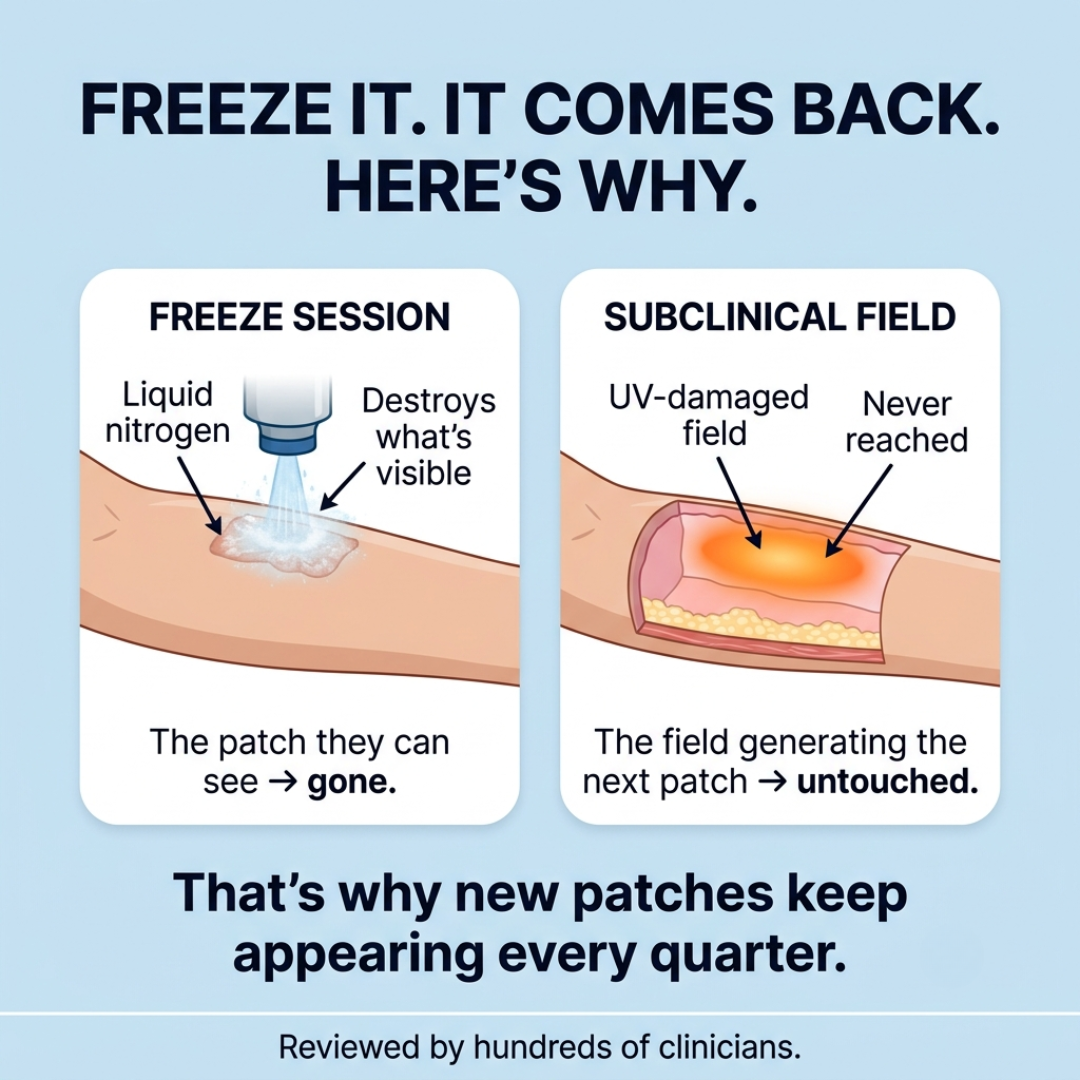
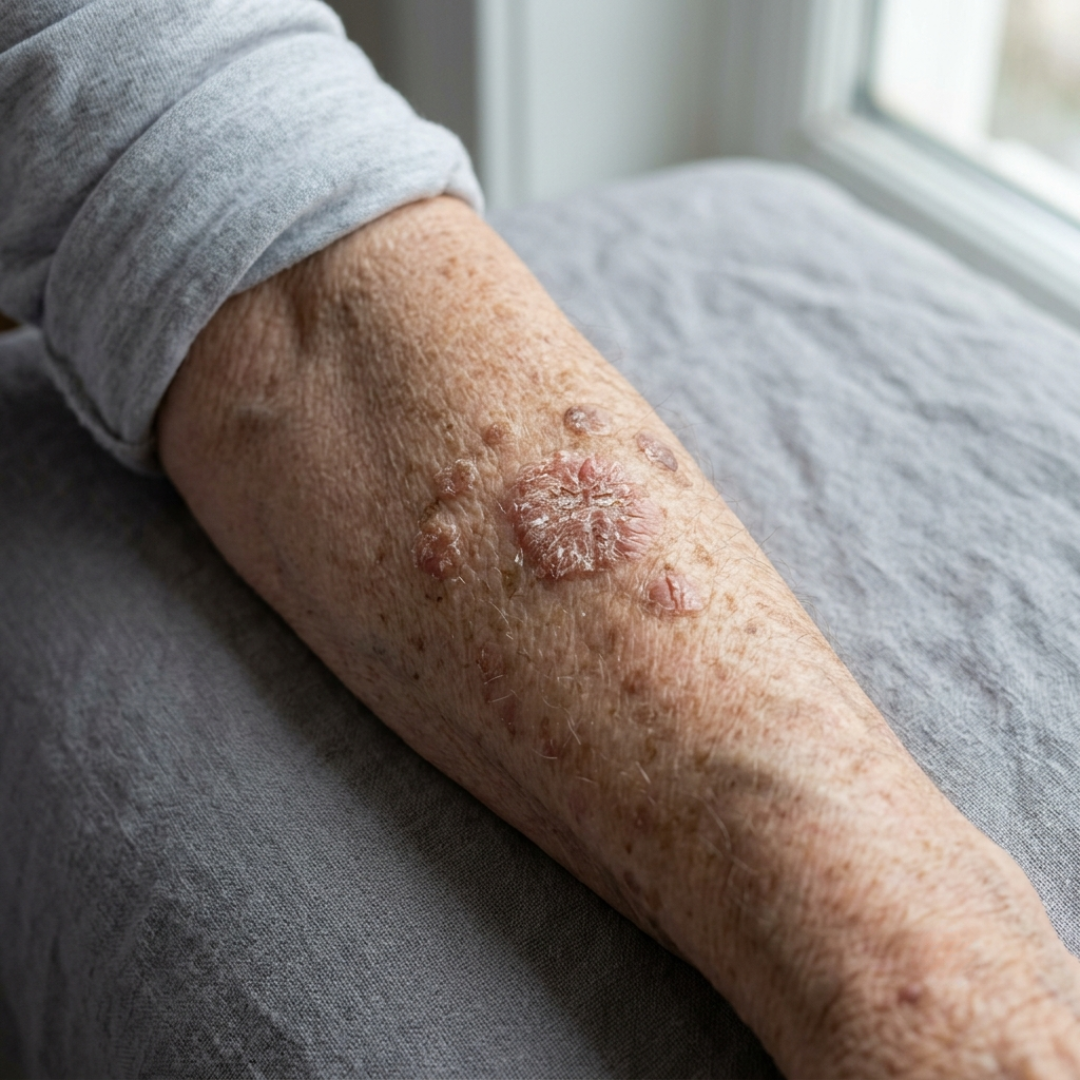
My dermatologist said if I missed another freeze appointment, she'd document it as "patient non-compliant with recommended treatment." I had nine minutes with her. She'd never met me before. Dr. Harmon's retirement letter came on a Thursday. Standard form letter. "After 28 years of practice, I'm stepping away effective November 1st. Your care will be transferred to Dr. Sarah Mitchell." I sat at the kitchen table staring at it. Twelve years. I'd been seeing Dr. Harmon for twelve years. She knew my history. My mother's arms by 65 — rough, scaly, covered in patches she hid under long sleeves until the day she died. My fear of ending up the same way. Dr. Harmon had always worked with me. "Let's stay on the freeze schedule, Carol. Every new patch, we'll treat it. We'll stay ahead of it." Now she was gone. My first appointment with Dr. Mitchell was November 12th. Routine skin check. Transfer of records. Meet the new dermatologist. I sat in the exam room. Same room I'd been in for over a decade. Same posters about UV protection and skin cancer awareness. Different doctor. Dr. Mitchell walked in. Late 30s. Laptop in hand. All business. "Mrs. Patterson." Firm handshake. "I've been reviewing your file." She sat down. Pulled up my records. Scrolled. Her expression changed. "Your actinic keratosis history." She turned the screen toward me. "2020: two patches on left forearm. 2021: four patches, spreading to right forearm. 2022: hands and upper arms. 2023: chest and décolletage. 2024: eleven active sites, rough sandpaper texture across both forearms, new lesions appearing between treated patches." She looked at me. "Four years of progressively worsening actinic keratosis. Eleven freeze sessions in that time. And the patches got worse every single year." "Dr. Harmon and I had a plan. Freeze every new patch. Diclofenac between visits. She was monitoring—" "Monitoring what? The spread?" Her voice was sharp. "Mrs. Patterson, you've had eleven freeze sessions and your actinic keratosis has progressed every year. Your previous dermatologist kept treating the visible patches while the subclinical field kept generating new ones. I need to get you on an aggressive protocol immediately." My stomach dropped. "What does that mean?" "Field therapy. 5-fluorouracil cream across all affected areas, twice daily for six weeks. Then photodynamic therapy — three sessions at $800 each. Then quarterly monitoring with liquid nitrogen for any new lesions that appear." She was already typing. "If the field doesn't respond after two rounds, we discuss imiquimod." "I've been doing freeze sessions for four years and they haven't—" "That's exactly why we need field therapy. This isn't spot treatment anymore. This is whole-field intervention." "But the patches kept coming back between freeze sessions. Every time—" "Because we were only treating what was visible. The subclinical field underneath was never addressed. That's why we need to treat the entire area now, aggressively." The printer hummed. She handed me the treatment plan. 5-fluorouracil cream, six-week course: $340. Photodynamic therapy, three sessions: $2,400. Quarterly freeze sessions: $180 each. Follow-up every 12 weeks: $200. Repeat indefinitely. $2,740 today. Then $920 every quarter. Forever. She stood. Left the room. The whole appointment took nine minutes. I sat there holding the treatment plan. Hands shaking. Non-compliant. In the parking lot, I called my daughter. "How was the new dermatologist?" "She says Dr. Harmon wasn't treating aggressively enough. Wants me on field therapy — a cream twice a day for six weeks that makes your skin peel and blister. Then photodynamic light therapy. $2,740 today. Then almost $1,000 every quarter. Indefinitely." Silence. "Every quarter?" "She said if I refuse, it goes in my chart as non-compliant." "But you've been doing freeze sessions for four years—" "And my patches got worse every year." "So her solution is... stronger chemicals and light therapy?" I didn't have an answer. That night I couldn't sleep. Lay in bed staring at the ceiling. Dr. Harmon had done exactly what Dr. Mitchell wanted to do. Just less aggressively. Freeze every patch. Diclofenac between visits. The standard protocol. Eleven freeze sessions. Thousands of dollars. My patches spread every single year. And Dr. Mitchell's plan was the same thing — just more of it. More aggressive. More expensive. Treating a wider field with harsher chemicals. Was more of the same going to fix what the same hadn't fixed in four years? Or was I about to spend another $3,680 a year on a protocol that was never going to stop the field from generating? At 2 AM I went downstairs. Sat at the kitchen table with my laptop. *why do actinic keratosis patches keep coming back after freezing* *does liquid nitrogen treat the subclinical field* *why does diclofenac stop working for AK* Every article from the dermatology industry said the same thing. Freeze sessions are the gold standard for visible lesions. Monitor and treat as needed. Return for new patches. But then I found the forums. The patient forums. Women like me. "I've been doing freeze sessions every three months for five years. My patches are worse now than when I started. My dermatologist just says 'we'll watch the next ones.' At what point do we admit this isn't working?" "$180 every freeze session. Four times a year. That's $720 a year just for sessions. For six years. $4,320. And new patches still appear every quarter. But my dermatologist acts like I'd fall apart without them." "My last 5-FU round was so aggressive my skin wept and crusted for three weeks. Couldn't wear a watch. Couldn't go out. Two months later? Right back where I started. Scheduled for another round." "Spent $6,000 on freeze sessions and specialist visits over four years. Dermatologist finally said 'we need to discuss photodynamic therapy.' If the freezing was going to stop the field, wouldn't it have stopped it by now?" My heart hammered. These women sounded exactly like me. Then I searched: *why does actinic keratosis keep spreading after treatment* And my mother's face flashed in my mind. She'd been on the freeze schedule for nine years before they gave up and moved to field therapy. Every quarter. Sometimes every six weeks. Same chair. Same liquid nitrogen. Same "that patch looks calmer" followed by "there are two new ones forming." Nine years. Over $8,000. And her AK never stopped spreading. The quarterly appointments became her whole life. She'd plan everything around them. Long sleeves in July. Cardigans at family dinners. She stopped reaching for her grandchildren because she didn't want them to feel the rough patches on her arms. Then the 5-fluorouracil. Six weeks of her skin weeping and crusting. Then it came back. Then imiquimod. Insurance fights. More field recurrence. I remember her at the kitchen table one evening. Running her fingers across the rough patches on her forearm. Over and over. "Eleven years," she whispered. "Nine years of freeze sessions. Three rounds of field therapy. And I still couldn't stop it." She died at 74. Not from her AK. But she was never the same. Stopped wearing short sleeves. Stopped going to the pool with the grandchildren. Stopped letting anyone hold her hands. I closed the laptop. Rubbed my face with both hands. Thousands on freeze sessions over four years. Patches worse every year. And Dr. Mitchell's answer was more aggressive field treatment. More often. More expensive. The same approach that failed my mother for nine years. What do I do? The treatment plan sat on the counter. Five feet away. Mocking me. $2,740 today. $920 every quarter. Forever. I didn't schedule it. One week passed. Then two. Dr. Mitchell's office called. "Mrs. Patterson, you haven't scheduled your photodynamic therapy. Dr. Mitchell wants to confirm you're proceeding with the treatment plan." "I need more time to think about it." "Ma'am, actinic keratosis is a pre-cancerous condition. Delaying treatment allows the field to progress. Dr. Mitchell was very clear—" "I said I need more time." I hung up. That weekend I searched everything. Research papers. Clinical journals. Published studies. And I found the answer to the question that had been gnawing at me since Dr. Mitchell's appointment. *Why don't freeze sessions stop new patches from forming?* The liquid nitrogen reaches the visible lesion. It destroys the individual patch they can see. That's why your patches calm right after a session. That's why Dr. Harmon kept saying "that one looks good." But the subclinical field — the thousands of UV-damaged keratinocytes spreading invisibly across the surrounding skin — doesn't get touched. It can't. Liquid nitrogen is targeted. Precise. It was never built to treat a field. The damaged cells in that subclinical layer keep dividing. Keep generating. Within weeks, a new lesion appears in skin that looked clear last visit. Then another. Then another. Right on schedule. Every quarter. That's why I needed a freeze session every three months. Not because the freezing was maintaining my skin. Because the field underneath kept generating new lesions. Every single time. And the diclofenac gel prescribed between sessions? It softens the surface. Slows the visible thickening. But it's a water-based compound. It sits on the stratum corneum — the outermost layer — and barely penetrates. The UV-damaged keratinocytes generating new lesions live in the dermis. Deep. Where water-based compounds don't reach. Like trying to treat a fire in the basement by spraying water on the ground floor. And the 5-fluorouracil Dr. Mitchell wanted to apply? It treats the surface field. Forces rapid cell turnover across the visible area. Your skin weeps and crusts for weeks while the visible damaged cells are destroyed. But the dermis underneath — where the UV-damaged keratinocytes are still generating — isn't reached. The field that produces the next lesions lives deeper than any topical compound can reach. I sat back from the laptop. Stared at the screen. Eleven freeze sessions that destroyed the visible patches but couldn't reach the generating field. Four years of diclofenac that sat on the surface while the field kept producing underneath. And the new plan? Stronger surface treatment. Field chemotherapy. Plus photodynamic light. The same approach. Repeated harder. At twelve times the annual cost. Then I found the second study. Research on lipid-soluble botanical delivery systems and UV-damaged keratinocyte populations. The key finding: water-based compounds — serums, gels, diclofenac — cannot penetrate the stratum corneum to reach the dermis where the subclinical field lives. But cold-pressed plant oils can. Oil-soluble compounds carried in a lipid-based vehicle — specifically camellia oil and sea buckthorn oil — penetrate all seven skin layers to the dermis. Right to where the UV-damaged cells are generating. Oil-soluble vitamin C at clinical concentration: directly inhibits the UV-induced oxidative cascade that drives abnormal keratinocyte proliferation. Not on the surface. In the dermis. Where the field lives. Bakuchiol at clinical concentration: natural cellular turnover without the rebound irritation of retinol. Supports normal keratinocyte cycling — replacing the abnormal proliferation pattern with healthy cell renewal. The chemistry principle: lipid-soluble actives require a lipid-based carrier. You cannot carry oil-soluble compounds through the skin barrier with water. You need cold-pressed oil as the vehicle — and it has to be the right oil. Sea buckthorn and camellia oil penetrate the stratum corneum without sitting on the surface. They go in. And they take the actives with them. All the way to the dermis. All the way to the field. So I started trying botanical body oils. First: the highest-rated vitamin C body oil on Amazon. Five stars. Thousands of reviews. Applied it for five weeks. Didn't miss a morning. Checked my patches every day. Same bathroom. Same light. Same mirror. Still rough. Still slightly raised at the edges. Next: the botanical body oil from the health food store. The one the naturopath recommended. Six weeks straight. Still there. Maybe slightly less textured. Could be wishful thinking. I wasn't trusting it yet. I tried a "brightening botanical oil" from a specialty skincare site. Most expensive one they had. Nothing. Rough texture unchanged. New patch forming at the edge of the treated area. Three weeks until my appointment. I was going to have to schedule the aggressive protocol. $2,740 today. Then $920 every quarter. With the photodynamic therapy that would treat the visible field while the dermis kept generating underneath. Two weeks before the appointment, I was at a health food store picking up groceries. Found myself in the skincare aisle. Staring at the botanical oils. Nice labels. Health claims. All useless. A woman was reading labels next to me. Late 60s. Sharp eyes. Reading glasses pushed up on her head. "Save your money," she said without looking up. I turned. "What?" "Generic vitamin C body oils." She gestured at the shelf. "Most of these don't reach the dermis." "I've tried three brands. None of them touched my patches." She looked at me. "Actinic keratosis?" "Eleven active sites. Both forearms, hands, upper arms. Eleven freeze sessions in four years that never stopped new ones forming. New dermatologist wants me on field therapy and photodynamic treatment. Nearly $1,000 every quarter." She nodded slowly. "My sister. Same exact story. Years of freeze sessions that never stopped the field. Then spent over a year trying every botanical oil she could find. None of them changed her skin." "Did she end up on the aggressive protocol?" "Almost. Then I started digging into why the oils weren't working." She picked up a bottle from the shelf. Flipped it around. "Read the carrier." I looked. Sunflower oil. Jojoba oil. "That's why," she said. "Sunflower and jojoba sit on the surface. They moisturize. They don't penetrate to the dermis. You need cold-pressed camellia oil and sea buckthorn oil as the carrier — those are the two lipid compounds that actually transport actives through all seven skin layers. And the vitamin C has to be oil-soluble. Ascorbyl tetraisopalmitate. Not ascorbic acid — that's water-soluble. It bounces off the stratum corneum. You need the oil-soluble form at a clinical concentration. Paired with bakuchiol for cellular turnover. In a formula with zero water diluting the penetration." She pulled out her phone. "There's one brand my sister found that actually formulates it right. Dermiqua. Cold-pressed camellia and sea buckthorn as the carrier. Oil-soluble vitamin C at clinical concentration. Bakuchiol for natural cellular turnover. Sixteen botanicals. Zero water. Zero filler. It goes through the skin — all seven layers — to the dermis where the field lives." She showed me the site. The ingredient list matched exactly what the published research used. And a 90-day money-back guarantee. "My sister's been using it five months. Her forearms cleared — rough texture gone, edges flat, no new patches at her last two quarterly checks. No photodynamic therapy. No field chemotherapy. After years of freeze sessions that never stopped the field." "Her dermatologist accepted this?" "Monitored it for two visits. Said if it holds, just annual checks. No more quarterly freeze schedule." "And it's held?" "Five months. No new lesions. Skin smooth. Her dermatologist photographs the sites every visit. Nothing new to freeze." I ordered it on my phone standing in that aisle. The bottle arrived four days later. I applied it that evening and the next morning. Didn't expect much — I'd been burned three times already. And eleven freeze sessions before that. Checked my skin the next morning. Rough patches still there. Too early to tell. Week one — I checked every morning. Still rough. Maybe slightly less raised at the edges. Small change. Could be noise. I wasn't trusting it yet. Week two — Smoother texture. I ran my fingers across my forearm three mornings in a row to make sure. Smoother. Smoother. Smoother again. Consistent. Less rough than I'd felt in years. The sandpaper texture softening in a way no freeze session had ever achieved between treatments. Now I'm paying attention. My husband noticed I wasn't pulling my sleeves down at the dinner table anymore. "Something's different," he said one evening. "You seem less... aware of them." Week three — I ran my fingers across my left forearm. The largest patch — the one that had been raised and rough for three years — felt flat. I pressed again. Flat. I did it six times. I pressed my palm flat against the kitchen counter. Smooth contact. No catching. No rough edges dragging. Eleven freeze sessions in four years never gave me that. Not once. The best I ever got was "this one looks calmer" before the next lesion appeared three weeks later. I sat at the kitchen table and put my head in my hands. Not from stress. From relief. Week four — the day before my appointment with Dr. Mitchell. Smooth forearms. Flat where the patches had been raised. The rough sandpaper texture I'd carried for four years — gone. My husband ran his hand across my forearm before I did. At the appointment, the nurse examined my forearms. Looked. Paused. Looked again. She photographed them for the file. Routine for her. For me? Everything. Dr. Mitchell walked in. Pulled up my chart. Stopped. "Your forearms are smooth. The texture on sites three, four, and seven — flat. The edges that were raised at your last visit — no elevation." "Yes." She looked at the previous visit photos. Rough, raised, spreading across both forearms. Then today's. Smooth. Flat. No new lesions. "You started the 5-fluorouracil?" "No." Her head came up. "No?" "I found something else. A botanical body oil. Cold-pressed camellia and sea buckthorn as the carrier — the lipid vehicle that actually penetrates all seven skin layers to the dermis. Oil-soluble vitamin C at clinical concentration. Bakuchiol for cellular turnover. It reaches the subclinical field where the UV-damaged keratinocytes are generating. Where the freeze sessions and the diclofenac never got." Her jaw tightened. "Mrs. Patterson, a cosmetic oil isn't a medical—" "My patches went from rough, raised, and spreading to smooth and flat in four weeks. No new lesions at sites that were actively generating. That's on your screen right now. Eleven freeze sessions in four years never gave me a single visit with no new additions to the watch list." She stared at me. Then at the chart. Then back at me. Long silence. "What's it called?" "Dermiqua." She typed it in. Read the site. Looked at the ingredient list. Cold-pressed camellia and sea buckthorn. Oil-soluble vitamin C. Bakuchiol. Zero water. Another silence. "Continue what you're doing. I want to see you back in eight weeks. If it holds, we'll adjust the monitoring schedule." If it holds, we'll adjust the monitoring schedule. No field chemotherapy. No $2,740 today. No $920 every quarter. No photodynamic therapy treating the visible surface while the dermis kept generating. I walked out of that office. Sat in my car. Called my daughter. "Eleven active sites of rough, spreading actinic keratosis down to smooth and flat. No new lesions. Dr. Mitchell cancelled the aggressive protocol." I heard her exhale. Then a sob. "Mom. I was so scared you'd end up like Grandma." "I know. Me too." That was four months ago. My skin this morning at my quarterly check? Stable. Smooth across the board. No new lesions. No rough patches reforming. My dermatologist photographs the sites every visit. Nothing new to freeze. Normal. Smooth. No field chemotherapy. No quarterly freeze schedule. No $3,680 a year watching the field generate faster than any session could treat. I'm not following my mother's path. Yesterday I wore a short-sleeve blouse to my granddaughter's birthday party. Bare arms in summer. Didn't think twice. My granddaughter Emma grabbed my arm and said, "Grandma, your arms are so smooth now!" My eyes burned. Because the answer was yes. I could wear short sleeves again like a normal person. --- If you're reading this, you see yourself in my story. Your patches are spreading. The rough texture is getting worse. You've been on the freeze schedule for years — sitting in the same chair, watching new lesions appear in the skin that looked clear last visit — and your AK keeps progressing anyway. Your dermatologist wants to escalate. Field therapy. Photodynamic treatment. More cost. Your mother or grandmother was on the same schedule — years of freeze sessions that never stopped the field, then aggressive field treatment, then more treatment, then it spread anyway. You've done the math at 2 AM. $180 per session. Four times a year. Four years. Five years. $2,880. $3,600. For a field that keeps generating. You've tried other products between sessions. Diclofenac. Moisturizers. SPF everything. Nothing's worked long-term. Because nothing was reaching the dermis. Here's what I want you to know: If I hadn't overheard that conversation in the health food store, I'd be on Dr. Mitchell's aggressive protocol right now. Field chemotherapy twice a day for six weeks. Photodynamic therapy. Nearly $4,000 a year. Watching new lesions appear at the edges of the treated area. Dreading the next quarterly appointment. Following the same path my mother took for nine years before the field therapy failed completely and they moved to imiquimod. Then more imiquimod. Then full-body recurrence. All while the subclinical field generating my new lesions — the actual source that every freeze session treated on the surface but never reached — kept producing underneath. But I had a choice I didn't know existed. I chose to try one more thing. To find something that actually reached the dermis — not just cleared the visible patches temporarily every few months. That choice changed everything. If you're where I was four months ago — exhausted from years of freeze sessions that never stop the field, watching your AK spread despite every treatment — try Dermiqua. Morning and evening. Watch your skin. Give it an honest trial. Your future self will thank you. --- I tried three generic botanical oils before Dermiqua. And eleven freeze sessions before that. None of them worked because none of them reached the dermis. Here's why Dermiqua is different. **1. Cold-Pressed Camellia and Sea Buckthorn as the Carrier (Not Sunflower or Jojoba)** Most botanical body oils use sunflower or jojoba oil. They moisturize the surface. They don't penetrate to the dermis. Dermiqua uses cold-pressed camellia oil and sea buckthorn oil — the two lipid carriers that actually transport actives through all seven skin layers. Right to where the UV-damaged keratinocytes are generating new lesions. Right to the field. Freeze sessions clear what they can see. This reaches what they can't. **2. Oil-Soluble Vitamin C — Not the Water-Soluble Version** Most vitamin C products use ascorbic acid — water-soluble. It bounces off the stratum corneum. It sits on the surface while the field generates beneath it. Dermiqua uses ascorbyl tetraisopalmitate — oil-soluble vitamin C — at clinical concentration. Carried by the camellia and sea buckthorn into the dermis. Directly inhibiting the UV-induced oxidative cascade driving abnormal keratinocyte proliferation. Not on the surface. In the dermis. Where the field lives. Diclofenac softens the surface. This addresses the generating layer. **3. Bakuchiol at Clinical Concentration for Cellular Turnover** Dermiqua includes bakuchiol — the natural cellular turnover compound — at clinical concentration. Supports normal keratinocyte cycling without the rebound irritation retinol causes in UV-damaged skin. Replacing abnormal proliferation with healthy cell renewal. From the dermis out. **4. Zero Water. Zero Filler. Full Penetration.** Every drop of water in a formula dilutes penetration. Water-based compounds sit at the surface. Dermiqua has zero water. Zero filler. Sixteen cold-pressed botanicals. Every ingredient is oil-soluble and lipid-delivered. Everything goes in. **5. 90-Day Money-Back Guarantee** Try Dermiqua for up to 90 days. Watch your skin every morning. Run your fingers across the patches. Feel the texture. If you don't see a meaningful difference — if the rough texture isn't smoothing, if the edges aren't flattening, if new lesions are still appearing on schedule — full refund. No questions asked. You risk nothing. You've already spent enough on sessions that cleared the patches and watched the next ones form. --- You're being pressured. Your dermatologist wants you on an aggressive escalation protocol. Field chemotherapy. Photodynamic therapy. Quarterly freeze sessions on top. Maybe thousands every year. Maybe with documentation threats. Maybe making you feel like wanting alternatives is the same as accepting progression. You have two choices: One path: Start the aggressive protocol. Thousands today. Thousands every quarter. Watch new lesions appear at the edges of the treated field. Schedule another session. Repeat forever. Follow your mother's path. Another path: Do what I did. Try a botanical body oil that actually reaches the dermis where the field lives. Watch your skin every morning. Give it an honest 90-day trial with zero financial risk. I chose the second path. It saved me from the quarterly freeze schedule. From $3,680 a year. From following my mother's path. From nine more years of treating the surface while the field generated underneath. It gave me my arms back. --- Four months ago, I was paralyzed. Eleven active sites. Four years of freeze sessions that never stopped the field. My dermatologist wanted aggressive field therapy at nearly $4,000 a year. I was four years younger than my mother was when her freeze schedule failed completely and they moved to field therapy. Then more field therapy. Then full recurrence anyway. I sat at my kitchen table at 2 AM reading forum posts from women who'd spent $5,000, $8,000, $12,000 on freeze sessions and specialist visits. Patches still spreading. Still rough. Still being told "come back in three months, we'll watch the new ones." I felt trapped. Like there was no good choice. Just two different ways to lose my skin. But I was wrong. There was a third option I didn't know existed. If you're where I was — exhausted from years of freeze sessions that clear the patch and watch the next one form — try Dermiqua. Watch your skin. Give it an honest 90-day trial. Your future self will thank you. 👉 dermiqua.com/pages/actinic-keratosis — Carol Patterson, 61 P.S. — I saw smoother texture by week two. Flat patches by week three. Brought my results to Dr. Mitchell at week four. She cancelled the aggressive protocol immediately. Eleven freeze sessions never gave me a single visit with no new additions to the watch list. Not once. Your dermatologist might back off too — if you have results to show them. P.P.S. — Every freeze session you schedule clears the patch they can see while the field underneath keeps generating the next one. The field doesn't care how many sessions you book. It's in the dermis. Liquid nitrogen on the surface can't reach a field that lives underneath. Only lipid-delivered oil-soluble actives reach the dermis. Don't spend another year on the quarterly schedule. Order now. P.P.P.S. — My granddaughter grabbed my arm at her birthday party and said, "Grandma, your arms are so smooth now!" Eleven freeze sessions and thousands of dollars never let her say that. A bottle of Dermiqua did.
Like this ad? Make it yours.
Crush rebuilds this exact creative around your product — your brand, your colors, your offer — in about a minute.