
Inactive· since Aug 9, 2026
- 22
- days it ran
- 0
- relaunches
Ad copy
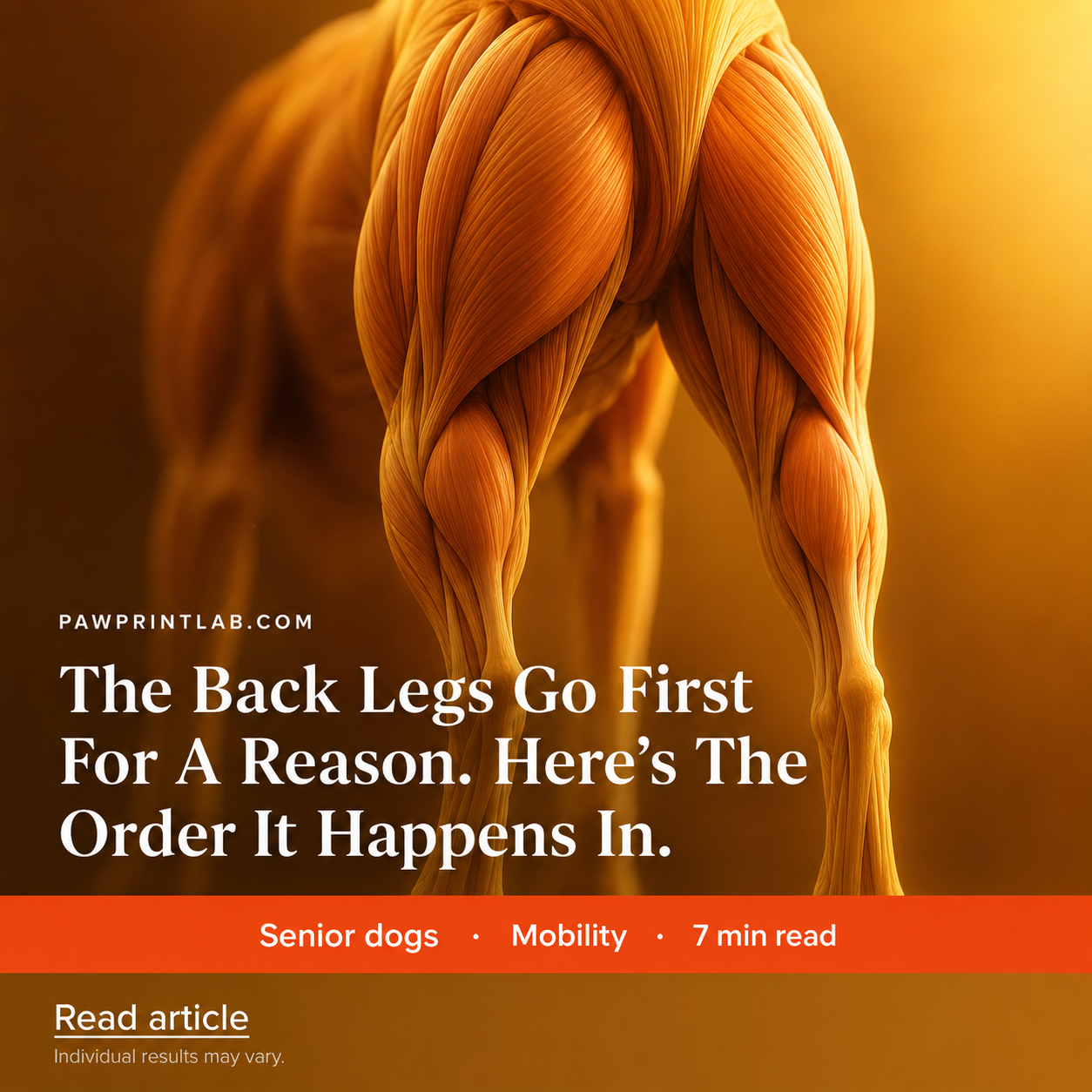
I am going to say something that nobody with an aging dog wants to hear and I am not going to soften it. The joint chews are not going to fix the back legs. Not the $46 ones. Not the $59 ones with the green label that everyone in the senior dog groups swears by. Not the prescription joint food. Not the fish oil. Not the laser package your vet sells in a six pack. NONE OF IT IS GOING TO FIX THE BACK LEGS. I know because I bought all of it. Every brand. Every food. Every add-on. For two and a half years. And my dog got so weak in the rear that my vet started measuring him for a cart. Because I spent two and a half years feeding a problem that nobody ever bothered to explain to me. And the worst part? My second dog started doing the same thing. Same age. Same slip on the same floor. And I almost let the whole thing happen again, because I was still following the same advice that got me nowhere the first time. I am done being polite about this. If your dog's back end is going and you are in a group somewhere asking whether to switch to the powder or add the green lipped mussel or try the other brand, you are spending money on the wrong part of your dog. Read this whole post. Every word. Because the answer is in here and it is not another chew. I live in Grand Rapids with my husband Tom and our two dogs. Duke was 11. Shepherd mix. Ninety pounds of leaning. The kind of dog who would put his whole body weight against your shins and just stand there being held. Scout is 7. Lab. Completely different animal. Goofy. Loud. Steals socks. Two completely different dogs. Same problem. For Duke it started when he was about 8 and a half. He slipped on the kitchen tile. Just once. Both back feet went out sideways and he did that awful splay where the legs slide apart and he could not get them back under him. I had to put my hands under his belly and lift. He looked at me while I did it. That is the part I remember. I took him to the vet. "Some rear end weakness. Very common at his age. Let's get him on a joint supplement and take some weight off." $46 a month. And honestly, it seemed to help. For about four months he was steadier. Fewer slips. He took the deck stairs without stopping halfway. I thought we had it handled. Then it came back. Not all at once. Slowly. Like somebody turning a dial down one click at a time. A pause at the bottom of the stairs. A little wobble when he stood up from a nap. Then the tile again. Then the hardwood. Then the two steps into the yard, which he had done ten thousand times. I told my vet. "Let's try a stronger formula." We switched. $59 a month. Helped for maybe six weeks. Then the wobble came back. "Let's add the prescription joint diet." $94 a month. On top of the chews. Then the laser therapy. $65 a session, twice a week for the first month. Monthly spend: over $300. And Duke was still sitting down halfway through walks. Still failing the first attempt to stand. Still needing my hands under him on the tile. Over $300 a month for a dog who could not get up off my kitchen floor. I posted in a senior dog group. "Duke is on chews AND joint food AND laser and he is still getting weaker in the back. Has anyone dealt with this?" Everyone had a suggestion. "Green lipped mussel. The chews are underdosed." "Try the powder instead. Powders absorb better than chews." "Turmeric paste. Look up golden paste." "Collagen. Bone broth. Eggshell membrane." "Get him a ramp and rest him. He is doing too much." So I tried. All of it. Green lipped mussel. $38 a month. No change. The powder. Three different brands. He ate around it. What he did eat did nothing. Golden paste. I made it on the stove like a lunatic at 11pm. Two months. Nothing. CBD. $55 a month for five months. $275. He seemed calmer. He was not stronger. A ramp for the car. Stairs for the couch. A runner rug down the whole hallway. An orthopedic bed. $740 all in. And "rest him." I rested him. I cut the walks in half. I stopped the trail. I kept him off the stairs. I stopped adding it up because the number was making me sick. And Duke kept getting weaker. His back end got narrower. You could see it. The muscle over his hips went soft and the bone came forward. His front end stayed thick and strong, which somehow made it worse to look at. Like the back half of him was being erased. He stopped meeting me at the door. He would lift his head from the bed and thump his tail and stay there. He started sitting down halfway up the driveway. Not tired. Not hurt. Just done. And then one night he could not get off the tile. I sat down on the floor next to him and got my arms under his chest and I could not do it alone. Tom had to come help. Ninety pounds and two people and my dog just lying there letting it happen. He put his head against my arm while we worked. Not panicking. Not scared. Just waiting for us to sort it out. That look is what broke me. I sat on that kitchen floor after we got him up and I thought: I am watching the back half of my dog disappear, month by month, and I cannot stop it. That was a Tuesday. I remember, because two days later Scout slipped on the same tile. He was 7. Same age Duke was when his started, near enough. Back feet went sideways. He got them back under him in a second and shook it off like it was nothing. I recognized it immediately. Same floor. Same splay. Same little pause before the stairs that I had explained away as nothing the first time. I knew exactly what the next two and a half years looked like. I had just lived them. Two and a half years of chews that work then fade. Two and a half years of food switches that change nothing. Two and a half years of buying gear and stacking receipts while the back end gets narrower underneath all of it. I could not do it again. I needed to understand WHY. Not "what should I try next." WHY. Why did the chews work and then stop? Why did the stronger formula do less than the first one? Why did every food change do nothing? Why did resting him not help? Why did it get worse every single year no matter what I bought? Three vets in two and a half years. Every one of them answered WHAT. What to feed. What to add. What to buy next. Not one of them answered why it kept happening anyway. So I did the thing you do at midnight. I read. Every night for two weeks after Tom went to bed. Forums. Vet school pages. Muscle research. Anything I could find. And at about 1am on a Wednesday I found a comment from a woman whose vet had explained it to her in two sentences. And when I read it I felt the floor go out from under me. Because it explained everything. Here is what nobody told me for two and a half years: Joint supplements are aimed at the cushion. The back legs are a power problem. Think about what your dog actually does when he stands up. He is not bending. He is pushing. The whole rear end is a push. Getting off the floor, taking a step up, holding himself steady on a slick surface. Push, push, push. Push is muscle. And after about age 7, dogs start losing muscle. The back half goes first, because the back half carries the biggest muscles, does the pushing, and sits at the end of the longest nerve pathways in the body. That is why the front end stays thick while the hips get narrow. It is not random. It is the order it happens in. And here is the part underneath that. The part I had never heard in my life. Muscle runs on energy. Real, physical energy, made inside each muscle cell by tiny power plants. To make that energy those power plants need a helper molecule called NAD+. As dogs get older they make less of it. And they lose it faster than they used to. Less fuel helper. Less energy made. Less push. The muscle did not quit. It ran low on fuel. The tiny engines in each cell start misfiring, like worn spark plugs, and the first thing you notice is the one job that takes the most power. Standing up off a hard floor. So the chews were never going to do it. Glucosamine is for the cushion between the bones. My dog's problem was not the cushion. My dog could not generate the power to push himself up. I had spent two and a half years buying cushion for a power problem. And here is the part that actually made me feel ill. Rest him. Everybody said it. I did it. I cut his walks in half. Muscle that does not get used loses mass faster. That is not a theory, that is just how muscle works. So every month I rested him, the muscle got a little smaller, so the next attempt at the stairs was harder, so I rested him a little more. I was not being cruel. I thought I was being kind. But the kindest sounding advice in the entire two and a half years may have been the one making the muscle go faster. Two and a half years. Three vets. Chews. Stronger chews. Prescription food. Laser. Mussel powder. Golden paste. CBD. Ramps. Rugs. Beds. And not one dollar of it went to the muscle or the energy the muscle runs on. Not one. They told me WHAT to buy. Nobody told me why it would not work. I called around the next morning and found a vet forty minutes out who does mobility and rehab work. Drove out there. Did not care. First thing she did was rule things out. X rays. A neuro check. She was blunt with me: some back leg problems are actual medical conditions, and those need a diagnosis, not a supplement. She checked for that first. Duke's came back as age related muscle loss. Not a disease. Muscle. Then she explained the rest of it, and it matched everything I had read at 1am. The push. The rear end going first. The energy inside the muscle cell. The fuel helper dropping with age. And then she said the thing that made it all click. "You cannot supplement a power problem with a cushion product. Glucosamine is not fuel. Fish oil is not fuel. The muscle needs energy, and the cell needs the building block it uses to make that energy. Then it needs work. Not rest. Work." "So what do I actually give him?" "The building block is called NMN. That is what the body uses to make NAD+. Ask what is in the bottle that the body actually uses to build it. That is the only ingredient question that matters." "And that is it?" "No. Second question is whether it is built to be absorbed or just built to be swallowed. Most of this category is a chew or a powder. Both have to survive the stomach before anything reaches the muscle. If it does not arrive, the label does not matter." She wrote three questions on the back of a notepad and handed it to me. 1. What is in it that the body actually uses to make NAD+? 2. Is it built to absorb, or built to be swallowed? 3. Will they show you third party lab paperwork for the batch in your hand? "Most of them fail number three," she said. "Not because they are hiding something. Because they never tested that batch." I went home and asked those three questions of everything in my cart. One brand answered all three. Pawprint Protocol. Liquid, not a chew. NMN as the lead ingredient, plus CoQ10 and resveratrol. Nanoliposomal, which is a long word for the actives being wrapped so they survive the trip and get where they are going. Up to 98% absorption. Third party lab tested by an ISO 17025 lab, batch by batch, made in a cGMP facility. 15,000+ dog owners are using it. I bought it that night. It cost less than one of Duke's vet visits. Six drops on his dinner. That is the whole thing. No pill pockets, no cheese, no wrestling a 90 pound dog with a capsule. And I did the other half of what she told me. I stopped resting him. Short flat walks. Twice a day. Every day. Backwards over a curb for the rear muscle. Two minutes at a time. Individual results may vary. This is just what happened in my house. Week 1 and 2: nothing I could point at. I kept watching. Kept counting the failed attempts to stand. Week 3: he got up off the tile on the first try. Once. I stood there like an idiot waiting for it to happen again. Week 4: it was most times, not once. The failed first attempt went from every morning to maybe twice a week. Week 5: he did the two deck steps without the pause at the bottom. He used to stop and look at them. He stopped stopping. Week 7: I got to the end of the driveway and realized he had not sat down. Then we did the block. He did not sit down. Week 9: I felt over his hips one night out of habit, the way I had every night for two years, checking how much was left. There was more there than the month before. I made Tom come feel it. He said "is that real?" It was real. Month 3: he met me at the door. He had not met me at the door in over a year. Just standing there in the hallway wagging his whole back end like nothing had ever been wrong with it. I sat down on the floor and cried into his neck and he had no idea why. For Scout, the one who had just started: Week 3: no more pause at the stairs. Month 2: no slips on the tile. Nothing developed. No wobble on the standing up. He never got a ramp. He never got the prescription food. He never cost me $300 a month and he never made me sit on the kitchen floor at midnight. Because I caught him at 7. Before it stacked up. One night I added up two and a half years of Duke. Joint chews: $1,380 Stronger formula: $1,062 Prescription joint diet: $2,256 Laser therapy: $780 Mussel powder, golden paste, CBD: $713 Ramps, stairs, rugs, beds: $740 Vet visits and imaging: $1,150 $8,081. Every dollar of it aimed at the cushion, the floor, or the furniture. Not one dollar aimed at the muscle, or the energy inside it. And the muscle was the whole thing the entire time. Scout will never go through what Duke went through. I am never buying a car ramp for that dog. I am never lifting him off a kitchen floor at midnight. If your dog is doing the pause at the stairs, or the splay on the tile, or the sit down halfway through the walk, go get a diagnosis first. Rule out the medical stuff. That part matters and I will not tell you otherwise. But if it comes back as "he is just getting older" and they hand you another chew, ask the three questions. Here is the whole thing written out, the muscle order, the fuel, and what to watch for at home: https://pawprintlab.com/pages/protocol-a1-backlegs Read the signs → You will see it before you feel it. The first try instead of the second. The stairs without the pause at the bottom. Your dog standing in the hallway when you come in the door, back end swinging, like he never stopped doing it. I wish somebody had told me two and a half years and $8,081 ago. EDIT: getting a lot of messages asking what I bought. It is Pawprint Protocol, the liquid one. Read the page above first, because the walking part matters as much as the bottle and I do not want anyone thinking drops alone fixed my dog. They did not. The drops plus the work did. And go to your vet first. Please. Rule out the medical stuff. P.S. Duke slipped on that tile for two and a half years while I spent $8,081 on cushion, gear, and rugs. Nobody sold me the muscle, because there is nothing to sell in "your dog's rear muscle is losing power and it runs on cellular energy." There is a whole aisle to sell in "here is another joint chew." That is the business model. The back legs were never a joint story. P.P.S. If your dog is 7 or 8 and just started the little pause before the stairs, you are in the best spot possible. Nothing looks wrong yet. That is the point. Large breeds start earlier than you would think. Scout is my proof. Same house, same floors, same tile. One got started early. One did not. The difference is two and a half years and $8,081. Read the signs → https://pawprintlab.com/pages/protocol-a1-backlegs
Like this ad? Make it yours.
Crush rebuilds this exact creative around your product — your brand, your colors, your offer — in about a minute.