
Inactive· since Jul 15, 2026
- 48
- days it ran
- 0
- relaunches
- 15,977
- EU reach
Ad copy
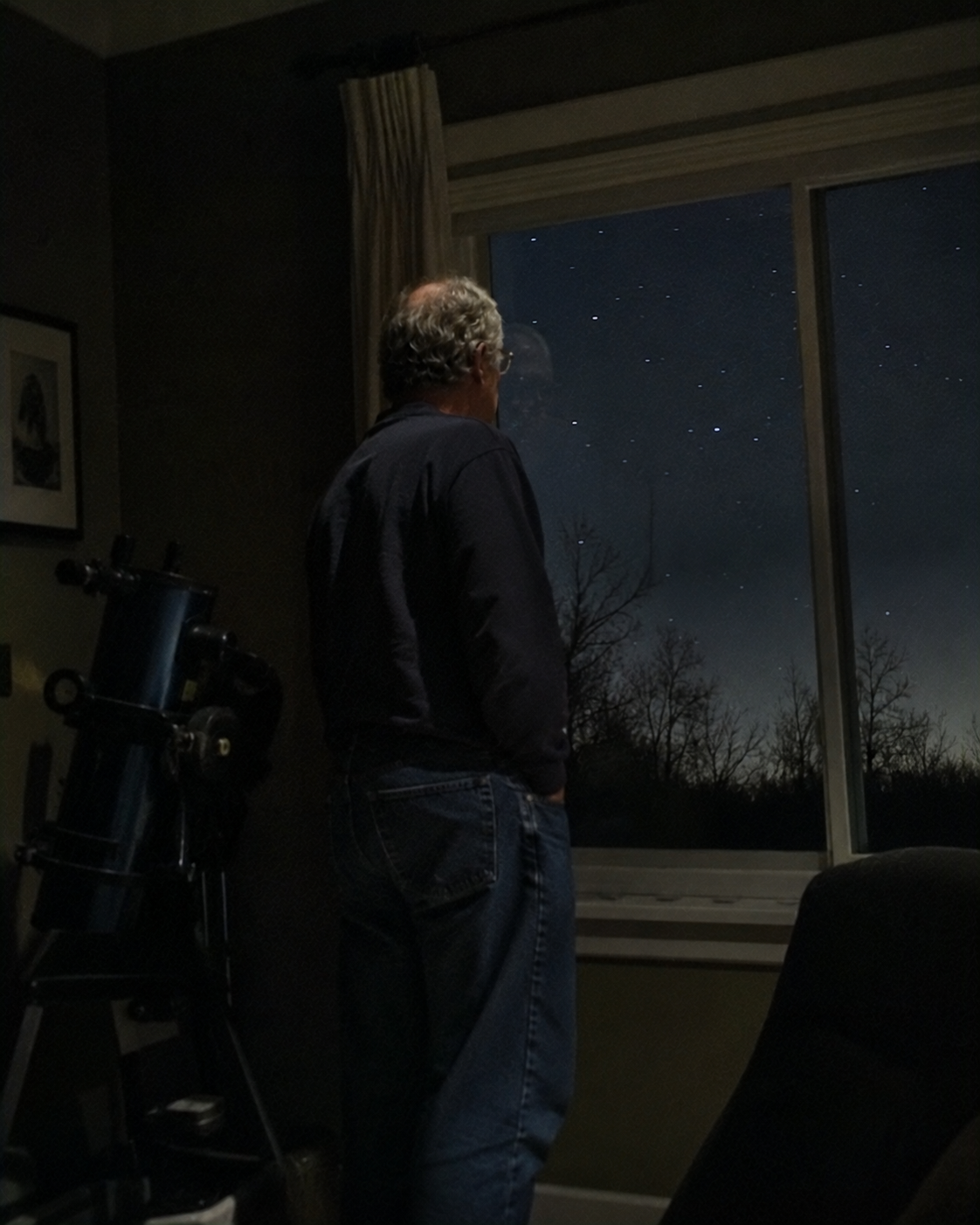
There was a perfect clear night this winter — no moon, no wind, the kind of sky I've chased for forty years. And I didn't go out under it. That's when I knew something was wrong. For forty years, a clear night was a summons. I'd see the forecast — no moon, low humidity, the air still — and something in me would stand up and start loading the car before I'd consciously decided to go. The telescope. The folding chair. The thermos. The red flashlight so as not to spoil my night vision. Out to the dark field east of town, where the sky still has its stars, and I'd stay till two, three in the morning, alone with it, perfectly content. I'm seventy. And this past January there came a night — a perfect night, the kind I've driven an hour for, no moon and crystal air and the whole winter sky laid out — and I stood at my window and looked up at it. And I didn't go. I couldn't find it in me to load the car. And I stood there, seventy years old, looking at the clearest sky of the season through glass, and I understood that something had gone wrong with me that no forecast could explain. It had been coming for a couple of years, the way nightfall comes — so gradually you can't name the moment it's dark. Astronomy is a hobby of stamina, though people don't think of it that way. It's late nights. It's cold. It's standing for hours, hauling equipment across a field in the dark, staying alert and patient past midnight. And the vigor that all of that takes had been quietly draining out of me. I started going out less. Leaving earlier — eleven instead of two. Then only on weekends. Then only on the very best nights. Then I'd talk myself out of even those, standing at the window, telling myself I'd catch the next one. The telescope sat under its cover in the garage for most of a year. I run the star-party every fall — the one where families bring their kids out to the field and I show them Saturn's rings and the craters on the moon and watch their faces do the thing faces do at their first sight of another world. Last fall, for the first time in fifteen years, I almost canceled it. I told myself it was the logistics. It wasn't the logistics. I didn't have the fuel for my own favorite night of the year. I did the sensible thing. I went to my doctor and told her plainly: I've lost something. The energy a man needs for his own life has drained off, and I can't say where it went. She took me seriously. Ran the full workup, the whole careful set, everything you'd want checked at seventy. And it all came back fine. Genuinely fine, she said. Better than a lot of men my age. I asked her why, then, a clear night couldn't get me off the couch. And she was honest with me. She said some of this dimming comes with the years. Keep active. Keep your interests up. Come back if anything changes. She wasn't dismissive. She just didn't have a next thing to hand me. And she was decent enough not to invent one. So I had a clean bill of health. And a telescope under a cover, and a sky I'd stopped going out to meet. There was a whole layer of how I felt that no panel was measuring. Nobody had a tool for it. Now, I am, by temperament and by hobby, a patient and skeptical man. You don't spend forty years at an eyepiece without learning to distrust a quick answer and a bright claim. Half of what people think they see in a telescope is what they wanted to see. The discipline of the thing is telling the real signal from the wish. So I did what came naturally. I went looking, carefully, in the literature. Not the miracle nonsense — I can spot an overclaim the way I can spot a satellite tracking through my field of view: it doesn't belong, and it's moving too fast. The real research. And what I kept returning to, over a good many evenings, was a growing body of research on molecular hydrogen and cellular wellness. Quiet research. Not flashy. Not a cure for anything and everything. Just a steady, patient amount of interest in something very small. Molecular hydrogen, I learned, is the smallest molecule there is. The smallest thing there is — which appealed to me, a man who spends his nights on the largest things there are. There's a pleasing symmetry in that, though symmetry proves nothing, and I knew it. And the most I'd responsibly take from the reading — an amateur astronomer, not a scientist, and I respect the line between them — was that it's looked at for supporting the body's natural antioxidant balance, supporting healthy circulation, and supporting healthy cellular energy. Cellular energy. The vigor that a cold field at midnight demands, and that had quietly left me. That was the layer nobody had a tool for. I'll be plain: I wasn't converted. I was a careful man deciding a quiet, plausible thing was worth a careful try. That's the most honest way I can put it. What I did next is the part I'd most want you to copy. Before I took a thing, I called my pharmacist — same fellow for years, who doesn't sugarcoat anything. Told him exactly what I was looking at, and everything I already take. Asked if there was any reason it'd be a problem alongside all of it. He looked into it and said there was nothing he'd be concerned about as an addition to my routine. Then I brought it to my own doctor at my next visit. Said it plainly: I want to add this. Not instead of anything you've got me doing. On top of all of it. Sensible? She said it sounded reasonable — added to whatever I was already doing, not replacing any of it, a fine thing to try. Two careful people, the same answer, before I spent a dime. And I'd tell you to do exactly that — especially if you're already taking something for your blood pressure, your blood sugar, or your heart. Check the instrument before you trust the reading. The one I landed on is called PrimeCell H2. A rapid-dissolve tablet. You drop it in a tall glass of cool water, it dissolves and releases the hydrogen, and you drink it fresh, right away. That's not a flourish — it's the reason for the design. Hydrogen's the smallest molecule there is, and it escapes the second it meets heat or sits out. So you don't mix it and walk off. You drink it right then. One tablet. One glass. Once a day. I changed nothing else. Same doctor, same routine, same everything she'd told me to do. I just set the glass next to my morning coffee and got on with my days. Now the honest part, because a man who fudges his observations has no business at an eyepiece. Nothing happened the first morning. Or the third. I drank my fizzy water and felt like exactly what I was: an old stargazer hoping a glass of water would put the night back in him. I nearly quit twice. I can't tell you which week it turned. I genuinely can't, and it troubles the record-keeper in me — I've logged every observing session for forty years in a stack of notebooks. But there came a clear, cold Friday in early spring. And I saw the forecast — no moon, still air — and something in me stood up and started loading the car before I'd consciously decided to go. The telescope. The chair. The thermos. The red flashlight. I drove out to the dark field east of town and I set up under the open sky, and I stayed until two in the morning, alone with it, perfectly content, the way I'd been a hundred nights before the dimming. I found Jupiter and four of its moons, strung out in a line the way Galileo first saw them. And driving home at two-thirty, tired in the good and earned way, I had to pull over for a moment, because I hadn't expected to get this back. It wasn't dramatic after that. It was just the night, returned to me. I went out on the clear nights again. Stayed late again. And last fall I ran the star-party — didn't almost-cancel it, ran it — and showed a fresh crowd of kids the rings of Saturn, and watched their faces do the thing, and felt, for the first time in two years, entirely myself doing it. I can't prove to you any of it was the tablet. I won't pretend I can, and you should mistrust any man who claims a clean result from a messy experiment. I was getting out more, the moment I had the vigor to — and getting out under the sky is its own kind of medicine for a man like me. A dozen things were in motion. Maybe it was all of them. Maybe it was the one I added. But I'd been doing every sensible thing for two years while the telescope stayed under its cover. And somewhere after the glass of water, quietly, the summons came back. That's the honest version. It's the only one I'll give you. The sky teaches you not to embellish. At my next visit my doctor went through everything and said I was in fine shape — same as before — and to keep doing what I'm doing. The report didn't change. The man carrying it went back out under the stars. So here's what the product is for, plainly. PrimeCell supports healthy cellular energy. It supports the body's natural antioxidant balance. It supports healthy circulation. That's not a promise about your nights, or your telescope, or anything at all. It's not a promise about anything. It's just what it's for. Some people notice something in the first week or two. Others take much longer. Some, I'd imagine, not much at all. Bodies are different. Mine is just one, with one story. It's a slow thing, taken steadily — the cellular processes it supports build up gradually, not overnight. It isn't a pill you reach for on a night you can't make yourself go out. It's a glass of water you drink every morning whether you feel anything that day or not. So here's what I'd tell you, if you were beside me at the eyepiece, waiting for your eyes to adjust to the dark. If the vigor's drained out of the thing you love — if you've started watching it through the window instead of going out to meet it, talking yourself out of the very nights you used to live for — and your doctor's looked you over and found you well, and there's no next thing to hand you: First, talk to your doctor or your pharmacist. Both, if you can. Especially if you're already taking something for your blood pressure, your blood sugar, or your heart. Ask the plain question: is this sensible to add to what I'm already doing? If they say yes — and there's a fair chance they will — it's a tablet and a glass of cool water in the morning. On top of everything else, not in place of any of it. Then give it a few weeks. Don't watch it like you're waiting on a cloud to clear. Just set the glass next to the coffee and let your body keep its own time. Be patient with yourself. The sky has waited billions of years; it'll wait the few weeks for you. But don't let it wait forever while you stand at the window. Some of us were made to go out under it. That's the whole of it. That's what a patient streak and a stack of honest reading, between them, did for me. And I'd be a poor sort of stargazer not to point the next person toward the dark field. P.S. The kids from the fall star-party write me letters sometimes — their teachers make them, but a few mean it. One little girl drew me a picture of Saturn with far too many rings and wrote "thank you for the planet" on it, as though I'd made the thing myself. It's taped inside the lid of my eyepiece case. I'd have missed that letter entirely if I'd canceled. That's reason enough for everything that followed. P.P.S. I keep a spare box in the cupboard now. PrimeCell's a small company and they've sold out before, and a man who never once drove to the dark field without a spare set of batteries is not about to run short on what his mornings depend on. It's there next to the coffee, every day. P.P.P.S. The steps, in order: Call your doctor or pharmacist first, ask if it's sensible to add to what you're on. If yes, drop one tablet in a tall glass of cool water each morning and drink it fresh, right away. Change nothing else — just add it. Then give it a few weeks. Some notice something in the first week or two, others longer, some not much at all. Be patient. P.P.P.P.S. PrimeCell H2 has a 90-day money-back guarantee — not satisfied for any reason at all, every penny back, no questions. For a supplement, that's the only sensible policy. Enough time to actually tell, instead of deciding in a week. I'd take the full ninety days. P.P.P.P.P.S. There's a comet coming next year — a good one, they think, visible to the naked eye if the predictions hold, which comets famously ignore. Two years ago I'd have read that news from my couch with a vague regret. This week I marked the date in my observing log, checked my charts, and started watching the long-range forecasts for a clear, moonless night. I intend to be standing in the dark field east of town when it comes, thermos in hand, to see it with my own eyes. That's not a headline. It's a small, quiet thing. But the small quiet things — an old man planning to be under the sky for a comet a year out — are the ones worth telling someone at the eyepiece about. 👉 https://track.getamalahealth.com/5548c06d-d9c3-4785-b466-fec64a6fdb28 The people and events depicted in this ad are illustrative and not based on any specific individual. Individual experiences vary. These statements have not been evaluated by the FDA. This product is not intended to diagnose, treat, cure, or prevent any disease.
Fix Yourself at the Cellular Level
PrimeCell H2 is a next-generation molecular hydrogen tablet formulated to support your body's natural antioxidant defenses — helping you feel sharper, more energized, and more like yourself.
LEARN MORELike this ad? Make it yours.
Crush rebuilds this exact creative around your product — your brand, your colors, your offer — in about a minute.