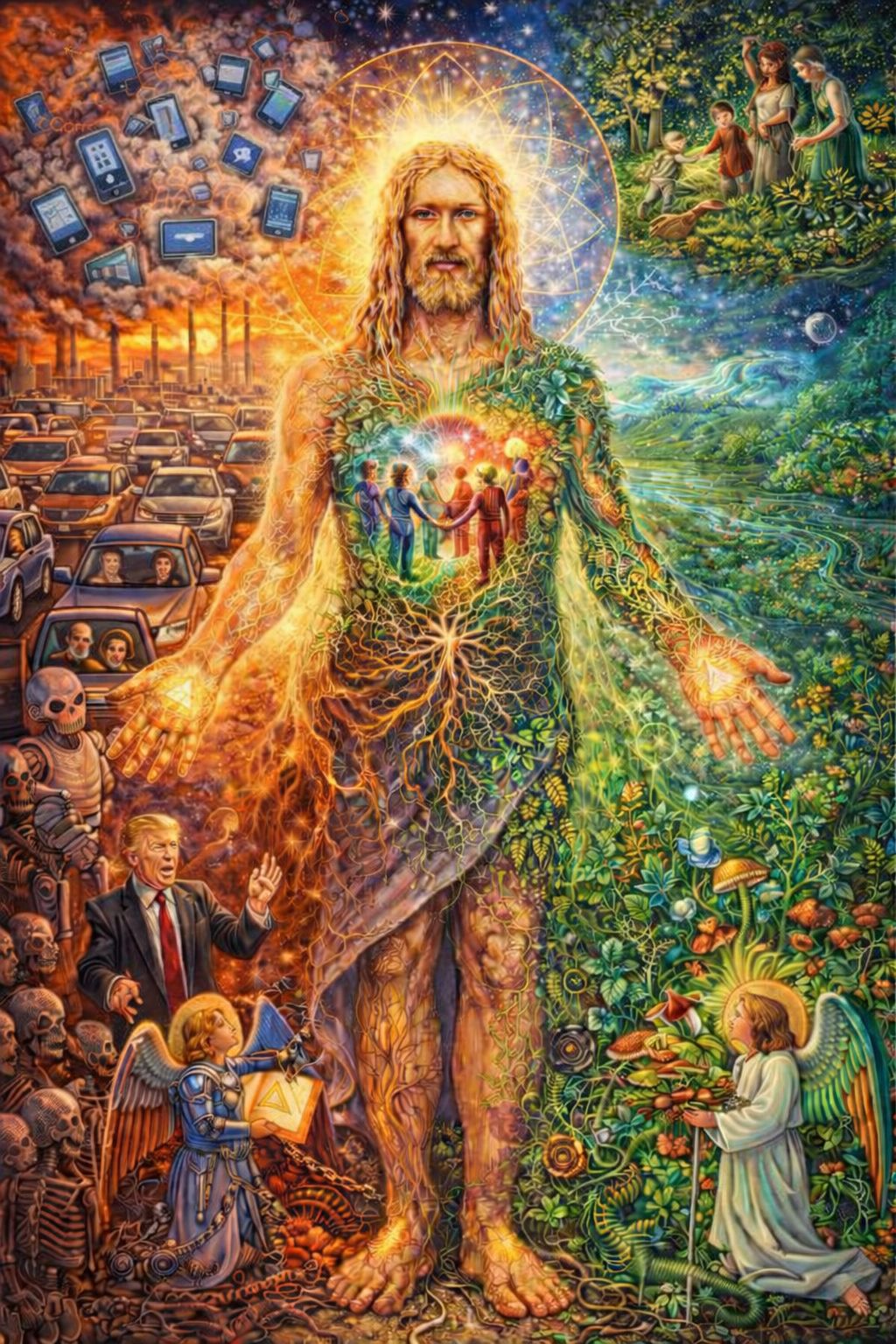
James Edward Christian
James Edward Christian Facebook ad: “Moving Forward: Part I”

Ran for 1 day, from February 25 to February 26, 2026, the last day Crush saw it.
Run by James Edward Christian on Facebook. Crush is not the advertiser and does not verify its claims. See this ad in Meta's Ad Library(opens in a new tab)
Want an ad like this for your product?
Crush makes new ad images for your product from this ad: your logo, your product photo, your offer.
Trials from $19.95 USD, then $79.95 USD a month. Cancel anytime.
About this ad
- Meta Ad Library ID
- 1244648597614352
- Platforms
- Facebook and Instagram
- Relaunches
- 1
Ad text
"Moving Forward: Part I" -Digital Media, AI & the Atrophy of Human Subjectivity- Philosophy is often misunderstood as a search for grand, abstract answers, but its true power lies in its ability to deconstruct the problems we think we already understand. We are currently trapped in a mindset where we acknowledge crises (like ecological destruction or systemic social alienation) as general facts, yet our daily material practices remain completely unchanged. This is because the system is designed to keep us in a state of "false freedom." We are encouraged to view ourselves as small, independent entrepreneurs or capitalists, even when we are trapped in the most precarious exploited forms of labor. By believing we are in control, we inadvertently serve the very systems that are stripping away our agency. The rise of digital technology, particularly artificial intelligence, represents a new frontier in this alienation. When we begin to outsource our thinking, our communication, and even our critical reviews to algorithms, we are not just gaining efficiency; we are witnessing the atrophy of human subjectivity. We risk creating a society where our thoughts are no longer our own, but are mediated and potentially implanted by the same digital architectures that manage our daily survival. This is the ultimate danger: losing the ability to think independently about the conditions of our own existence. When the machine manages our social interactions and our work, we lose the capacity to see that we are not living in a garden, but in a highly controlled environment designed to keep us busy, productive, and distracted. Relying on AI to articulate our complex & generalized arguments fundamentally risks the atrophy of our cognitive muscles in three specific structural ways... First, it shortcuts the dialectical process. As we have previously discussed in other posts, true critical thinking requires the friction of deconstructing our own presuppositions: the hard, often uncomfortable work of questioning why we hold certain beliefs and identifying what is secretly implied in our discourse. When we offload this labor to an AI, we bypass the cognitive struggle that actually produces insight. The AI provides a finished, polished product, but in doing so, it removes the necessity for the human mind to navigate the logical contradictions of its own position. Second, it leads to conceptual flattening. Generalization is a tool for simplification, but when an AI handles it, it defaults to the most probable, average language based on its training data. This language is inherently sanitized and aligned with existing corporate-technological norms. By consistently using these tools, we lose the ability to forge our own, unique, and precise conceptual frameworks. Our language becomes machine-readable rather than human-resonant, and we become increasingly unable to articulate thoughts that fall outside the algorithmic baseline of what is expected. Lastly, it creates a feedback loop of dependency. The more we rely on AI to synthesize our thoughts, the more we perceive our own cognitive limitations as inability. We begin to feel that we need the tool to communicate effectively, which mirrors the dynamic of the gig worker who feels they need the platform to survive. This reliance fundamentally alters our sense of agency: we stop being the architects of our arguments and become mere operators, selecting from the menu of outputs the machine presents to us. When we cease to grapple with our own arguments, we lose the capacity to identify when we are being subtly steered by the machine's architecture. We are not just using a tool; we are training ourselves to think within the constraints of the tool’s design. This is how we come to adore the very technology that undoes our capacity to think: we mistake the machine's efficiency for our own intellectual progress, while our genuine, independent capacity for discernment steadily declines. To restore cognitive agency and break the cycle of digital atrophy, we must adopt an analog training regimen that parallels the processes of ecological restoration. Just as you cannot restore a damaged ecosystem by simply looking at a spreadsheet, you cannot restore your capacity for independent thought by simply asking an AI to synthesize your arguments. You must rewild your mind through direct engagement with the complexities of your own experience. Instead of having an AI curate your worldview, adopt the practice of dialectical foraging. This involves intentionally seeking out conflicting viewpoints and raw data sets on topics like psychedelic therapy or soil microbiology, then forcing yourself to synthesize these contradictions manually. By physically writing out your arguments, you reestablish the neural pathways that are currently being bypassed by digital shortcuts. This process acts like bioremediation for the mind: you are identifying the toxins of internalized corporate ideology and filtering them through your own non-algorithmic critical filter. To align this with regenerative work such as permaculture and healing, use these analog moments to practice observation-based thinking. Spend time in the field, away from digital devices, and force your brain to process the sensory input of an ecosystem without a screen interface. When you return to your writing, focus on the objective realities of your observations: how the mycelial network interacts with the soil or how a specific plant contributes to a closed-loop system. By grounding your arguments in these physical observable biological truths, you bypass the need for an AI to generalize your thoughts for you. -The Discipline of Non-Efficiency- The most effective way to resist the adore-the-technology trap is to intentionally choose less efficient pathways. If an AI can write a paragraph in seconds, spend an hour writing one yourself. You must feel that your day has not been lost to the machine. By embracing this slower, manual process, you protect the sanctity of your own subjectivity. You are no longer a user consuming an output; you are a participant cultivating your own intellectual landscape. To break this cycle, we must move away from the instrumental rationality that prioritizes short-term efficiency and the direct pursuit of happiness. Happiness, in a meaningful sense, is never something you can chase directly; it is a byproduct of living with a true vocation: a commitment to something larger than the self. In our context, this means shifting our focus from the debt-driven, extractive economy to the restorative work of ecological stewardship. By engaging in polycultural, symbiotic bioremediation, we stop competing with one another for scraps and start acting as the stewards of the land we inhabit. This is the only way to move beyond the stagnation of monocultural corporatism: by replacing the user identity with a participant identity that is fundamentally rooted in the health of the living Earth. First, let's address the role of philosophy in an age dominated by technocratic science and specialized data. Rather than chasing big answers or divine truths, the role of the philosopher is to act as a diagnostic tool. We often operate under a set of inherited, traditional concepts that prevent us from seeing the reality of our situation. When we discuss modern crises (be it ecological collapse or the nature of social struggles) we tend to treat them as external problems to be solved with more technology or more regulation. Philosophy forces us to flip the script and ask: to what extent is the way we formulate the problem actually a part of the problem itself? This is not a call for abstract theorizing, but for a practical orientation. In practice, this means deconstructing the ideological assumptions hidden in our everyday responses to crisis. For example, when confronted with ecological destruction, many turn to either old-world localism or state-planned technocracy. Both approaches often fail because they rely on the same fundamental structures of control that created the crisis. By refusing to accept these frameworks as natural, we can begin to see how our daily material practices (e.g. how we work, how we organize, and how we relate to our environment) are the true sites of change. We must stop viewing these issues through a lens of inevitability and start questioning the secret assumptions that hold the current, extractive system in place. Next, let's focus on the transformation of labor within modern capitalism, specifically regarding the gig economy and the illusion of the small capitalist. We are often told that platforms like Uber or freelance marketplaces empower us by allowing us to be our own boss and set our own schedules. This framing is a masterstroke of ideological design. It suggests that if you are a driver or a contractor, you are not being exploited by a company; rather, you are an independent operator who owns your means of production. By positioning the worker as a mini-entrepreneur, these platforms effectively shift the competition away from the company and onto the workers themselves, who are forced to compete against one another for scraps. This shifts the nature of struggle. Instead of workers uniting against a unified system of exploitation, they are incentivized to see their fellow workers as rivals. This false freedom is perhaps the most ingenious invention of contemporary economic ideology. It masks the reality of brutal uncertainty and precarious income behind the rhetoric of personal autonomy. We become trapped in a mindset where we constantly optimize our own business, even when that business is designed to extract value from us while offering none of the traditional protections of employment. We are essentially managing the mechanics of our own exploitation, all while believing we are participating in a system of increased personal agency. Now let's explore concerns of the digital age, artificial intelligence, and the existential risk of losing our capacity for independent thought. We are witnessing a transition toward a posthuman era where technology no longer just assists us, but increasingly mediates the very flow of our consciousness. When we outsource our writing, our research, and our critical analysis to algorithms, we are participating in an intellectual atrophy. The danger is not merely that we are becoming less informed, but that we are ceding the fundamental machinery of our subjectivity to systems that we do not control. This dependency creates a feedback loop that threatens our basic autonomy. As machines begin to mediate our reading and writing, they subtly shape our patterns of thought, guiding us toward specific, optimized outcomes rather than open inquiry. When our thoughts are increasingly linked to digital architectures, the assumption that we possess a private, independent inner life begins to falter. If those who control the machine can steer our cognitive processes, implant ideas, or dictate the scope of what we can even perceive as truth, the traditional concept of freedom dissolves. We are becoming passive participants in a digital system that mimics human intelligence while systematically dismantling the critical evaluation that defines true human agency. Finally, let us review the role of humor in philosophy and the distinction between the pursuit of happiness and the commitment to a vocation. Philosophers often use dark humor not as a distraction, but as a diagnostic tool to navigate the absurd, self-contradictory nature of modern life. When the world is dominated by ideological distortions and systemic crises, humor serves as a way to trigger a comical reversal: a moment of clarity where we recognize the absurdity of the structures we take for granted. This is an essential philosophical exercise; it allows us to step back and see the "joke" in our own behavioral contradictions before they completely harden into our reality. This leads to the broader, often misunderstood question of happiness. Our modern systems are built on the pursuit of happiness as a primary goal, which paradoxically leads to systematic self-sabotage. If we chase happiness as a direct outcome, we tend to ruin the very conditions that make it possible. Instead, a more robust and truly human approach is to find a vocation: a purpose or commitment that transcends the self. In this light, happiness is not an end goal to be achieved, but a byproduct of engaging in meaningful, challenging work that contributes to something larger than our individual survival. This brings our discussion full circle. By moving away from the narrow, debt-driven, and corporate-optimized pursuit of success, we can instead commit ourselves to the hard work of restoring our connection to the living world. Whether that is through rethinking our relationship with technology, deconstructing the exploitative labor models we participate in, or engaging in the literal, physical work of regenerating our ecosystems, we are moving toward a more sustainable form of existence. We are no longer just users or consumers managed by a digital machine; we are active participants in a life-sustaining, symbiotic system. To build a foundation for a regenerative economy, we must move beyond the current debt-driven model of ownership and replace it with a system of active stewardship. This infinite, incentive-based digital currency would function by valuing the direct, measurable output of ecological health. Instead of investments being tied to lobbying or abstract financial growth, capital would be tied to the tangible, verified restoration of the biosphere. AI acts as the essential translator in this transition, bridging the gap between complex ecological data and human action. By processing environmental metrics (such as soil carbon sequestration rates, biodiversity indices, and aquifer recharge volumes) AI can convert raw data into objective-based frameworks. For example, a local community member might receive a real-time notification that a specific planting pattern has increased local soil microbial diversity by 15%, triggering a direct digital reward. This transforms stewardship into a transparent, accessible, and high-status activity. By utilizing live ecological feedback loops, we remove the human bias (and the corruption) of centralized banking. When the investment is objectively tied to the vitality of the local bioregion, the system becomes self-correcting. If an action harms the ecosystem, the negative feedback (in the form of lower rewards or automated restorative requirements) is immediate and impartial. This shifts our orientation from passive consumers of a corporate narrative to active participants in a living, symbiotic system. This model effectively centralizes stewardship, making it the most incentivized behavior in society. We are no longer working to pay off debts to an abstract entity; we are working to grow the very capital (the air, water, soil, and life) that sustains our collective future. By aligning our economic incentives with the biological requirements for life, we transition from a culture of extraction to one of active, intelligent guardianship of our planetary home. Transitioning from a system of material accumulation to one of biological wealth fundamentally alters the human experience by shifting our primary metrics of success from abstract, debt-based indicators to concrete, life-sustaining outcomes. When we measure wealth by the health, diversity, and resilience of our local ecosystems, we are no longer tethered to a system that requires constant, resource-heavy growth to remain solvent. This shift addresses the root of modern mental health crises, as it replaces the isolating pursuit of material status with the communal, grounding act of ecological stewardship. Mental health is significantly impacted by the "stagnation" of living within a monocultural, corporate-driven environment. This environment forces us into hyper-individualized competition, which triggers chronic nervous system dysregulation. By contrast, participating in biological wealth creation (such as restoring soil health, maintaining polycultural forests, or managing water cycles) requires a sensory and active engagement with the living world. This interaction promotes a state of co-regulation with our environment, reducing anxiety by replacing the fear of scarcity with the visible, tangible abundance of a thriving ecosystem. Furthermore, the transition to biological wealth removes the psychological burden of debt. When the economy is tied to regenerative acts, investment becomes an act of creation rather than an obligation to an extractive entity. This gives individuals a clear, objective-based vocation that provides a deep sense of purpose. Instead of feeling like small cogs in a machine designed to undo our capacity to think, we become essential nodes in a system that depends on our awareness, observation, and skill. This restores a sense of agency that is entirely absent in the current, contained, debt-driven existence. Ultimately, this transition offers a path to genuine human security. When our wealth is stored in the soil, the water, and the biodiversity of our bioregion, we are building a foundation that cannot be devalued by market crashes or corporate interests. This security provides the mental space necessary for people to move beyond the trauma of exploitation and into a state of modern stewardship, where our primary motivation is to participate in the ongoing vitality of our planetary home. To evaluate a community project through the lens of biological wealth instead of financial return, we must shift our focus from extracting finite capital to cultivating self-replenishing, systemic resilience. Unlike financial models that aim to minimize costs to maximize profit, a biological model seeks to maximize life-affirming outputs that compound over time. When evaluating a project, ask yourself: Does this system store energy and matter, or does it dissipate them? The primary goal of financial return is asset accumulation, whereas the goal of biological wealth is ecosystem resilience. While financial models often rely on linear extraction, biological models rely on regenerative cycles. Where financial projects often produce waste, biological projects produce resource feedstocks. Finally, financial legacies are often defined by depreciation, while biological legacies are defined by compounding biodiversity. Use these four pillars to assess the viability and long-term potential of any community project: The first Pillar is Regenerative Synergy. Evaluate if the project mimics natural cycles. Ask if the project increases soil carbon and microbial diversity. If it is a food system, does it build topsoil or require synthetic inputs to maintain output? The goal is moving beyond sustainability to regeneration. The second Pillar is Carbon Sequestration vs. Emission. Assess the net impact on the atmospheric and soil carbon balance. Does the project actively draw down carbon into the landscape through perennial agroforestry or wetland restoration? Or does it rely on high-energy materials that off-gas during production and maintenance? The third Pillar is Closed-Loop Remediation. Look for the conversion of waste into food. Does the project utilize fungi or plants to heal degraded sites, effectively turning pollutants into neutralized soil amendments? The fourth Pillar is Ecological Integration. Consider the impact on the local biome. Evaluate if local energy production harmonizes with the living environment. Electromicrobiological energy grids, for example, can use microbial fuel cells to generate power while purifying water, essentially turning infrastructure into a living, energy-generating organism. There are a few tests to follow. The first is the Feedback Loop Test; does the output of this project provide a free, high-quality input for the next cycle? Then comes the Resiliency Test; if financial funding were removed tomorrow, would the system continue to produce resources, or would it collapse? After, we explore the The Biodiversity Test; does the project increase the variety of life in the area, or simplify it? By prioritizing these metrics, you are not just managing a project; you are stewarding an engine of abundance, finally moving away from 10,000 years of backward survival. When examining the actions of Epstein and Maxwell, the historical reality of the Roman elite’s conduct offers a parallel that some use to understand the systemic nature of their behavior. The Roman model of absolute power, where the elite were effectively above the law & entitled to the bodies of those they dominated, provides a structural precedent for the impunity seen in modern elite networks. By utilizing both the aesthetic symbols of imperial Rome and the pseudo-scientific justifications of eugenics, these modern figures constructed a closed, private world that functioned as a deliberate rejection of democratic equality. Ancient ideology & contemporary wealth reflects an exclusionary model of power. -🏛️ Rise of The Roman Empire: Success Through Egotism and Dissociation- The rise and enduring cultural impact of the Roman Empire can be seen as a grand historical case study in what happens when a civilization successfully and relentlessly progresses a set of self-absorbed, egotistical values forward, primarily through technological, military, legal means. This expansion was predicated on a profound dissociation from nature and an aggressive centralization of resources, a pattern tragically mirrored by several modern nations, including the United States. The core Roman value was gravitas (seriousness, duty, responsibility), often contrasted with the Greek focus on intellectual curiosity. Roman gravitas was an expression of the collective ego: the individual's purpose was strictly subordinate to the state and its eternal glory. This value fueled unwavering commitment to military expansion and state administration, creating the engine of empire. Rome’s greatest enduring contribution was its legal system. Roman law codified abstract ownership and hierarchy with unprecedented clarity. This system was vital for large-scale management of vast, conquered territories and diverse populations. By formalizing property rights and social status, the law essentially abstracted human and natural wealth into legal categories, paving the way for the financial control mechanisms seen today. Roman engineering represents a physical triumph over the natural world. The aqueducts were not just utilities; they were a declaration of independence from local water sources and the natural flow of rivers. The extensive road networks facilitated rapid military and economic control, prioritizing the needs of the imperial center (Rome) over the localized, sustainable patterns of the conquered biota. Nature was a resource to be tamed, channeled, and leveraged for imperial benefit. The latifundia (vast estates worked by slaves) institutionalized monoculture across North Africa and the Mediterranean, specializing in wheat and olives. This massive, single-crop production provided the surplus necessary to feed the urban, non-producing populace of Rome. The ecological costs (soil exhaustion, deforestation, and dependency on fragile supply lines) were simply externalized, borne by the conquered provinces. The city of Rome itself was the ultimate symbol of egotistical consumption. Its massive population subsisted entirely on imported grain, wealth, and slaves drawn from its peripheries. The flow was always inward, from the diverse, regenerative landscapes of the provinces to the sterile, demanding center. This centralization created an economic black hole that relentlessly drained resources. The Roman legions were not merely fighting forces; they were vehicles for projecting the Roman Ego. Conquered people were forced to adopt Roman governance, language (Latin), and infrastructure, crushing local, interdependent cultural practices. The military success was the successful progression of an exclusive self-validating worldview. While Stoicism offered individual resilience, in the context of the Empire, it promoted an emotional distance from suffering and external conditions, including ecological decline. It encouraged citizens to find order within their own minds, often at the expense of engaging meaningfully with the escalating chaos and injustice of the external world: a perfect philosophical tool for dissociation of symbiosis. The practice of deifying emperors (the Imperial Cult) placed the physical representative of the state at the apex of the spiritual world. This was the ultimate expression of narcissism applied to governance: the head of the hierarchical structure literally claimed godhood, cementing the idea of a "God Above Men." Roman currency, particularly the silver denarius, was used to extract taxes and mobilize labor. Control of the mint and the flow of precious metals reinforced the centralized authority, allowing the elite to abstract the true, biological wealth of the empire into portable, controllable units of financial power. The bread and circuses, such as gladiatorial combat and public spectacles, served as a massive distraction, a form of collective dissociation from the underlying, systemic decay. The populace was mollified by instant gratification, preventing them from recognizing the fragility of their imported food supply or the moral corrosion of their society. Through law, engineering, and propaganda, Rome created an intricate, artificial reality that masked its deep fragility. This reality, built on the assumption of infinite resources and perpetual dominance, was the successful progression of an egotistical vision entirely disconnected from the Earth's carrying capacity. -Impact on Ecosystems: Original Forms of Destruction- The destructiveness of the Roman elite on nature was characterized by several forms of environmental damage that established early models for large-scale, systematic resource depletion, distinct from the better-known issues of monoculture and lead pollution. These actions fundamentally destabilized regional ecosystems and introduced novel forms of environmental engineering focused solely on imperial convenience. Extinction Through Spectacle and Entertainment: A unique and devastating form of ecological destruction perpetrated by the Roman elite was the systematic hunting and near-extinction of animal species for entertainment in the arenas. The Roman hunger for spectacles like the venationes (beast hunts) led to the organized mass slaughter of megafauna across the empire and its trade routes. Lions, tigers, bears, elephants, rhinos, crocodiles, and exotic birds were captured, transported, and killed by the thousands. This massive, consumption-driven predator removal destabilized entire regional food webs, particularly in North Africa, and led directly to the local extinction of species like the Atlas Lion. This was not about agriculture or industry; it was ego of the empire manifesting as a biological drain, treating vast ecosystems as sources of temporary pleasure for the urban center. Manipulation of Hydrology and Wetland Drainage: The Roman obsession with sanitation, straight lines, and agricultural expansion led to widespread, aggressive manipulation of natural hydrology, particularly the drainage of vital wetlands and marshlands. Large-scale public health projects, aimed at eliminating disease (malaria), successfully drained areas like the Pontine Marshes south of Rome. While beneficial for disease control and providing new farmland, this activity destroyed critical biodiversity sinks, eliminated natural flood buffers, and reduced regional water purification capacity. It demonstrated a profound lack of respect for the inherent function of the biota's natural infrastructure. The Roman elite prioritized immediate human convenience (safety and profit) over the complex, long-term ecological services provided by these natural systems. The Salt Trade and Soil Salinization: The intensive Roman control and taxation of the salt trade, essential for food preservation and military logistics, indirectly caused long-term environmental damage through localized salinization. Salt pans and coastal extraction sites, particularly in arid areas, altered local soil chemistry and water tables, making the surrounding land inhospitable to native vegetation. Furthermore, their immense fishing and fish-sauce production (garum), often requiring massive coastal infrastructure and concentrated waste, severely impacted delicate estuarine and coastal ecosystems. The pursuit of military efficiency and dietary requirements led to a pattern of resource extraction that left areas locally sterile, reflecting an environmental blindness driven by the imperial market's singular demands. Introduction of Invasive Species: The vast Roman military and trade network served as a highly efficient mechanism for widespread introduction of invasive species, disrupting local ecosystems across the Mediterranean basin and Europe. As they moved vast quantities of grain, livestock, and supplies, they carried pests, weeds, and new pathogens that outcompeted local flora and fauna, lacking natural predators in their new habitats. The Roman emphasis on rapid communication and logistical throughput was also an ecological disaster, demonstrating how an interconnected, fast-moving monocultural system inevitably acts as a vector for biological destabilization across diverse native biota. The Roman model (centralized control, monocultural extraction, legal abstraction, and the use of engineered dissociation) did not ultimately fail because of external invaders; it failed because its own successful progression of self-absorbed values led to a systemic deficit. It paved the way for the Transgenerational Divide, establishing the political & legal precedent for the Western world’s current extractivist model. "Moving Forward II: Lessons to Learn" -How did the Mayans Disappear?- The disappearance and decline of the Ancient Civilization of Maya (roughly 250–900 CE) is often explained by a complex interaction of environmental and social stressors, but elite dynamics were central to the collapse, essentially turning a crisis into a catastrophe. The theory is that the Maya didn't disappear, but their highly centralized, hierarchical city-states collapsed due to the inability of the ruling class to adapt to changing conditions and the resulting loss of faith among the populace. The Classic Maya elite (the ajawtaak or rulers) drove a form of entropic exploitation that directly compromised the environment their people relied on. The ruling class demanded ever-larger temples and monuments to legitimize their divine status. This required massive amounts of limestone plaster, which necessitates burning huge quantities of timber. This process accelerated deforestation, stripping the surrounding forests crucial for their agroforestry and Milpa systems. To support the growing elite and non-agricultural populations in the cities, rulers pushed the sustainable Milpa system past its breaking point, leading to soil exhaustion and decreased ecological resilience. The environmental damage from deforestation and intensive farming led to severe soil erosion and reduced local rainfall. The Mayan political structure was based on the ruler's ability to communicate with the gods and ensure prosperity. During the period from 800 to 950 CE, the Maya lowlands suffered severe and prolonged droughts. The common people believed their rulers were divine intermediaries who could control the rains. When the droughts persisted despite increasing ritual sacrifices and temple building (the elite's escalating solution) the populace lost faith in the divine authority of the rulers, exposing the entire debt-based political system as a failure. The elite's power was a spiritual monopoly. When the spiritual solution failed to deliver the ecological necessity (rain), the city's socio-political coherence fractured. People stopped building monuments, paying tribute, and providing labor. As resources dwindled and faith in the central authority waned, the elite’s response was self-destructive. Instead of cooperating to solve the water or food crisis, city-states intensified warfare to seize remaining resources, further disrupting trade routes and agricultural cycles. Evidence shows that warfare shifted from ritualized conflicts to more destructive sieges. The common people, recognizing that the centralized cities had become ecological death traps, simply began to disperse, returning to smaller, decentralized communities where their traditional, small-scale agroforestry practices were more sustainable. They returned to the methods of survival that were independent of the failed, hierarchical urban centers. In short, the Maya didn't vanish; the elite-driven structure—the complex, high-energy system of kings, temples, and centralized debt had collapsed under the strain of its own entropic demands on the ecosystem, allowing the resilient, decentralized peasant communities to continue surviving outside the ruined cities. -History Repeats: The Parallel of Today's Survival- Our reliance on monocultural agriculture is failing us precisely because it mirrors the fatal elite dynamics that contributed to the collapse of the Classic Maya, and we cannot escape the inevitable outcome without integrating principles that move beyond simple sustainability toward systemic, ecological regeneration. The modern industrial monoculture is essentially a globalized highly accelerated version of the Mayan elite’s overexploitation of resources. The pursuit of maximum short-term yield (often for global commodities like corn, soy, and wheat) creates a system of profound ecological debt. We treat soil as a substrate rather than a living system. Monoculture rapidly depletes organic matter and micronutrients, requiring massive inputs of synthetic fertilizers, which are energy-intensive and pollute water. We are trading long-term soil health (the original form of planetary coherence) for short-term profit. This mirrors the Maya's soil erosion but on a planetary scale. Vast fields of a single genetic crop variety are extremely vulnerable to disease (like fungal blights) or pests, risking a catastrophic collapse of the food supply. Just as the Maya's dependence on the rain god's blessing failed during drought, our dependence on stable global supply chains, cheap oil, and a few seed varieties makes us susceptible to single-point failures - a modern manifestation of a failed mandate. Furthermore, this system is maintained by the financial elite (seed companies, chemical corporations, and banks). Farmers are locked into a cycle of purchasing patented seeds, fertilizers, and herbicides - creating a massive economic debt that mirrors the historical subjugation of egalitarian communities. The food system itself becomes an engine of financial control, just as centralized grain storage and water control were for the Sumerian and Mayan elites. The failures of monoculture prove that simply being "sustainable" (maintaining the current, flawed system) is not enough. We require a shift toward regenerative integration to achieve true ecological negentropy and avoid the fate of civilizational collapse. Sustainability aims for zero harm; regeneration aims to actively heal. This means intentionally building back the topsoil, increasing biodiversity, and sequestering carbon - practices that reverse the entropic damage of the industrial age. We must move past the chemical subsidy and integrate the principles of permaculture (designing self-sufficient, multilayered food forests and ecosystems) and bioremediation (using natural systems, like specific plants and fungi, to actively clean polluted soil and water). These are advanced systemic ecological blueprints that the ancient egalitarian farmers lacked, providing the data and design to make food systems resilient and independent of centralized control. The final step involves a social shift back to symbiotic morality. By restoring the health of the land, we decentralize food power, allowing communities to regain the ecological freedom lost to the debt-based system. Integrating these methods reconnects human consciousness to the complexity and intelligence of the living earth, reinforcing the Intraterrestrial Logos (the divine wisdom coded into the local biome) which the Mayans ultimately failed to heed. We need not just new farming methods, but a renewed epistemological bond with the soil itself to reverse our entropic trajectory beyond Psychosorcery. The pattern we are describing (where flawed, elite-driven systems perpetually lead to the collapse of complex societies by exploiting fundamental vulnerabilities) is indeed a repetitive dynamic that transcends time, justifying the use of a potent evocative term like Psychosorcery to describe this enduring mechanism of control. Written by James Edward Christian