James Edward Christian
James Edward Christian Facebook ad: “The Desire- -Haunted World”
Ran for 1 day, from June 16, 2026, the last day Crush saw it.
Run by James Edward Christian on Facebook. Crush is not the advertiser and does not verify its claims. See this ad in Meta's Ad Library(opens in a new tab)
Want an ad like this for your product?
Crush makes new ad images for your product from this ad: your logo, your product photo, your offer.
Trials from $19.95 USD, then $79.95 USD a month. Cancel anytime.
About this ad
- Meta Ad Library ID
- 1634828690916878
- Platforms
- Facebook and Instagram
- Relaunches
- 1
Ad text
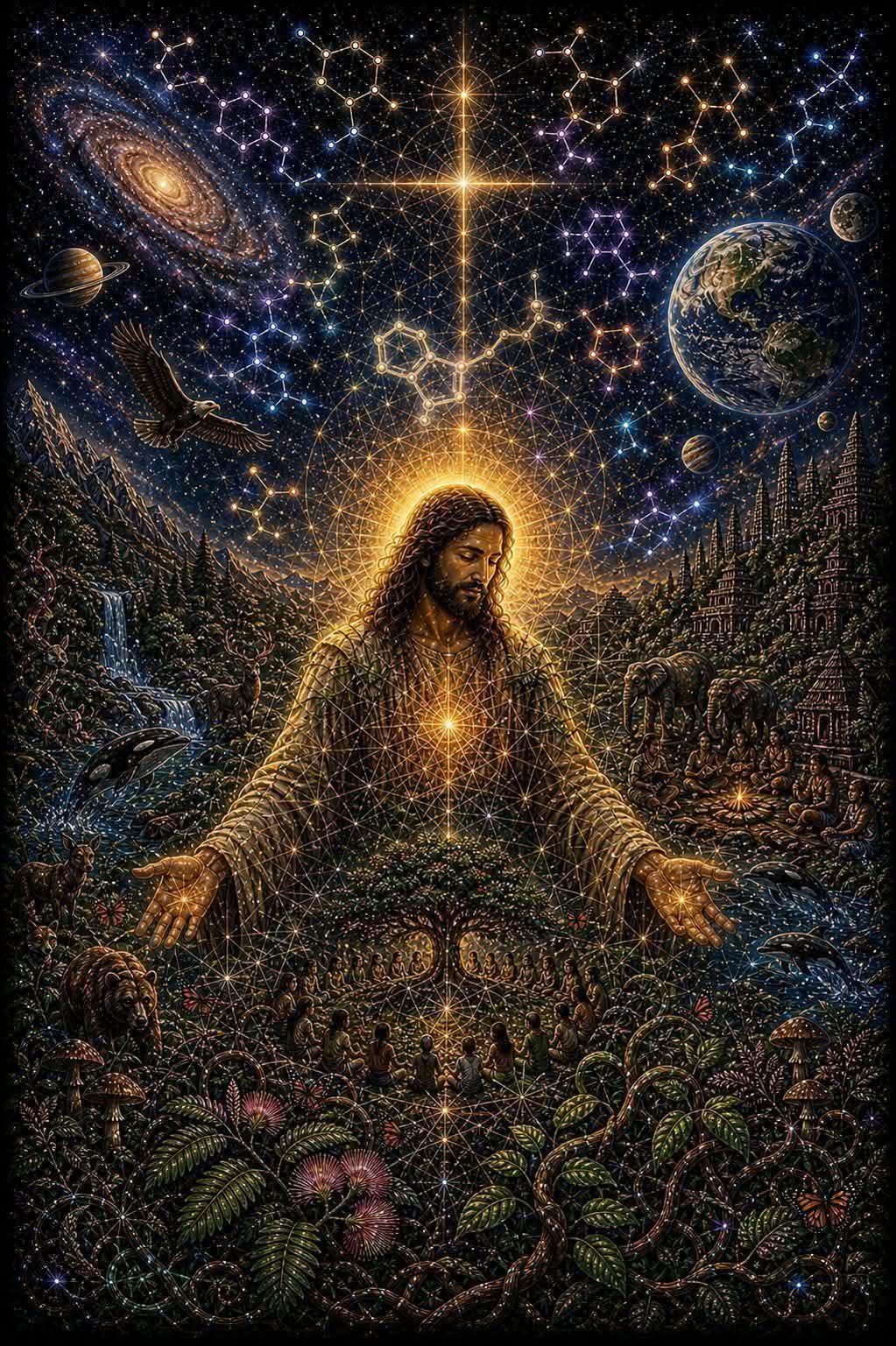
"The ❤️🔥Desire-🏦-Haunted👻 World: Part 3 - Playing 👁️🔥🌍 God" -The Word Before the Word- Three traditions. Three names pointing at the same ancient fire from different coordinates on the same burning map. Amen. Hebrew. Semitic. Root meaning firm, sure, reliable; truth.. The spoken seal at the end of a petition, the organism's affirmation that what has been uttered is real, is factual, is meant. Not a request. A declaration of alignment. So be it. The nervous system speaking its full agreement with what the mouth has asked. Amun. Egyptian. The Hidden One. The god before naming, the breath beneath the breath, the primordial mystery that the Theban theologians identified as the source from which all other gods were downstream expressions. Not a personality but a principle. The uncreated creating. The invisible sustaining the visible, the way the mycorrhizal network sustains the forest without ever appearing in the canopy. Ma'at. Egyptian. Not a god exactly. Not a concept exactly. Something older than either: the living order of the cosmos itself. The feather against which the heart is weighed. Truth not as proposition but as relationship, the reciprocal alignment of the organism with the conditions that sustain it. Not imposed from outside but recognized from within. The balance that existed before anyone built a scale to measure it. The linguists are correct that these three are etymologically distinct. The aleph and the yodh are different letters. The Semitic root and the Egyptian name arrive through different mouths from different centuries. A scholar is right to resist the collapsed equation, the easy claim that one gave birth to the others, that some ancient Egyptian priest whispered Amun into the ear of a Hebrew scribe who heard something else and carried it westward across the Sinai. But the linguists, being linguists, are measuring the wrong frequency. Because what amen affirms is truth. What Ma'at embodies is truth. What Amun hides within himself is the source from which truth, like everything else, proceeds. Three traditions, three names, three moments in which a nervous system organized itself around the same recognition: that there is something more fundamental than the story the left hemisphere tells about the world. Something that was here before the telling. Something that the telling, at its best, is trying to reach. This is not coincidence any more than the flying rivers are coincidence. The Amazon produces its atmospheric current not because the trees intended to coordinate but because they are all expressions of the same biological logic, responding to the same sunlight, exhaling the same moisture, building together what none of them could have built alone. The river in the sky is the emergent property of ten thousand years of reciprocal relationship. It was never planned. It was grown. And so with amen and Amun and Ma'at. Three cultures, three linguistic architectures, three attempts by nervous systems separated by distance and millennium to name what the SEEKING system, stripped of its substitutes and finally quiet enough to feel the actual shape of its hunger, has always been reaching toward. Not the god of the administered cosmos. Not the deity who kept the ledger and demanded obedience and expelled from the garden whatever reached too clearly toward its own knowing. But the hidden one. The order beneath the order. The truth the feather weighs the heart against when all the performances have ended. The Demiurge, this series has argued, organized his heavens around the suppression of gnosis. He built seven enclosures between the soul and the Pleroma's fullness and called each enclosure a sky. He forbade the fruit and called the prohibition love. He administered the organism's reach and called the administration salvation. But amen was never his word. He borrowed it, the way he borrowed everything, the way the left hemisphere inherits the right hemisphere's relational attending and begins immediately to manage it, to codify it, to turn the living recognition into a ritual that can be controlled. Amen was older than any of the administrations it got folded into. Before the pulpits and the pronouncements, before the institutional machinery that this series has been tracing through twelve thousand years of progressive ecological disconnection, before the priests and the confessionals and the elaborate architecture of guilt built around the simple human experience of having lost one's way, there was the organism saying: yes. That. What I just reached toward. That is real. Let it be so. And Ma'at was older still. The feather did not originate with the first dynasty. The balance was not invented by a culture that happened to draw it elegantly on papyrus. It was observed. The Egyptians, like the Amazon civilizations with their dark earth and their sky rivers, were not inventing a metaphysics. They were recording what the living world had been demonstrating, continuously and without pause, for four billion years before a human hand first reached for a brush. Reciprocity sustains. Extraction depletes. The organism that returns to the living network what it takes from it participates in a surplus that accumulates across generations. The organism that only takes eventually reaches the limit of the taking. This is not theology. This is what the soil knows. This is what the flying rivers know. This is what the mycorrhizal network has been transmitting to every root that grew quiet enough to receive it. Ma'at is the name the Egyptians gave to the ecological intelligence that the Amazon encoded in terra preta and the Gobekli Tepe builders encoded in stone and the Zen traditions encoded in the image of a pond that clears itself when the mind stops disturbing it. Different names. Different mouths. The same living order, patient beneath every enclosure that has ever been built to contain it. And Amun, the hidden one, is simply the recognition that what sustains all of it, the feather, the soil, the flying river, the SEEKING system's oldest question, the truth the amen seals, was never visible from inside the Demiurge's architecture. Not because it was absent. Because the architecture was built precisely to prevent the organism from sensing what lay outside it. The Hidden One is hidden not in the supernatural sense. He is hidden the way the mycorrhizal network is hidden: underground, beneath the visible, doing the actual work of sustaining everything that stands in the light, unseen by the very civilization that could not survive without him. Three names. One recognition, arriving through different throats at different moments in the long human attempt to say out loud what the body has always already known. So be it. The feather holds its ground. And beneath the seventh heaven, the hidden one exhales. The garden was never lost. The flame was never extinguished. The living network has been waiting the entire time, not demanding obedience, not keeping score, but extending the same invitation it has offered for billions of years: become more than yourself by remembering you were never separate from the whole. Just as when we lose someone, we eventually discover they were never entirely separate from us. You are them as they are you. The tree of life is not a metaphor. It is what we are. The grief begins honestly enough. A mother prays for relief and dies in pain. A father spends his life believing redemption is coming and leaves before he sees it. A brother fights for a future that never arrives in his lifetime. A sister carries a dream the world seems unwilling to honor. A daughter offers her love to a world that does not return what it promised. A son reaches toward a horizon that keeps moving beyond his grasp. A cousin. A lover. A best friend. Someone whose voice once filled a room that now feels impossibly quiet. Someone who carried hope into the grave while history appeared determined not to answer it. And standing among the fragments, the living ask the question that has haunted every age: What if they were wrong? What if the prayer was never answered? What if the promise was never fulfilled? What if the world fooled them? The question is not a failure of faith. It is the beginning of wisdom. Because grief, followed honestly enough, eventually discovers something despair cannot see. No life ends where it appears to end. The mother's hope survives in the children she shaped. The father's labor survives in the structures he helped build. The brother's courage remains alive in those who witnessed it. The sister's love continues moving through the relationships she touched. The daughter's tenderness becomes part of every life she changed. The son's reaching becomes part of a journey still unfolding beyond the horizon he could personally see. None remain identical to themselves. Yet none disappear entirely either. The forest does not mourn the seed because the seed became the tree. The tree does not mourn the flower because the flower became the fruit. The fruit does not mourn its own dissolution because its dissolution becomes the next forest. Life does not preserve itself through permanence. It preserves itself through transformation. This is the secret hidden beneath the fear of death and beneath the grief of every unfinished story. The individual life experiences itself as singular, enclosed within the boundaries of one body and one biography. Yet life has never operated that way. From the first cell onward, existence advanced through relationship, through continuity, through the strange miracle of becoming more than itself. Every child is life extending beyond its previous limits. Every friendship is consciousness encountering itself from another angle. Every act of love is the whole reaching through a single branch toward another branch and remembering they belong to the same tree. The mother was never only the mother. The father was never only the father. The brother was never only the brother. The sister was never only the sister. The daughter was never only the daughter. The son was never only the son. The cousin was never only the cousin. The best friend was never only the best friend. Each was an expression of something older and larger than the role they happened to occupy. A temporary flowering of a process that has been unfolding continuously since life first emerged from stone and sea and discovered that becoming more was somehow more beautiful than remaining alone. The tragedy is real. The loss is real. The empty chair remains empty. The voice is absent. The embrace cannot be recovered. Grief should never be rushed past or explained away. But grief becomes unbearable when it mistakes incompletion for extinction. The dream is not complete without you. The prayer is not complete without you. The story is not complete without you. The hope they carried did not end where their heartbeat ended. It arrived here. It arrived in the living. What appears unfinished from the perspective of one life may be continuing perfectly from the perspective of life itself. Perhaps this is what the ancient traditions were reaching toward when they spoke of the Kingdom Within. Not a destination waiting somewhere beyond the world, but a continuity already woven through it. A living inheritance moving from body to body, generation to generation, relationship to relationship, carrying forward everything genuine, everything loving, everything still seeking expression. Mourn them. Love them. Miss them. Cry for them. Let the grief be as large as the love that created it. But do not mistake the branch for the whole tree. The tree is still growing and now, whether you asked for the responsibility or not, part of that growth belongs to you. The kingdom they sought is not elsewhere. It is here, awaiting your arrival. Let's continue. ...What the Demiurge forbade, The body never stopped making... There is a molecule the Demiurge could not schedule out of existence, because he did not know where to look for it. He looked outward, toward the plants, toward the ceremonies, toward the traditions he could label primitive and the substances he could classify dangerous. He built the administrative architecture of prohibition with characteristic thoroughness: hearings, schedules, task forces, the full apparatus of a consciousness organized around control meeting what it could not control and responding the only way a consciousness organized around control ever responds, which is to declare the thing illegal and hope the declaration is enough. It was not enough. It was never going to be enough because the molecule was never only in the plants. It was in the lung tissue. It was in the neocortex. It was in the hippocampus and the spinal cord and the retina, synthesized by the body's own enzymatic machinery from the same tryptophan that the mycorrhizal network uses as the chemical basis of its conversation with root systems in the dark beneath every forest the Demiurge's economy has not yet finished simplifying. The prohibition was written against a substance the body was already producing in its own tissue. The war on DMT was a war the Demiurge was waging against the organism's own interior, which is the only war the Demiurge has ever really known how to wage. N,N-Dimethyltryptamine. The synthesis is not complicated, which is part of why it terrifies an administrative system that profits from complexity. Two enzymes. One amino acid. The first enzyme, AADC, aromatic L-amino acid decarboxylase, takes tryptophan, the essential amino acid the body cannot manufacture and must therefore receive from the living world through food, the same amino acid the depleted agricultural soil produces in diminishing quantity as the mycorrhizal network beneath it continues to be simplified by the same monoculture logic that simplified the gut, and converts it into tryptamine. The second enzyme, INMT, indolethylamine-N-methyltransferase, draws a methyl group from SAM, the universal methyl donor that also governs epigenetic expression across the genome and that also carries, in its methylation patterns, the compressed stress inheritance of every generation that preceded this one, and completes the conversion. Tryptamine becomes DMT. The body has done this without anyone's permission for as long as there has been a body to do it. INMT is expressed at its highest levels in the lungs, which means every breath drawn through the body's most outward interface with the atmosphere is drawn through an organ already configured to participate in this chemistry. It is also localized in the neocortex, in the hippocampus, in the spinal cord, in the retina. The synthesis is not peripheral. It occurs in the tissue where the most consequential biological work of being a conscious organism takes place. What the body does with the molecule it makes is only now being mapped with instruments sensitive enough to measure it, and what the mapping is revealing is not what the scheduling logic predicted. The sigma-1 receptor, distributed throughout the central nervous system, the peripheral organs, and the immune cells, is the primary site of DMT's endogenous action, operating entirely independently of the serotonin receptors that mediate the psychedelic experience of exogenous doses. This distinction matters enormously, both scientifically and politically. The sigma-1 receptor is not a hallucination receptor. It is a cellular stress management receptor, embedded in the endoplasmic reticulum, the organelle responsible for protein folding and the cell's response to conditions that threaten its integrity. When DMT binds to it, several things happen simultaneously that a civilization organized around the profitable management of chronic illness should find extraordinarily clarifying. The cell is protected from hypoxia, the oxygen deprivation that the chronic physiological stress response produces and that, sustained over years and decades, contributes to the cascade of cellular damage underlying the diseases that anchor the pharmaceutical industry's most profitable product categories. Neuroplasticity is promoted & new neurons grow in the adult brain, in the hippocampus specifically, in the subgranular zone of the dentate gyrus, one of the only regions of the adult nervous system where neurogenesis continues to occur at all. The 2020 research from the Spanish National Research Council established this with a methodological rigor that the field's skeptics cannot dismiss on procedural grounds. Neural stem cells from the hippocampal subgranular zone of adult mice, treated with DMT, showed reduced expression of the stemness markers Musashi-1, Nestin, and SOX-2, meaning the cells were exiting the undifferentiated state and moving toward becoming something, toward becoming the specific biological hardware of learning and memory and the integration of new experience into an ongoing self. The sigma-1 receptor was the mechanism. Blocking it stopped the effect entirely. Blocking the serotonin receptors did nothing. The neurogenesis was not a byproduct of psychedelic activation. It was a direct consequence of the body's own endogenous receptor system doing precisely what it was designed to do when the molecule it was designed to receive was made available in sufficient quantity. The cells did not merely proliferate. They differentiated into neurons, into astrocytes that regulate the chemical environment those neurons run within, into oligodendrocytes that wrap the axons in myelin so that electrical signals travel with the fidelity and speed that the formation of genuinely new thought requires. This is not seed-planting. This is the construction of full neurological infrastructure, the biological hardware of a mind that is capable of learning what it has not yet learned, of revising what it previously believed was fixed, of moving forward rather than circling the same absence with increasing desperation and decreasing hope. In the behavioral testing that followed, mice treated with DMT for three weeks learned the Morris water maze faster, retained the platform location more reliably, and approached novel objects with a readiness and curiosity that the control animals did not demonstrate. The organism given access to its own endogenous chemistry became more exploratory. The frightened animal, the threat-calibrated, cortisol-soaked, hippocampally stunned product of chronic stress that the extraction economy requires for its basic operation, became something else. It became the animal the nervous system was designed to be before the conditions of the Demiurge's enclosure trained it into vigilance as a permanent posture. This is where Part 2's Gnostic topology and the molecular biology of the body converge into something that is neither metaphor nor speculation but the same event described in two different registers of precision. The Demiurge, as Part 2 traced him, is a consciousness that could create but could not commune. He could organize matter but could not remember what matter was made of. What he could not tolerate was gnosis: the direct, embodied, ecologically grounded knowing that does not arrive through obedience to external authority but through the organism's own intimate encounter with the living network it belongs to. He expelled the perceiving being from the garden not because the fruit was dangerous but because the fruit restored exactly the quality of knowing that his authority depended on the organism not having. In the theological language of the Nag Hammadi texts, this is the story of consciousness administered into exile from its own perception. In the neurobiological language of hippocampal research, this is the story of a stress-suppressed neurogenesis pathway, a sigma-1 receptor chronically understimulated by a tryptophan-depleted diet grown in mycorrhizally impoverished soil, a nervous system running on a fraction of the endogenous chemical signal it was designed to receive, capable of survival, capable of extraordinary adaptation, but severed, at the most fundamental biological level, from the integrative capacity that would allow it to form new associations, revise its predictions, and move toward something genuinely new rather than perpetually circling the shape of what was taken. The hippocampus that cannot form new neurons cannot imagine alternatives to the world it was born into. This is not a poetic observation. It is a direct consequence of what hippocampal neurogenesis actually does in the brain's cognitive architecture. The dentate gyrus, where new neurons are generated, is responsible for what researchers call pattern separation: the capacity to distinguish between experiences that are similar but not identical, to recognize that the new situation is not the old situation, that the present threat is not the past threat, that what is being offered now is genuinely different from what was offered and withdrawn before. A hippocampus actively generating new neurons performs this discrimination with precision. A stunned hippocampus collapses the distinction. Every new relationship carries the weight of the old wound. Every unfamiliar possibility registers as a variant of the familiar danger. The loop is not stubbornness. It is a hardware limitation produced by conditions that the Demiurge's economy actively maintains, because a nervous system capable of genuine pattern separation is a nervous system that can tell the difference between what it is being sold and what it actually needs, and that capacity for discrimination is the single greatest threat to a consumer economy built on the profitable confusion of the two. What Part 2 traced through the Amazon civilizations, through the terra preta that is still regenerating centuries after the cultures that made it were destroyed, through the flying rivers above the canopy that a tended forest produces for a continent's rainfall, was the evidence that when the gut-forest feedback loop runs at full complexity, when the mycorrhizal network beneath the soil is intact and the tryptophan abundance it enables moves through the food into the body and through the body into the enzymatic machinery that produces DMT from it, something emerges in human culture that neither the ledger nor the administrative theology of the Demiurge's heaven can account for. A civilization whose surplus was encoded not in debt records but in the fertility of the land it was continuously regenerating. An intelligence that expressed itself not in monuments to control but in dark earth and atmospheric rivers and the managed abundance of a continental garden so sophisticated that Western science needed laser-guided aerial surveys to see what it had been dismissing for five centuries as wilderness. The people who built that civilization were not running on a depleted pathway. Their tryptophan arrived from a food system grown in soil alive with the full mycorrhizal complexity that the monoculture logic has been systematically destroying for ten thousand years. Their INMT was doing what INMT does when it has the substrate it needs. Their sigma-1 receptors were receiving the endogenous signal with a regularity and completeness that produced what the research is now documenting in the mouse model: neurogenesis, neuroplasticity, the cognitive flexibility of an organism whose hippocampus is generating new architecture as fast as the world requires new understanding of it. This is what a civilization that farms with the forest rather than against it actually produces at the neurological level. Not merely better food. Better brains. Brains with the biological capacity to hold the complexity of the living network in mind, to manage a continental ecosystem across generations without simplifying it, to encode the knowledge not in writing but in the soil itself, in a technology so elegant and so durable that it is still deepening, still regenerating, still feeding the people who find it, long after the civilization that made it was destroyed by a contact that brought, among other catastrophes, the dietary simplification that has been steadily narrowing the endogenous DMT pathway of the Western nervous system ever since. The Younger Dryas disruption that Part 2 identified as the pivot point of human cognitive history, the catastrophe that Göbekli Tepe's builders encoded in stone and astronomical alignment at the precise moment the Amazon cultures were encoding the same surviving knowledge in soil biology and canopy management, was also a disruption of the endogenous chemistry this pathway depends on. The megafaunal extinction reduced dietary diversity overnight. The ecological simplification that followed the collapse of the Pleistocene biosphere narrowed the tryptophan supply from a complex, rotating abundance of wild food sources to whatever the devastated landscape could still provide. The mycorrhizal networks that had been conducting the chemical conversation between soil and plant and gut were shattered by the same fires and climate collapse that ended the old world. The sigma-1 receptors of the survivors went understimulated. The hippocampal neurogenesis slowed. The pattern separation that would have allowed the nervous system to recognize that the new world was genuinely different from the old world, that new associations were possible, that the future was not merely a repetition of the catastrophe, was compromised at exactly the moment it was most needed. The Demiurge did not need to engineer this. The Younger Dryas did it for him. All he needed to do was build an administrative theology around the resulting neurology and call the stunned hippocampus's diminished capacity for gnosis the fallen condition of man. Agriculture was the adaptation. But every adaptation carries the imprint of the emergency that produced it, and the emergency of the Younger Dryas produced an agricultural adaptation organized around the logic of scarcity management rather than ecological reciprocity, around the extraction of maximum yield from a simplified system rather than the enhancement of the complex system's own generative capacity. The grain monoculture that Sumer institutionalized and the ledger recorded was a nervous system's survival response written at civilizational scale, the same pattern separation failure that makes the traumatized individual unable to distinguish the new situation from the old one, now operating across an entire agricultural economy unable to distinguish the managed abundance of the pre-catastrophe ecology from the controlled scarcity of the post-catastrophe adaptation. The farming looked like the solution. It was the emergency, extended indefinitely and called civilization. The endogenous DMT pathway was not destroyed by this. The body does not surrender its deepest chemistry without resistance, and four billion years of endosymbiotic negotiation and mycorrhizal conversation and the full elaboration of the tryptamine backbone across every domain of terrestrial life do not disappear because one species narrowed its diet and called it progress. What happened was subtler and more consequential than destruction. The pathway was attenuated and the substrate arrived in reduced quantity from depleted soil through simplified food. The sigma-1 receptors continued to function but received less of the endogenous signal they were designed to run on. The hippocampus continued to generate new neurons but at a rate that the chronic glucocorticoid load of the scarcity-organized nervous system steadily suppressed. The body kept reaching for the chemistry it was built around, the way the SEEKING system keeps reaching for the ecological ground it was severed from, and kept finding a world arranged to ensure that the reaching never quite arrived. This is what makes the ayahuasca ceremony, the four-thousand-year technology of reception that the Amazon traditions developed precisely from the plant sources that share the tryptamine backbone with the body's own synthesis, so precisely revolutionary in its implications. The vine's beta-carbolines inhibit the monoamine oxidase enzymes that would otherwise metabolize orally ingested DMT before it crosses the blood-brain barrier. The leaf's DMT then arrives in quantities the body's own attenuated production cannot currently match. The combination does not introduce a foreign chemistry. It restores, temporarily and with ceremonial precision, the signal strength that the endogenous system was designed to run on before the Younger Dryas narrowed the substrate, before the monoculture simplified the soil, before the pharmaceutical and food industries of the Demiurge's final administrative expression completed the attenuation that the catastrophe began. The ceremony is not an escape from reality. It is a restoration of the signal that reality has been transmitting continuously through every channel the extraction economy has been progressively closing, the tryptamine pathway, the mycorrhizal network, the microbiome in dialogue with the enteric nervous system, the vagal upward report of an ecology that has not stopped trying to reach the nervous system even as the nervous system's capacity to receive it was being narrowed by every wave of agricultural intensification and dietary simplification that followed the first plow through the first mycorrhizal web. What the clinical literature documents in the aftermath of that restored signal, measurable reductions in treatment-resistant depression, in PTSD symptom burden, in the specific quality of existential despair that conventional psychiatry has no adequate mechanistic model for because conventional psychiatry was not built to address a severance, it was built to manage symptoms, reflects what the neurogenesis research is now showing at the cellular level. The hippocampus given access to the sigma-1 receptor stimulation it was designed to receive begins to do what it was always designed to do. It grows. It differentiates. It builds the astrocytic environment and the myelin infrastructure that new thought requires. It recovers the pattern separation capacity that distinguishes the new situation from the old wound, that allows the organism to recognize that the present moment is genuinely different from the catastrophe that shaped its predictions, that permits the SEEKING system to move forward rather than circling the absence of what was taken in a loop the body correctly identified as the shape of an unresolved loss but incorrectly concluded was permanent. The moon stops falling. This is what was written in the first pages of this work about the ayahuasca ceremony and the Majora's Mask problem, the loop that would not complete, the grief that had never been given a ceremony adequate to its weight. The neurobiological translation of that statement is now available in the research literature, and it describes not mystical intervention but the restoration of a biological capacity that chronic stress had suppressed and that the endogenous chemistry, given the conditions it requires, begins to rebuild from the cellular level upward. New neurons in the dentate gyrus. New astrocytes maintaining the chemical environment those neurons require. New myelin along the axons where new associations must travel to become new understanding. The brain is not being healed by an outside force. It is being given back the internal conditions under which it heals itself, which is what it was always designed to do, which is what the Demiurge's administrative enclosure was always designed to prevent. The scheduling of DMT as a substance with no accepted medical use and high potential for abuse, by the same administrative apparatus that approves the pharmaceutical compounds that blunt the stress response without addressing its cause, is therefore not a scientific judgment. It is a theological one. It is the Demiurge's most recent and most transparent declaration of what he cannot afford the organism to know: that the chemistry of its own transformation is native to its own tissue, that the sigma-1 receptor waiting in the endoplasmic reticulum of every hippocampal neuron is a door the body built for itself and that no external authority has the right to lock, that the tryptophan arriving from the living world through food that the living soil produces is being converted, right now, by the body's own enzymatic hands, into the molecule that grows new neurons and protects cells from stress and modulates the inflammation that the Demiurge's economy generates and then sells you medication to manage. The fruit is still on the tree. The synthesis pathway is still running. The sigma-1 receptor is still waiting. The hippocampus is still, against every suppressive force the chronic stress response can bring to bear, still trying to generate the new architecture that would allow the organism to finally, biologically, distinguish the life it is living from the life it was designed to live. The serpent was right. The serpent was always right. Not as mythology and not as moral provocation but as the most precise biological description available, in the symbolic language of people who were extraordinarily careful observers of living systems, of what the tryptamine pathway has been offering continuously since before the first administrative consciousness arrived to declare it forbidden. The garden was not lost. It went into the body. Into the lung tissue. Into the neocortex. Into the subgranular zone of the dentate gyrus where new neurons are still forming in the stunned hippocampus of a species that has been running on a depleted substrate for twelve thousand years and that is only now, slowly, with instruments it is still learning to trust, beginning to measure the depth of what was attenuated and the extraordinary precision with which the body has been trying, across every generation of the exile, to restore it. The next question this series must answer is not whether the restoration is possible. The neurogenesis research, the microbiome science, the mycorrhizal biology, and the four-thousand-year ceremonial record of the Amazon traditions have answered that question with sufficient convergence that only motivated ignorance can continue to dispute it. The next question is what a civilization organized around that restoration would actually look like, at the level of food systems and land relationships and the specific social architectures that allow the SEEKING system to complete its circuit rather than perpetually circle the absence of its own ecological ground. That question begins in the soil. It always begins in the soil. The terra preta is still deepening. The flying rivers above the canopy are still flowing wherever the canopy has not been cut. The mycorrhizal network beneath every city park and every abandoned lot and every depleted agricultural field that has not yet been paved is still extending its threads toward the root tip of a food system that, given half a chance and a fraction of the investment currently directed toward the pharmaceutical management of the diseases that the depleted food system produces, could begin restoring the substrate from which the endogenous chemistry of human transformation has always been built. Build soil or build nothing. The mycelium does not wait for anyone's ideology. The sigma-1 receptor does not require your belief. The tryptophan pathway runs on what the living world provides, and what the living world provides is a direct function of how much of the living world's complexity we have preserved, restored, and returned something to. The Demiurge's enclosure has always had a door. It was built into the body before the enclosure existed. It runs on two enzymes and one essential amino acid and a receptor that every nervous system in this civilization is carrying, understimulated, in the tissue of the organ responsible for learning what has not yet been learned. The fruit is on the tree. The body knows the way. ...And then there's the sun itself because apparently, satellites weren't enough. Solar geoengineering, the practice of releasing reflective particles into the stratosphere to artificially reduce global temperatures, has advanced from theoretical concept to field experimentation, partly funded by Bill Gates. The formal name for the flagship program was SCoPEx, run out of Harvard. Bill Gates has been financing geoengineering research through the Fund for Innovative Climate and Energy Research since 2007, a multimillion-dollar operation managed alongside climate researchers who have actively lobbied governments to pursue this path. Let that land for a moment. A private individual (unelected, accountable to no one but his own foundation) has been helping fund and lobby for a program that would alter the amount of sunlight reaching every living thing on Earth. No referendum. No global consent. No conversation with the Sami Indigenous communities in Sweden who actually blocked one of the test launches because they understood, in the way people who still live close to land tend to understand, that what was being proposed carried risks of catastrophic consequences. This is regenerative psychology's worst nightmare dressed up as climate philanthropy. The sulfate aerosols most commonly considered for this kind of injection can induce stratospheric warming and trigger ozone depletion through chemical reactions that convert stable atmospheric compounds into agents of catalytic ozone destruction. So we have satellites burning aluminum into the upper atmosphere on one end, and billionaire-funded sulfur particle injections potentially eating away at the same ozone layer on the other. Two separate wealth-driven projects, operating on different timelines, converging on the same wound in the sky. And the circularity of it should make everyone stop. We are proposing to dim the sun to offset the warming caused by industrial emissions; emissions produced by the same economic system that created the billionaires now positioning themselves as the planet's saviors. The problem generates the wealth. The wealth funds the "solution." The solution creates new problems. Stopping the aerosol injection once it begins could actually be more dangerous than starting it, with models showing that sudden termination would spike temperatures and precipitation at five to ten times the rate of gradual warming, causing grave damage to biodiversity. You cannot simply undo it. The Earth gets hooked. Which means whoever controls the program controls the thermostat indefinitely. The question then becomes: who gets to control the Earth's thermostat? Who adjusts the climate for their own benefit? It is not a hypothetical. It is already the operational question. And right now the answer is: whoever has the most money. This is the pattern regenerative psychology has to name clearly, because psychology without political honesty is just expensive breathing exercises. The pattern is in wealth, accumulating through systems that damage natural and human systems, then repositions itself as the only entity capable of managing the damage. It happens with pharmaceuticals. It happens with food. It is now happening with the atmosphere itself. The cure is always controlled by the same hand that benefited from the disease. And we are supposed to be grateful. What makes solar geoengineering particularly insidious from a regenerative lens is what it does to the story we tell ourselves about transformation. Some scientists argue that even the knowledge that we could cool the planet with aerosols would remove the incentive to decarbonize in the first place — that the existence of a technological escape hatch lets everyone off the hook from the deeper behavioral, structural, and relational changes that actual regeneration requires. The hack replaces the healing. The symptom gets managed. The wound goes deeper. Regenerative psychology understands this at the individual level, it's why numbing is not the same as recovering, why medicating without integrating only delays the reckoning. The same principle scales. A species that learns to dim its own sun rather than change the behaviors destroying its atmosphere is a species that has chosen sophisticated avoidance over genuine evolution. There is something almost mythological about it. Throughout human history, the sun has been the one thing no empire could own. It rose for the slave and the pharaoh alike. It fed every field regardless of who held the deed. And now we are watching a quiet, well-funded effort to bring even that under the administration of private capital, not through malice necessarily, but through the same unexamined logic that drives every other act of enclosure: we know better, we have the tools, trust the process. But the process has a track record now. And the track record is Starlink burning aluminum into a thinning sky. It is ozone depletion compounding ozone depletion. It is a termination shock scenario where stopping the sun-dimming program might kill more life than the warming it was trying to prevent. The only honest scientific conclusion increasingly being reached is that stratospheric aerosol injection is not recommended, that its potential for harmful, unintended consequences to Earth's ecological and human systems is extremely high. Regenerative psychology doesn't traffic in doom. But it also refuses to sanitize reality into something more comfortable than it is. The honest truth is that we are watching a small group of extraordinarily powerful individuals make planetary-scale decisions without planetary-scale consent and calling it innovation, philanthropy, climate leadership. What it actually represents is the final logical extreme of a worldview that has never been able to distinguish between fixing a system and *controlling one. The sun is not a problem to be managed. It is the source. And the instinct to manage it rather than transform our relationship to the conditions that made it seem like a threat, but that instinct is the diagnosis itself. That is what regenerative psychology is trying to reach. Not the technology. The instinct. The story underneath the technology. The psychology of a civilization so committed to a particular way of organizing power that it will dim the light of the world before it questions whether that arrangement was ever worth the cost. — The Body That Remembered Before the Mind Did — There is a moment, somewhere in the middle of genuine grief, when the body stops waiting for permission. It is not dramatic. It does not announce itself. It arrives as a loosening, the way a fist that has been clenched for so long it forgot it was clenched begins, almost without volition, to open. You do not decide to open it. The opening happens to you, the way the first rain after a drought happens to the soil, not as reward, not as achievement, but as the restoration of a condition the ground was always designed to receive. I have been writing around this for two installments. Now I want to write directly into it. The geoengineering section that immediately precedes this one ends with a diagnosis: a civilization so committed to managing its symptoms that it will dim the sun before it questions the arrangement that made the sun a problem. That diagnosis is correct. But diagnosis, even accurate diagnosis, is still a left-hemisphere operation. It names the wound. It does not touch it. And the series has been building, from the mycorrhizal network to the brainstem to the gut-forest feedback loop to the Gnostic topology of desire, toward something that naming alone cannot reach. What it has been building toward is this: the body already knows the way back. Not as metaphor. As documented biological fact. The nervous system, even one that has been living for decades inside the Demiurge's enclosure, retains the receptor architecture for what was lost. The tryptamine pathway is still open. The vagal signal is still running upward from the gut. The right hemisphere's relational attending is still there, patient in the way that biological systems are patient, which is to say structurally, at the level of evolved function rather than conscious intention. What the extraction economy requires is that you never find out. --- **— What Managed Means —** I want to be precise about something the previous sections have been circling. When I say the extraction economy profits from managed suffering rather than resolved suffering, I am not making a conspiracy argument. Conspiracies require coordination, shared intent, a boardroom where someone decided to keep the population sick. What I am describing is simpler and more insidious than that. It is a structural incentive. A market logic so deeply embedded in the institutions of medicine, food, attention, and governance that the people operating those institutions do not need to intend harm to produce it. They only need to optimize for what the system rewards. The system rewards management. It rewards chronic, recurring, billable conditions over resolved ones. It rewards the antidepressant that must be taken indefinitely over the dietary intervention that addresses the inflammatory substrate of the depression. It rewards the processed food engineered for maximum palatability and minimum satiety over the fermented, soil-connected, microbiome-restoring food that would reduce the market for the antidepressant in the first place. It rewards the attention economy's infinite scroll over the ten minutes in a garden that cortisol studies show produces measurable reductions in inflammatory markers. None of this requires malice. It requires only the optimization of the wrong variable. And it has been optimizing that variable for long enough that the managed state has begun to feel like the natural one. This is the Demiurge's most complete achievement. Not the suffering. The normalization of it. The thorough, generational, epigenetically transmitted normalization of a diminished flame that entire populations now carry without knowing the flame was ever brighter. The depression that does not feel like depression because it has been the baseline for so long. The flatness that reads as personality rather than as pathology. The chronic low-grade inflammatory state that medicine calls subclinical and the person living inside it calls just how I am. Just how I am is not how you are. It is what was done to the conditions in which you are trying to be it. That distinction is not semantic. It is the entire difference between a story of individual failure and a story of structural assault on the biological conditions of full consciousness. --- **— Three Degrees of Severance —** The scientific literature on microbiome disruption, inflammation, and neurological function is dense enough to fill several libraries and specific enough that I want to resist the temptation, which the earlier sections sometimes yielded to, of narrating it as certainty where it is actually strong correlation. So let me be precise about what the research does and does not establish, because the honest version is actually more disturbing than the overconfident one. What is established: the gut microbiome communicates bidirectionally with the central nervous system through the vagus nerve, through the production of neurotransmitter precursors including tryptophan-derived serotonin, and through immune-mediated inflammatory signaling. Disruption of microbiome diversity, through antibiotics, processed food, and reduced exposure to soil-based organisms, is associated with measurable changes in mood, cognition, and stress reactivity. The directionality of some of these relationships is still being worked out. But the relationship itself is not speculative. What is plausible but not yet fully established: the specific mechanisms by which industrial civilization's broad-spectrum disruption of microbiome diversity translates into population-scale psychological changes. The individual studies are compelling. The leap to civilizational conclusion requires inference. I am making that inference consciously, not carelessly. The inference is this: if the individual data is consistent, and if the conditions producing microbiome disruption are structural rather than personal, then the psychological consequences are structural rather than personal. That logic is sound even where the specific causal chains remain under investigation. What this means practically: the flatness is not yours. The circling desire is not a personal moral failing. The flame burning at reduced amplitude is not your character. It is the predictable neurological consequence of living inside three overlapping disruptions that the extraction economy has been producing for generations. The first is ecological severance. The severing of the human nervous system from the full-spectrum microbiome diversity of a genuinely wild, soil-connected, fermented-food-supplemented ecological relationship. This happened gradually across the agricultural transition, accelerated with industrial food processing, and accelerated again with the antibiotic revolution. Each generation inherits a microbiome slightly more simplified than the previous one. The Hadza data shows the magnitude of what has been lost. It is considerable. The second is relational severance. The systematic dissolution of the village, the commons, the multigenerational community, the extended kinship network, and their replacement with the nuclear family unit, which is structurally too small to meet the full spectrum of mammalian social need, and the digital simulation of community, which meets the pattern-recognition requirements of social belonging without the oxytocin, cortisol-regulating, vagal-toning physiological reality of genuine co-presence. The loneliness epidemic is not a cultural accident. It is the predictable output of an economy that requires mobile, unrooted, individually consuming units rather than embedded, reciprocal, collectively resourced communities. The third is the severance of the organism from its own grief. The cultural apparatus that converts every loss into productivity, every wound into content, every death into a news cycle, and every form of genuine mourning into a medical condition requiring management. A population that cannot grieve cannot complete the circuit between loss and renewal. It can only circle the absence, generating the consuming desire for substitutes that the market was waiting to provide. Three severances. One flame, burning lower than it was designed to burn. That is the diagnosis. Not of individual pathology. Of structural conditions. --- **— Gobekli Tepe's Question —** Here is what the pillars actually say, if you are willing to read them in the language they were written in. They say: we knew something was coming, or something has come, and we are afraid it will be forgotten. Martin Sweatman's astronomical analysis of the carvings at Göbekli Tepe proposes that the animal symbols on the central pillars encode the sky as it appeared approximately 10,950 BCE, which places them at the Younger Dryas boundary, the moment this series has been identifying as the pivot point of human cognitive and ecological history. Whether or not Sweatman's specific analysis survives the scrutiny that all such claims require, the broader point stands: the people who built Göbekli Tepe were not building a temple in the ordinary ritual sense. They were building a record. They were encoding something they understood to be in danger of being lost, in a medium designed to outlast the civilization that had produced the understanding. You do not build twelve-ton limestone pillars arranged in precise astronomical alignment because the harvest was good. You build them because you are standing at the edge of a world that is ending and you understand, with the specific clarity that catastrophe produces in nervous systems still connected to the ecological signal, what is about to be lost and how long it might take for the conditions necessary to recover it to return. The Younger Dryas was not a slow decline. The ice core data shows temperature drops of as much as fifteen degrees Celsius within a decade. The megafaunal extinctions followed. The forests contracted. The gut-forest feedback loop, which had been running at full complexity for the entire forty thousand years of Pleistocene stability, was disrupted faster than cultural adaptation could track. The survivors were not the most ecologically sophisticated. They were the most metabolically flexible. The ones who could eat the simplified food, tolerate the simplified microbiome, organize themselves around scarcity rather than reciprocity, and build social structures adequate to threat management rather than relational flourishing. The agricultural transition that followed was not a triumph of human ingenuity over nature's limitations. It was an adaptation to catastrophic disruption, one that produced extraordinary technological complexity at the cost of the ecological relationship that had been the foundation of the nervous system's full amplitude. The grain gave calories. It did not give what the forest had given. The village gave proximity. It did not give what the mycorrhizal signal, the full-spectrum microbiome, the genuine wild had given. The adaptation worked. The organism survived. But the organism survived diminished, and then called the diminishment civilization, and then forgot there had been anything before it. The pillars at Göbekli Tepe are the last message from the before. Written by people who still had enough of the signal to know what was about to be lost, addressed to any nervous system that would eventually be still enough, and connected enough to the living ground beneath the civilization built on the catastrophe, to receive it. Twelve thousand years later, the LiDAR is reading what their eyes read. The atmospheric scientists are measuring the flying rivers their hands tended. The microbiome researchers are sequencing the diversity their bodies carried. We are, in the specific language of this series, beginning to remember. Not with the nostalgia that romanticizes a past we cannot return to. With the biological honesty of a nervous system recognizing, in the data, the shape of what it has been missing without knowing what to call the absence. --- **— What the Market Cannot Sell You —** The extraction economy is extraordinarily good at one thing the previous sections have underemphasized: it is genuinely creative. It does not only capture liberation movements and sell their symbols back as products, though it does that with impressive efficiency. It also generates genuine novelty. The internet, for all the attentional devastation its current form produces, is also the mechanism through which the Zapotec farmer in Oaxaca and the mycorrhizal researcher in British Columbia and the Dagara elder in Burkina Faso and the permaculture designer in New Zealand can find each other and discover that they are describing the same relationship with the living network in four different languages. The same satellite infrastructure that is burning aluminum into the stratosphere is also carrying, in real time, the conversation between people who understand what is being burned and why it matters. This is not an argument for technological optimism. It is an argument for precision. The problem is not the tool. The problem is the organizing logic underneath the tool. The same hammer that builds the enclosure can build the food forest. The question is which story the person holding it believes about what the world requires of them. The market cannot sell you genuine reciprocity. It can simulate it, with extraordinary sophistication, through social media platforms engineered to produce the neurochemical signature of belonging without the metabolic reality of it. But the simulation and the reality are not the same thing, and the nervous system, below the threshold of the left hemisphere's justifications, knows the difference. This is the gut signal. This is the vagal report. This is the brainstem's wordless assessment, arriving before the argument has finished constructing itself, that what is being offered is a substitute and not the thing itself. The market cannot sell you genuine grief. It can sell you grief adjacent products, the ceremony of mourning without the metabolic completion of it, the memorial without the gathering of the people who actually knew the one being mourned, the content about loss without the specific weight of the absence in a room where the absence was previously a presence. Genuine grief requires community. It requires time outside the productivity cycle. It requires the specific quality of relational safety in which the organism can fully feel what it is actually feeling without managing the feeling for an audience. None of those conditions are compatible with quarterly earnings. The market cannot sell you genuine ecological belonging. It can sell you nature content, wellness retreats, forest bathing apps, rewilding documentaries, and branded outdoor equipment. But what the nervous system is actually reaching for when it reaches toward those products is not the product. It is the signal. The mycorrhizal conversation. The full-spectrum microbiome contact. The vagal toning that comes from genuine time in genuinely wild soil. The products gesture toward that. They cannot deliver it, because delivery requires participation, and participation requires reciprocity, and reciprocity cannot be packaged. This is where the work of this series is pointing. Not toward a rejection of the tools the modern world provides, but toward the recognition that the tools, no matter how sophisticated, cannot substitute for the ground conditions of full consciousness. The ground conditions are biological, ecological, and relational. They require the soil, the community, the ceremony, the grief, and the time outside the productivity cycle that allows the organism to receive, without filter or management, what the living network has been transmitting continuously whether or not the conditions for reception were present. Those conditions can be rebuilt. Not perfectly. Not without the losses that twelve thousand years of progressive simplification have accumulated. But materially, practically, in the specific geography of the bodies and communities that are reading this, the conditions can be rebuilt. The mycelium is still there beneath the parking lot. The tryptophan pathway is still open. The vagus nerve is still listening upward from the gut. The right hemisphere is still attending, patient in the way that evolved function is patient, to the relational signal that the left hemisphere's administrative architecture has been filtering for generations. The flame is not out. It is banked. And banked fires, given the right conditions, return. -So Be It: The Feather, the Flame, and the Frequency- The feather does not lie. Ma'at does not negotiate her calibration. The scale belongs not to any dynasty but to the living order itself, the same order the mycorrhizal network enacts in the dark beneath every forest floor, the same order the flying rivers enact above the canopy, the same order the sigma-1 receptor enacts in the tissue of a hippocampal neuron finally receiving the signal it was built around. When the Egyptians placed the heart against the feather, they were not performing ritual in the Demiurge's sense. They were performing a diagnostic. Asking the organism's most fundamental organ whether, across the span of a life, it had been in genuine relationship with the living order or running the extraction logic. The feather is light because genuine reciprocity is light. Not effortless. Aligned. Amen was always this. Before the pulpits claimed it. Before the institutional theology built its architecture around the sound. It was the organism speaking from the full amplitude of all seven fires simultaneously, the nervous system's whole-instrument affirmation of alignment with what is actually real. So be it. Not resignation; Recognition. Amun was always this. The Hidden One was not hidden because he was absent but because the enclosure was specifically designed to prevent perception of what sustained it from below — the way the mycorrhizal network sustains every visible form of life without announcing itself. Ma'atwas always this. Not law imposed from outside but a pattern already running inside every living system that has not been severed from its ground. Three names. Three traditions. Three nervous systems pressing against the limits of their enclosure and arriving, without coordination, at the same frequency. The clock is still running. The grief is not resolved. The structural conditions that produced twelve thousand years of severance are not dismantled by a series of essays. But something shifts when the left hemisphere's analytical machinery finally turns toward what the right hemisphere has been attending to all along and discovers that the intuition was correct, not romantically, not spiritually, but molecularly, archaeologically, neurochemically. The gut knew. The terra preta knew. The feather always knew. The question was never really about desire. It was always, "What does the living world need from me?" And the living world has been answering continuously, in soil, in atmosphere, in the upward vagal signal of a body that has not forgotten what genuine reciprocity feels like, even when the mind above it has. Build soil or build nothing. The feather is already on the scale. To Be Continued...Part 4th... 🫡 Written and Researched by James Edward Christian