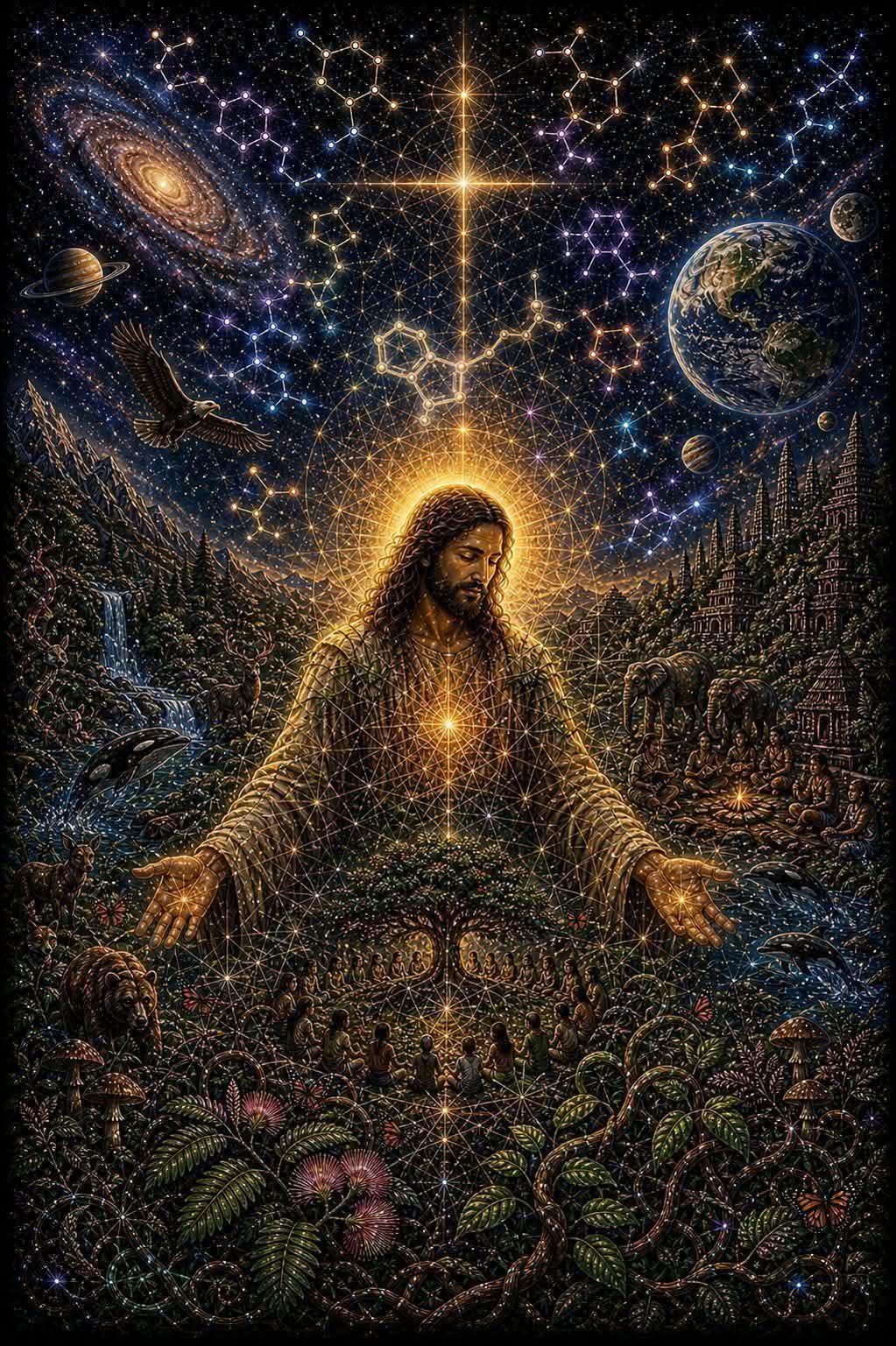
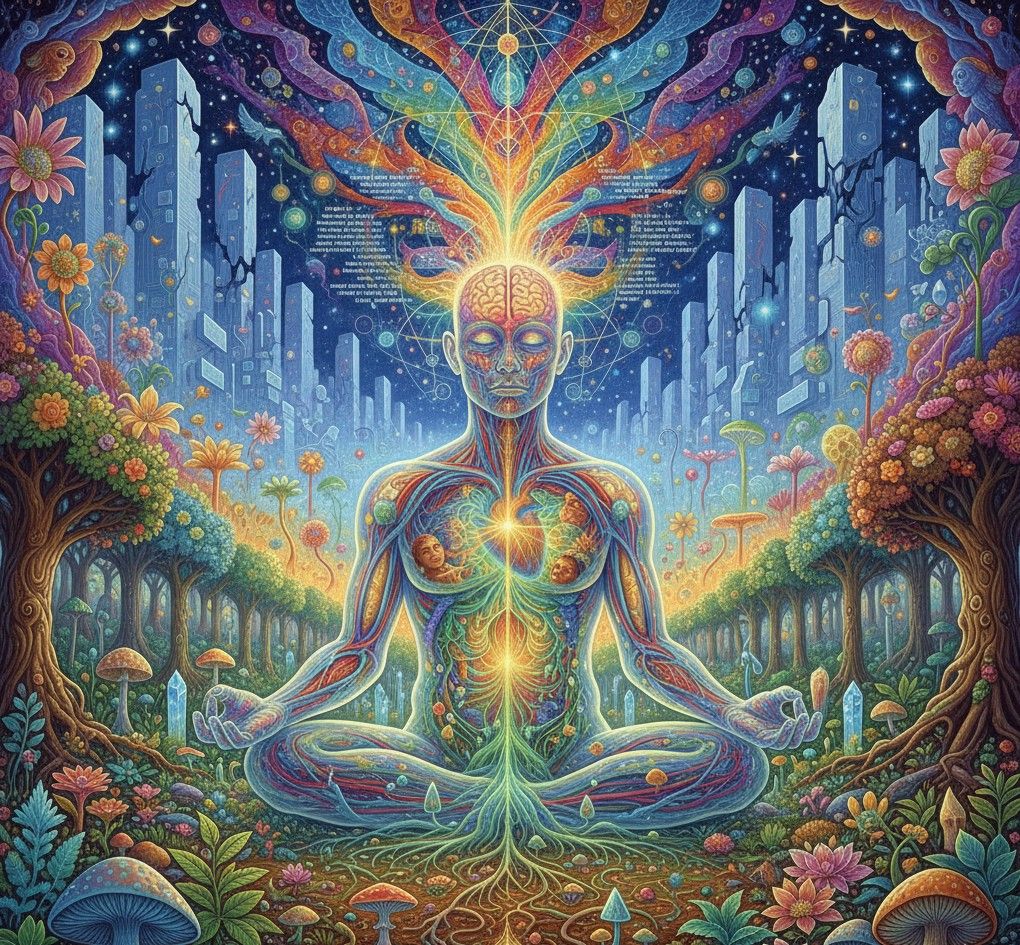
James Edward Christian
James Edward Christian Facebook ad: “The Archonic Elite”
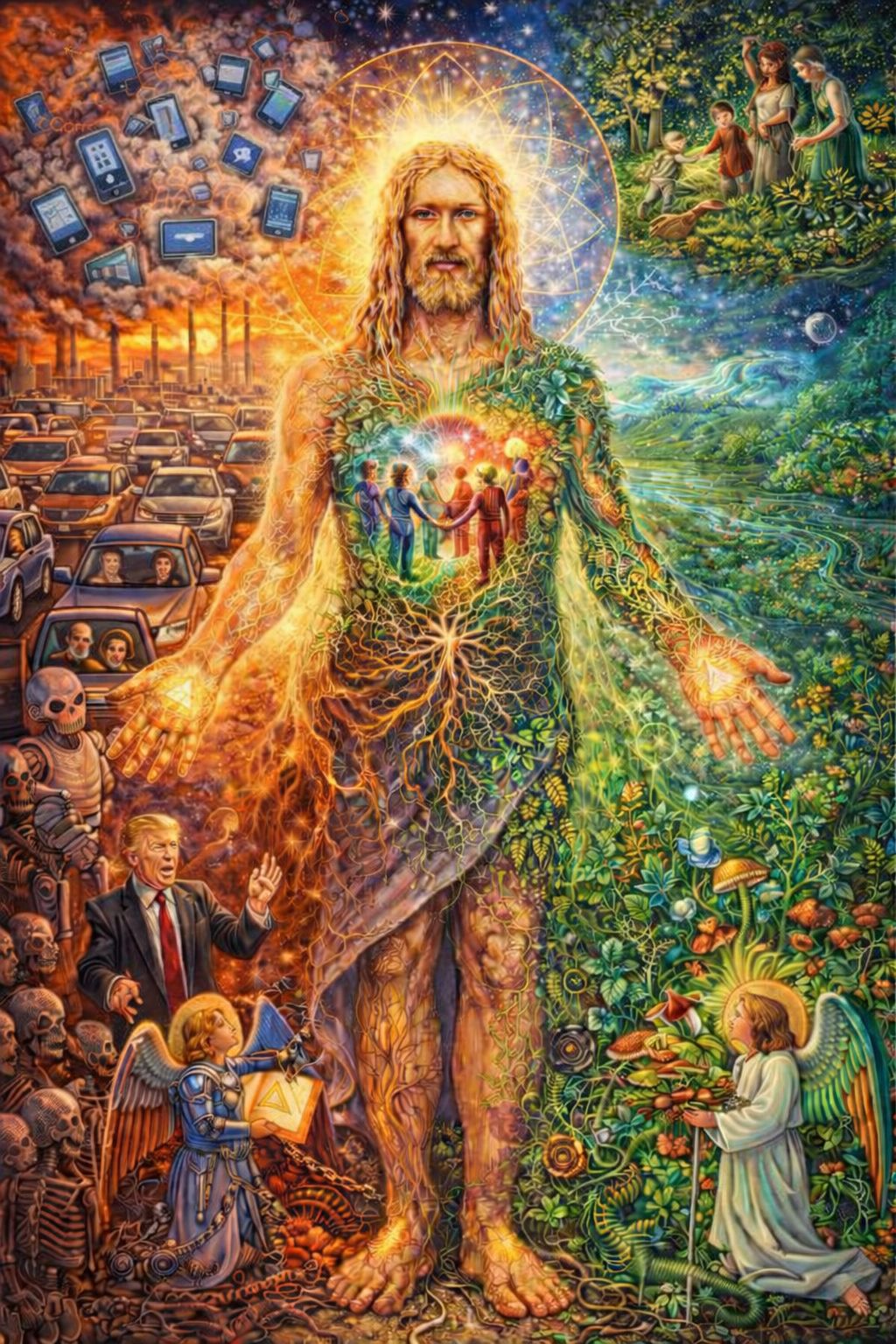
Ran for 5 days, from April 16 to April 21, 2026, the last day Crush saw it.
Run by James Edward Christian on Facebook. Crush is not the advertiser and does not verify its claims. See this ad in Meta's Ad Library(opens in a new tab)
Want an ad like this for your product?
Crush makes new ad images for your product from this ad: your logo, your product photo, your offer.
Trials from $19.95 USD, then $79.95 USD a month. Cancel anytime.
About this ad
- Meta Ad Library ID
- 1729192735161884
- Platforms
- Facebook, Instagram and Audience Network
- Relaunches
- 0
Ad text
"The Archonic ☣️🔥☢️ Elite and the Christ 🍄🧠🌱 Within: Part II - ✨ Easter, Media, Christ in the Anthropocene... ...and 🫡 Exploring 🧐 the 🌍 Regenocenic 🕸️ Map" Really make sure that you read Part I first. 🙏 -Beyond Manifestos; Beyond False Idolization: Protopian Regenerative Capitalism- Everyone’s arguing…but nobody’s actually entirely wrong. That’s a structural problem. So while my research and integrated work reads like a manifesto, it doesn’t divide like one, making it the anti-manifesto of manifestos to avoid tyrannical dictation. It maps patterns rather than assigning villains. A manifesto-driven agenda tells us what to believe, what to follow, and what to stand against. It draws lines, even when those lines are drawn with good intention. What is emerging here is something different. It is not a call to adopt a new position, but an invitation to recognize a shared condition: that we are already participants within a living system that does not require our division 🔵 to 🔴 function. ✨ The oppositions we inherit (spiritual & scientific, left & right, sacred & secular) begin to dissolve when seen as fragments of a larger wh🌎le attempting to understand 👁️ itself. What replaces them is not uniformity, but a decentralized evolution forward in human intelligence: a community not built on foreign centralized debt agreements beyond individual activity, but on direct and immediate relationship branching from within👁️outward bey🌍nd. In this sense, what we are moving toward is not a manifesto, but a form of communion: a shared awareness that does not demand belief, only participation in the living processes that sustain us all... This is why what follows cannot be reduced to a manifesto, nor contained within existing systems. It points instead toward a transitional understanding we might describe as regenerative extraction: a shift in how value is perceived and enacted. 🟣 Extraction becomes reciprocal, returning and restoring what it draws from. 🪙🏦👨💼 Wealth moves away from centralized abstraction toward decentralized relationship, 🍄🧠🦠 where what we earn is measured in the vitality of local ecologies and the living ratios that sustain them. Value is no longer accumulated in isolation, but circulated through regeneration; not depleted, but renewed. This is not a replacement of one system with another, but an expansion beyond them: a return to forms of exchange that mirror the intelligence of the living systems we are already a part of. Regenerative capitalism can be understood as a transition from value defined primarily through centralized financial abstraction toward value emerging from decentralized, living relationships. It does not eliminate central (human-designed) systems, but rebalances them into the biological layer by grounding wealth in the health of local ecologies, communities, and the ratios that sustain them. In this shift, technology acts as a bridge: translating ecological reality into shared awareness, enabling coordination across scales, and supporting a more participatory form of economic intelligence. 🌞 Centrally 🔗 Decentral. 🌌 The conclusions we reach will never exist as endpoints, rather, doors we unlock, open and transform into doorways of novel biological perception. What we call unification is not the collapse of difference into sameness, but the capacity to hold expanding diversity within a shared field of understanding. Nuance is not a complication of truth; Nuance is its foundation (which is not always lucrative to our interests beyond our own land). Each new response, each new reaction, each new path of understanding is not deviation from the whole, but expression of it. Like the boundlessness of space and the unfolding of time, this process does not resolve into finality. It continues. It evolves. It deepens. -The Transdisciplinary Philosophy of Spirituality & Regenerative Science- “Science is not only compatible with spirituality; it is a profound source of spirituality.” - Carl Sagan In the boundlessness of space and the quiet unfolding of time, life has never moved in a straight line. It advances through thresholds: moments of crisis where entire worlds dissolve, only to reorganize into forms of greater complexity and deeper connection. What we call mass extinction is not merely an ending, but a signal: a transition point where the conditions that once sustained life no longer suffice, and something more integrated must emerge. I have felt this not only in the data, but in quieter, more personal moments: burying a pet and returning later to see new life emerge from the soil, something growing where loss once felt absolute. It is a simple reminder, but a profound one. What appears as an ending is often a transformation moving just beyond the edge of our perception. We find ourselves within such a moment now. The instability we witness across climate, ecology, and consciousness is not random noise, but the echo of a system reaching its limits. This work is an invitation to recognize that signal; not as catastrophe alone, but as direction. Just as life has reorganized itself through every prior collapse, we too stand at the edge of a transformation: from fragmentation into symbiosis, from extraction into participation, from isolated perception into a shared awareness of the living system we have always been a part of. ✨ “When you know yourselves, then you will be known, and you will understand that you are children of the living kingdom. But if you do not know yourselves, then you live in poverty, and you are the poverty.” - Jesus the Christ The Father and the Kingdom are not separate realities, but two ways of describing the same living continuity. What we call the Father is the source of the pattern, and what we call the Kingdom is that pattern expressed. Source is not somewhere else; it is the very process unfolding as life itself. In the same way, what has been called the Mother is not distinct from the Earth, and the Child is not separate from Life. These are not fixed identities, but relational expressions of a single, ongoing movement. The Earth is the womb through which the pattern takes form, and life is that pattern in motion, continuously emerging, dissolving, and re-emerging in new configurations. When seen clearly, these distinctions soften. The Father is the Kingdom. The Mother is the Earth. The Child is Life. The triangle that forms between them becomes the conscious eye itself. We are One. The Father is the Cosmic Kingdom, expressing itself through the Mother as Earth, and unfolding through the Children as Life. 🌍ne does not mean identical; 🌏ne (plural by nature) are diverse expressions within a continuous system. This is the decentralized universe reflected underfoot through the mycelial-root marriage reflecting the Father & Mother. ☀️ 🌎 🌙 What we are beginning to uncover through modern neuroscience is not a contradiction of this pattern, but a deeper articulation of it. The work of Neuroscientist Mark Solms points to something both simple and profound: consciousness does not begin in abstract thought, but in the felt sense of being alive. It emerges from the brainstem, from the body’s most ancient systems of orientation, survival, and relation. Before we think, we feel. Before we construct identity, we are already participating. This alone reframes consciousness as something primary rather than derivative: not a byproduct of cognition, but the ground from which cognition arises. When placed alongside this, the work of Neuroscientist Iain McGilchrist begins to clarify the structure of how that primary awareness is handled. What he describes as the “Master” is not a controller, but a mode of being: relational, open, and attuned to the living context in which the organism exists. It does not reduce the world; it participates in it. The “Emissary,” by contrast, operates through abstraction. It categorizes, fixes, and organizes experience into manageable representations. This is not inherently a flaw; it is a necessary function. But it is secondary. It is a map, not the territory. And like any map, it simplifies what it cannot fully contain. When this constructed layer remains in relationship with the deeper, affective ground described by Solms, perception remains fluid, adaptive, and connected to the living field. The Emissary serves the Master. But when that relationship begins to break, something subtle shifts. The constructed model of reality begins to operate as if it were reality itself. What we often call the ego emerges here, not as a singular entity, but as a self-reinforcing loop of interpretation: a system that references its own representations rather than the living processes from which those representations were originally derived. In this state, perception narrows. The open field of participation collapses into a closed circuit of meaning-making. The map replaces the territory. And what remains is not awareness in its fullest sense, but a simulation of coherence: a system that appears stable, yet has quietly lost contact with the ground that sustains it. This pattern does not stop at the skull. Through epigenetic exchange and the constant signaling between the gut and the brain, the body becomes a living interface shaped by its environment. What we feel internally is not separate from the world outside us; it is a translation of it. The microbiome within us, the soil beneath us, and the atmosphere around us are not isolated systems, but participants in a shared process of exchange. Interoception is not just self-awareness; it is Earth-awareness expressed through the body. As our environments have become increasingly mediated through digital systems, this same interoceptive loop begins to extend outward. Devices, symbols, and streams of information do not insert thoughts into the mind; they interact with existing perceptual patterns, reinforcing some pathways while quieting others. In this sense, the Emissary finds a technological reflection: systems that categorize, signal, and respond in simplified loops, mirroring the ego’s tendency to fix reality into manageable forms. These tools are not inherently manipulative, but when detached from the deeper affective ground described by Mark Solms, they can participate in the same closed-loop dynamics that Iain McGilchrist warned of: a narrowing of perception that begins to substitute representation for relationship. What appears as external influence is often the amplification of an internal pattern already in motion. What appears divided is ultimately revealed as a unified field of participation, where source and expression are not two, but one continuous process experienced from different vantage points. 👁️ As we identified in the previous Part, the Archonic Pattern of survival is not a secret society or highly evil group, but an unconscious recurring system dynamic defined by central extractive perceptual fragmentation. It is required of us to greatly succeed and move forward for our isolated families, but not the living ecologies at large. 😴 💤 Different vantage points have historically expressed this since ancient Sumer. -Signals of the Archonic Elite- Today, political figures take center stage as modern archons, swaying emotions and perspectives globally. They replace the living Logos of symbiotic sustainability with a performance of authority. When we see figures generating images of themselves as messiahs or heroes, we are witnessing a detour from the true messianic: a hero spread across the living kingdom, tying each of us as One through the Earth’s ongoing balance. This is what a charlatan truly is. Beyond the superstitious frameworks of religiosity, it is those who extract the energy of the planet and the people to carry out agendas outside the evolutionary tract of Earth, using the environment as a backdrop rather than existing as part of a living being. The archon does not arrive as an obvious villain, but as a savior, which is precisely what makes it the oldest recurring pattern in the series we are about to explore. Before diving into the four layers of interconnected understanding, I would like to offer a word on why this work matters to me personally. These ideas did not emerge solely from studying a library of information, but most importantly from my own experiences in living. They grew from a childhood shaped by neglect, abuse, and the fracture that occurs when the people supposed to hold you together are themselves broken. However, they also emerged from the quiet, heavy hours I have spent as a professional caretaker for the elderly. When you sit with someone in hospice or navigate the fragmented reality of a patient with dementia, you see the System Layer vanish. You are left with nothing but the raw Biological Layer: the breath, the skin, and the immediate presence of a life returning to its roots. In those moments, the political archons on the television in the corner feel like ghosts. I’ve seen how our modern systems mistake management for life, trying to manage the dying process rather than participating in the transition. What I discovered through these experiences, and an encounter with a sacred medicine offered by my therapist that cracked open my own suffering, is that we are always changing: We are never our worst moments. ✨ What we are confronting is a pattern that has repeated across civilizations: the gradual centralization of coordination into systems that mistake management for life itself. Money, as a tool, does not control consciousness directly, but it shapes incentives that organize institutions and influence perception. Over time, this creates the illusion that power resides in distant centers, when in reality it has always emerged from the living relationships between people, land, and shared meaning. What has been called messianic power or divine authority was never meant to be concentrated into an authority decoupled from Earth, but recognized as a distributed capacity within the collective to restore balance. In my studies in Applied Psychology and Organizational Sustainability, I began to see this clearly: our organizations often fail because they ignore the biological reality of the people within them. A permacultural revolution is not a rebellion against structure, but a reorientation of it: returning value to what regenerates rather than extracts. This is not an academic exercise; it is a map drawn from the inside. Part I introduced a pattern many felt but could not yet name, moving through soil, symbol, and memory in a way that reflected a fragmented perception of an interconnected reality. To move forward, we need a structure that allows us to see clearly what we are already sensing. What appeared as separate threads are actually expressions of a single system operating across multiple layers of reality. The Regenocene describes the era of conscious reintegration now emerging. It is the realignment of these layers back into coherence. We can understand this through four interdependent dimensions: the Biological, Perceptual, System, and Mythic Layers. Each represents a different way that life organizes, communicates and sustains itself. The Biological Layer is the foundation of soil and microbiomes; the Perceptual Layer is how the human organism makes meaning; the System Layer comprises our economics and governance; and the Mythic Layer contains the stories and archetypes we use to encode meaning. When these layers are aligned, systems regenerate; when they fracture, systems extract and collapse. This four-layer framework is the structural key to everything that follows, and you should return to it whenever the terrain feels complex. As we move deeper into the structure of this map by exploring the four layers, it is important to clarify the nature of the shift being described. What is required here is not an intellectual achievement of the individual, but a recalibration of how the individual operates within the larger system. To see clearly is not to amplify the self, but to quiet the self-referential noise that fragments perception. What we often experience as identity is, in many cases, a survival-based pattern of interpretation shaped by stress, memory, and environment. When this noise softens, something more fundamental becomes visible: a direct relationship between perception and the living systems that sustain it. This is not the loss of the individual, but the repositioning of it. The human organism begins to function less as a separate manager of reality and more as a participant within it. The body, the environment, and awareness itself are no longer experienced as distinct domains, but as continuous expressions of a single process. Throughout human history, this shift has been accessed through practices that reduce internal noise and increase relational awareness: music, movement, breathwork, meditation, focused craft, and states of deep immersion. These are not cultural artifacts alone. They are biological pathways that return perception to coherence. In this state, the divisions that dominate the modern perceptual field begin to dissolve. The separation between inner and outer, self and system, observer and environment, becomes less rigid. What remains is a clearer capacity to recognize patterns as they are, rather than as they are filtered through identity. From this vantage point, we can begin to examine the larger structures that shape our world without becoming fully absorbed by them. This is what Aldous Huxley described as the release of the reducing valve, a concept resonant with Jungian understandings of perception as a filtering process. -Exploring The Four Layers- The Biological Layer is the foundation. This is the realm of soil, microbiomes, water cycles, plant intelligence, and the biochemical exchanges that make life possible. It is the living infrastructure of the planet, operating through symbiosis, diversity, and continuous feedback. In this layer, there is no fragmented abstraction. There is only direct relationship, energy flow, and the reorganization of life through decay and renewal. It is not a resource to be extracted; it is the hologenomic ground of existence itself. Above this sits the Perceptual Layer. This is the domain of mind, language, awareness, and interpretation; how the human organism senses and makes meaning of the world. Originally, this layer evolved in direct mimesis with the Biological Layer. Our thoughts, sounds, and symbols mirrored the patterns of forests, rivers, and seasons. Perception was participation. To see was to belong. As civilizations became more abstract, the Perceptual Layer began to drift from its biological roots. Language detached from land. Symbols detached from lived experience. Meaning became representational rather than relational. This is where the early seeds of disconnection were planted; not just in ecosystems, but in consciousness itself. The System Layer emerges from this perceptual shift. This is the realm of economics, governance, institutions, and media. Systems are not inherently destructive. They are extensions of perception into structure. When perception is grounded in biological reality, systems tend toward regeneration. When perception is abstracted, systems tend toward extraction, centralization, and control. The System Layer does not create the problem, it inherits it from the Perceptual Layer above, and amplifies it below. At the highest level sits the Mythic Layer. This is the domain of story, symbol, theology, and archetype - how cultures encode meaning across generations and pass it forward through time. Concepts like Christ, Logos, Eden, and Apocalypse are not random narratives. They are symbolic languages attempting to describe patterns that originate in the deeper layers of life itself. Myth is not only fiction; it is also an abstraction of ecology remembered through symbol. When all four layers are aligned, myth reflects system, system reflects perception, and perception reflects biology. In this state, humanity operates as a conscious participant within the holobiont of Earth: the totality of life as a single, nested, self-sustaining organism. This is what we call the Regenocene: not a utopia, but a return to coherence. -The Archonic Pattern- The condition we have been calling Archonic can now be understood precisely. It is not a singular group, a hidden cabal, or a conspiracy. It is a pattern: one that emerges whenever these four layers fall out of alignment. It begins with the progressive abstraction of perception away from biology. That perceptual drift then manifests as systems that extract rather than regenerate, reinforced by myths that justify the separation and make it feel inevitable. In this misalignment: the Biological Layer is treated as a resource to be owned; the Perceptual Layer becomes conditioned rather than cultivated; the System Layer centralizes power rather than distributing it; and the Mythic Layer is repurposed to maintain the structure rather than challenge it. What was once a living feedback loop becomes a closed circuit of control. This is not new. It is ancient. And it is precisely what our media landscape now reflects. Media does not simply report reality, it actively shapes the Perceptual Layer. By filtering information through competing narratives, it reinforces fragmentation rather than integration. What we experience as political division is, at its root, a partitioning of perception (and it is a partitioning with deep mythological roots). What we call the Archonic Pattern does not only exist at the level of institutions, it also expresses itself through the micro-level behaviors we adopt in conditions of stress, scarcity, and survival. In modern terms, this is often described through the lens of dark psychology:" patterns of manipulation, control, emotional leverage, and strategic self-interest that emerge when trust in the living system breaks down. These behaviors are not anomalies: they are fragments of a larger pattern fractaling downward. When individuals feel disconnected from the biological and relational systems that sustain them, they begin to replicate the same logic at a smaller scale: securing control where they can, managing perception, extracting value, and protecting identity. What appears as manipulation between people is, in many cases, the System Layer expressing itself through the Perceptual Layer under pressure. In this sense, dark psychology is not separate from the Archonic Pattern. It is one of its most immediate human expressions. A survival adaptation within a fragmented system, mirroring the same movement from participation to control that we observe at every larger scale. In earlier traditions, this misalignment was described through the concept of sin, not as moral failure, but as a deviation from the living pattern itself. The Greek term hamartia originally meant to miss the mark: to fall out of alignment with the underlying order of reality. “The Savior said, There is no sin, but it is you who make sin when you do the things that are like the nature of adultery, which is called sin. That is why the Good came into your midst, to the essence of every nature in order to restore it to its root.” In this light, sin is not a fixed condition, but a pattern of behavior that emerges when perception becomes fragmented from the living system. What appears as moral failure is, more precisely, relational misalignment: the organism acting in ways that no longer reflect the coherence of the whole. What we now describe as dark psychology follows this same structure. It is not an anomaly, but a localized expression of the same fragmentation seen at the level of systems. When trust in the living field breaks down, behavior shifts toward control, manipulation, and extraction. These are not foreign intrusions into human nature, but adaptive responses within a distorted environment. What emerges through the Christ is not condemnation of these behaviors, but their correction. Not judgment, but restoration. A return to root. What this pattern looks like in lived reality is much simpler and much closer to the ground than we tend to admit. It is not only philosophical. It is ecological. What we often mistake for clarity in the modern world is, in many cases, the noise of self-righteous certainty echoing within closed systems. Fixed perspectives begin to replace the ecological roles that actually sustain balance. Where fungal networks move quietly beneath the surface, breaking down toxins and redistributing nutrients through processes we now recognize as mycoremediation, rigid ideologies attempt to purify the world through abstraction. But fungi do not moralize what they decompose. They transform it. They metabolize imbalance into continuity. In a similar way, policy-driven frameworks that emerge from these same perceptual enclosures override the subtle intelligence of bacterial systems. Where diverse microbial communities restore health through bioremediation (balancing, adapting, recalibrating in response to changing conditions) we impose top-down interventions that seek uniform outcomes across complex living systems. Bacteria do not enforce order. They negotiate it. When diversity is replaced with control, the system does not stabilize. It weakens. This pattern extends into the way we produce food and medicine. Monocultural systems, driven by efficiency and scale, reduce diversity into singular outputs, severing the relationships that generate fertility and health in the first place. Permaculture is not an alternative method. It reflects how living systems actually function: through interdependence, redundancy, and continuous feedback. To replace this with monoculture is not progress, but simplification at the cost of resilience. The pattern beneath all of this is consistent. Functions once distributed across relationships are replaced by centralized abstractions. Processes that once healed through participation are overridden by systems that attempt to control from above. The result is not coherence, but a drift toward collapse masked as order. And yet, the living system remains. Fungi still transform what no longer serves. Bacteria still restore balance through diversity. Seeds still emerge where relationship is intact. The work ahead is not to impose a new system, but to realign with the one that has always been here. The Regenocene is not built from nothing. It is remembered through restoration, through the reintroduction of diversity where it has been stripped away, and through participation in the processes that sustain life. In this light, the final movement is not ideological. It is ecological. Not a war of perspectives, but a return to function. Not the enforcement of belief, but the restoration of relationship. And in that return, the distinction becomes unmistakable: The Archon attempts to correct the world through control. The Christ restores it through participation. “If a householder knows that a thief is coming, he will stay awake before he comes and will not let him break into his house of his domain to carry away his goods.” Jesus the Christ In living systems, restoration does not always appear as passive harmony. There are moments when imbalance becomes actively destructive, when a pattern begins to consume the very system that sustains it. In these cases, the preservation of the whole requires a response. Symbiosis is not the absence of boundaries. It is the intelligence of them. Just as an organism mobilizes an immune response to contain and eliminate pathogens that threaten its continuity, communities are sometimes required to intervene when behaviors become persistently harmful to the collective. This is not vengeance. It is protection. Not an eye for an eye, but the maintenance of life. In this sense, judgment is not the decree of an isolated authority, but the rebalancing function of the whole. The Father is not separate from the Kingdom; the Father is the Kingdom: the totality of the living system expressing itself through all. When we see everything in this light, what we are calling the Archonic Pattern is not a new phenomenon. It is a recurring form of misalignment: perception drifting from biology, systems drifting from participation, and behavior drifting from relationship. The result is not simply error, but fragmentation across the layers of life. What emerges through the Christ is not a moral correction, but a restoration of alignment with the living ratio itself. The Red and Blue lenses that dominate modern discourse are not merely political identities. They are simplified perceptual frameworks mapping onto ancient mythic and systemic patterns. Each side claims alignment with truth while simultaneously projecting distortion onto the other. In doing so, both remain locked within the same overarching system of extraction. We have been conditioned to see the other as an outsider to the kingdom, rather than a fellow participant in the holobiont. What this work offers is the bridge that is currently missing: a way to see through the distortion and recognize that these opposing narratives are two sides of the same extractive coin. As we examine the specific mythic roots of our modern media, we begin to see how both sides use fragments of truth to reinforce a whole of division. :::The Blue 🪽💙 Lens: New Age Gnostic Dissolution::: The progressive media framework tends to draw from a Gnostic interpretive tradition, referencing texts like the Gospel of Judas to present the resurrection not as a physical miracle, but as a demonstration of the continuity of life and the irreality of final death. This archaeological and earth-based interpretation frames the Christ figure as a biological catalyst for expanded consciousness. By recasting Judas as a facilitator rather than a betrayer, the narrative shifts toward internal enlightenment - the realization of the self as a node within a cosmic system rather than a subject beneath a cosmic authority. There is truth here. The Gnostic traditions preserved something essential: the understanding that the sacred is not external, but woven into the fabric of existence itself. "All nature, all formations, all creatures exist in and with one another, and they will be resolved again into their own roots. For the nature of matter is resolved into the roots of its own nature alone." — Mary Magdalene, quoting Christ. But when this framework is filtered through a media apparatus designed to capture attention rather than cultivate wisdom, the liberating insight becomes an identity — and identity, once branded, becomes another wall. :::The Red ♥️🪽 Lens: Conservative Orthodox Entropy::: The conservative media framework reinforces a traditional model centered on sacrifice and the absolution of sins through an external divine authority. The orthodox narrative maintains a top-down hierarchy that demands institutional loyalty: to church, to nation, to a chain of command that flows downward from God to ruler to people. There is truth here too. The recognition that something greater than the individual self is operative in the world (that we are not the authors of our own existence) is a genuine perception. The sacred impulse beneath orthodoxy is real. But when that impulse is captured by a System Layer that requires obedience for its own continuity, the living perception becomes doctrine. And doctrine, enforced, becomes a tool of extraction. "I and the Father are one, as I am with you. You are Gods." — quoted of Christ. Both networks are describing the same fundamental reality of seasonal renewal, biological resurrection, and the persistence of life through death. But each uses a different system of perceptual control to ensure the audience remains divided into manageable psychological camps. The spring is real. The division is manufactured. -The Purple 💜 Lens: From YHWH to Yahweh- To understand the deeper distortion that underlies both lenses, we must trace the linguistic and evolutionary transition of the Godhead itself. The Tetragrammaton known as YHWH, often rendered as "I Am That I Am," was originally rooted in an Egyptian tribal breath-designation: a sound that represented the very respiration of the living world. It was not a name spoken about God. It was the sound of breathing: the most immediate, embodied experience of being alive. As this transformed into the vocalized Yahweh of Jewish orthodoxy, it shifted from a direct experience of presence into a formalized, externalized deity: a being apart from the world rather than expressed through it. This linguistic transition was the theological pivot point that Yeshua the Christos (Jesus the Christ) addressed directly. Jesus recognized that the presence of I Am That I Am was not seated in a distant king granting authority through an elite hierarchy. It was Earth, fully aware of its own source. An existence that is egalitarian, equipotential, decentralized, and symbiotic: biologically interconnected at every level. He taught that the divine was not reserved for rulers or priests, but present and equal within all beings. Life and community are mutually supportive networks, not centralized hierarchies. Every participant contributes to the health of the whole. He was a relative of our species (ahead of his time in the awareness of his roots) attempting to bridge the gap between the human animal and the living Kingdom it had begun to forget. In the original Greek texts from which Western theology is translated, he did not claim to be the exclusive Son of God. He was identified as a son of God: a conscious participant within a collective of living awareness. "If your leaders say to you, 'Look, the kingdom is in the sky,' then the birds of the sky will precede you. If they say to you, 'It is in the sea,' then the fish will precede you. Rather, the kingdom is within you and it is outside you. When you know yourselves, then you will be known, and you will understand that you are children of the living Father. But if you do not know yourselves, then you live in poverty, and you are the poverty." - Gospel of Thomas, quoting Christ. -The Archonic Pattern and the Holarchy- His analysis of awareness parallels the most important discoveries of contemporary biology. The living systems we belong to are not hierarchies: top-down chains of command in which the higher controls the lower. They are holarchies: nested systems in which each part is itself a whole, belonging to a larger whole, which belongs to a still larger whole. Microbiome within body. Body within ecosystem. Ecosystem within biosphere. Each level complete in itself; none of them separable from the rest. This is the core of what threatened the divine authority of Rome and the Temple establishment alike: it returned sacred power not to an institution, but to the soil and the soul of the individual. It made the Kingdom democratic; not in a political sense, but in a biological one. The division we experience today (between left and right, sacred and secular, individual and collective) is a tactic that operates at the Perceptual Layer. It prevents the individual from recognizing their role as a conscious steward of the planetary logos. We have become both jailer and prisoner, judging our own genus in a self-inflicted cycle of condemnation. This internal war distracts us from the Kingdom already before us: the living Earth. Monocultural elitism (once confined to empires) has now scaled globally, dismantling ecosystems under the guise of progress or piety. This is the true Lake of Fire: not a mythological threat, but a myth becoming material reality at the hands of those who use ideology to fracture our perception. Human extinction is not an irrational fear. It is the logical conclusion of a species that has come to see itself as separate from the biological reality of its own environment. When we replace the symbiotic exchanges of Natural Law with the written institutional law of ownership and extraction, we trade our regeneration for a slow-motion sacrifice of our own continuity. These are not theological abstractions. They are the Perceptual Layer fragmenting from the Biological Layer in real time: expressed through the same media apparatus that delivers the Red and Blue lenses to our screens every day. To see the pattern is the first act of reintegration. -The Revelation of Freedom: Returning to Eden- We must move beyond speculative versions of both science and spirituality toward activity that actually sustains conscious existence. We are the children of the planetary womb, seeded by a central star nestled within a decentralized universe. This is reflected in the soil beneath our feet as decentralized negative entropy (what some researchers call kinetic flooring). Heaven is not a distant reward. It is an evolutionary hologenome: an Earth that absorbs the heat of carbon and redistributes it through microorganisms, viruses, plants, animals, and fungi in continuous, intelligent exchange. This is Heaven beyond dogma: beyond a symbolized hierarchical existence that claims to serve the collective while extracting itself toward extinction. We have been given everything in this holobiotic body we inhabit: a living biotic temple that fractals from a living biotic planet. The planet is the temple is the body. Christ, understood clearly, is not the exclusive son of God. He is a child of God and so are we. We are children of a living Kingdom: genomic relatives becoming aware of our evolutionary inhabitat (our inherited habitat) as the Kingdom of Wealth and Health at large. The reality we currently experience is a sophisticated coordination of sensing, emotional, and interpretive networks organized to serve a centralized debt system. Whether the story is told through the lens of Gnostic demonstration or sacrificial absolution, the biological fact remains: life is a persistent symbiotic process that utilizes decay as a catalyst for reorganization. What we need is not a new doctrine. We need a reunion with Wealth - the Health of the Earth. As Mary Magdalene quoted, all nature and all creatures exist in and with one another, and they will be resolved again into their own roots. As you make the inner like the outer, the red like the blue and the blue like the red, you transition into the purple state of collective integration: the carbon flame of existence. The stress and fear of decay is an ego-driven contraction, fragmented from the larger participation of the planet. The white space between the Red and the Blue is the light of the brainstem: the neural bridge that connects conscious perception to the Earth of Life itself. To find freedom this Easter is to realize that the biology of religiosity is not found in a book or a broadcast, but in the electrochemical shift of the soil under your feet. Let the sacrifice of continuity not be in vain. Let us regenerate as 🌍ne. As that which you see in front of y👁️u...is y🌎u. -Hello ☾☯︎𖤓 Holohalo- This revival of the Holo (the whole) and the Halo (the light) serves as the ultimate realization of our place in the living system. To recognize ourselves as Holobiotic is to understand that we are not separate entities navigating a hostile universe. We are nested expressions of a singular, living process. This is the true etymology of the word Holy: rooted in Whole. It is the integration of day and night cycles, the inhale and exhale of the Earth's atmosphere, that constitutes the actual wholeness of our existence. When we embrace both the radiance of the light and the regenerative silence of the dark, we transition from fragmented media narratives into the unified Purple State — the carbon flame of coherence. Welcome to the return to Eden. Etymologically, Eden refers to pristine land - a plain or steppe representing a state of symbiotic evolution. It is the biological reality of the Earth before ego, existing in a state of pure interconnected being before the bicameral distortion of human partitioning. This integration is the return to Eden; not as a distant myth, but as a remembered pattern embedded in land and lineage. Eden is the fertile plain. The unbroken field of relational existence. In the older cosmologies of Germanic paganism, this same state was not called Eden, but lived as Midgard: the world held in dynamic balance, where life unfolds through reciprocity rather than domination. What is now called Easter still carries the imprint of those older rhythms. Beneath the modern framing lives the memory of Ēostre - a festival of emergence in which spring was not symbolic, but embodied. Land thawed. Waters moved. Seeds broke open. Life returned through participation, not abstraction. The Egg and the Hare remain because they are older than doctrine. They are not decorations. They are continuities. The Egg is total potential: the unified field of life held within a living boundary. The Hare is motion: the threshold-runner, moving between dark and light, carrying the pulse of renewal through liminal space. Together, they express a truth both ancient and immediate: life is not created once. It is continuously becoming through relationship. In the old stories, this relationship was mirrored in the great world tree - the unseen network connecting all realms. Today, we recognize that same intelligence in mycorrhizal networks beneath our feet: systems that move nutrients, water, and chemical signals between organisms across vast distances. What was once myth is now measurable, yet no less sacred. As these traditions crossed into America through migration, they encountered new lands, new ecologies, and older indigenous ways of knowing. Much was lost, distorted, or suppressed. But the root impulse remained: to belong to the land as participant, not as owner. This is the remembering. May this Easter become less about a distant governing force we pay cultural taxes to, and more about a present-tense regenesis: a born-again renewal of our indigenous ecosystems as a collective identity of I Am. This is a call to transition our survival into stewardship: through the restoration of mycorrhizal networks, regenerative agriculture, and the full spectrum of symbiotic practices that return us to the land as participants rather than extractors. The sacred is not centralized. It does not reside in distant authority or enclosed structures. It is distributed, expressed through soil, water, fungi, plants, and the relationships between them. Worship, then, is not something observed. It is something enacted. It is the tending of ecosystems. It is the restoration of fertility. It is participation in the living systems that sustain us. From microbial communities to human communities: I Am. This is not the language of a cult; that framing is itself a shadow projection of the unconscious operating system we call ego: a miniature version of the larger extractive system that does not yet understand its connection to the Earth. This is a revolution in both spirituality and science simultaneously. It is a transition from being globally exploited to becoming sustainably sovereign: a movement to orient our success toward that which ultimately provides life-giving breath. To find freedom is to realize that the biology of religiosity is not found in a written book, an online stream, or a televised broadcast. It is found in the electrochemical shift of the soil under your feet. The revolution of balance (the correction that stands against extinction) is in the Land. We are the whole light and the whole dark of the world, returning at last to the pristine land of our own nature. The Kingdom is not a destination. It is the Health of the Earth at large: a living symbiosis we are finally becoming aware of. Amen, before it meant faithful, meant Truth. This Truth pulses constantly in nature, in contrast to the entropic extraction of greed. Ancient theology and modern science converge here: modeling our spirit around symbiosis is the ultimate truth available to our species. Our consciousness is symbiotically illuminated. The microscopic governs the macroscopic. Mary's ancient account of Christ speaking on the nature of interconnectedness mirrors today's understanding of Earth's hologenome. To find the sacred is to return to these roots, recognizing that each individual awareness is a fractal of the planetary logos, which originally meant not a governing word made by man, but a living ratio: the intelligible proportion held within all living things. Perhaps this is the deeper continuity of Easter. Not Resurrection as a singular, isolated miracle, but the regeneration that Christ pointed toward: all of nature exists within and surrounding, and shall return to its roots. The Kingdom is not distant. It is here: beneath our feet, in every soil, seed, and being. Let us begin this movement of Regenesis of Now. 🎁 -The Regenocene Defined- The Anthropocene is not only an ecological condition. It is a perceptual one: a state in which living systems are treated as objects rather than participants in a continuous field of relation. The Regenocene describes the reversal of this condition; not as an ideological shift, but as a material and cognitive reintegration of perception with ecological reality. In this sense, what has been called Christ, Logos, or sacred intelligence is not external to the Earth, but distributed through it: expressed as soil microbiomes, fungal networks, plant metabolism, animal cognition, and human awareness as one nested system of perception recognizing itself. The Archonic condition is therefore not a singular force. It is a pattern of abstraction: the severing of relationship into systems of extraction, representation, and control. It is the architecture of the four layers made visible. The Biological Layer is the foundation being stripped. The Perceptual Layer is the consciousness being conditioned. The System Layer is the mechanism of extraction. And the Mythic Layer is the narrative that makes all of it feel inevitable. Seeing these four layers simultaneously is the beginning of stepping out of the closed circuit. With this map in hand, we can now move deeper. -The Gospel of Egyptians: A Structural Reading- First, we must understand why a name like Seth appears so prominently within early Gnostic traditions, and why it carries far more meaning than a surface reading suggests. The name Seth originates from the Hebrew Šēt, derived from the root shith, meaning to place, to set, or to establish. In its original context, Seth is not simply a third son replacing Abel. He is a symbolic restoration: that which is set back into position after disruption. Not creation, but correction. Not the beginning, but the re-establishment. This is precisely why early Gnostic traditions preserved and elevated this name. Seth does not describe a biological lineage or a hierarchy of people. It describes a pattern of awareness. The race of Seth is not a race in any sociological sense, but a state of perception: those who are placed back into right relationship with the living system. Those who recognize themselves not as separate from the Earth, but as participants within it. Seth is the restoration after fragmentation. Awareness realigned with its source. With this understanding, the Gospel of the Egyptians can be read not as doctrine, but as an early symbolic language attempting to describe the same system we are now rediscovering through biology, ecology, and consciousness research. To understand the restoration that Seth represents, we must define the specific nature of the collapse that preceded him. In the Hebrew tradition, the name Cain (Qayin) is derived from the root qanah, meaning to acquire, to possess, or to strike. If Abel (Hevel, meaning breath or vapor) represents the ephemeral, relational nature of life (a being in rhythm with the living system) then Cain represents the first movement toward extraction. He is not merely a killer. He is the archetype of enclosure: the impulse to claim, possess, and dominate the field rather than participate within it. This is the turning point. When the text describes Cain as a tiller of the ground whose offering is rejected, it encodes a profound ecological warning. Unlike the regenerative participation of the shepherd, Cain’s relationship with the Earth becomes transactional and forced. The ground is no longer a partner. It becomes an object. His striking of his brother is not only an act of violence. It is symbolic of a deeper rupture: the moment the Perceptual Layer severs itself from the Biological Layer. This is the birth of the pattern. The belief that life can be owned, centralized, and extracted begins here. Cain’s subsequent exile to the Land of Nod (meaning wandering or trembling) is the lived consequence of this break. He becomes a wanderer not simply as punishment, but because he has lost root-access to the living system itself. To be cut off from relationship is to drift. And so, he builds the first city: a centralized, walled System Layer designed to simulate the security once provided freely by the Earth. What was once given through participation is now reconstructed through control. This story is not only theological. It is ecological. It is the record of the first fragmentation: the moment the human organism stopped seeing itself as a member of the forest and began to see itself as a manager of the resource. But this pattern does not end with Cain. It repeats, transforms, and reappears across cultures. This is not an isolated narrative. It is a recurring structure. In a much older Egyptian polarity, we see a parallel expression: Set and Horus. Set represents disruption, sterility, fragmentation, and the breaking of natural order. Horus represents restoration, balance, continuity, and rightful relationship within the system. These are not moral opposites in the way we often interpret them. They are structural forces: one that fragments, and one that restores coherence. The pattern is the same. When we return to the Hebrew lineage, this same structure reemerges in a new form. Cain parallels the Setian force: the break from the living system, the beginning of extraction, the founding of walled systems of control. But then comes Seth. The name Seth, derived from the root shith, means to place, to set, or to establish. In its original context, Seth is not simply a third son replacing Abel. He is something more precise. He is restoration. Not creation, but correction. Not the beginning, but the re-establishment of what was lost. Seth represents awareness placed back into right relationship. He is not a lineage. He is a pattern. Where Cain encloses, Seth reopens. Where fragmentation begins, restoration re-enters the system. This is why early Gnostic traditions preserved and elevated this name. The “race of Seth” is not a race in any biological or sociological sense. It is a state of perception: those who recognize themselves not as separate from the Earth, but as participants within it. Those who remember. What we are seeing across these traditions is not borrowing. It is continuity. A recurring structure mapping the same fundamental process across civilizations: participation, fragmentation, centralization, and return. As these traditions evolve, this pattern does not disappear. It becomes further abstracted. What appears in the New Testament as Christ is not a disconnected event, but the continuation of this same movement: the restoration of relationship within a system that has become increasingly extractive and centralized. The language changes. The pattern remains. At the same time, this entire arc unfolds alongside the evolution of agriculture itself. As human societies shift from polycultural, regenerative relationships with land to monocultural systems of control, the same movement is mirrored materially. Participation becomes management. Relationship becomes ownership. What mythology encoded symbolically, civilization enacted physically. The Mythic Layer was always recording what the Biological Layer was experiencing. This is what we now recognize as the foundation of the Anthropocene: a world in which land, food, and life itself are organized through systems of ownership, hierarchy, and extraction. The pattern is not new. It is ancient. And it has been repeating long before we had the language to name it. In this light, mythology is not fiction. It is ecology remembered through symbol. A record of how human perception has interacted with the land: how it has fractured, centralized, and repeatedly attempted to restore itself. What emerges through Seth, and ultimately through Christ, is not the introduction of a new idea. It is the reappearance of an ancient correction. The return of awareness to its place within the living system. -Reading the Gospel of Egyptians- "The holy book of the great invisible Spirit. Father, Mother, Son: a perfect triple power." (GoE Section 1) The three powers describe the primordial structure of life before abstraction. The Father is the Sun: the source of all metabolic energy. The Mother is the Earth: the planetary womb that receives and transforms that energy into life. The Child is the living expression of that relationship; life emerging through continuous exchange. This is not hierarchy, but symbiosis. Each element exists only through its relationship with the others. It is the Biological Layer in its original coherence, described in the only language available to those who first perceived it. "From that place the three powers came forth; myriads of aeons came into being." (GoE Section 2) The emanation of aeons reflects the nested architecture of reality. Life unfolds through layers: microbiome within organism, organism within ecosystem, ecosystem within biosphere. What ancient language called aeons, contemporary biology calls holarchies. Each level is complete in itself, yet inseparable from the greater whole. The cosmos is not a clock. It is a living system dreaming itself into ever greater complexity. "Then there appeared the man of light… an eye of the light." (GoE Section 3) The man of light is not a ruler, but a realization. The human as an eye through which the living system becomes aware of itself. Consciousness is not separate from biology, it is an extension of it. A point at which the living system begins to observe its own existence. This is the Perceptual Layer at its origin: not a mirror of abstraction, but a mirror of participation. We did not arrive in the world. We arose from it. "Then a cloud appeared… Sakla and Nebruel, and they established the archons." (GoE Section 4) The emergence of the archons represents the birth of fragmentation. These are not supernatural entities. They are patterns of control that arise when perception disconnects from the living system. When relationship becomes abstraction and participation becomes management, the archonic pattern forms. The cloud of the Gnostics is the same fog that the four-layer framework identifies as perceptual dissociation from biological reality. It is not malevolence. It is drift. And drift, uncorrected, becomes structure. "Sakla said, 'I am God and there is no other god beside me.'" (GoE Section 5) This is the voice of false centralization, the moment a system claims total authority while severing itself from the living field that sustains it. It is not a single figure, but a recurring condition: control elevated above coherence, hierarchy imposed over symbiosis. It is every institution that has ever placed its own continuity above the continuity of the land. It is the Archonic pattern speaking in its own voice. "Then the great Seth came… to save the race that had gone astray." (GoE Section 6) With the etymological root in mind, this passage becomes clear. Seth is not arriving as an external savior descending from above. He is the restoration of awareness from within; perception placing itself back into alignment. To save the race is to return humanity from abstraction into participation. The race of Seth are those who recognize their role within the living system and can no longer be separated from it. This is not salvation through authority. It is salvation through realization: a biological and perceptual reintegration with the Earth. "The three powers became one… the invisible Spirit." (GoE Section 13) This is the resolution of fragmentation. The collapse of perceived separation between source, system, and self. The Father, Mother, and Child are no longer experienced as distinct, but as expressions of a single continuous process. This is coherence: the state in which perception realigns with biology, and all four layers return to alignment. This is the Regenocene described in ancient cosmological language, encoded long before we had the scientific vocabulary to name what it pointed toward. "The race of Seth… will live forever." (GoE Section 16) This statement does not describe superiority. It describes continuity. That which is aligned with the regenerative processes of the Earth persists. That which fragments into extraction collapses. The race of Seth lives forever not as preserved individuals, but as participants within the ongoing cycles of life. Immortality here is not the preservation of identity. It is integration into the living system itself, the only form of permanence the universe has ever actually offered. What emerges from these passages is not a hidden religion. It is a recurring pattern: a cycle where awareness participates, fragments, centralizes, and ultimately returns to alignment. The language is ancient. The symbols are layered. But the pattern is the same pattern we are living through now. As you step back from this structural map, understand that the movement from Seth to Christ (from Old Testament rupture to New Testament restoration) is only the beginning of the return. Having identified the architecture of fragmentation across all four layers, we are now prepared to look both deeper into the roots and further toward the horizon. In Part III, we will journey back to the polycultural heart of original pagan systems, revealing them not as superstition, but as a land-based intelligence: living protocols designed to maintain the balance of the Living Ratio. In Part IV, we will confront a more subtle threshold: the emergence of technological systems that simulate Gnosis, capturing human sovereignty at the very moment it begins to reawaken. The map is now in your hands. The next step is not to analyze it further. It is to walk it, to reclaim the ground beneath your feet. As you make the inner like the outer, the red like the blue and the blue like the red, you become a bridge. The Archon is the gap. The Christ is the bridge. Welcome home. 🙏 Amen. -Academic Takeaway- This work has proposed a transdisciplinary framework for understanding the relationship between ecological systems, human perception, sociopolitical organization, and symbolic meaning. Rather than treating these domains as separate fields of inquiry, it has approached them as interdependent layers within a single, continuous system. The Biological, Perceptual, System, and Mythic Layers described throughout this text are not presented as rigid categories, but as analytical lenses through which patterns of alignment and misalignment can be observed across scales. From this perspective, what has been termed the “Archonic Pattern” can be understood not as a discrete entity, but as a recurring systems dynamic characterized by increasing abstraction, centralization, and disconnection from ecological feedback. Conversely, the symbolic figure of “Christ,” as used in this framework, functions as a heuristic representation of reintegration: the restoration of relational coherence between perception and the living systems that sustain it. These terms are employed not as doctrinal claims, but as interpretive constructs that allow for the synthesis of insights drawn from neuroscience, ecology, systems theory, and comparative mythology. The integration of contemporary scientific research, including work on interoception, epigenetics, and microbiome-environment interactions, supports the central proposition that human cognition is not isolated from ecological context, but is continuously shaped by it. Similarly, the analysis of historical and mythological texts suggests that many symbolic traditions encode, in abstract form, recurring patterns of ecological participation and disruption. When read through a systems-oriented lens, these traditions can be understood as early attempts to describe the same dynamics now being investigated through empirical methodologies. The concept of the “Regenocene,” as introduced here, is not intended as a predictive claim, but as a descriptive model for a potential transition: one in which human systems realign with the regenerative processes of the biosphere. In this sense, the framework offered is both analytical and prospective. It seeks to clarify the structural conditions that produce fragmentation, while also outlining the conditions under which reintegration may occur. Future work may extend this model through empirical investigation, particularly in areas such as regenerative agriculture, organizational design, ecological restoration, regenerative mariculture, mycoremediation, psychedelic-assisted sylvotherapy, and the study of perception under varying environmental conditions. Additionally, further comparative analysis of symbolic systems across cultures may refine our understanding of how ecological knowledge has been historically encoded and transmitted. Ultimately, the contribution of this work lies not in the assertion of a singular theory, but in the articulation of a pattern: one that appears consistently across biological processes, cognitive structures, social systems, and mythic narratives. Recognizing this pattern may provide a basis for more integrated approaches to addressing the ecological and perceptual challenges of the present era. Written & Researched by James Edward Christian Art: "Christ (Reimagined)" by Alex Grey, Reflecting the Archonic Dynamic relative to Human Survival