
Active· since Aug 24, 2026
- 18
- days running
- 2
- relaunches
- 2,258
- EU reach
Ad copy
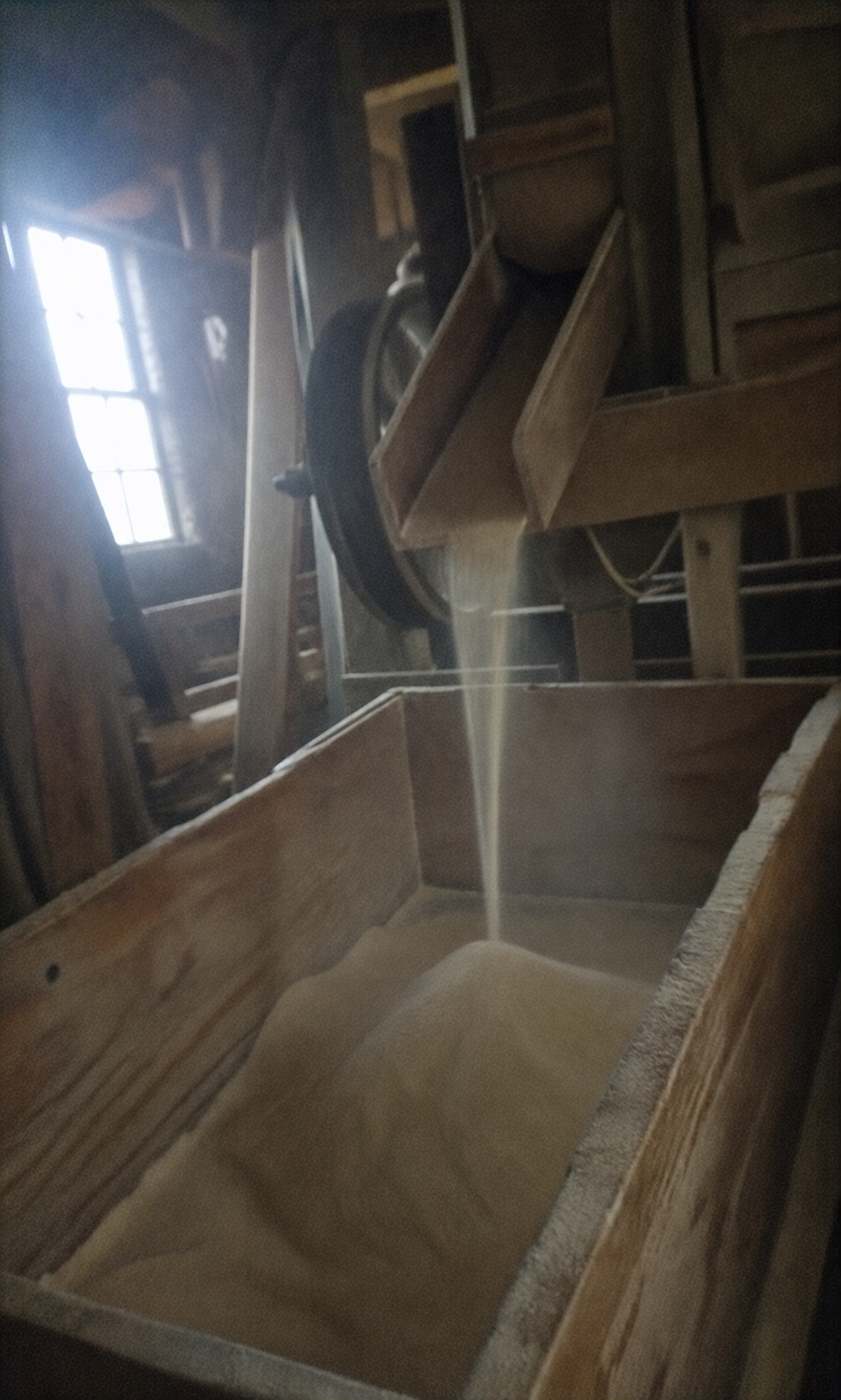
Picture a Mill That Never Worked Late — and See Why It Still Stands. Picture a water-powered gristmill on a Saturday morning in early autumn, the wheel turning at the pace of a slow conversation. Picture the woman walking up the gravel to ask about a millstone. Call her Dot. And picture the man in the doorway with flour on his forearms, seventy-seven years old and entirely unhurried. Call him Merle. Dot came for a five-minute business question. She's going to leave with a sentence she cannot put down. Let me back up. You need Dot first, and you have met Dot — she may be the most competent person you know. Dot is sixty. For twenty-six years she has run estate sales — the whole operation, start to finish, for families who are downsizing, relocating, or settling a house that's changing hands. What that job actually is: she walks into a full house and turns it into an organized, priced, photographed, advertised, staffed, two-day event. And she is magnificent at it. Here is the shape of Dot's work, and hold onto it, because it's the shape of everything else in her life: Nothing happens for weeks. Then everything happens at once. A sale is a mountain. Four days of sorting and pricing, a night of staging, two days on her feet running a crowd, a Monday of hauling what didn't sell. Then the mountain is over, and there's a flat plain of days where nothing is due, and then another mountain appears on the horizon. Dot has run her entire life on that rhythm for twenty-six years. It works — professionally. It's the only way that job canwork. The trouble is that she has never once, in her whole adult life, run anything any other way. Look at how Dot does an ordinary week. She doesn't cook dinner; she cooks the month — one enormous Sunday, six pots going, containers labeled and stacked, a freezer like a warehouse. It's efficient. It's also why there is no such thing as a Tuesday kitchen in Dot's house. She doesn't garden; she gardens in April, in a single heroic weekend, and then the beds run on their own recognizance until the whole thing is a jungle by July and she has a conversation with herself about weeds. She doesn't run errands; she has an errand day, and God help the errand that comes up on the wrong side of it. Her whole life is a series of mountains and plains. Every project in it is a push. And the thing about a life made of pushes — this is the part that took her twenty-six years and one gristmill to see — is that it has no daily gear. Anything that needs to happen every day simply has nowhere to live in it. There's no slot for small-and-constant, because the whole machine is built for big-and-occasional. So the daily things in Dot's life all die the same quiet death. Not from a decision. She never decides. They just get folded into the next mountain, and mountains have no room for anything but the mountain. Dot doesn't complain about any of this. It isn't a crisis; it's a hum — a low background awareness that the plains between mountains keep getting flatter, and that the list of things she does every day has gotten very, very short. She would tell you she needs a better system. Dot has excellent systems. That's the joke. She has a color-coded, laminated, twenty-six-year-proven system for turning any house in America into a two-day event. She just doesn't have a system for Tuesday. So: the mill. The estate she's working that month is an old farm property at the end of a county road, and in the barn — under a tarp, under forty years of nothing — is a millstone. Not a decoration. A real one, four feet across, and the family wants to know what it is and who'd want it. Dot, who prices everything from butter churns to snowmobiles, does not know what a millstone is worth. But she knows who would. Because eleven miles up the same road there's a working mill. Water-powered. Ground grain for the county since before the county had roads, and grinds it still, on Saturdays, for anyone who shows up with cash and a jar. Which is how Dot ends up on the gravel at ten in the morning, with a photograph on her phone, meeting Merle. Merle looks at the picture and gives her more information than she needs, because that's what men like Merle do: the stone's type, its likely age, the two people in the state who'd want it, and what he'd tell them it's worth. Business concluded, ninety seconds flat. And then, because Dot is standing there and the flume is open, he says: "You want to see it run?" She has a mountain waiting. Four rooms unpriced. A crew arriving at one. "Sure," says Dot, surprising herself. Inside, the mill is a slow machine. That's the first thing that gets her. The wheel turns outside at the speed of the water, not a hair faster. The gears take it up, the shaft turns, the runner stone rides above the bed stone, and out of the chute comes flour — in a thin, patient, continuous stream. Not a burst. A stream. Dot watches it and does what Dot does at any operation she doesn't understand: she starts asking capacity questions. How much per hour. How much a day. Merle answers all of it happily. And then, because she keeps asking it different ways, he laughs and gives her the real answer. "You're trying to find the big day," he says. "There isn't one." He nods at the wheel through the window. "That water's been coming down the same hill at about the same rate since before my great-grandfather bought this place. It doesn't care that you've got a wedding Saturday or a crowd on Sunday. It gives you the same turn it gave yesterday. That's all it's ever going to give you." He runs a hand along the housing, the way people touch things they've spent decades near. "Everything this mill ever made, it made a handful at a time. There's no way to run a month's flour in one afternoon. You can't hurry water and you can't stack up tomorrow's turn and use it today." Dot, professionally, sees a limitation. She says so — nicely, because she likes him. And Merle gives her the sentence. "That's not the limitation, ma'am. That's the reason it's still standing." He lets that sit exactly as long as it needs to. "Mills that tried to be big are all gone. There were four on this creek when I was a boy. The other three chased the volume — bigger stones, more custom, run all night when the orders piled up. They ran hot, they broke, they got fixed, they broke again. Every one of them is a foundation in the weeds now." He shrugs. "This one never worked late. Not once, in all the years anybody wrote down. It ran the water it had and it stopped when the water stopped, every single day, and that's the whole reason there's a mill here for you to come ask about a stone." Then the line Dot will carry eleven miles home, and considerably further: "The steady ones outlast the strong ones. Always did. Nothing here does much in a day, and it's done more than all of them put together." Somebody comes in with a jar for cornmeal. The tour's over. Dot buys a two-pound bag of flour she has no plan for, because you don't take a man's tour and leave with nothing. And she drives back down the county road doing arithmetic, which is what happens in these stories, and what happened to her. Twenty-six years of mountains and plains. Every good thing she's ever tried to add to her life, she added the only way she knows how: as a mountain. A push. A project with a start date and a finish, run hard, then over. The cooking mountain. The garden mountain. The errand day. The various campaigns of self-improvement, each launched with the exact energy of a two-day estate sale, each lasting about as long. And the plains in between were never rest. They were just the part where nothing daily could happen, because nothing daily had anywhere to live. Dot has three of the other mills on that creek in her own life. Foundations in the weeds. Things she ran hot until they broke. And she has, if she's honest — and she's a woman who prices strangers' belongings for a living, so she is relentlesslyhonest — almost nothing that runs like the mill. Almost nothing small, constant, and unhurried. Almost nothing that gives the same turn every day and asks for no push at all. That's the whole discovery, and it's worth saying plainly: The things that last in a life aren't run in bursts. They're run at the pace of whatever comes down the hill every day, whether you feel like it or not — and the smaller that daily turn is, the longer the thing survives. You can't batch a habit. A Sunday spent on one doesn't buy you the week. Every day gives you the same turn it gave yesterday, and the only question is whether the thing you care about is small enough to fit inside it. Which brings this story — through that door, and no other — to beets. Because here's a thing Dot knows better than almost anyone alive, and had never once put together until that morning. She has emptied a thousand kitchens. Farmhouse kitchens, town kitchens, apartment kitchens; kitchens from the twenties and kitchens from last year. She has priced more crocks, graters, mandolines, canners, and stained wooden bowls than any museum owns. And the same handful of things turn up in all of them, across every decade, in every kind of house. A crock. A dented colander. A wooden spoon gone permanently dark red at the bowl end. That last one is the beet, showing up in a thousand strangers' kitchens across a hundred years, unannounced, in the same modest way every time. People have been eating beets for thousands of years. They were in the root cellars and soup pots and pickle jars of half the world's grandmothers long before anyone could say why — kept, replanted, and put up every autumn on nothing more than the accumulated verdict of generations. The beet is a mill, not a mountain. Ugly, cheap, patient, keeps all winter, does its work in a handful at a time. Today the why is better understood: beetroot naturally contains dietary nitrates, and the body converts those into nitric oxide, a molecule that helps support healthy blood flow.* Beets also carry betalains — the deep crimson pigments that give them their color and turn a wooden spoon dark for good. Nature did the formulating a long time ago. Steady kitchens just never stopped keeping it. But here's Dot's honest problem, and probably yours. Every traditional form of the beet is a mountain. The pickling is a canning day — an entire Saturday with the big pot out, which is exactly the kind of thing Dot is excellent at and does once every three years. The roasting is an evening with an hour in it. The juicing is a machine, a pile of produce, and a sink full of parts. Every classic form of the beet asks for a push. And a life made of pushes has room for exactly one push at a time, and the push is already spoken for. That's how a food this old ends up missing entirely from the life of a woman who owns four crocks she bought at other people's sales. Rosabella Beetroot is the beet at mill pace: two capsules, once a day. No push. No project. No day set aside, no big pot, no cleanup, nothing to run hot. Small enough to ride the one thing Dot's day already does at the same hour whether it's a mountain day or a plain day — the coffee, which happens at six, which has never in twenty-six years required a system. What's in it reads in one breath. 1,300mg of organic beetroot powder per serving — a serving being those two capsules. One active ingredient, with the dose printed plainly on the label, nothing to decode. Non-GMO, third-party lab tested, produced under GMP, made in the USA from globally sourced ingredients. It contains no caffeine. Sixty capsules in a bottle; thirty days. A handful at a time. Which, per the mill, is the only pace anything survives at. And now the part you don't usually read in something like this, so read it twice: Nobody here is going to promise you a transformation. We're not going to tell you what you'll feel or when. Bodies are different, and yours doesn't owe an advertisement anything. And let's be plain about the ceiling, the way Merle would be: a capsule is not a mill, and it isn't dinner either. It won't feed a table, it won't fill a cellar, and nothing in a bottle will ever be as good as a beet roasted properly on a Sunday you actually had free. This is the small daily turn — the version that fits on the flat days as well as the mountain days, which is the only test a daily thing ever has to pass. What can be promised is what's on the label — at a pace a crowded life can actually keep. One thing before anything goes in a cart: talk to your doctor or pharmacist before adding any supplement, especially if you take any medication. This goes alongside the rest of a routine — the meals, the walks, the sleep — not in place of any of it. Before adding it to the morning routine, Dot checked with her doctor or pharmacist, then put the bottle beside the coffee. On Amazon, Rosabella Beetroot sits at 4.4 out of 5 across more than 14,000 ratings as of August 2026. If you're not satisfied for any reason, return the product within 90 days of delivery for a full refund. The ending is small, and by now you know that's the point. Dot did not become a different woman. She still runs sales the only way sales can be run — mountains and plains, four days of pricing, a Monday of hauling. The garden still goes in over one heroic April weekend, and it will still be a jungle by July, and she has made peace with the jungle. The freezer is still a warehouse. What changed is smaller than any of that, and it's the only thing that changed. There's a bottle on the counter next to the coffee maker, which is the one appliance in that house that has never needed a project. And the list of things Dot does every single day — the list that had gotten very, very short — is one item longer than it was. That's all. One item, at mill pace, requiring nothing. No push day. No campaign. No mountain scheduled for it, because it will never need one. The routine got simpler. Not the life — the life is a series of mountains, and honestly, she likes the mountains. Just the routine: one small turn that happens whether it's a big week or a flat one, at the same hour, the way the water comes down the hill. And on the shelf above the coffee maker, mostly for the joke, there's a two-pound bag of stone-ground flour she still hasn't opened. Dot is an illustration, as we said in the first line. What she illustrates is the shape of a routine — not a result anyone is promising you. P.S. If your own creek has three foundations in the weeds — the campaigns you ran hot until they broke, the systems that lasted exactly one season — nothing is wrong with your discipline. You can't batch a habit; a Sunday spent on one doesn't buy you the week, and every day gives you the same turn it gave yesterday. The trick the old operations knew isn't effort. It's scale: pick the version small enough to fit inside an ordinary day, and let the ordinary days do the rest. P.P.S. What it is, plainly: organic beetroot powder in capsules — 1,300mg per two-capsule serving, one active ingredient, dose on the label, no caffeine, non-GMO, third-party lab tested. Thirty days a bottle. That's the whole story. P.P.P.S. If you're not satisfied for any reason, return the product within 90 days of delivery for a full refund. Enough time to find out whether it holds a place on the flat days as well as the busy ones — which is the only test that matters for deciding that. Individual experiences vary. These statements have not been evaluated by the Food and Drug Administration. This product is not intended to diagnose, treat, cure, or prevent any disease.
Support stamina and heart health every day
LEARN MORELike this ad? Make it yours.
Crush rebuilds this exact creative around your product — your brand, your colors, your offer — in about a minute.